Thirty seconds, three questions. When was each hoist last thoroughly examined in a LOLER inspection? Where is the written report that says so? Do the slings carry dates of their own?
Most managers get two out of three. Slings are the gap. People write the law as LOLER, or lolers, and in full it is the Lifting Operations and Lifting Equipment Regulations 1998.
The LOLER inspection schedule for a care service, in one list
- Lifting equipment used to lift a person: thoroughly examined at least every 6 months.
- Accessories for lifting, which includes slings: at least every 6 months.
- Other lifting equipment that does not lift people: at least every 12 months.
- Equipment covered by an examination scheme: at the intervals that scheme sets.
- After exceptional circumstances that could affect safety: examined again.
- Before first use, unless it is new and comes with its declaration of conformity.
- After installation, and again after assembly at a new site or in a new place.
Regulation 9 of the LOLER regulations on thorough examination and inspection carries all of it. The intervals apply where wear could make the kit dangerous.
Every audit in the library is free to run, with scoring, actions and a report. No card needed.
Create a free accountThe law's own phrase is deterioration liable to result in dangerous situations. That phrase does a lot of work.
A ceiling track hoist in daily use is plainly in scope. So is the stand aid that only comes out at weekends.
Between thorough examinations, the Regulations allow inspection by a competent person. That happens at suitable intervals, where it is appropriate. Many services do it themselves, in a monthly walk round.
Why a sling carries its own examination date
The definitions decide this, not custom. An accessory for lifting is equipment for attaching loads to machinery for lifting, and a load includes a person.
A sling attaches the resident to the hoist. So it is an accessory, and it falls under the same interval of at least every 6 months.
Slings go missing from LOLER inspection schedules because they live in bedrooms, not in the plant room. A good register names the sling, its size, its date and the person or hoist it belongs with.
Figure: bed poles, bath lifts and stand aids sit on the same register as the hoists.
How to adapt the schedule to the kit you own
The interval is the same for most of what a care home owns, because nearly all of it lifts people. The differences are in what travels with each item.
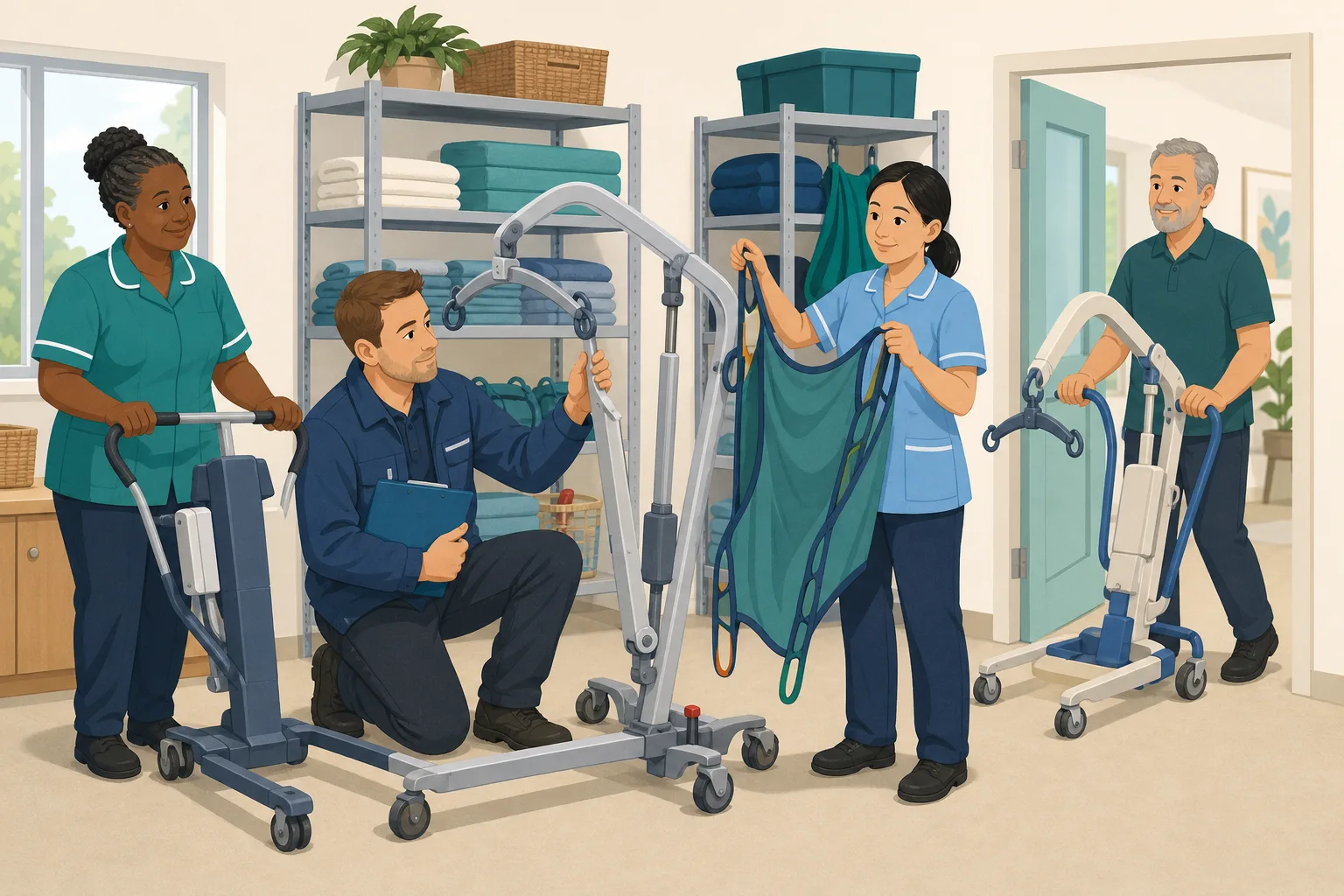
- Ceiling track hoist. The track counts as well as the motor, because lifting equipment includes the attachments that anchor, fix or support it.
- Mobile hoist. The spreader bar goes with it.
- Stand aid. Still 6 months, even where it comes out twice a week.
- Bath lift. In scope where it lifts a person in or out.
- Slings and straps. Each one named, sized and dated.
- Minibus tail lift. We would treat it as equipment that lifts people.
For each item, five lines are enough:
- The date of the last thorough examination.
- The date the next one falls due.
- The label on the equipment, and whether it matches the report.
- Any defect found, and what was done about it.
- Who is trained to use it.
CareStream holds those five lines against the audit, so the dates and the photographs sit together rather than in two systems.
Who does the examination, and what competent means here
A thorough examination means an examination by a competent person. Any testing that fits the purpose is part of it. The Regulations set no job title.
A LOLER inspection care home staff can rely on leaves two things behind: a dated written report and a label that matches it. If the label and the report disagree, trust neither.
Borrowed and hired kit brings one more rule. Equipment that comes from another business must not be used without proof of its last examination. The proof travels with the kit.
So a hoist that arrives from a loan store with no paperwork waits in the hall. The same goes for a replacement sent while yours is repaired.
We would also keep the planning duty in mind. Regulation 8 on the organisation of lifting operations says each lift must be planned by a competent person, supervised, and carried out safely. That is your staff, on the day, not the engineer.
What the report must say, and when the hoist stops
The duties here are sharper than most managers remember, and Regulation 10 of the LOLER regulations on reports and defects spells them out.
Pick an audit, assign it, score it on a phone and close the actions. Create a free account to start.
Create a free account- The examiner must tell you at once of any defect that is or could become a danger to people.
- They must then report in writing, as soon as practicable, with the detail Schedule 1 requires.
- A copy goes to anyone you hire or lease the equipment from.
- Where the defect brings a risk of serious personal injury, a copy also goes to the enforcing authority.
- Once you have been told, that equipment must not be used until the defect is put right.
Read that last line twice. It is not a recommendation. A hoist with a reported danger comes out of service that day, and the sling with it where the examiner has covered both.
Where maintenance and hoist training sit
Two more duties run alongside. Work equipment must be kept in efficient working order and good repair, and where machinery has a maintenance log, that log must be kept up to date.
Training is the other. Regulation 9 of the work equipment regulations on training requires adequate training for every user. It must cover the methods, the risks and the precautions.
The same duty covers anyone who supervises or manages that use. Senior carers and team leaders are inside it, not outside it.
So hoist training is not only the practical session. It is the record that each user and each supervisor had it, and that it covered the kit you actually own.
What a care inspector asks about equipment
The care side of this sits in Regulation 15 on premises and equipment. Equipment must be clean, secure, suitable, properly used, properly maintained and in the right place.
Domiciliary services get one useful carve out. Equipment at a person's own home falls outside parts of that regulation where the provider did not supply it and the accommodation is not part of their care.
That is not a free pass. The Care Quality Commission will still ask how your staff decided the hoist was safe to use that morning.
Three pieces of evidence answer that well: the current examination report, the training record for the carers on shift, and your own monthly check. Keep them where a visitor can see all three in one go.
Benefits of CareStream for lolers and the hoist inspection record
- The free hoist, sling and lifting equipment audit runs 44 checks.
- It is built for a monthly walk round by the manager or the maintenance lead.
- Each hoist and sling is checked against its examination record, its label and who it is allocated to.
- The finished run becomes a report with section scores, photos of what you found, actions and signatures.
- The free moving and handling of people course takes 60 minutes, and the certificate sits in the same record.
CareStream does not replace the engineer or the examination. It tells you which hoist is close to its date, and which sling nobody has looked at.
What to do the day a defect report arrives
Take the equipment out of use first, before the paperwork. Label it. Tell the staff on shift, and tell the night team in writing, because that is where the message usually breaks.
Then record three things: the defect, the date you stopped using it, and who you told. Our equipment and lifting policy gives wording a service can adopt. Book the repair, and set the next loler examination date before you close the file.
Sources
- Regulation 9, Lifting Operations and Lifting Equipment Regulations 1998: thorough examination and inspection · legislation.gov.uk
- Regulation 10, Lifting Operations and Lifting Equipment Regulations 1998: reports and defects · legislation.gov.uk
- Regulation 2, Lifting Operations and Lifting Equipment Regulations 1998: interpretation · legislation.gov.uk
- Regulation 8, Lifting Operations and Lifting Equipment Regulations 1998: organisation of lifting operations · legislation.gov.uk
- Regulation 9, Provision and Use of Work Equipment Regulations 1998: training · legislation.gov.uk
- Regulation 15, Health and Social Care Act 2008 (Regulated Activities) Regulations 2014: premises and equipment · legislation.gov.uk
Frequently asked