Give every carer your policies in the language they think in
Around one in five care workers in England reads English as a second language. Your policies are written in English, your read receipts say they were read, and nobody has ever checked whether they were understood. CareStream serves the same policy in over sixty languages, on the carer's own phone.
14 day free trial · Set up in a day · UK data residency
A read receipt is only worth what the reader understood
An inspector will not ask whether you sent the policy. They will ask a carer what it says.
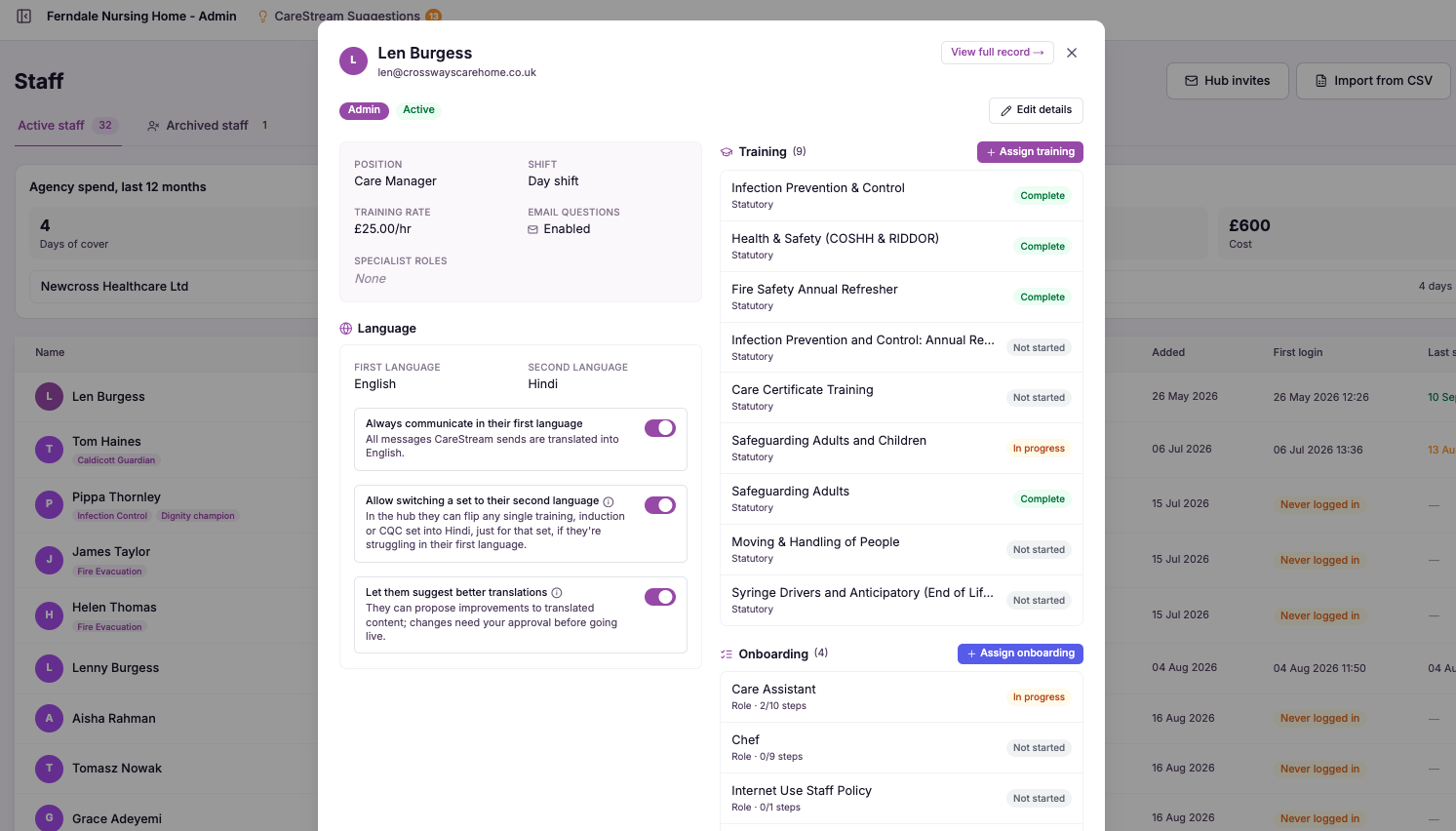
Sixty plus languages, one policy
You maintain one English policy. Every carer reads it in their own language, and when you update the English the translation follows automatically.
On their phone, not a shared PC
No work email, no password to forget. They sign in on their own device and the whole library is there, in their language, on a break.
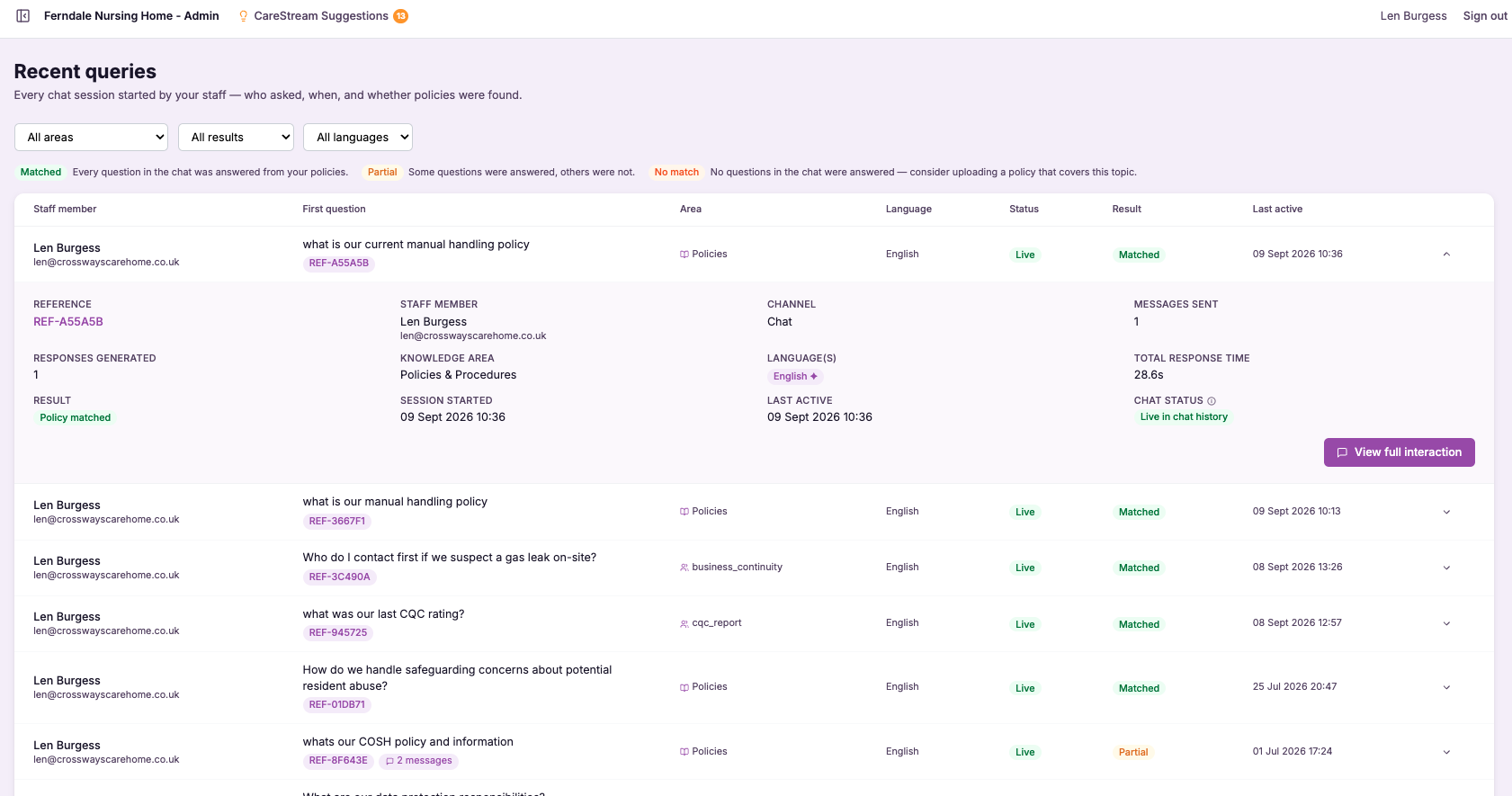
Questions answered privately
A new carer can ask what to do about a refused medication without having to admit to a colleague that they did not understand the policy.
What CareStream actually does here
One library, sixty plus languages
- Policies translated as a whole, not phrase by phrase, so meaning survives
- Update the English and every language follows, with the version recorded
- Staff pick their language once and everything arrives in it
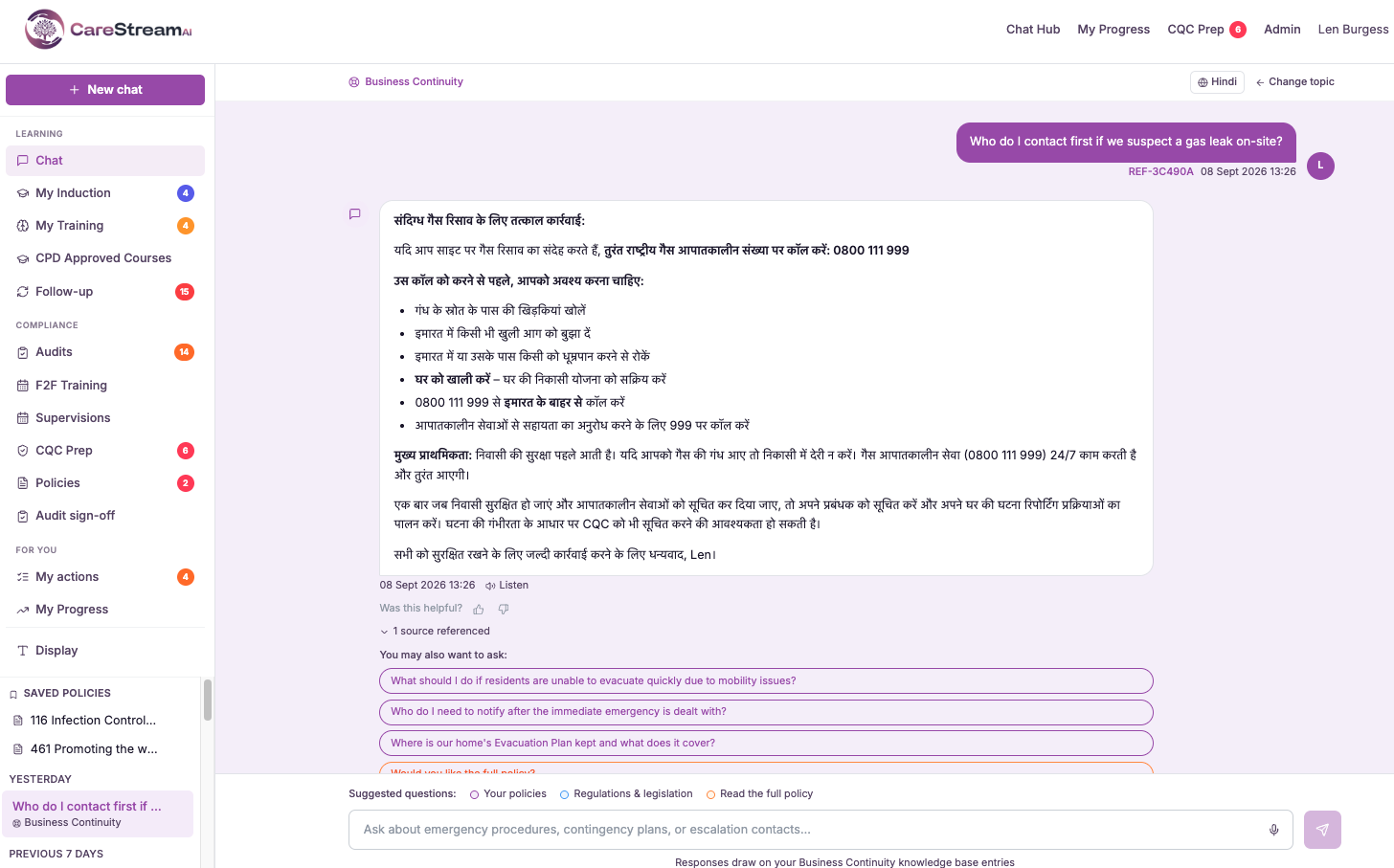
Ask a question, get an answer from your own policies
- Plain language questions, answered from your library rather than the internet
- The source section is shown, so the carer can read the actual wording
- Asked and answered in their language, without involving a colleague
Evidence that means something
- Read receipts recorded against the version live that day
- Language recorded alongside the read, so you can show what they read
- Comprehension checks logged separately from the read itself
Guides on this subject

Onboarding International Care Staff: A 4-Week Induction Playbook for UK Providers
The uncomfortable truth is this: the Health and Care Worker visa route for care workers has closed. Every international recruit you hire from now on...
Read article
Translating Care Policies: What Gets Lost, and How to Check Understanding
Your care policies are written in English. A significant portion of your workforce thinks, dreams, and asks questions in another language....
Read article
How Many Care Workers in England Speak English as a Second Language? The Data Behind the 3am Question
The adult social care sector has spent years recruiting internationally while never once testing whether policy comprehension survived translation....
Read articleStaff Hub in 60+ languages, answered
Getting started
Which languages are supported?
More than sixty. Staff choose their own language the first time they sign in and can change it at any point.
Do we have to translate our policies ourselves?
No. You maintain the English version and translation happens automatically, including when you update it.
What if a policy uses terms specific to our service?
Service specific terms can be added so they translate consistently across the whole library rather than differently in each policy.
For the carer
Do they need a work email address?
No. The staff hub works on their own phone and they can sign in without a password.
What if they cannot read well in any language?
Translation does not solve literacy, and you should not treat it as though it does. Modules can be read aloud, and the comprehension check should be a conversation.
Can they ask questions in their own language?
Yes, and the answer comes back in the same language with the source section shown.
Evidence
Does an inspector accept a translated policy as evidence?
The evidence is that the person could access and understand the policy. A read receipt in a language they read is stronger than one in a language they do not.
Can we show which language someone read a policy in?
Yes, it is recorded with the read.
What happens when we update the English?
Every language updates, the new version goes to everyone it applies to, and the previous version stays on the record.
A practical guide to language access in adult social care
Roughly one in five of the adult social care workforce in England was born outside the UK, and in some services it is far higher. Most language policy in care consists of translating an induction booklet once and hoping. This guide covers what language access actually requires, where translation is enough, where it is not, and how to evidence comprehension rather than delivery.
Delivery is not comprehension
The whole problem sits in one gap. A policy was sent, opened and signed for. None of that establishes that the person understood what it asked of them, and in a sector where policies describe how to keep people safe, that gap is where the risk lives.
This is not a criticism of the workforce. Anyone reading a technical document in a second language works harder for less certainty, and a care policy is a technical document written in institutional English. The reasonable response is to remove the language barrier where you can and check understanding where you cannot.
Where translation is enough, and where it is not
Translation handles vocabulary and it handles it well. A carer reading the medication policy in Portuguese will follow the sequence of steps as reliably as a first language English reader.
It does not handle three things. Terms with no clean equivalent, where a phrase like duty of candour carries regulatory meaning that a literal translation loses. Cultural expectations about escalation, where a carer from a system with a stricter hierarchy may not challenge a senior. And literacy, which is a separate problem that translation can disguise.
A workable standard
Aim for three things rather than a policy document about language. Every policy available in the language the person reads most comfortably. A named comprehension check for the safety critical subjects, done as a conversation rather than a form. And a private route to ask a question, because the barrier is usually embarrassment rather than access.
- Every policy available in each staff member’s own language
- A recorded comprehension conversation for safeguarding, medication and moving and handling
- A private way to ask a question without approaching a colleague
- Language recorded against the read receipt
- Terms specific to your service translated consistently
Where CareStream fits
The Staff Hub holds one English library and serves it in over sixty languages, on the carer's own phone, with the language recorded against every read. Questions can be asked in plain language and answered from your own policies with the source shown, which is the private route that matters most in practice.
The comprehension conversation stays with your seniors, where it belongs. What the software removes is the excuse that the policy was not accessible.
General guidance, not legal advice. Regulatory requirements change and vary by service type. Check the current CQC guidance and your own registration conditions before relying on any of the above.
General guidance, not legal advice. Regulatory requirements change and vary by service type. Check the current CQC guidance and your own registration conditions before relying on any of the above.
Read next
Written on Staff Hub in 60+ languages
Onboarding International Care Staff: A 4-Week Induction Playbook for UK ProvidersThe uncomfortable truth is this: the Health and Care Worker visa route for care workers has closed. Every international recruit you hire from now on...Translating Care Policies: What Gets Lost, and How to Check UnderstandingYour care policies are written in English. A significant portion of your workforce thinks, dreams, and asks questions in another language....How Many Care Workers in England Speak English as a Second Language? The Data Behind the 3am QuestionThe adult social care sector has spent years recruiting internationally while never once testing whether policy comprehension survived translation....