Bring a stale policy set back up to date without starting again
Half your policies were last reviewed in 2022. Rewriting all of them is not realistic and not necessary. Find what has actually been overtaken, fix that, and leave the rest alone.
14 day free trial · Set up in a day · UK data residency
Out of date is not the same as wrong, and treating them the same is why nothing gets done
The job is triage. Most stale policies need a sentence changed, not a rewrite.
Review dates that are real
A review date per policy, a dashboard of what is due, and a way to mark a policy reviewed with a record of who did it.
Find the dated content
Superseded guidance, roles that no longer exist and thresholds that have moved, found across the library rather than policy by policy.
Replace a phrase everywhere
Change a dated phrase once and it updates across every policy that uses it, with your wording rather than an imposed replacement.
What CareStream actually does here
See what is actually due
- Review dates held per policy and editable, not a blanket annual cycle
- A dashboard of what is due, with a banner when something is overdue
- Mark as updated per item, so the list empties as you work
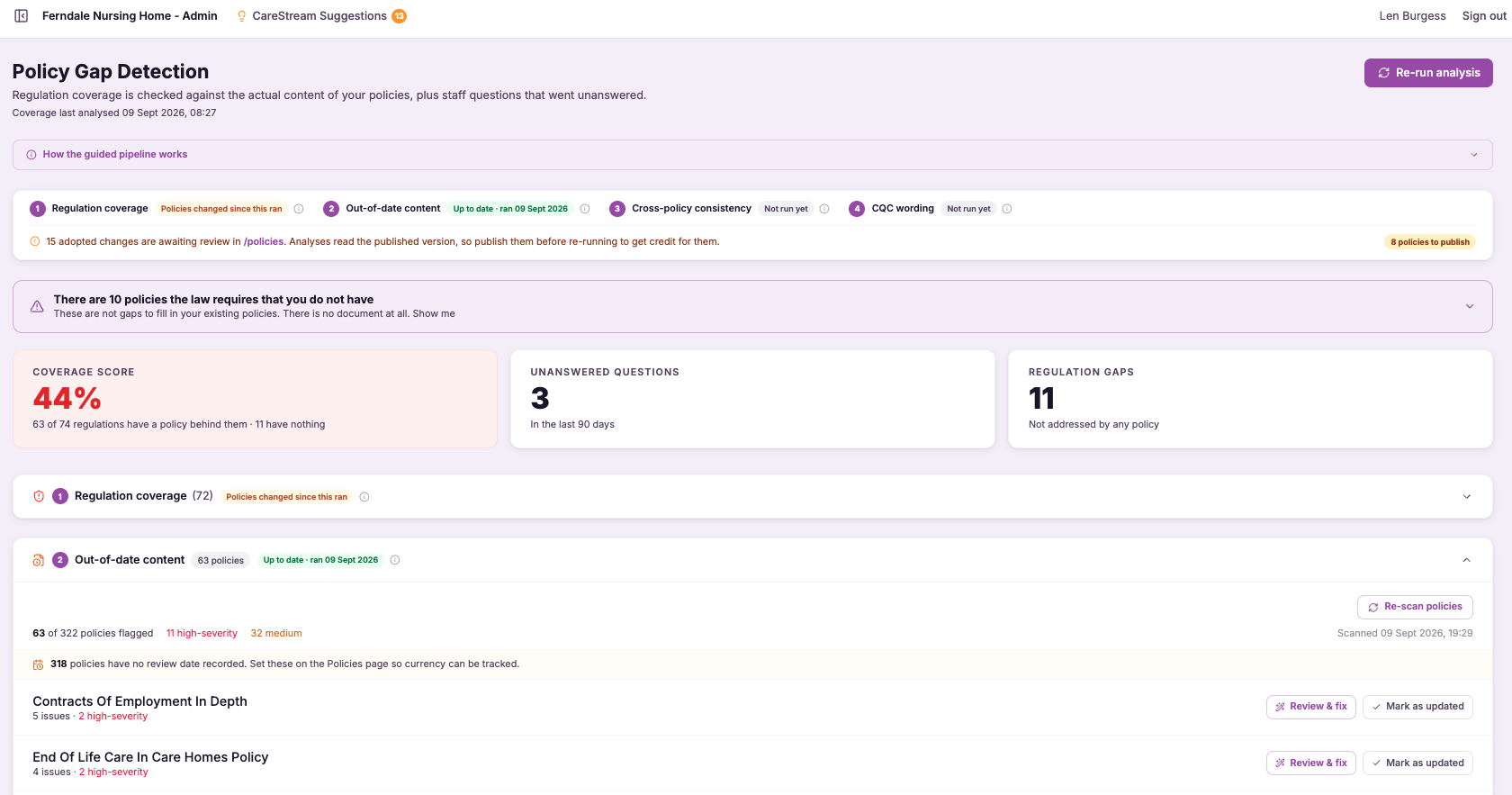
Find the content that has been overtaken
- Superseded guidance and dated phrasing found across the whole set
- Named roles that no longer exist flagged wherever they appear
- COVID era wording surfaced so you can decide what stays
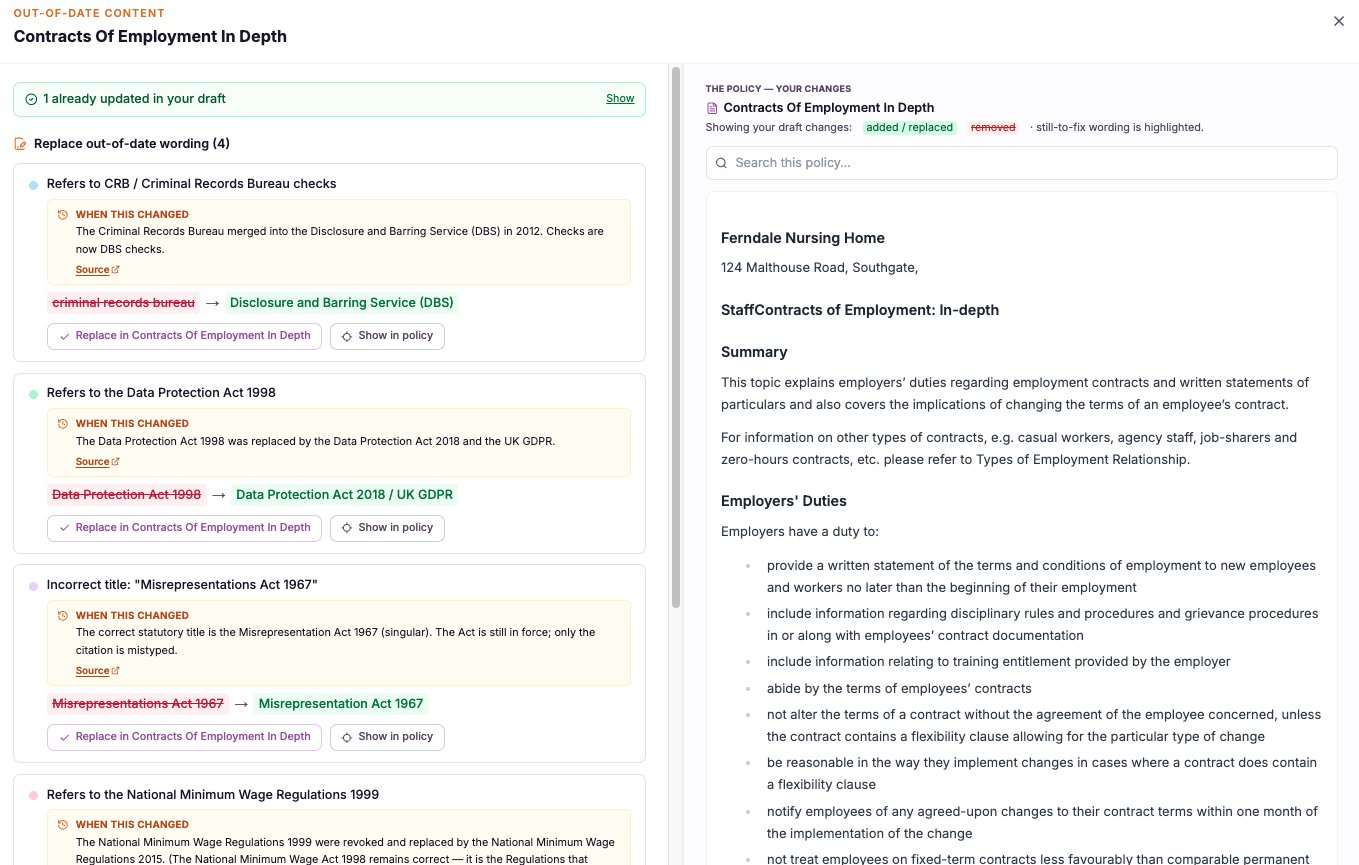
Fix it without a rewrite
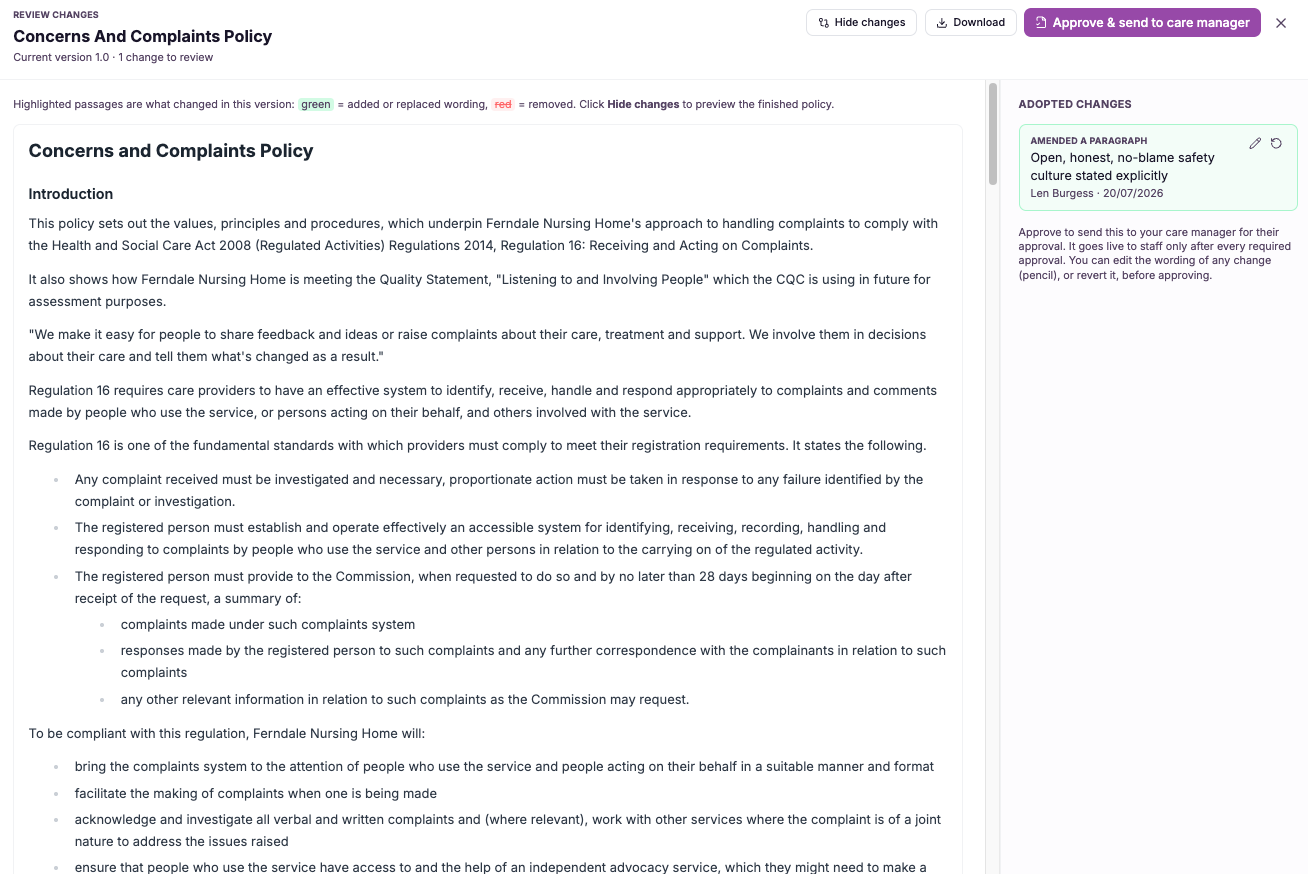
- Edit wording directly in the policy panel
- Replace or remove a phrase across every policy at once, in your words
- Staff get the updated version, recorded against that version
Guides on this subject

Updating COVID Policies in Care Homes: What to Keep, What to Cut, and What to Rewrite
Your policy library is carrying dead weight. Somewhere between the fire safety folder and the medication management file sits a visiting policy that...
Read article
Six signs your policy set has quietly drifted out of date
Every care service has out-of-date care policies. Not because anyone is negligent, but because a policy library is a living thing, and living things...
Read article
How Often Should Care Policies Be Reviewed? The Honest Answer for UK Care Providers
The sector baseline has settled on annual review for most core policies. That is the defensible starting point, but it is not the whole answer. The...
Read articlePolicies Out of Date, answered
Triage
Do we have to rewrite everything?
No, and you should not. Most stale policies need a specific correction, and identifying which is the whole job.
How often should policies be reviewed?
Annually for most, sooner for anything safety critical, and immediately when something changes that affects the policy.
What counts as out of date?
Content overtaken by guidance, roles that no longer exist, thresholds that have moved, and links that no longer resolve.
COVID era wording
Should we delete all the COVID content?
No. Some of it became permanent good practice. The judgement is which, and the post on this is worth reading before you start deleting.
Can we remove a phrase across the whole set?
Yes, and you can replace it with your own wording rather than accept a suggested one.
Will removing it reset staff acknowledgements?
Not for minor corrections. Substantive changes are treated as a new version.
Keeping it current
How do we stop drifting again?
Review dates per policy, a dashboard that surfaces what is due, and legal change tracking that tells you which policies a regulatory change affects.
Who should own the review?
One named person for the schedule, with subject owners for the content. The failure mode is a schedule nobody owns.
Can we see the history?
Every version is kept, with what changed and who changed it.
A guide to reviewing and refreshing an ageing policy set
Almost every service has policies that have not been looked at in years, and almost every service knows it. What stops the work is not indifference, it is that the job looks like rewriting ninety documents. It is not. It is finding the specific content that has been overtaken.
Sort before you write
Split the library into three. Policies that are current and need only a review date. Policies with specific content that has been overtaken. And the small number that are genuinely obsolete and need rewriting.
In most services the middle group is the largest and the third is tiny. Doing this sort first turns an impossible project into a fortnight of targeted edits.
What actually goes stale
Content is rarely wrong in general. It is wrong in particulars, and the particulars are predictable.
- Superseded guidance still cited as current
- A named role or post holder who has left
- A threshold or timescale that has since moved
- Links that no longer resolve
- Pandemic era measures presented as standing practice
- Equipment or systems the service no longer uses
Where CareStream fits
Review dates are held per policy and editable, with a dashboard of what is due and a banner when something is overdue, so the schedule is visible rather than theoretical.
For the content itself, dated phrasing is found across the whole library at once and a phrase can be replaced or removed everywhere it appears, in your own wording. Legal change tracking then tells you which policies a new regulatory change affects, which is what stops the set drifting again.
General guidance, not legal advice. Regulatory requirements change and vary by service type. Check the current CQC guidance and your own registration conditions before relying on any of the above.
General guidance, not legal advice. Regulatory requirements change and vary by service type. Check the current CQC guidance and your own registration conditions before relying on any of the above.
Read next
Written on Policies Out of Date
Updating COVID Policies in Care Homes: What to Keep, What to Cut, and What to RewriteYour policy library is carrying dead weight. Somewhere between the fire safety folder and the medication management file sits a visiting policy that...Six signs your policy set has quietly drifted out of dateEvery care service has out-of-date care policies. Not because anyone is negligent, but because a policy library is a living thing, and living things...How Often Should Care Policies Be Reviewed? The Honest Answer for UK Care ProvidersThe sector baseline has settled on annual review for most core policies. That is the defensible starting point, but it is not the whole answer. The...