Turn an incident into training by the end of the week
Something happened on Tuesday. The learning from it should reach the people it applies to before it happens again, not in next year's annual round.
14 day free trial · Set up in a day · UK data residency
The gap between learning something and teaching it is where services get caught twice
An investigation that ends in a report has not changed anything on the floor.
Built from the policy it touched
The module comes from your own policy on the subject, so what staff learn matches what your policy actually says.
Only the people it applies to
Assigned by role, so you are not sending a medication module to the kitchen and diluting the point.
Days, not the next annual cycle
From investigation outcome to assigned module in an afternoon, which is the only timescale that changes behaviour.
What CareStream actually does here
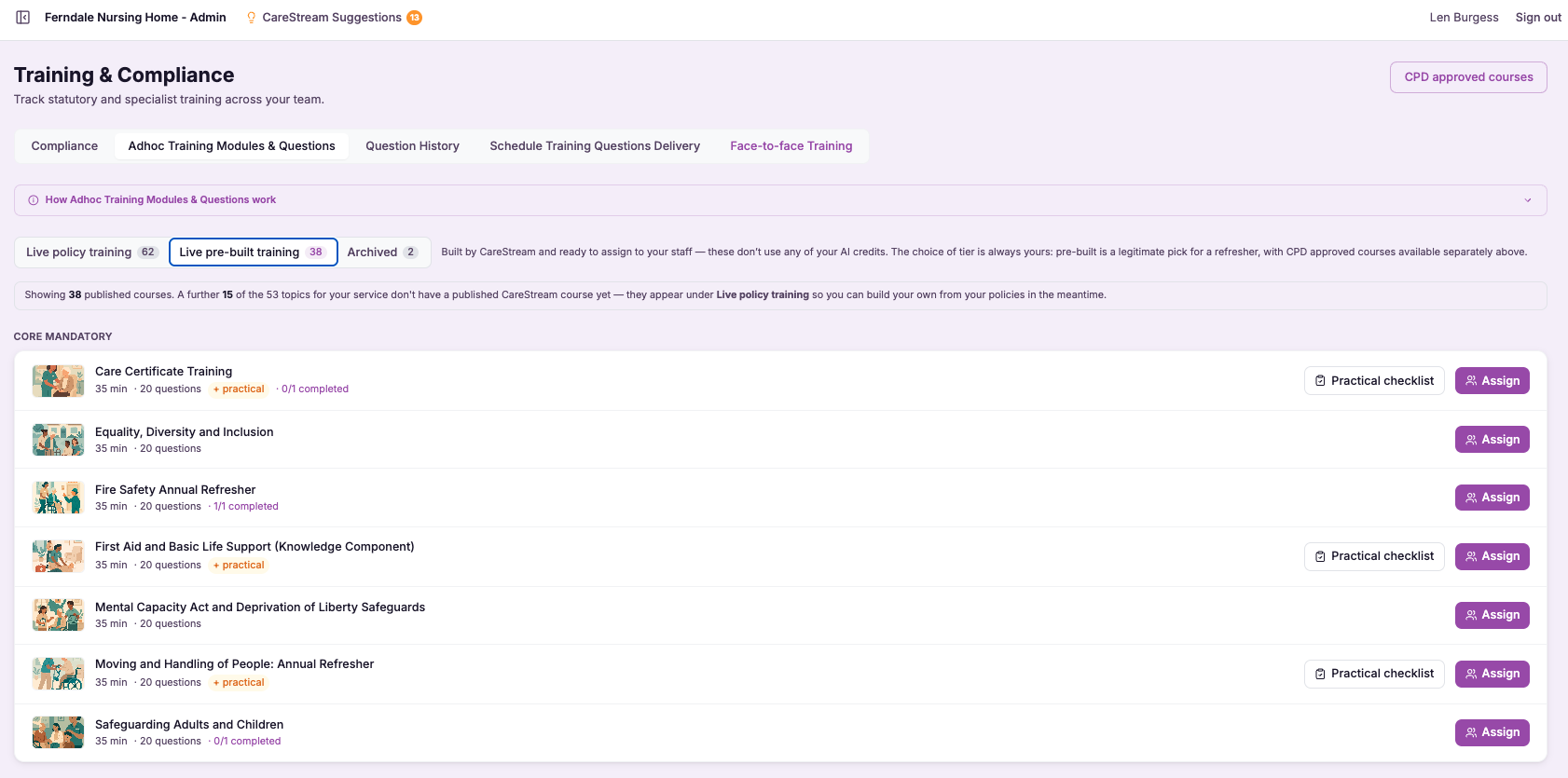
Generated from your own policy
- A module built from the specific policy the incident touched
- Uses your wording, not a generic course on the subject
- Reviewed by you before it goes anywhere
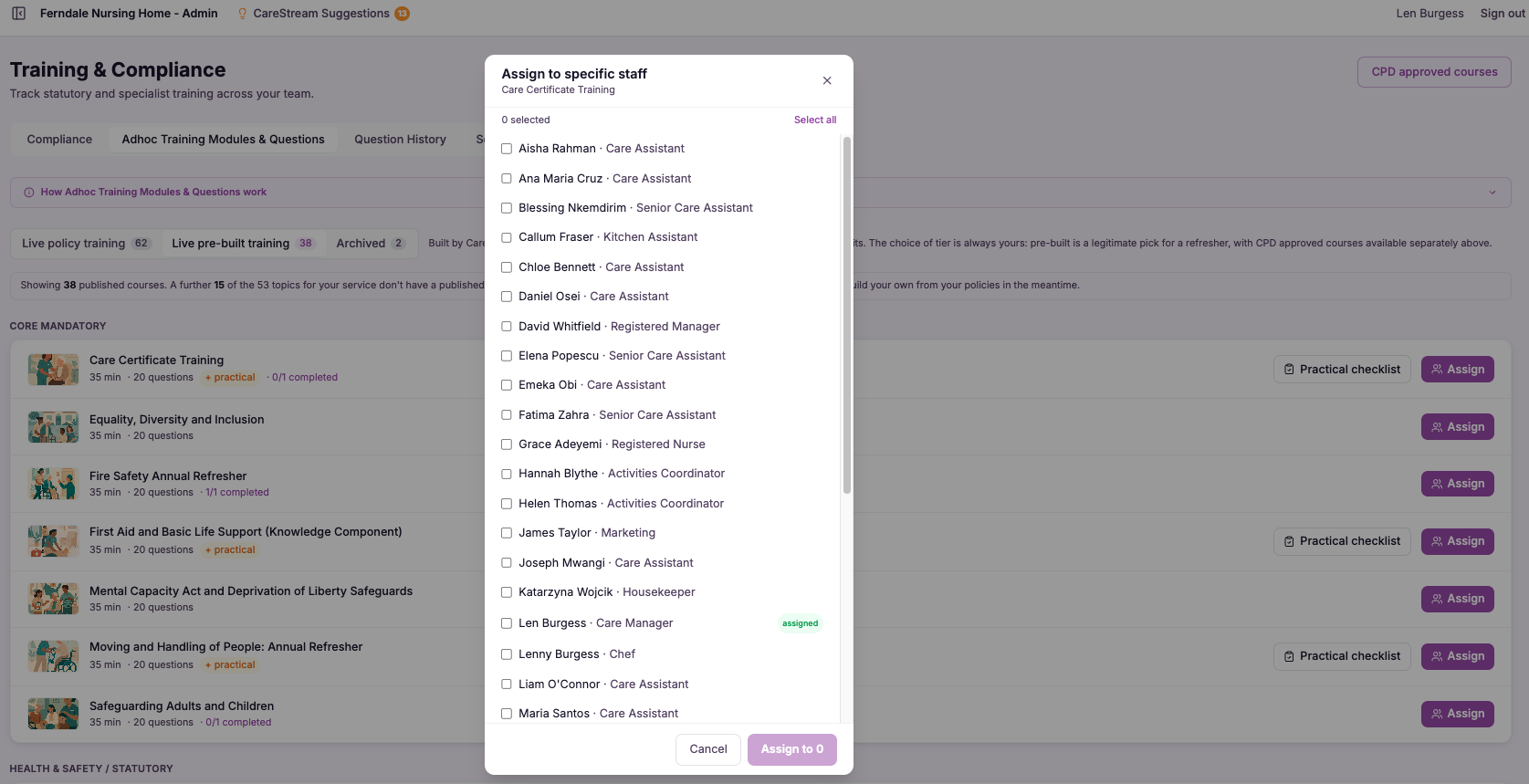
Assigned to the right people
- Assignment by role, so the population is the affected one
- Delivered to their staff hub in their own language
- Outstanding staff visible without producing a report
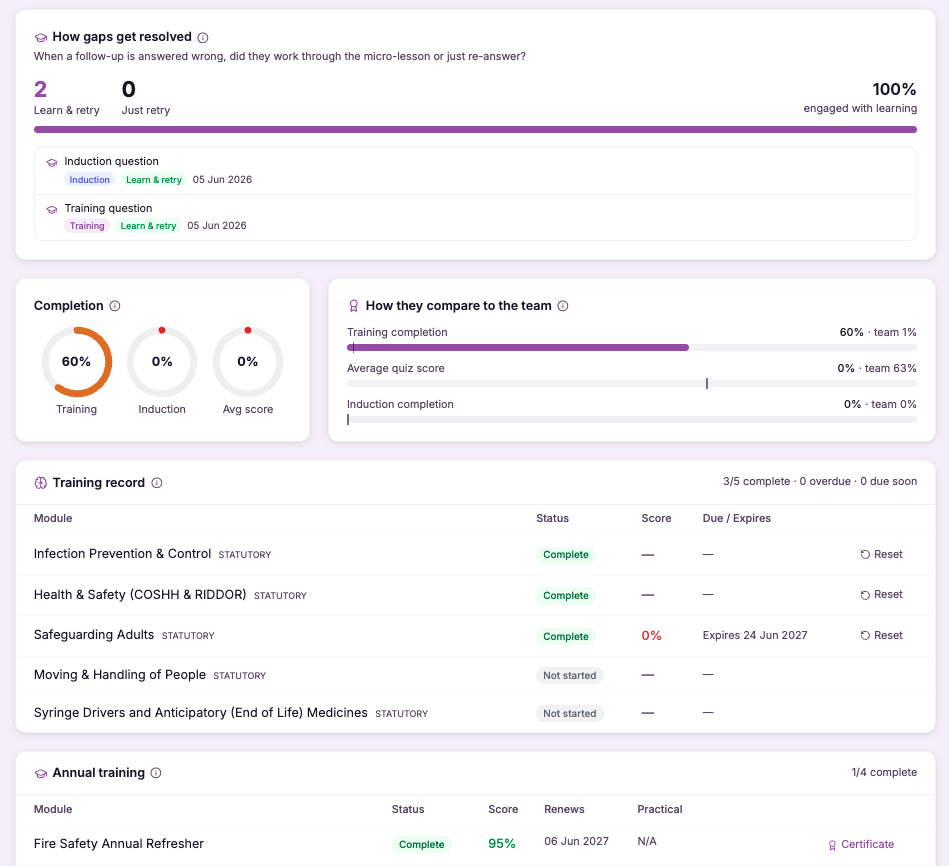
Closed with evidence
- Scores recorded alongside completion
- Competency observation logged where the subject is practical
- The whole response sits on the record next to the incident
Guides on this subject
Incident-Led Training in Care: Turning What Went Wrong Into What Your Team Learns
Every incident is already a training moment. The medication error, the fall, the complaint from a family member, the near miss on a night shift. Each...
Read article
Micro Learning for Care Staff: What Works on a 12-Hour Shift
Your training room is empty because your staff are on shift. That is not a scheduling failure. It is the reality of running a 24/7 care service, and...
Read article
Policy Changed. Who Needs Retraining? A Four-Question Framework for Care Managers
A policy update lands in your inbox at 4.45pm on a Friday. Your first instinct is to retrain everyone, because retraining everyone feels safe. It...
Read articleAdhoc Training, answered
Speed
How quickly can we get a module out?
Same day. The module is generated from the policy, reviewed by you, and assigned.
Do we have to write it?
No. It is generated from your policy and you review it, which is a different job from writing a course.
Can we edit it before it goes out?
Yes, and you should. The generated module is a draft.
Scope
Who receives it?
Whoever the policy applies to, by role. You can narrow it further.
Does everyone need retraining after an incident?
Usually not, and sending it to everyone is not thoroughness. It is an inability to tell who is affected.
Can we use this for policy changes as well as incidents?
Yes, that is the same mechanism. A changed policy can carry a short module explaining what changed.
Evidence
Does this count as evidence of a response?
Combined with the investigation record, it evidences that learning reached the people it applied to and that they demonstrated it.
What about practical subjects?
An observed competency is recorded alongside the module, because a score alone does not evidence a practical skill.
Is it kept separate from annual training?
It sits on the same staff record but is identifiable as adhoc, so the annual position stays readable.
A guide to responsive, incident led training
Most services investigate well and train slowly. The investigation concludes, a report is written, an action is logged, and the training that would have prevented a recurrence arrives months later attached to the annual round. This guide is about closing that gap without turning learning into blame.
Learning and blame share a border
The single reason incident led training goes wrong is that it feels punitive to the people receiving it. If a module lands three days after a colleague made a mistake, everyone knows why it arrived.
Two things help. Assign by role rather than by involvement, so it is clear the subject is being reinforced rather than an individual corrected. And separate the training from the disciplinary process explicitly, in writing, at the point it is assigned.
From outcome to module
The steps are simple and the discipline is in doing them quickly.
- Identify the specific policy the incident touched
- Decide which roles the learning applies to
- Generate a short module from that policy and review it
- Assign with a stated reason that is about practice, not people
- Record an observed competency where the subject is practical
- Close the loop on the incident record
Where CareStream fits
An adhoc module is generated from the specific policy the incident touched, so what staff learn is what your policy says rather than a generic course on the topic. You review it before it goes out, assign it by role, and it arrives in the staff hub in each person's language.
Scores and observed competencies land on the same staff record as everything else, so the response is visible next to the incident rather than filed separately.
General guidance, not legal advice. Regulatory requirements change and vary by service type. Check the current CQC guidance and your own registration conditions before relying on any of the above.
General guidance, not legal advice. Regulatory requirements change and vary by service type. Check the current CQC guidance and your own registration conditions before relying on any of the above.
Read next
Written on Adhoc Training
Incident-Led Training in Care: Turning What Went Wrong Into What Your Team LearnsEvery incident is already a training moment. The medication error, the fall, the complaint from a family member, the near miss on a night shift. Each...Micro Learning for Care Staff: What Works on a 12-Hour ShiftYour training room is empty because your staff are on shift. That is not a scheduling failure. It is the reality of running a 24/7 care service, and...Policy Changed. Who Needs Retraining? A Four-Question Framework for Care ManagersA policy update lands in your inbox at 4.45pm on a Friday. Your first instinct is to retrain everyone, because retraining everyone feels safe. It...