Prepare every staff member for the questions they will actually be asked
Inspectors talk to your carers, not to you. Role matched questions your team practises in the staff hub, in their own language, so nobody is asked something for the first time on the day.
14 day free trial · Set up in a day · UK data residency
Ancillary staff get asked too, and are almost never prepared
The kitchen and maintenance teams are the ones an inspector often reaches first.
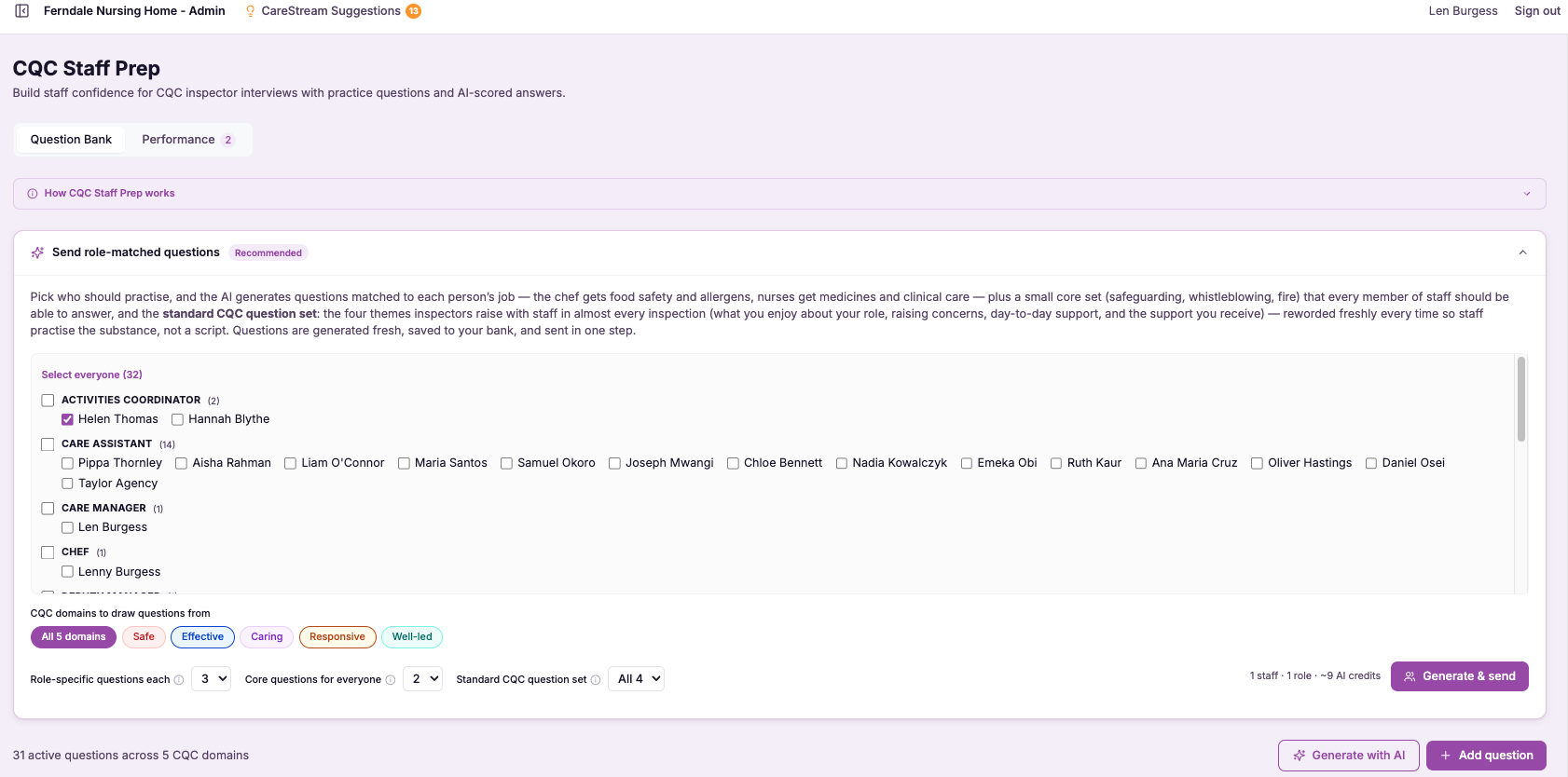
Matched to the role
A nurse, a care assistant and a kitchen assistant get different questions, because they will be asked different questions.
Sends them back to the policy
An answer is not supplied. The question points at the policy the answer comes from, so what is built is understanding.
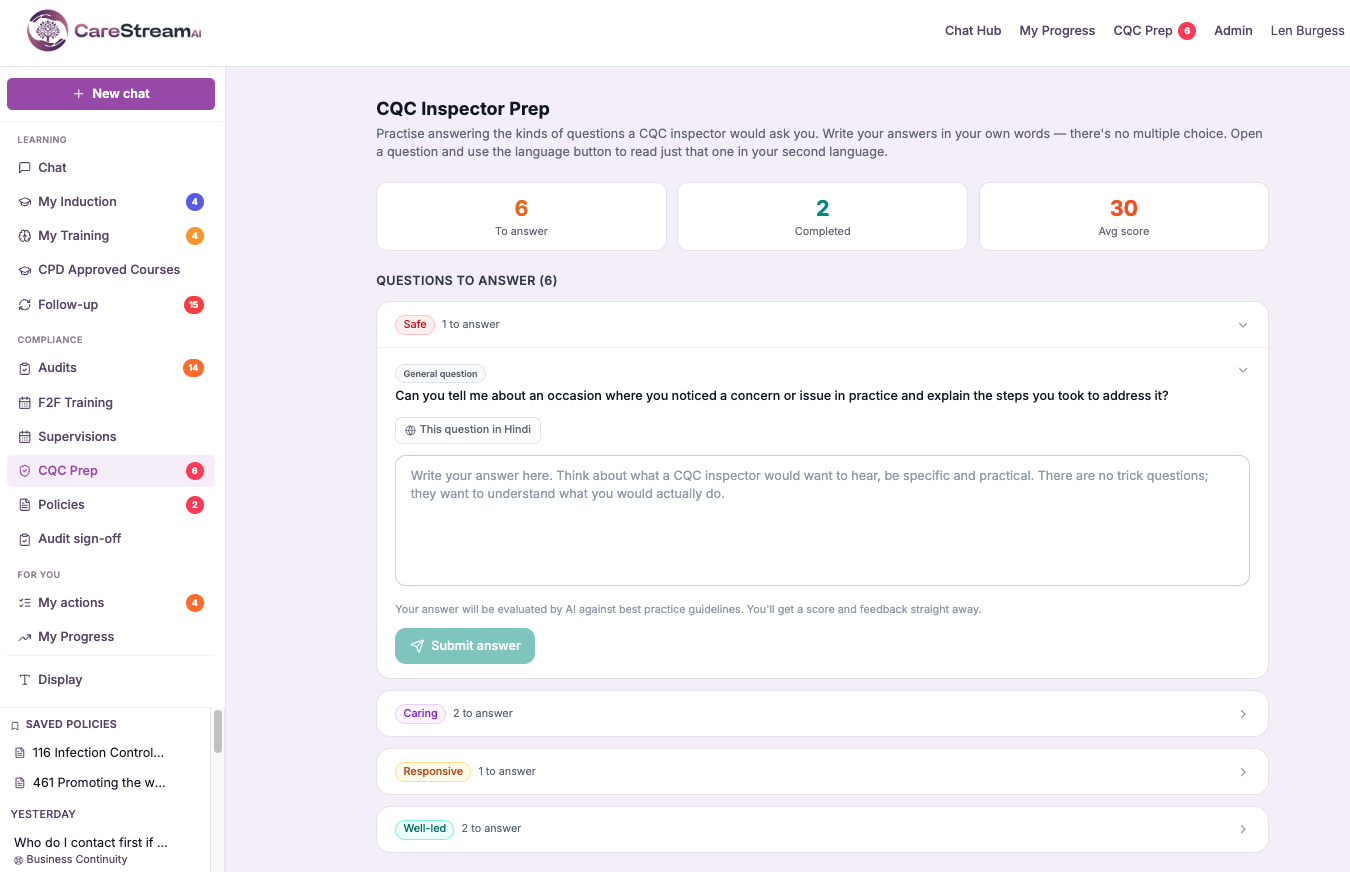
In their own language
Practising in a second language on the spot is a bad way to find out whether someone knows the answer.
What CareStream actually does here
Question sets by role
- Core set everyone gets, plus role specific sets on top
- Ancillary roles covered properly rather than as an afterthought
- Practised in the staff hub, on their own phone
Understanding, not scripts
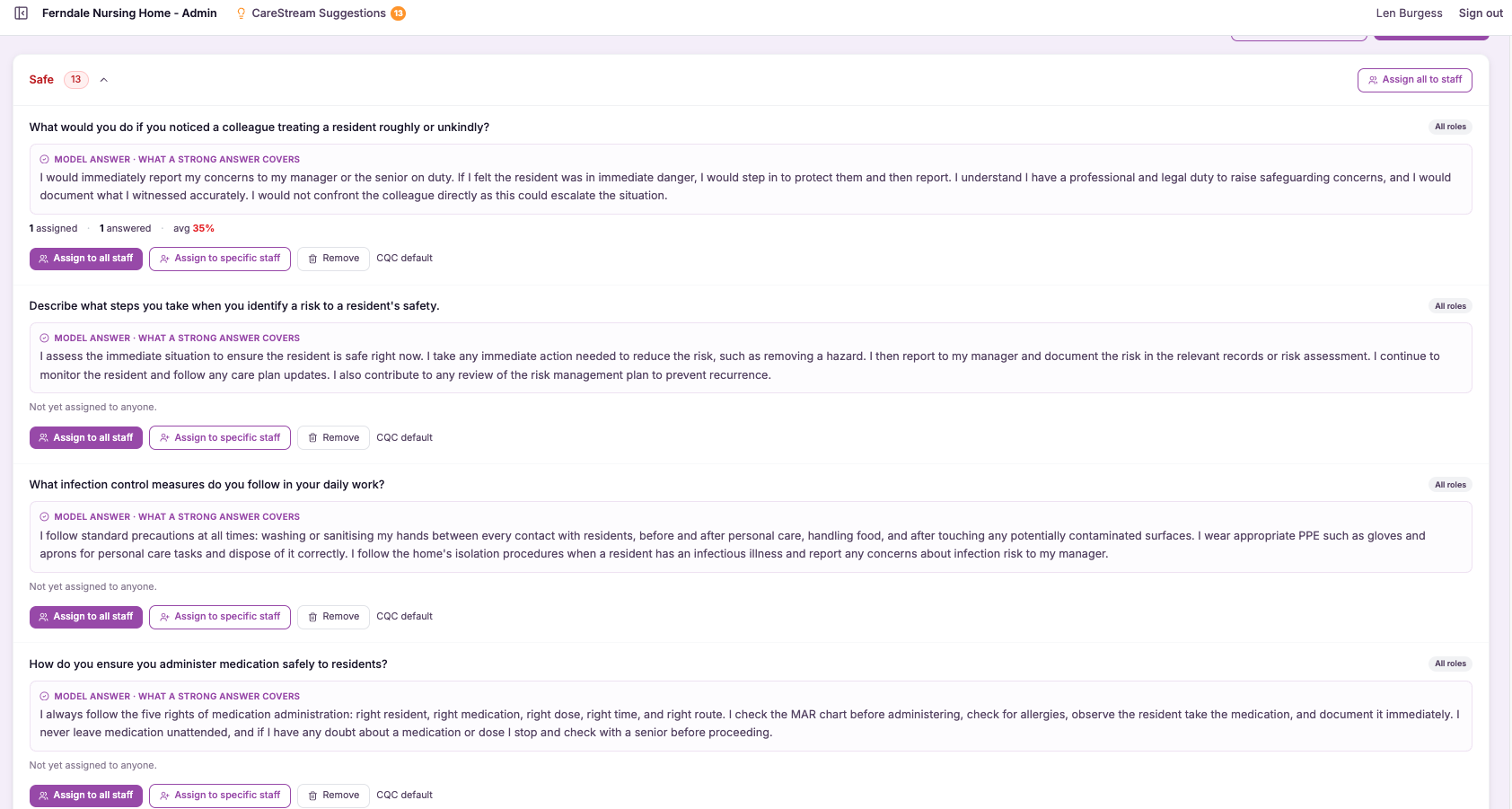
- Each question links to the policy section the answer comes from
- No model answers to memorise and repeat back
- What is built is recall of practice rather than of a sentence
Readiness you can see
- Who has practised, by role, without producing a report
- The roles nobody has covered surfaced before an inspector finds them
- Print a set for a supervision conversation if you prefer paper
CQC Prep Questions, answered
The questions
Where do the questions come from?
They reflect what inspectors ask staff in practice, grouped by theme and matched to the role.
Are model answers provided?
No, deliberately. Each question points at the policy the answer comes from, because rehearsed answers are transparent and undermine confidence.
Can we add our own?
Yes, including questions specific to your service.
Coverage
Which roles are covered?
Care assistants, seniors, nurses, and the ancillary roles that are usually missed, including kitchen, maintenance and administration.
Do agency staff need this?
Anyone on shift can be spoken to, so a short core set for agency is sensible.
How long does it take a staff member?
Short sessions rather than one sitting, done on their own phone between tasks.
On the day
Will this make our staff sound rehearsed?
It should do the opposite, because there is nothing to rehearse. The practice sends them to the policy rather than to a script.
Can we see who is ready?
Yes, by role, which is how the uncovered groups surface.
What if someone freezes anyway?
That happens, and it is a normal human response. What preparation changes is whether they had ever considered the question before.
A guide to preparing a whole team for inspection
The most predictable failure in inspection preparation is that the manager is ready and the team has never been asked. The second most predictable is that the care staff were briefed and the kitchen was not. This guide covers both, and argues against the thing most services do first.
Do not write model answers
The instinct is to produce a sheet of questions with the right answers and circulate it. It is the wrong move, for two reasons.
First, it is obvious. An inspector who hears the same phrasing from three people knows exactly what happened, and it converts a neutral conversation into a sceptical one. Second, a memorised answer collapses under a follow up question, and the staff member is left more exposed than if they had answered in their own words.
Prepare by role
Different roles get asked different things, and the roles least likely to be prepared are the ones most likely to be approached informally.
- Care assistants: daily practice, dignity, escalation, knowing residents
- Seniors: supervision, delegation, incident handling
- Nurses: clinical decisions, medication, capacity and consent
- Kitchen: dietary needs, allergens, how they learn about a resident’s requirements
- Maintenance: hazards, restricted areas, contractor handling
- Administration: records, confidentiality, complaints handling
What good preparation looks like
Ask real questions in supervision over the weeks before, in the person's own language where that helps, and when they do not know, send them to the policy rather than telling them the answer. That builds something that survives a follow up question.
Accept that some people will still be nervous. Nervous and honest reads far better than fluent and rehearsed.
Where CareStream fits
Question sets are matched to the role, including the ancillary roles that are usually missed, and practised in the staff hub on the person's own phone in their own language.
Each question links to the policy section the answer comes from rather than supplying an answer, and readiness is visible by role, which is how you find out that nobody in the kitchen has done it while there is still time.
General guidance, not legal advice. Regulatory requirements change and vary by service type. Check the current CQC guidance and your own registration conditions before relying on any of the above.
General guidance, not legal advice. Regulatory requirements change and vary by service type. Check the current CQC guidance and your own registration conditions before relying on any of the above.