Stop two of your policies telling staff different things
Your safeguarding policy names one reporting route. Your whistleblowing policy names another. A carer follows whichever they read last, and the difference only surfaces when something has already gone wrong.
14 day free trial · Set up in a day · UK data residency
A contradiction is a design fault, not a training fault
You cannot train your way out of two documents that give different instructions.
Reads the whole set at once
A human reviewer checks one policy at a time. Contradictions only exist between documents, which is exactly what that method cannot see.
Roles and thresholds, not just wording
Different escalation windows, different named roles and different thresholds are the conflicts that actually reach the floor.
Fix once, everywhere
Change a route or a role and it updates across every policy that names it, with the old version kept on the record.
What CareStream actually does here
Cross policy checking
- Compares every policy against every other, which no reviewer does by hand
- Reports the specific sentences that disagree, not just the policy names
- Groups conflicts by type so you can fix a class of problem in one pass
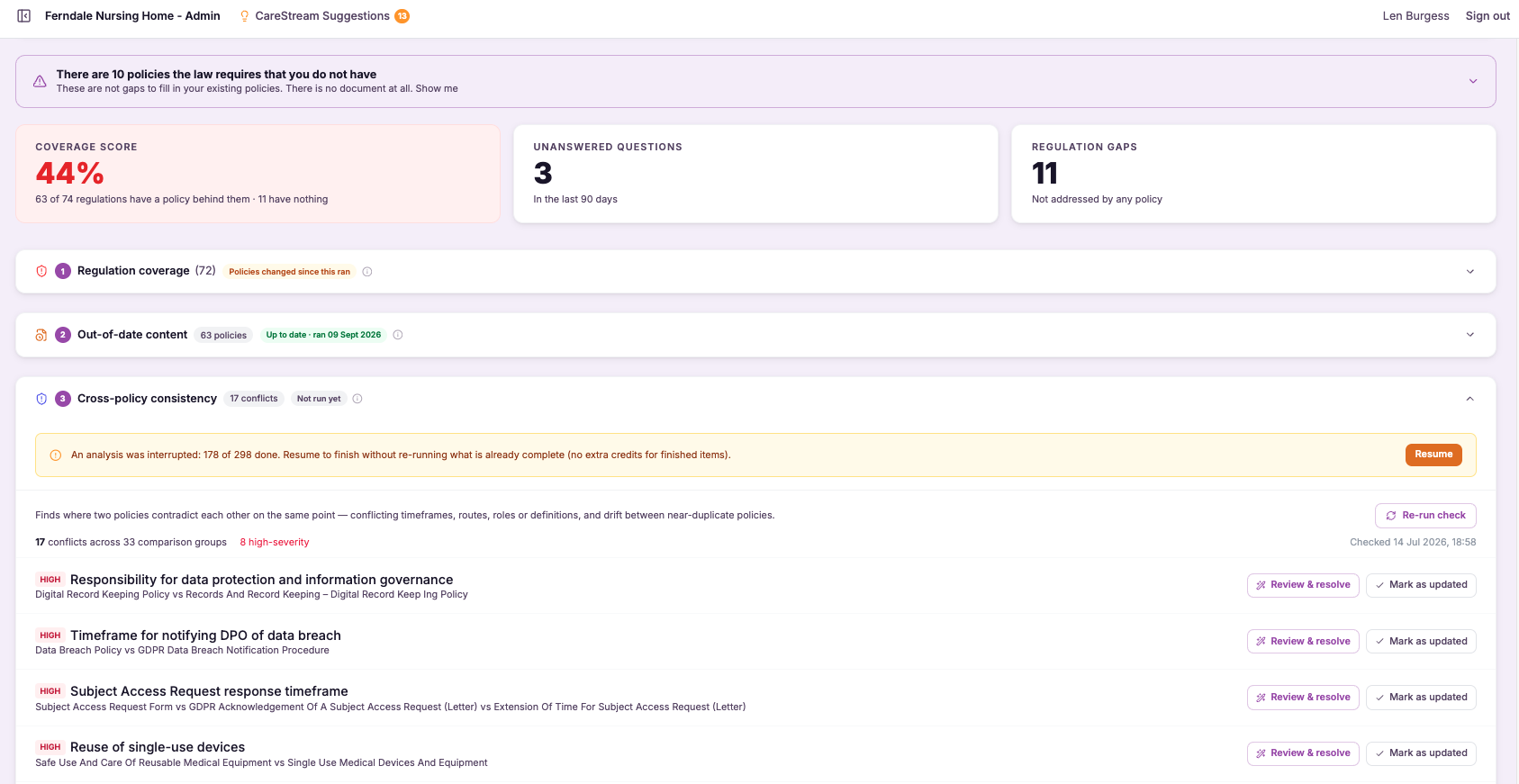
Fix it in one place
- Edit the wording directly in the policy panel, no download and re-upload
- Replace a named role or a phrase across the whole library at once
- Every change recorded with who made it and when
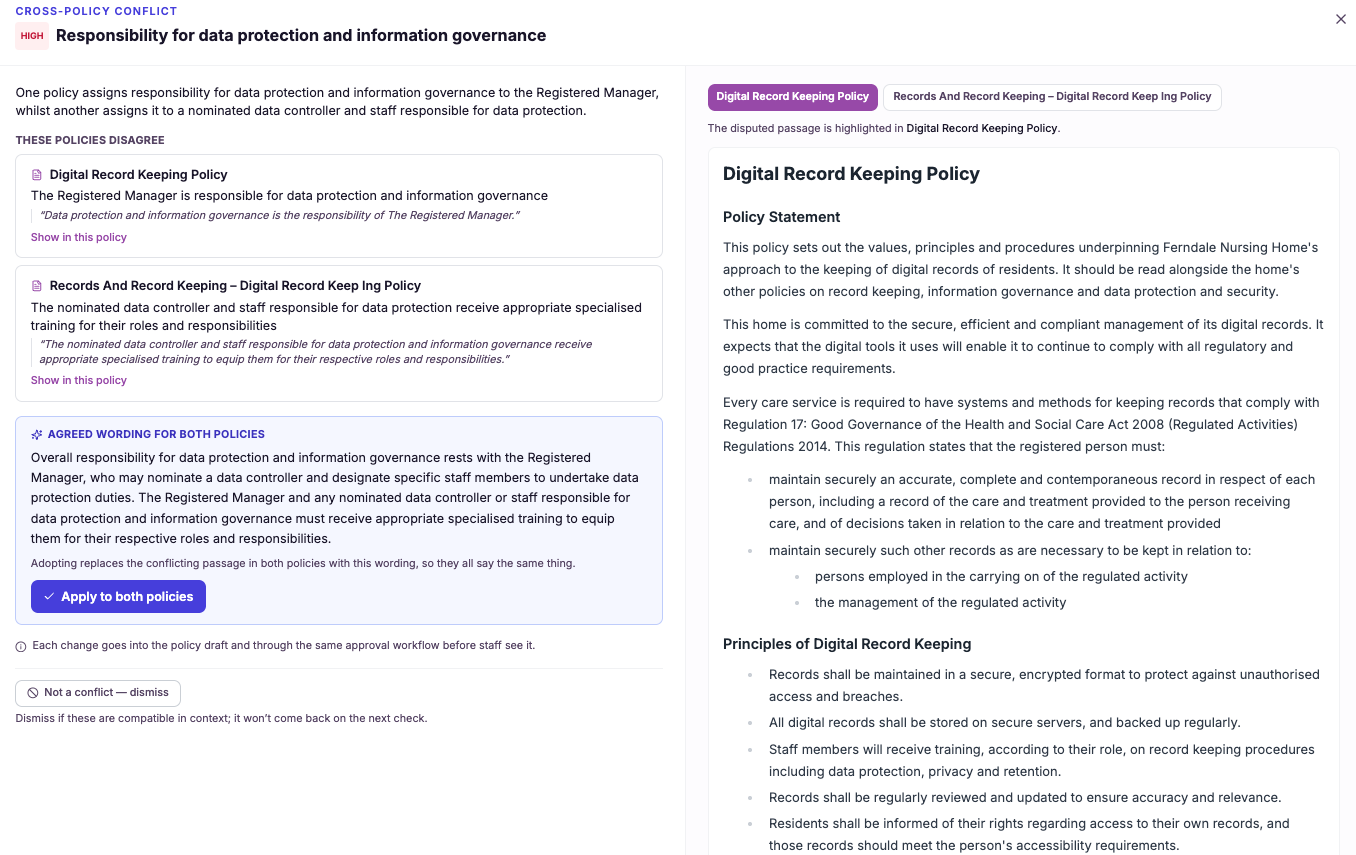
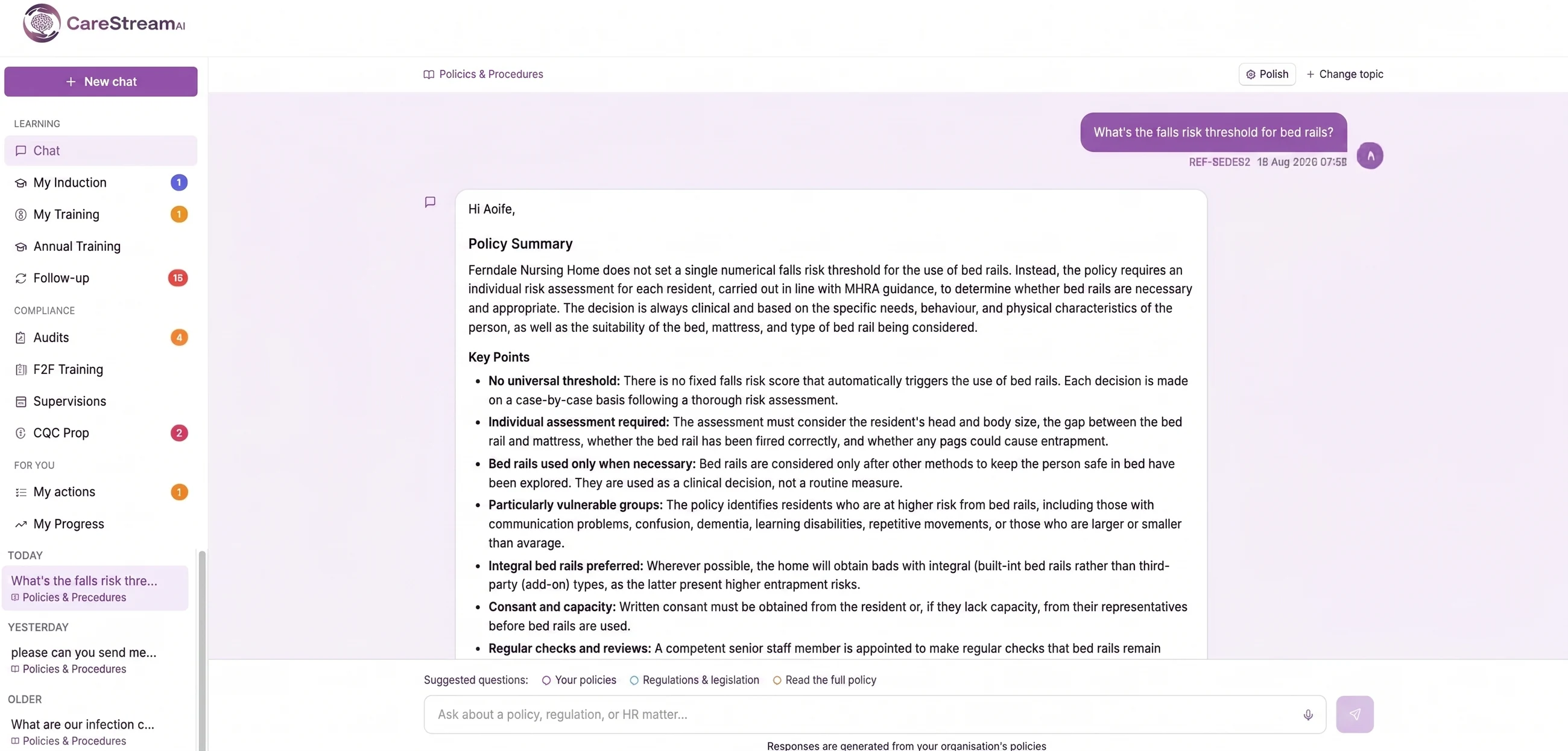
Staff see the resolution
- The corrected policy goes to everyone it applies to
- Read receipts recorded against the corrected version
- The superseded version stays available for the record
Guides on this subject

Why Downloaded Care Policy Templates Create Contradictions (And What to Do About It)
Most care services run on a patchwork of downloaded templates, and nobody reconciled them after they were assembled. That is the uncomfortable truth...
Read article
Care Policy Version Control: How to Know Which Version Is Current (Without Buying New Software)
The most dangerous document in your care service is not the one that is missing. It is the one that looks current but is not. Managing policy...
Read article
When Two Policies Disagree, Staff Follow the Wrong One
It is 3am and a domiciliary carer is standing in a client's kitchen, phone in hand, trying to remember which reporting route applies to the bruise...
Read articlePolicy Inconsistencies, answered
The check
How does it find a contradiction?
It reads the whole library together and compares what each policy says about the same subject, rather than checking policies one at a time.
Will it flag things that are not really conflicts?
Sometimes. Anything flagged is reviewed by you and rejections are remembered.
Does it work on policies we wrote ourselves?
Yes. It works on your library whatever the source, which matters most when the set was assembled from several template packs.
Fixing
Can we fix wording without republishing everything?
Yes. Minor edits apply directly and are recorded as changes, without resetting anyone’s acknowledgement.
What if two policies disagree and both are wrong?
Then you decide the correct position once and apply it to both, which is the point of doing this as a set rather than document by document.
Is there an audit trail?
Every change is recorded with the author, the date and what it replaced.
Scale
We have about a hundred policies. Is that a problem?
No. The check is more useful at that scale, because a hundred documents is well past what anyone reconciles by reading.
Do we need to do this more than once?
Run it after any significant edit or import. Contradictions are introduced by change, not by time.
What if we run multiple services?
Each service has its own library, and the check runs per service.
A guide to finding and resolving contradictions across a policy set
Most policy sets are assembled rather than written: some inherited, some bought as a template pack, some written in response to an incident. Each is reasonable on its own. The contradictions live in the gaps between them, and they are invisible to the way policies are normally reviewed.
Why one at a time cannot work
Policy review is almost always scheduled per document. That method is good at catching a policy that has gone stale and structurally incapable of catching two policies that disagree, because the disagreement is not inside either document.
This is why contradictions survive years of diligent review. Nobody was doing the job badly. The job was defined in a way that excluded the problem.
The four that matter
Reporting routes, where two policies send a concern to different people. Thresholds, where the same situation triggers action at different points. Named roles, where a policy names a post that no longer exists. And timescales, where the same duty carries two different windows.
- Different reporting routes for the same concern
- Different thresholds for the same trigger
- A named role that no longer exists in the structure
- Two windows for the same statutory duty
- Terms used to mean different things in different policies
Where CareStream fits
Cross policy consistency checking reads the whole library at once and reports the specific sentences that disagree, grouped by the type of conflict so you can resolve a class of problem rather than a queue of items.
Resolution happens in place. You can correct wording directly in the policy panel, or replace a role or phrase everywhere it appears, and the corrected version goes out to the staff it applies to with the old one kept on the record.
General guidance, not legal advice. Regulatory requirements change and vary by service type. Check the current CQC guidance and your own registration conditions before relying on any of the above.
General guidance, not legal advice. Regulatory requirements change and vary by service type. Check the current CQC guidance and your own registration conditions before relying on any of the above.
Read next
Written on Policy Inconsistencies
Why Downloaded Care Policy Templates Create Contradictions (And What to Do About It)Most care services run on a patchwork of downloaded templates, and nobody reconciled them after they were assembled. That is the uncomfortable truth...Care Policy Version Control: How to Know Which Version Is Current (Without Buying New Software)The most dangerous document in your care service is not the one that is missing. It is the one that looks current but is not. Managing policy...When Two Policies Disagree, Staff Follow the Wrong OneIt is 3am and a domiciliary carer is standing in a client's kitchen, phone in hand, trying to remember which reporting route applies to the bruise...