Training collection
Mandatory Care Training
Mandatory care training is the set of subjects every care worker must complete, refresh and evidence. This collection gathers your mandatory care training into one place, written for care settings rather than for a general workforce. Every course here answers to something specific: a regulation, a national standard, a commissioner's contract or a recognised piece of good practice, and we say which one on every course page so you are never guessing what a module is for.
You can buy a single course for £25.99 when you have one gap to close, or take a platform licence and get the whole library, the training matrix and the evidence record together. Staff complete their courses on a phone, on shift or at home, and can read the material in their own language, so night staff, bank staff and part-timers are not left waiting for a session they can never attend. Face-to-face sessions and practical sign-offs sit in the same record as the e-learning, so what you can show an inspector is the whole picture rather than half of it. CareStream courses are CPD accredited where accreditation matters to you.

This training covers how we protect vulnerable adults and children from abuse, harm and neglect at our home. You will learn to recognise signs of abuse, understand our reporting procedures, and know how to respond to challenging behaviour and potential radicalisation risks. This is essential knowledge for keeping everyone in our care safe.

This annual refresher covers the essential knowledge you need to move and handle people safely in our home. It reviews why safe moving and handling matters, the principles we follow, how to assess and plan moves, and how to protect both the people we support and yourself from injury. Remember: this module covers knowledge only. You must also complete practical competency assessments with your supervisor.

This training covers how to prevent and control infections in care settings to keep residents, staff and visitors safe. You will learn about hand hygiene, personal protective equipment (PPE), cleaning procedures, and how to respond when infections occur. These practices protect everyone and meet legal duties under the Health and Social Care Act.
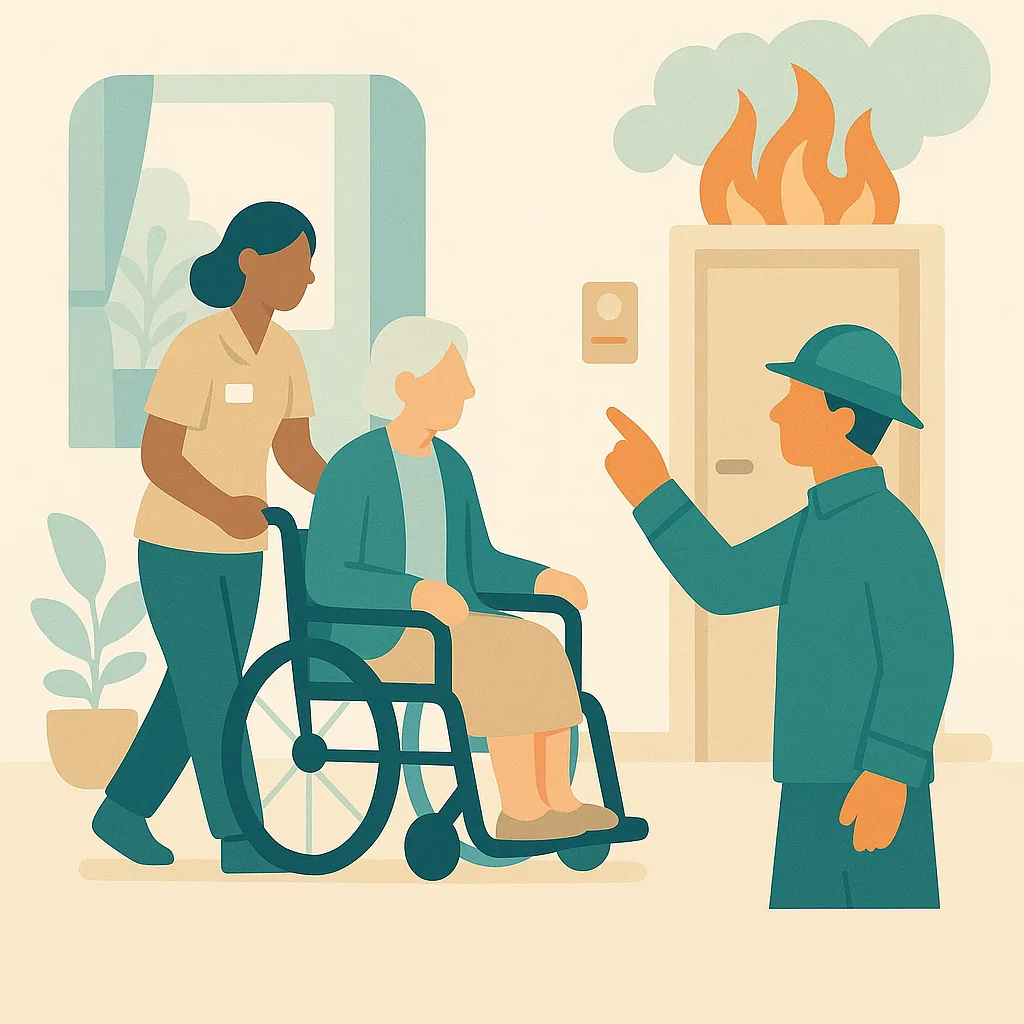
This training covers fire safety procedures at our home, including prevention, what to do if you discover a fire, evacuation procedures, and your responsibilities. Fire safety is everyone's responsibility and understanding these procedures protects residents, visitors and staff.
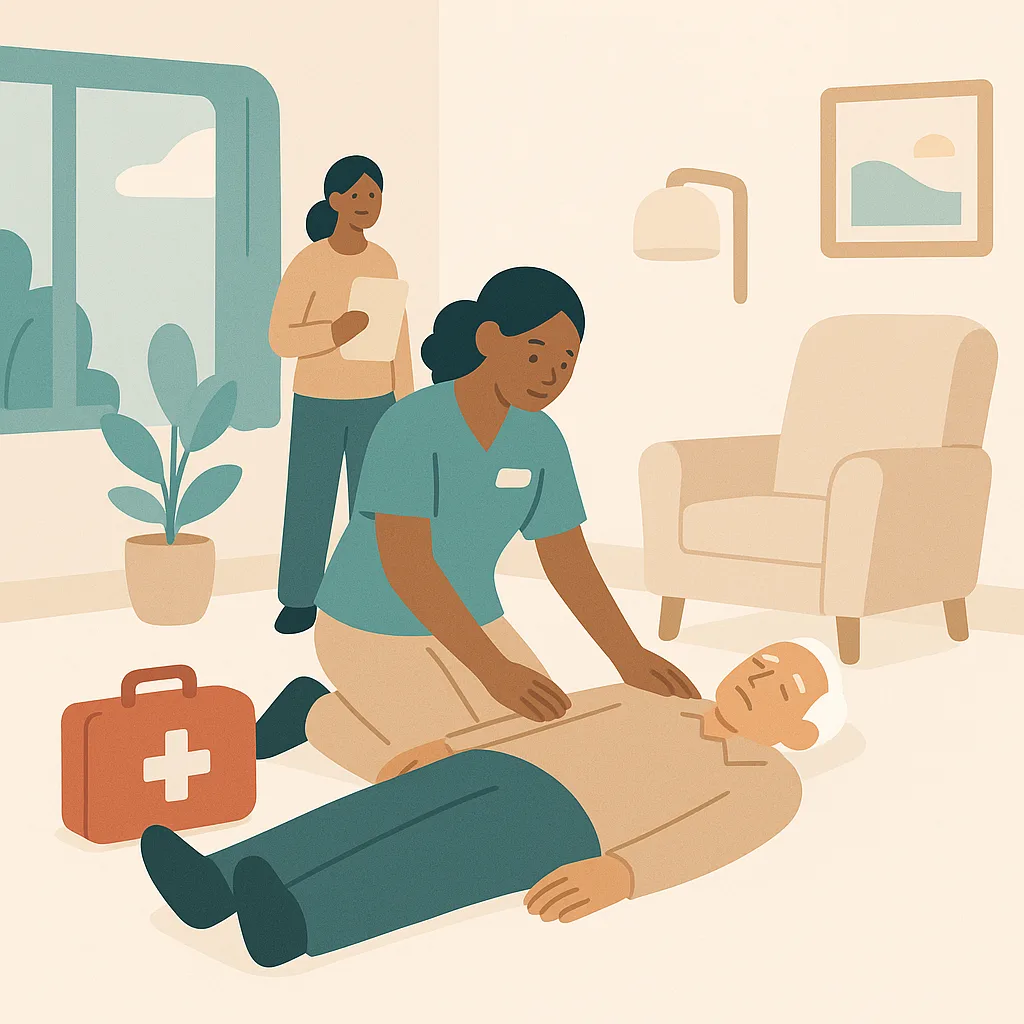
This module covers the essential knowledge you need to respond safely and effectively to medical emergencies in our care home. You will learn when and how to get help, how to assess a resident's condition, and the principles behind basic life support. Remember: this module covers knowledge only—you must also complete practical, observed competency assessments to demonstrate your skills in real situations.

This training covers how to keep food safe and prevent illness in a care setting. You will learn about storing, preparing and serving food safely, preventing contamination, and protecting residents with food allergies. These practices protect everyone's health and meet legal requirements.
Training your staff will absorb, and evidence that stands up when someone asks to see it
What mandatory care training actually means, and what the law requires
The phrase covers three different things that the sector routinely treats as one, and separating them saves you money and argument. Some training is required by law. The Health and Social Care Act 2008 (Regulated Activities) Regulations 2014, in particular Regulation 18 on staffing, requires that staff receive the training, supervision and appraisal necessary to carry out their role, and the Care Quality Commission assesses providers against it. The Health and Care Act 2022 added a statutory requirement that CQC-registered providers ensure staff receive learning disability and autism training appropriate to their role, and the Oliver McGowan Code of Practice, which commenced on 6 September 2025, sets the benchmark for what that training must look like. Some training is required by an employer, a local authority or an integrated care board through a contract, which is why two services in the same town can face different lists. And some is good practice: sensible, expected, widely done, but not written into law. We label which is which throughout the collection, because a requirement you cannot trace to a source is a requirement you cannot defend.
Which services and which roles have to complete it
If you carry on a regulated activity, you are in scope, and that is broader than most lists suggest. Residential care homes, nursing homes, domiciliary care agencies, supported living services, extra care and live-in care providers, hospices, substance misuse services, independent hospitals, GP practices and dental practices all sit under the same staffing regulation, even though the subjects that matter differ enormously between them. Within a service, the requirement follows the role rather than the job title on the rota. Care assistants and support workers need the full core set. Senior carers usually add medication administration and competency assessment, and often first aid. Nurses hold their own professional revalidation requirements on top. Registered managers and deputies need everything their staff need plus the governance subjects, because you cannot sign off competence in something you have never covered yourself. Ancillary staff in the kitchen, laundry and maintenance need health and safety, infection prevention and control training, fire safety and safeguarding awareness, and bank and agency staff need evidenced training before they work a shift, not after it. You can see which subjects each role has to complete and set that expectation once rather than argue it every month.
The core statutory subjects in this collection, and what each one answers to
Safeguarding adults and children training covers recognising abuse and neglect, raising an alert, and what to do when the person you are worried about is a colleague, and it answers to Regulation 13 on safeguarding service users from abuse and improper treatment. Moving and handling of people training covers risk assessment, hoisting, slide sheets and helping someone move safely, and answers to the Manual Handling Operations Regulations 1992. Infection prevention and control training covers hand hygiene, personal protective equipment, outbreak management and cleaning, and answers to Regulation 12 on safe care and treatment. Medication administration and competency covers the six rights, controlled drugs, covert administration and refusals, and supports a competency assessment rather than replacing it. Mental Capacity Act 2005 training covers capacity assessment, best interests decisions and Deprivation of Liberty Safeguards, and answers to Regulation 11 on consent. Fire safety answers to the Regulatory Reform (Fire Safety) Order 2005. Food hygiene answers to retained food safety law. Alongside these sit the induction standards for new starters, including the full Care Certificate induction standards for new care staff, which since the 2025 update run to sixteen standards.
How often each subject needs repeating, and what sets the frequency
This is where most training matrices quietly go wrong, because annual refreshers are often recorded as a legal rule when no such rule exists. In truth, the law usually requires that staff are competent and that training is repeated often enough to keep them so, and leaves the interval to your risk assessment. Moving and handling has no statutory renewal period. The annual refresher most services run comes from employer policy, insurer expectation and commissioner contracts, and it is a perfectly good decision, but it is your decision, and you should record it as such. Fire safety instruction must be repeated periodically, with your fire risk assessment setting the rhythm. First aid certificates for a recognised qualification last three years, and the Health and Safety Executive recommends an annual refresher in between. National Institute for Health and Care Excellence guidance on managing medicines in care homes recommends reviewing medicines competence annually. Safeguarding and the Mental Capacity Act 2005 have no fixed statutory cycle, so most services work to a defined interval and review it after any incident. Write the interval, write what sets it, and the matrix becomes defensible.
Buy mandatory care training by the course or by the platform, and compare the value properly
Who these courses are perfect for
These courses are made for the person who owns the training matrix on top of a full job: a registered manager, a deputy or a senior carer at a CQC registered service of roughly fifteen to eighty staff, with no learning and development department and no real training budget. They suit you particularly well at the moments when training actually gets bought, and those moments are familiar. A cohort of new starters lands and needs induction evidenced within twelve weeks. A batch of annual refreshers all expire in the same month because everyone was trained together two years ago. An inspection is booked, or a report has said training was not evidenced. A local authority or integrated care board asks to see a training matrix before renewing a contract. A medication error or a handling injury exposes a gap you already suspected. Agency spend is rising, and you would rather upskill your own people. Or you have inherited a matrix nobody has touched in two years, and you need to know what is real.
Why our courses are written differently to generic e-learning
Most care sector e-learning began life as office training with a care module bolted on, and it shows the moment a staff member reads an example about a filing cabinet. Every CareStream module is written for the setting: a scenario in a resident's bedroom at two in the morning, a family member disagreeing with a best interests decision, a district nurse who has not arrived. Statutory modules put staff inside a situation and ask them to decide, rather than marching them through slides to a certificate. Content is human-reviewed and hand-checked before it goes live, and updated when the law changes rather than when a renewal invoice falls due. Modules can be read in the staff member's own language, which matters when a good carer is being assessed on their English rather than their practice. Courses are personalised to your service where that is relevant, and completion certificates are print-ready for your file. Every course connects to the policy it supports in practice, so what staff are taught and what your policy says do not contradict each other.
What a certificate proves, and what an inspector actually looks for
A certificate evidences completion. It does not evidence competence, and it is worth being honest about the difference, because inspectors are. What gets looked at is whether the training suits the role and the people you support, whether it is current, whether your records show who completed what and when, and above all whether the service can demonstrate that staff practise safely, not merely that they attended. That is why a medication course sits alongside an observed competency assessment, and why moving and handling e-learning sits alongside a practical sign-off with a named assessor and a date. If an inspector asks for training records you cannot produce, the problem is rarely that the training never happened, it is that attendance was recorded on a sign-in sheet in a drawer and the spreadsheet was last updated by someone who left. Completion, expiry, practical sign-offs, and certificates belong in one place, with a live training matrix that shows renewals and gaps across every member of staff.
Get started today, and what the price includes
A single CPD accredited course is a one-time purchase at £25.99 per course. No subscription, no contract, no minimum seat count and no quote needed, so a service with twenty-six staff is not asked to buy a licence priced for two hundred. You can check the price on any course page before you order, compare prices against a per-seat annual contract and decide which represents better value for the size you actually are. If you need the whole library, the training matrix, the evidence pack and face-to-face records together, a platform licence is available; you can pay monthly or pay annually, and you can cancel anytime at the end of your term. Purchases go through secure checkout, and staff can be enrolled the same working day. Our return policy applies as set out in our terms, so a full refund is available if a course is unused and the purchase was made in error. Order today and put one subject right, or move the whole matrix across at once. CareStream is here either way.
Mandatory Care Training FAQs
What is considered mandatory training in adult social care?
Mandatory training is the set of subjects a member of staff must complete to work safely and lawfully in their role. In England, it is a mix of three things: training required by law under the Health and Social Care Act 2008 (Regulated Activities) Regulations 2014 and health and safety legislation; training required by your employer, local authority or integrated care board through contract; and training that is established good practice. All three can appear on the same matrix. What matters is that you can say which category each subject falls into and where the requirement comes from.
What mandatory training courses are required for social care staff?
The usual core set is safeguarding adults and children, moving and handling of people, infection prevention and control training, fire safety, first aid and basic life support, food hygiene, health and safety, Mental Capacity Act 2005 training including Deprivation of Liberty Safeguards, equality, diversity and inclusion, data protection, and learning disability and autism training meeting the Oliver McGowan Code of Practice. Services add subjects according to the people they support, such as dementia awareness, medication administration and competency, epilepsy and rescue medication, catheter care or end-of-life care.
What are some examples of mandatory training in a care home?
In a residential or nursing home, a typical new starter completes safeguarding, moving and handling, infection prevention and control, fire safety, basic life support, food hygiene, health and safety, the Mental Capacity Act 2005, equality and diversity, data protection, and learning disability and autism awareness, alongside the Care Certificate standards. Senior staff add medication administration and competency assessment. Kitchen, laundry and maintenance staff complete health and safety, fire safety, infection prevention and control and safeguarding awareness, because they are in the building and around residents every day.
What training do new care staff need before they start work?
Before a new starter delivers care unsupervised, most services complete safeguarding, moving and handling, infection prevention and control, fire safety and basic life support, plus an introduction to the people they will support. The Care Certificate standards then run through induction and are usually completed within twelve weeks of starting. There is no single legal list of what must happen on day one, so the test is Regulation 18: the person must have the training necessary to carry out their role safely from the moment they carry it out.
Is Oliver McGowan training mandatory, and who has to do it?
Yes. The Health and Care Act 2022 introduced a statutory requirement that CQC-registered providers ensure their staff receive training on learning disability and autism appropriate to their role, and the Oliver McGowan Code of Practice commenced on 6 September 2025 as the standard against which this is assessed. Tier 1 applies to staff who may occasionally come into contact with autistic people and people with a learning disability; Tier 2 to staff providing direct care and support. Each tier involves e-learning followed by interactive training co-delivered by people with lived experience.
Browse the rest of the library
Most services need more than one. These are the collections people buy alongside this one.
Policies are one part of it.
CareStream is the compliance system underneath: your policies, your staff training, your audits and your evidence, kept current and ready for the day somebody asks to see them.
- Policies written and kept updated for you
- Staff training that records itself against the standard
- Gap analysis showing what you are missing before an inspector does
- Everything in one place, for one price