Staff finished the course, the certificates went in the file, and that box is now ticked for three years. It is not. A COSHH certificate carries no expiry, because the Control of Substances Hazardous to Health Regulations 2002 never mention one.
Six beliefs do most of the damage in care services. Here is each one, and what the text actually says.
The law asks for training, not a certificate
The duty is to teach, not to collect paper. Where work is liable to expose a member of staff to a hazardous substance, the employer must give suitable and sufficient information, instruction and training. You can read it in Regulation 12 on information, instruction and training.
Read the whole instrument and the word certificate appears four times. Each time it means a written exemption granted by the regulator, not proof that a care worker sat a course.
So a coshh training certificate is evidence that you met part of the duty. It is not the duty itself, and nobody is required to issue you one.
The CPD certified Care Certificate and the annual courses are free on every plan. No card needed, and every staff login is included.
Create a free accountNothing in the Regulations runs out after three years
Type coshh training how often into a search box and you will get three years, two years and annually, with confidence behind each. None of them comes from the Regulations.
What the text does say is that training must be adapted to take account of significant changes in the type of work or the methods used. The trigger is change, not the calendar.
New cleaning contract. New laundry chemical. A thickener moved to a different cupboard. Each of those is a better reason to retrain than a date.
Most services settle on a yearly refresher anyway, and we think that is sensible. Just do not confuse a sensible habit with a legal interval, because only one of them has to bend when a product changes in March.
There is no COSHH qualification to hold
A coshh qualification is not a thing the Regulations recognise. They ask for training matched to the level, type and duration of exposure that your own assessment identified.
That assessment comes first. Regulation 6 on the assessment of health risks requires it before the work is carried out, and the training then has to reflect what it found.
The same question gets typed as cosh certificate, with one h. The answer does not change.
A generic course cannot name what is in your sluice
This is the belief that costs most. The training has to name the substances staff may meet and the risks each one presents. It must also cover any workplace exposure limit, and give access to the safety data sheet.
No course bought off a shelf knows what sits in your sluice room. It cannot list your products, and it cannot tell staff what your assessment concluded about them.
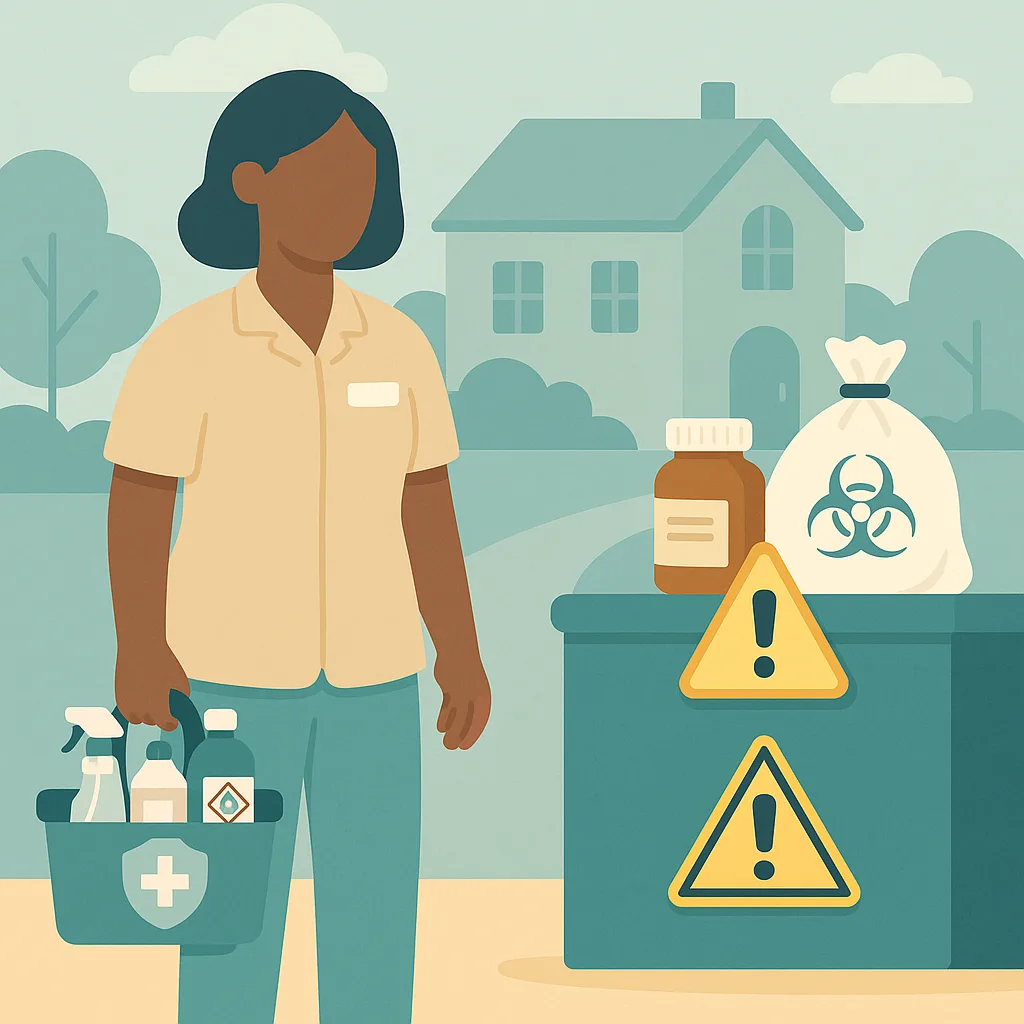
Figure: the products in the basket are the ones the training has to name.
Use a course for the general knowledge, then add the local part yourself. A short walk round the cupboards with the safety data sheets in hand closes the gap that no online module can.
A safety data sheet is not an assessment
Managers often file the supplier's safety data sheet and treat the job as done. The sheet is written about the product. Your assessment is written about the way your service uses it.
One tells you that a concentrate burns skin. The other tells you that it is decanted in a sluice with a poor extractor fan, by staff wearing the wrong gloves, twice a shift.
Staff need both, and they need to know where each one is kept. A sheet locked in the manager's office is no use to a night worker dealing with a spill.
What the certificate actually proves
Look at the wording on a CareStream certificate. It states that the named person completed the course, and that it does not confirm competence in a role, treatment or activity.
That line is there because the distinction matters. The employer remains responsible for making sure training meets the requirements that apply to the service.
So a certificate answers one question: did this person learn and pass. Whether they handle a concentrate safely on a Tuesday afternoon is a question for observation.
Free courses, an 80% pass mark assessment, certificates and a training matrix. Create a free account and start with the Care Certificate.
Create a free accountTreat the two as separate lines in the training record. One line holds the course and the score. The other holds the date a senior watched the person work and signed to say it was done properly. This is exactly why CareSteram was built: so you can send multiple training updates about COSHH (and other training) to your staff regularly.
COSHH is not only for the cleaning cupboard
The duty covers every employee liable to be exposed. In a care home, this usually reaches housekeeping, laundry, kitchen, maintenance and care staff who use sprays, gels and clinical waste.
It reaches further than your payroll. Employers must also make sure that anyone who is not an employee, but carries out work in connection with these duties, has the same information, instruction and training.
Agency and bank workers fall squarely in that group. So does the contractor who turns up to clear a drain.
The people you support are exposed too, and they cannot always move away. Someone resting in bed while a room is cleaned around them has no say in which spray is used, which is worth remembering when you choose products.
What to keep instead of a date in a spreadsheet
A file that answers an inspector holds four things, and only one of them is a certificate.
- The register of hazardous substances in use, and a written assessment for each one.
- The safety data sheet for every product, where staff can reach it on shift.
- A record of who was trained, when, and what the training covered.
- A note of what changed since, and who was retrained because of it.
The last line is the one that is usually missing. A product changed, the assessment was updated, and nobody wrote down who was told.
Build the habit into the ordering process instead. When a new product arrives, the person who accepts it checks whether it is on the register and whether anyone needs telling before it is used.
That is a smaller job than an annual retraining push, and it answers the question an inspector is more likely to ask.
Benefits of CareStream for your COSHH certificate
The CareStream COSHH course is CPD certified and free for every member of staff, in English, with no card needed.
- It runs to 8 lessons and about 60 minutes, then a 32 question assessment with a pass mark of 80 per cent.
- A wrong answer opens a follow up lesson on that point, so the gap is closed rather than scored.
- Each learner gets a named, dated coshh certificate carrying the CPD Certified mark, which you can download as a PDF.
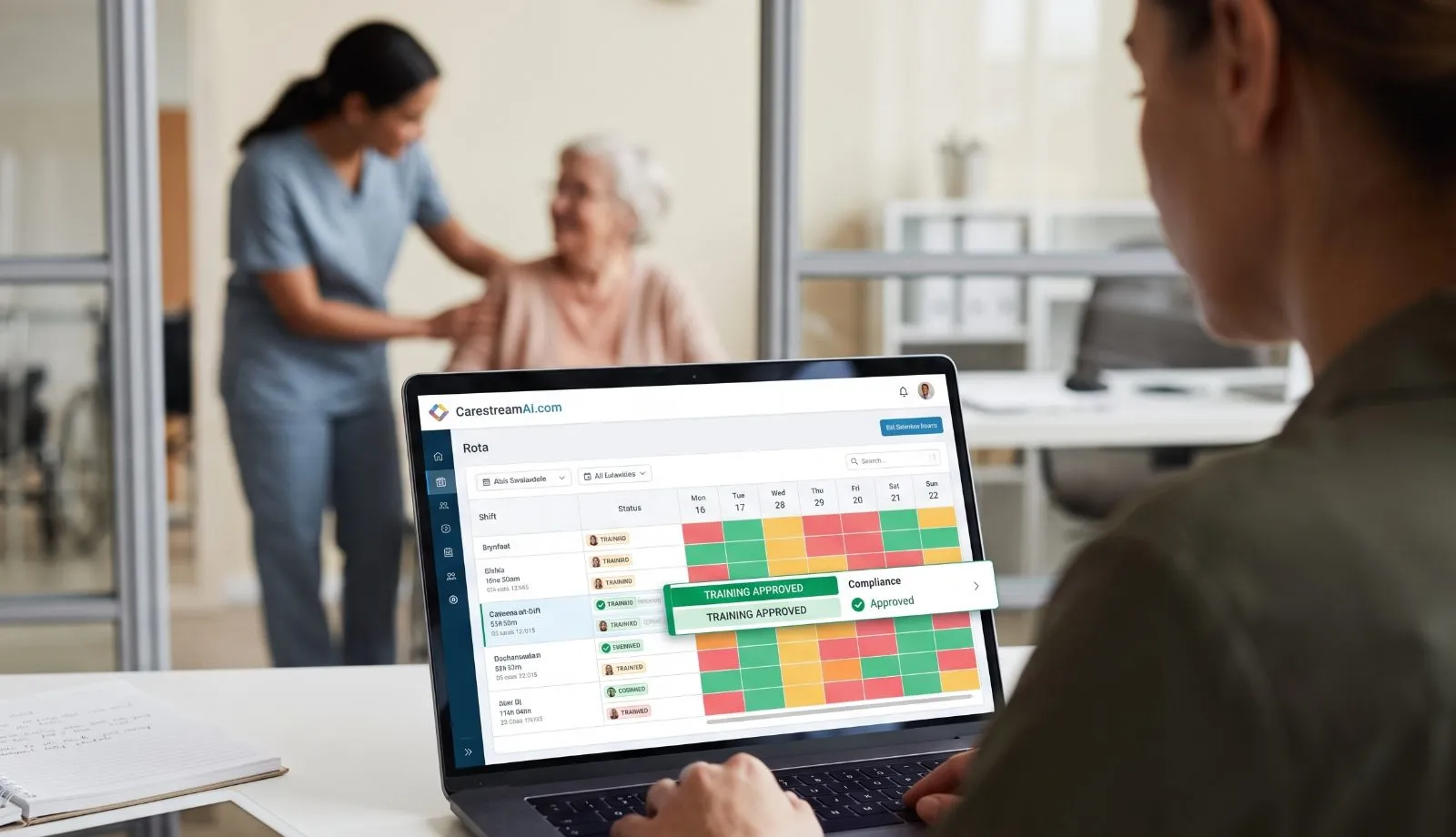
- The training matrix shows who has finished, their score and when their record is due again.
- The free COSHH Compliance audit covers 43 checks, starting with whether a register exists and whether every product on it has a written assessment.
Open the free COSHH course for care staff or run the COSHH compliance audit against your own cupboards.
Where to start this week
Count the hazardous products in one store room and check how many have an assessment that matches how they are used. That number tells you more than any training report.
Then read our guide to what COSHH training for care staff should cover and set the local part against it. If the written document needs work first, the COSHH policy is written for care services.
Keep the certificates. They are useful evidence, and they cost you nothing. Just stop treating them as the whole answer to a duty that is really about what staff know.
Sources
- Regulation 12 of the COSHH Regulations, information, instruction and training (legislation.gov.uk) · legislation.gov.uk
- The Control of Substances Hazardous to Health Regulations 2002, full text (legislation.gov.uk) · legislation.gov.uk
- Regulation 6 of the COSHH Regulations, assessment of health risks (legislation.gov.uk) · legislation.gov.uk
Frequently asked