Priya manages a thirty bed home. Every month she reads the same list: eleven carers with a refresher overdue, three practicals not yet signed off.
She has tried reminders and a word at handover. Now she is weighing a care home staff incentive scheme. She has three worries. It may feel like a bribe, start a row about fairness, or cost more than planned.
Those worries are the right ones, and they are what anyone asking how to motivate care staff should test first. Below, an imaginary home answers each, step by step.
The example home and the rule it started with
This is an invented example, built to show how the rules fit together. Hollybank is a thirty bed residential home with a mixed team: full time seniors, part time carers, two new starters and a few agency staff.
Its manager set one rule before anything else. A reward must follow something the home can already prove, such as a passed assessment, and never a promise or a favour.
That rule matters because the law already expects training to happen. Regulation 18 (staffing) says staff must receive the support and training needed for their duties. The full text of Regulation 18 on staffing is short and worth reading.
The Care Quality Commission adds that training should be monitored, with action taken quickly when requirements are not met. A staff reward scheme is one optional way a home may choose to help with that. It does not replace supervision or the manager's own follow up.
It also needs honest limits. Recognition for training is not the same as proof of competence, so the manager still watches practice on the floor.
Step one: decide what earns points
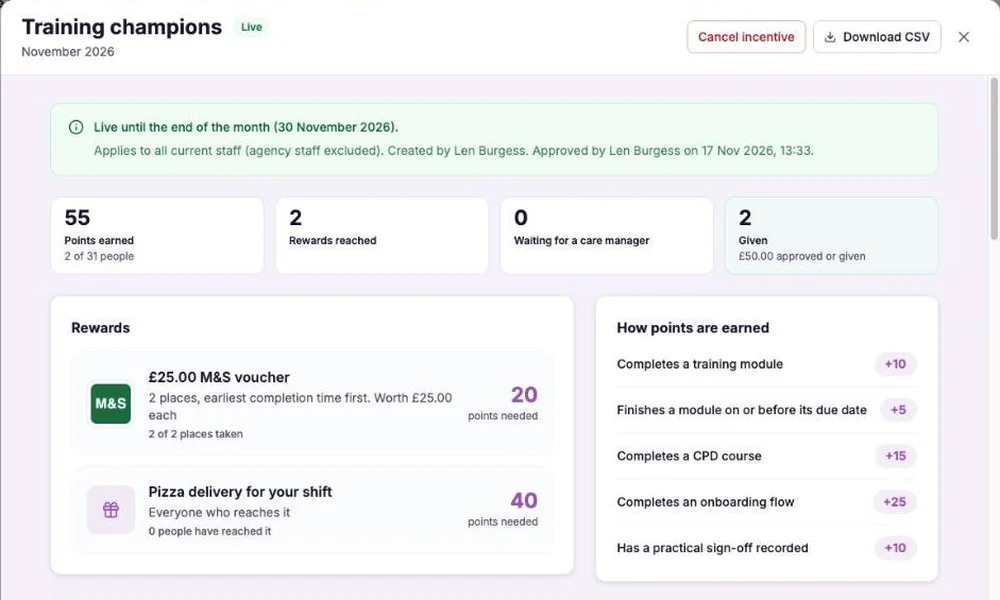
Hollybank lists the things it wants to see more of. Each gets its own points, and each can have a cap per person, so nobody can pile up points in one easy way.
- Completing a training module, counted only once the assessment is passed at the module pass mark.
- Finishing a module on or before its due date.
- Completing a CPD course.
- Completing an onboarding flow.
- A practical sign-off recorded by a manager.
Notice the first item. A module that is merely opened earns nothing. Where a module needs an observed practical, it also counts only after a manager has signed the practical off.
Book a short demo and see how CareStream keeps your policies, training and CQC evidence in one place.
Book a demoThat one detail removes most of the bribery feel. Staff are not rewarded for clicking through a screen. They are recognised for finishing what the home needs: a person who has been taught, tested and, where it applies, watched doing the task.
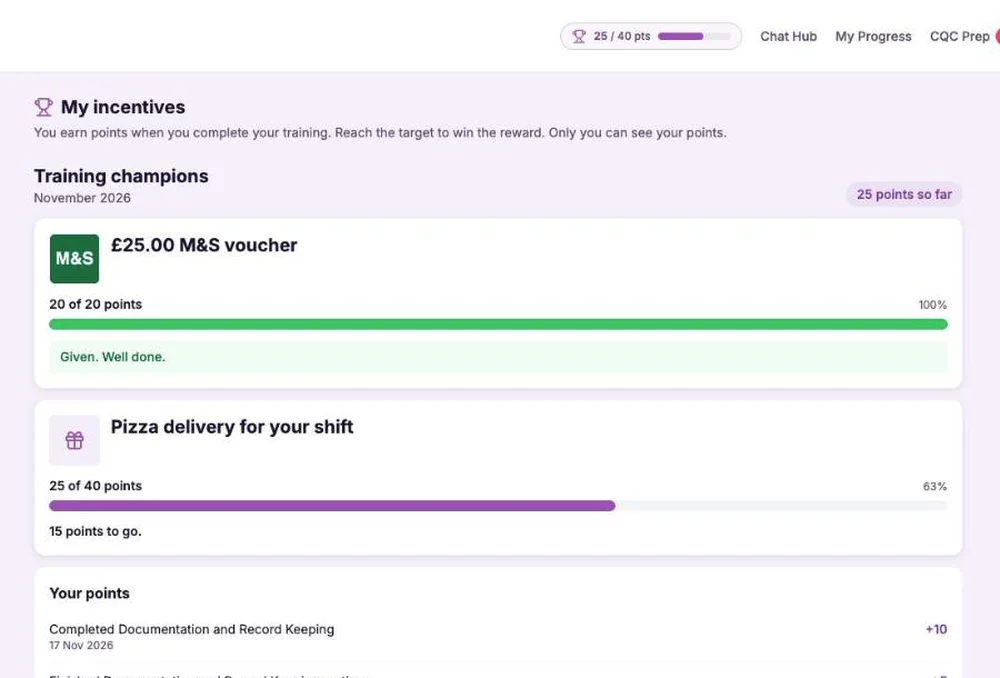
Figure: what staff see in the hub. Only their own points and progress are shown.
Step two: let the records award the points
Points can be a spreadsheet job, and a spreadsheet invites arguments. The safer rule is that points come from records the home already keeps, and nobody types them in by hand.
That protects the manager from disputes. It also protects staff from a scheme that favours whoever shouts loudest.
An incentive can apply to all staff or to chosen staff. Agency staff are best left out unless the manager chooses them, because their training is usually arranged elsewhere.
Step three: set rewards and fair targets
Hollybank offers a shop voucher as its main reward, with the shop logo uploaded as an image. A reward is free text, so a voucher reward could equally be a lunch or a thank you card. It can also carry a money value for the home's own records.
Each reward has a points target. There are two ways to share it out.
- Limited places. The first people to reach the target win them, decided by the real completion time.
- Everyone who qualifies.
Hollybank uses limited places for the voucher and everyone who qualifies for a smaller thank you.
Targets can be set per person. A part time carer, a new starter and a long serving senior each get a target that suits their hours and what is due. Otherwise the scheme quietly rewards whoever has the most shifts.
Step four: keep it private and kind
There is no leaderboard. Staff see only their own points and progress, as a number and a progress bar, under My incentives in the staff hub. A small live points tracker also sits in the top bar, on mobile too.
Points reset each month. Nobody is left far behind for long.
What about people who miss out on a limited reward? They get a kind thank you that points them to the training still outstanding. The aim is training engagement, not a contest, and a small staff reward scheme in a care home works best when nobody feels watched.
If someone leaves the home, they lose access to points and rewards.
Step five: approve before it starts, and before anything is given
Cost is where a monthly incentive can run away. Hollybank puts a person between the idea and the spend, twice, and keeps the places on each reward limited.
A care manager, usually the budget holder, approves the incentive before it goes live. The same manager approves each reward before it is given. Someone then marks it as given.
A quick demo shows exactly how CareStream would work for your service. Book a time that suits you.
Book a demoCareStream only records, approves and reports. It never buys vouchers or moves money.
Where a reward has a money value, we suggest the home checks with its payroll provider or adviser before it goes live. There is a CSV for payroll, and a note in CareStream saying the same thing.
Step six: read the results, then adjust
The admin dashboard card shows how many staff have earned points, and how many rewards are reached, waiting and given. It shows cost against an optional monthly budget. It also compares training completions with the month before.
Each person's staff record shows this month's position and every past month.
Hollybank asks one question at the month end: did the overdue list get shorter? If not, the points were wrong, or the targets were.
Staff also get emails at the right moments. One goes out when an incentive launches, and a points summary arrives at most once a day. At the end of the month winners get one message, and everyone else gets a thank you saying a new incentive will launch soon.
This is staff recognition built on facts the home already holds. The manager's real job, a kind word on the floor, stays with the manager.
A good scheme also shapes staff training motivation over several months. We suggest watching the trend across several months, not one month alone, before changing the rules.
Benefits of CareStream for a care home staff incentive scheme
Staff incentives sit on top of the training records the home already holds. They are on the Professional and Enterprise plans.
An admin builds the incentive for the month. Points are added automatically. The staff incentives feature page describes the screens, and the pricing page shows what each plan includes.
Each rule above has a place in the product. It has caps per way of earning, per person targets, a care manager's approval and a payroll CSV. It records, approves and reports. It never buys a voucher or moves money.
Staff incentives care home managers set up this way sit beside the training the home already runs. The training features cover the courses and matrix that the points are drawn from.
What to do next
Write down the three pieces of training you most want finished. Give each its own points and a cap. Choose one modest reward, set the number of places, and ask your budget holder to approve it before it starts.
Then check the reward value with your payroll provider. For the wider picture on what staff must complete and how often, read our list of mandatory training for care staff, or browse the guides.
Sources
Frequently asked