Usually the assessor is whoever manages the new starter, and nobody asks any more. A sharper habit is to test, standard by standard, whether that person can judge it. Below are eight questions for a care certificate assessor, with the evidence we would show in reply.
Our answers rest on one document: the Care Certificate standards assessor and employer guide. We call it the Assessor Guide. Read the full Assessor Guide on the Skills for Care site to check any point.
Four bodies publish it together: the Department of Health and Social Care, NHS England, Skills for Care and Skills for Health. A shorter Skills for Care questions and answers document backs it up. We call that one the Q&A.
Who is your assessor, and why that person?
The Assessor Guide gives the assessor one job: deciding whether a support worker has met the standards. To do it, the person must be competent in the standard they assess. For almost all assessors, that competence comes from a qualification related to the role.
One person need not cover all sixteen. That surprises many services. Basic life support, Standard 12, may call for a different assessor from the other fifteen.
We would pick a senior carer or a deputy over a registered manager who is already stretched. The trade off is rota time, so give the assessor protected hours. A manager who assesses in the gaps between calls will rush, and the evidence will show it.
The CPD certified Care Certificate and the annual courses are free on every plan. No card needed, and every staff login is included.
Create a free accountDoes an assessor need an assessor qualification?
No. The Assessor Guide sets no such rule. The employer must simply be confident that the person is competent to assess. Without a relevant qualification, it suggests they work to National Occupational Standard CLDLD09, Assess learner achievement.
Some services look for care certificate assessor training. The Q&A points to free learning materials for assessors on the elearning for healthcare platform, so it is a choice and not a rule.
In our view the better test is simple, and shorter than any course. Could this person explain to an inspector why they judged a worker competent? Keep one line per assessor:
- Name and role.
- The standards they assess.
- Why the employer is confident they are competent.
What did the assessor actually watch at work?
Look at the verbs. Where a standard says demonstrate, take steps to, use or show, the evidence must come from real work. The assessor stands in the room, or at the doorway, and watches it happen.
Take an example.
Outcome 7.2b covers privacy and dignity in personal care. The Assessor Guide lists examples such as knocking before entering and getting the curtains right. It adds that a worker need not show every example, nor show it a set number of times.
Each care certificate observation is a judgement. The assessor may be satisfied after one span of duty, or want more.
What goes on the record matters as much as the visit. We would note four things after every observation:
- The standard and outcome the visit evidenced.
- What the worker did, in plain words.
- The assessor's decision: met, or not yet met.
- The date, the assessor's name and the next step.
One visit can feed more than one standard. The Assessor Guide says evidence may count towards several, and it urges assessors to work this way. A good morning of personal care can show communication, privacy and hand hygiene together.
Why was that skill shown in a classroom?
Sometimes that is allowed. Simulation is allowed only where a skill could not reasonably be assessed in real work, or is unlikely to occur during induction. Basic life support is the guide's own example.
Remote video and live recordings are a separate matter. The Assessor Guide rules them out where they would compromise the dignity and confidentiality of the people supported.
We would write one sentence on the file each time simulation was used, saying why real work was not possible. An inspector then sees a decision, not a shortcut.
Where does the online course fit in care certificate assessment?
It covers knowledge. The Assessor Guide says eLearning is a way to acquire and show knowledge, not skill, and that eLearning alone cannot provide full achievement.
Where eLearning is used, it needs an assessment attached, such as questions and answers, so that the service can show what the worker actually learnt. Attendance alone proves nothing.
So the course sits in the file beside the observation. It never replaces it. Knowledge verbs such as describe, explain and identify can be answered in writing or aloud, says the Q&A on assessing knowledge and understanding.
Free courses, an 80% pass mark assessment, certificates and a training matrix. Create a free account and start with the Care Certificate.
Create a free accountHow much evidence is enough?
Enough is what leaves the assessor confident. That judgement is theirs alone, says the Assessor Guide. A worker cannot be part skilled and still meet a standard, however much paper sits in the file. The care certificate competency assessment should be as rigorous as for any formal qualification.
Each piece of evidence faces five tests:
- Valid: it relates to the standard being claimed.
- Authentic: the worker produced it.
- Current: it is recent enough to trust.
- Reliable: it truly represents what the worker can do.
- Sufficient: it meets the standard in full.
No limit applies to attempts. The employer decides what happens if a worker cannot meet a standard after proper support.
When did this person start working out of sight?
Before the assessor had judged them competent. The Q&A expects regulated providers to assess a new support worker first. It adds that enough time must be planned for it.
Regulation 18 is the legal footing. Under the Health and Social Care Act 2008 (Regulated Activities) Regulations 2014, staff must get the support, training and supervision their work needs. See the published text of Regulation 18 for the exact words.
Direct supervision, with the worker in the supervisor's line of sight, should last until the worker is judged safe to be left alone with the people they support. Phasing helps. As each standard is met, supervision for that task can ease.
Who can sign off the Care Certificate, and where is the record?
The employer. The Assessor Guide says the registered manager in adult social care signs the worker off as having met all the standards. They must be assured that the teaching and assessment were good enough.
That care certificate sign off cannot be outsourced. An employer may buy in training or assessment, says the Q&A, but it stays responsible for the award. Training firms may help with the learning, but they may not issue the certificate.
The award uses the approved national template. The employer keeps the record locally and makes it available to the worker. Where possible, it can also go into the Adult Social Care Workforce Data Set, known as ASC-WDS.
Benefits of CareStream for your care certificate assessor
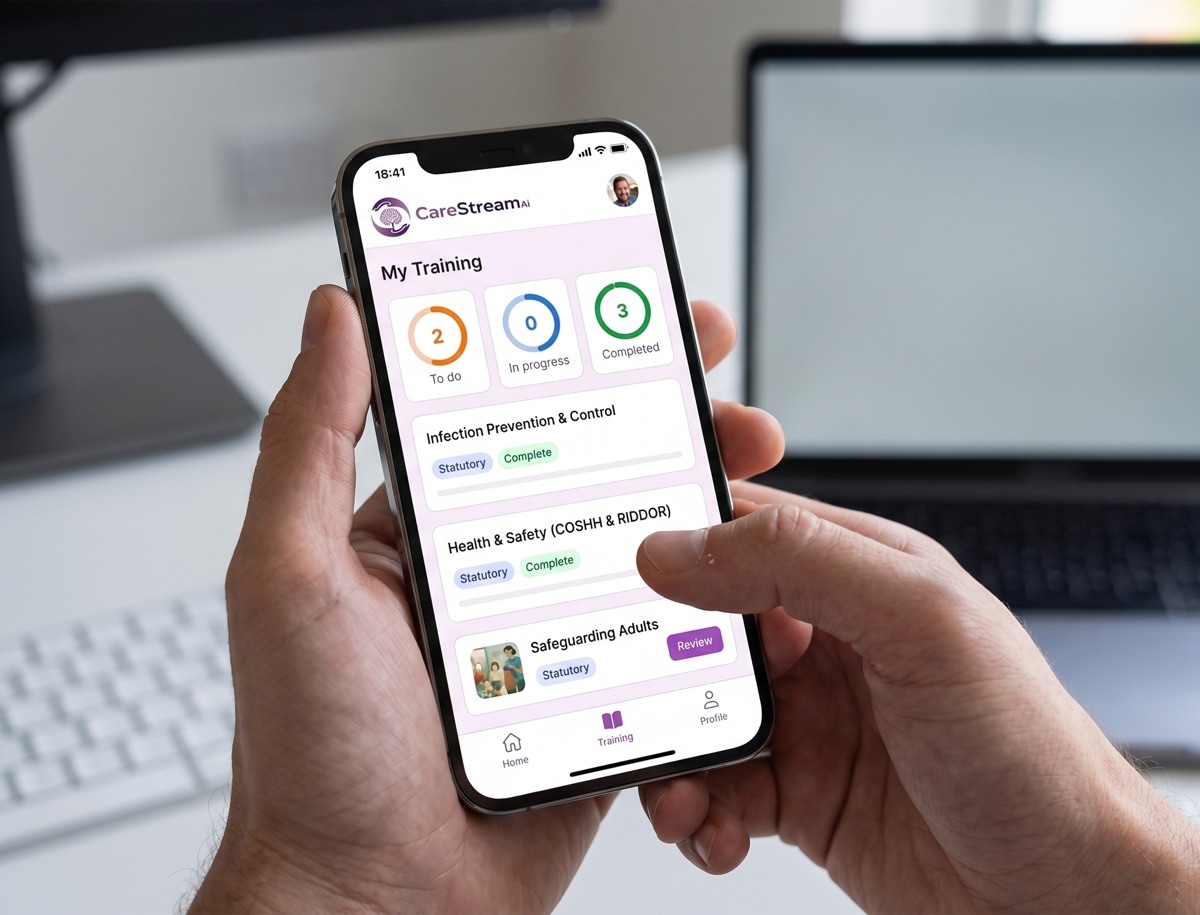
Our free Care Certificate course covers the knowledge side and leaves the judgement to your assessor.
- It takes 90 minutes and has 32 questions.
- It includes a printable observed competency checklist, with lines for the assessor to tick and sign.
- The certificate is not issued until the manager records the observed sign off.
- The record keeps the name of the manager who signed and the date.
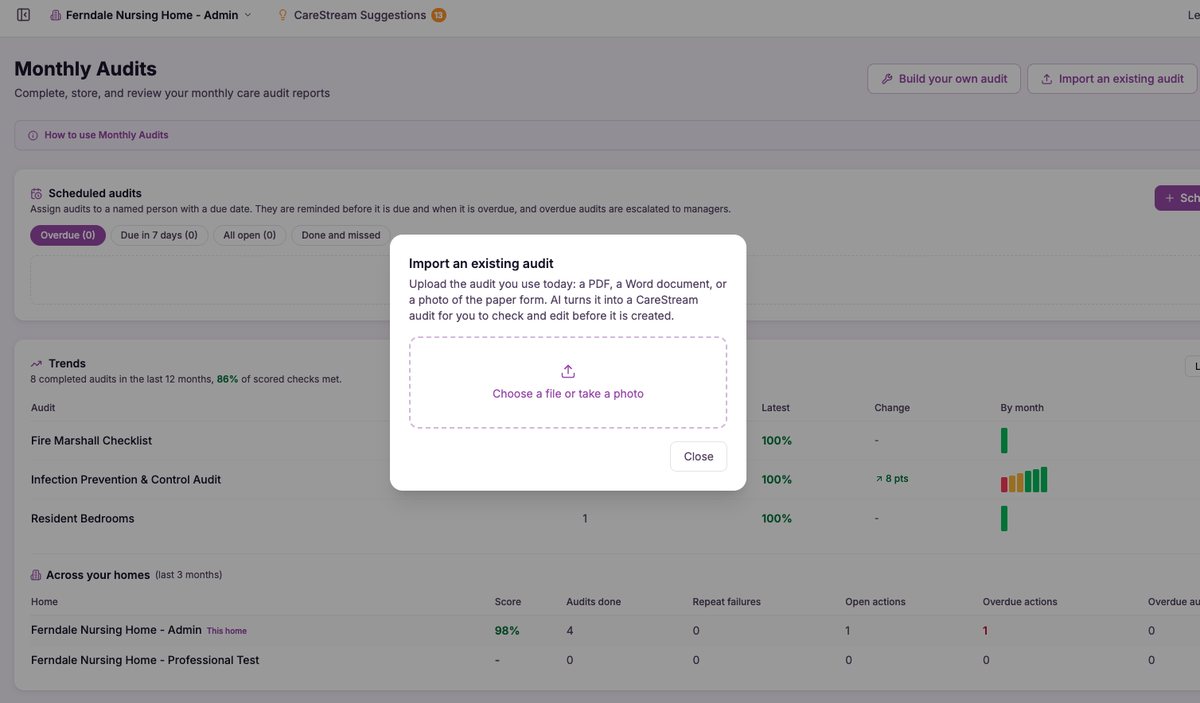
- A matrix shows who has attended and who is still missing, as in the figure below.
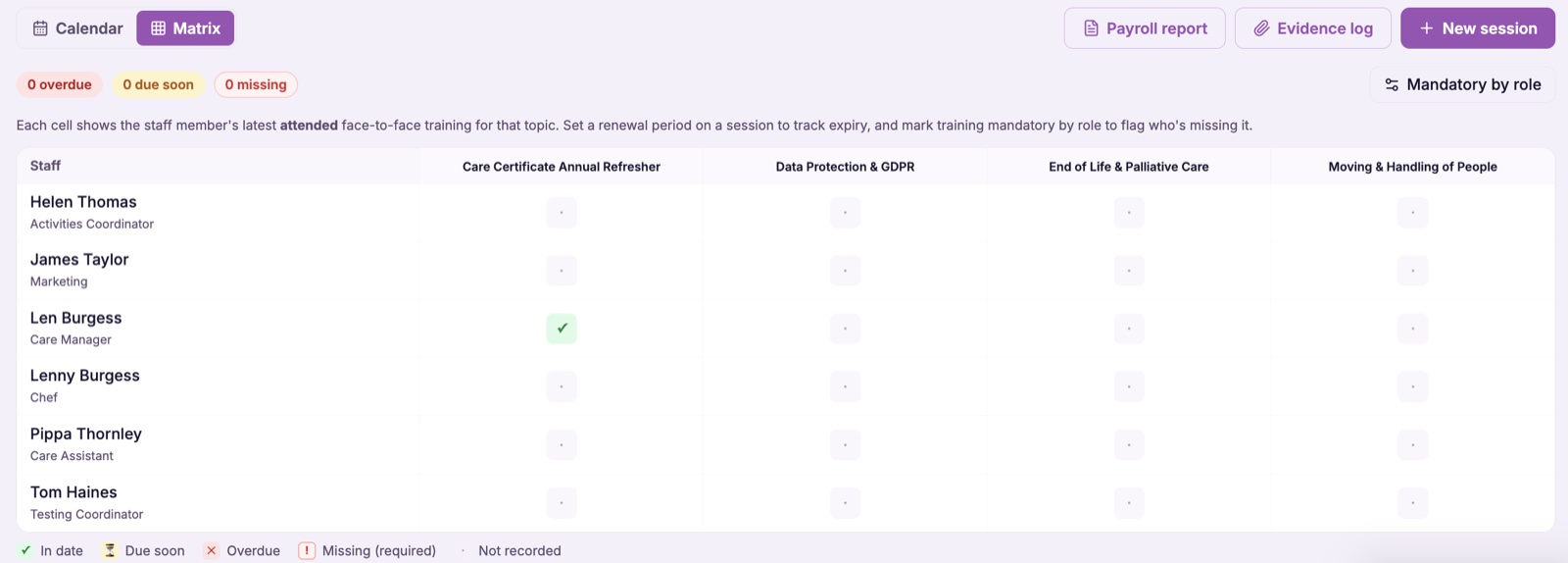
Figure: the matrix marks who has attended, so gaps show up before the next sign off.
CareStream does not award the Care Certificate. Your employer does, after your assessor has watched the work. The free Care Certificate course costs nothing on the free plan.
What to do before the next starter arrives
Pick the assessor for each standard and write down why. Book the first observation into the rota in week one, before the starter has a full set of shifts to cover. Decide now who signs off. Then decide where the record will live.
Then keep the pieces together in one file: the knowledge results, each observation, and the sign off. Our complete guide to Care Certificate training covers the wider induction around it.
Sources
- Care Certificate standards assessor and employer guide (Department of Health and Social Care, NHS England, Skills for Care and Skills for Health) · skillsforcare.org.uk
- Skills for Care: Care Certificate standards · skillsforcare.org.uk
- Questions and answers for health and adult social care professionals (Skills for Care, Skills for Health and NHS England) · skillsforcare.org.uk
- NHS Employers: Care Certificate · nhsemployers.org
- legislation.gov.uk: Regulation 18 (Staffing), Health and Social Care Act 2008 (Regulated Activities) Regulations 2014 · legislation.gov.uk
Frequently asked