The Care Certificate is the law for every new care worker. Plenty of managers believe that, and some job adverts say it too.
So is the care certificate mandatory? Not in law. The official Q&A for health and adult social care professionals calls it a recommended tool. NHS England, Skills for Care and Skills for Health publish it together, and the Questions and answers on the Care Certificate standards.
The law asks for something wider. Here are six beliefs we hear, each tested against the text.
Belief one: the law names the Care Certificate
It does not. Look in the Health and Social Care Act 2008 (Regulated Activities) Regulations 2014 instead. Regulation 18 (the staffing duty) wants staff to be given the training and backing for the work they do, plus supervision and appraisal.
The words Care Certificate are not in the full text of Regulation 18 on staffing. People ask is the care certificate compulsory, or is the care certificate a legal requirement. The certificate is neither, but the training duty is.
Belief two: without it, an inspector will mark us down
Not for that alone. The Q&A says providers can use the standards as a framework to meet Regulation 18. A framework is a way, not the only way.
The CPD certified Care Certificate and the annual courses are free on every plan. No card needed, and every staff login is included.
Create a free accountThe Care Quality Commission publishes guidance on Regulation 18 for providers. A provider must have an induction programme that prepares staff for the job.
Our reading is that an inspector wants to see that programme working.
If you use another induction route, be ready to show what it covers and who signed it off. If you use the Care Certificate, show the observed practice, not only the course. Neither choice decides a rating.
Belief three: everyone on the payroll needs it
This is where managers over comply. So who needs the care certificate? The Q&A aims the standards at workers joining health or adult social care with no past training or sector experience.
Its examples are care assistants, care workers, homecare workers and care support workers. Employers may decide that other groups would benefit.
The Q&A also names roles that do not need to complete it:
- receptionists
- porters
- cooks and kitchen staff
- drivers
- cleaners
- finance clerks
The employer may still pick parts that suit the role. Volunteers depend on their duties. If a volunteer does the same work as a care worker, the full standards can be used.
Belief four: agency and bank staff are exempt
They are not. The Q&A says providers regulated by the Care Quality Commission must assess the training needs of all staff new to their organisation. That covers agency, bank and directly recruited workers.
So the care certificate for agency workers is a duty to assess, not a duty to start from scratch. You decide what each person needs, and you keep the record.
Belief five: experience means they can skip it
Sometimes, but not by default. A worker arriving with years in care, or with a qualification or apprenticeship, still needs checking. The employer should make sure skills and knowledge are current.
The Q&A suggests using the self-assessment tool to find gaps. The employer then arranges extra training or workplace assessment. Sometimes the result is that the employer asks for the whole programme.
Care out of sight is the line to watch. In homecare and community roles, the Q&A expects the assessment to happen first. A new worker must be judged competent before delivering care out of line of sight of a more experienced colleague.
Belief six: a finished online course is the certificate
A course gives knowledge. A certificate needs more than that, and the Q&A is blunt about where the extra comes from.
Under the Q&A, a worker has to learn the material and then prove competence across every one of the 16 standards. Evidence of performance must come from real work, watched by the assessor. It adds that eLearning alone cannot provide full achievement.
The employer signs it off, and the care certificate sign off is a named decision by a senior person. An outside learning provider may help with the training, but it must not sign and issue the certificate under any circumstances.
The Q&A adds a limit. If a worker cannot complete every standard, the employer must not use the Care Certificate logo for the parts finished.
For what each of the 16 standards asks, see our complete guide to Care Certificate training.
Free courses, an 80% pass mark assessment, certificates and a training matrix. Create a free account and start with the Care Certificate.
Create a free accountThree questions that sort a new starter
Before day one, ask three things. They turn the Q&A into a decision you can record.
- Will this person give direct care? If so, the full standards are the default.
- Have they worked in care before, or hold a care qualification? If so, check current skills with the self-assessment tool and fill the gaps.
- Will they work alone in someone's home? If so, plan the observed assessment first, with enough time for the assessor.
Write the answer and the reason on the staff record. The care certificate requirements are then easy to show to an inspector, a commissioner or the worker.
What the Q&A leaves to you
Where the Q&A says little, it hands the decision to the employer. It says sufficient time should be planned for the assessor, but it does not name who your assessor should be, and that choice is yours.
Pick a named assessor for each starter. We suggest someone who has seen the person work, not someone who only reads the paperwork. Put the observation time on the rota. Assessment squeezed into a busy shift is easy to sign off thinly, and a thin sign off is what an inspector would question.
What about deadlines and renewals?
Two questions follow from sign off: how long do starters have, and does the certificate lapse?
On the first, the NHS Employers page for hospitals and trusts sets a 12 week limit, counted from the start of the process. The adult social care Q&A sets no deadline. We suggest a service adopts the same twelve weeks, since the care certificate 12 weeks rule gives a clear target and an open ended plan tends to drift.
On the second, does the care certificate expire? The Q&A sets no expiry or renewal period. The worker keeps the certificate and access to their evidence, which supports portability between employers.
How often to refresh is your call. Many services run an annual refresher, and our own recommendation is to record it.

Figure: whoever joins the team, the induction decision for each role belongs in the record.
Benefits of CareStream for the learning half of induction
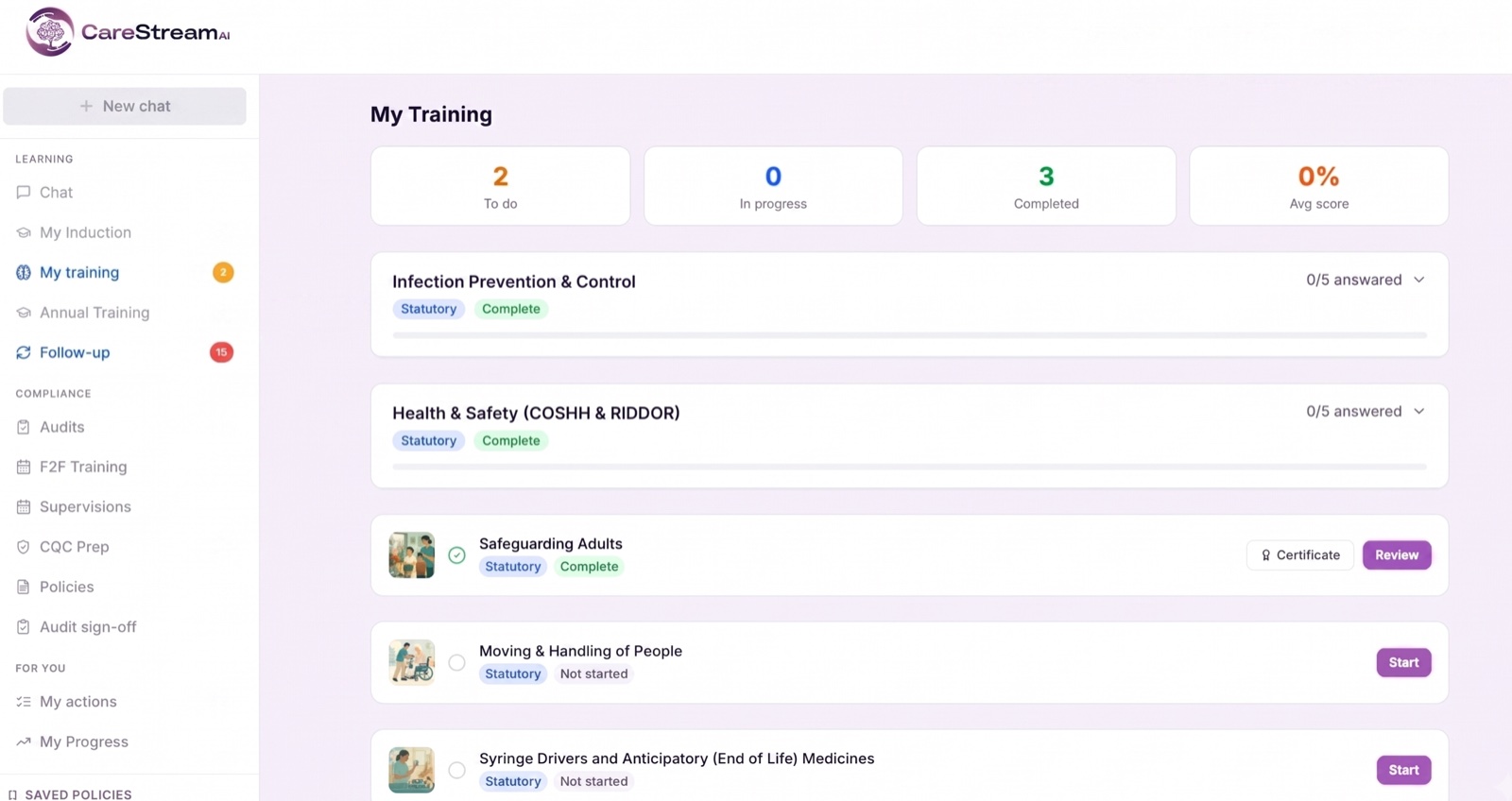
Is the care certificate mandatory for your starters? Not in law, but most services still want the learning half done well. Our free CPD certified Care Certificate course runs for about 90 minutes and is included in the free plan.
- Every member of staff gets a certificate when they pass the assessment.
- A training matrix gives the manager a view of finished and outstanding learners.
- Access does not expire.
- Your assessor still observes practice and signs off. CareStream does not award the Care Certificate, and the free plan has no card.
A rule you can put in the induction file
Write three short lines. Who must complete the standards, who gets a chosen part, and who signs off. Then test each new starter against them on day one. CareStream holds the course, the certificate and the matrix in one place, so the file stays easy to check.
That is the whole of the law in practice. Train and support the person, assess them before they work unseen, and keep the record. The Care Certificate is the framework most services pick to do it. The related list of mandatory training for care staff shows the rest of the induction picture.
Sources
- NHS England, Skills for Care and Skills for Health: Care Certificate standards questions and answers · skillsforcare.org.uk
- legislation.gov.uk: Regulation 18 (Staffing), Health and Social Care Act 2008 (Regulated Activities) Regulations 2014 · legislation.gov.uk
- Care Quality Commission: Regulation 18 Staffing guidance for providers · cqc.org.uk
- NHS Employers: Care Certificate · nhsemployers.org
Frequently asked