Twelve weeks at three shifts a week is 36 shifts. The CareStream course takes 90 minutes, which is a fraction of one of them.
So how long does the care certificate take? On paper, twelve weeks. People search for the care certificate 12 weeks rule for good reason. In practice, a few hours of learning and a long run of watching someone work you can complete the care certificate once the practical element is signed off.
The plan on one screen
Here is a suggested plan for a starter who works three shifts a week. The twelve-week limit is the official part. The split inside it is our suggestion, so adapt it to your rota.
- Day one: write the start date and the twelve week point in the staff record. Name the assessor.
- Weeks 1 and 2: the starter does the 90 minute course and shadows a colleague.
- Weeks 3 to 8: the assessor watches real work and records what they see, standard by standard.
- Weeks 9 to 11: catch up on anything not yet seen, and repeat any observation that was not clear.
- Week 12: the manager checks all 16 standards are signed and records the outcome.
Notice how little of that is learning. Most of it is observation, which is why the clock runs so long.
The CPD certified Care Certificate and the annual courses are free on every plan. No card needed, and every staff login is included.
Create a free accountWhat does the 12 week limit actually say?
The NHS Employers Care Certificate page says individuals must complete the Care Certificate within 12 weeks of starting the process, meeting each of the 16 standards. That is the whole rule as it is published.
Three points follow from it. The limit is a ceiling and not a target. It covers all 16 standards, not a sample. And it starts when the person starts, not when they get round to it.
The page does not say what happens if a starter misses it. We would not invent a rule, so say plainly in your own induction policy how you handle a late finish.
Many managers ask how long to complete the care certificate in a way that suits the rota. Treat the care certificate time limit as a small project with a start, a middle and an end. The plan above does that.
How long is the course itself?
Short. Our Care Certificate course runs for 90 minutes and asks 32 questions, two for each of the 16 standards. A learner who is not sure of a question gets three attempts, then goes back over the material.
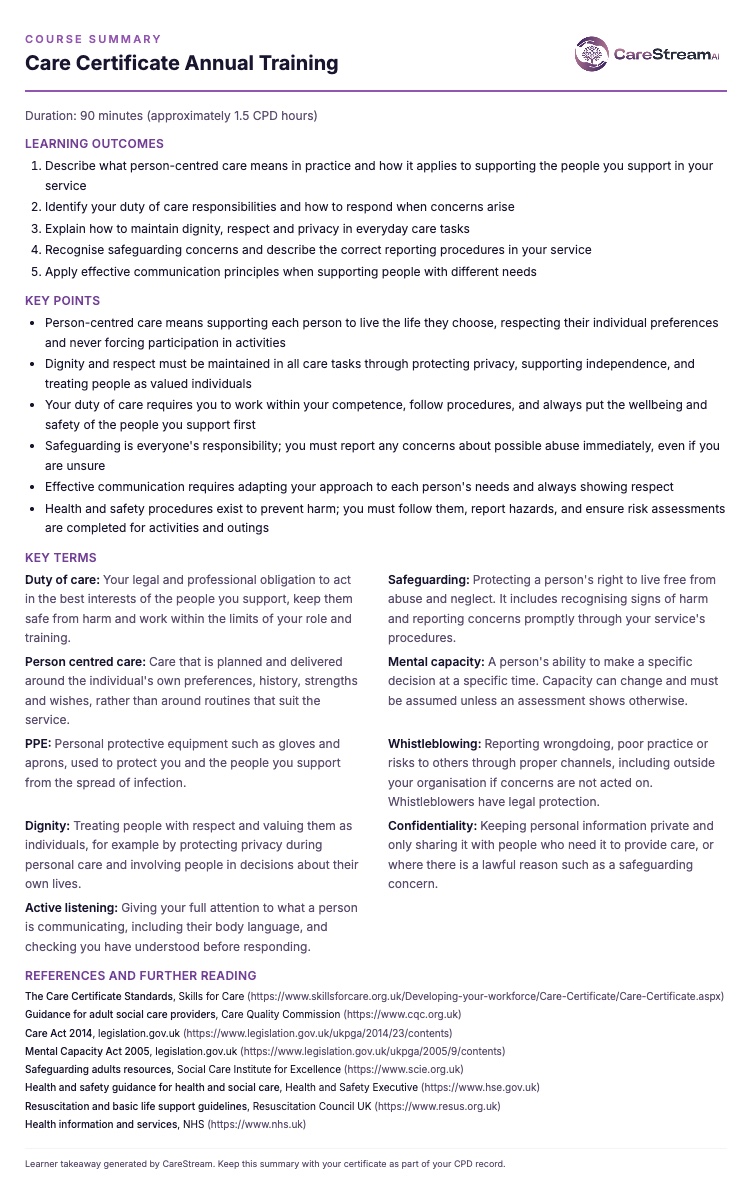
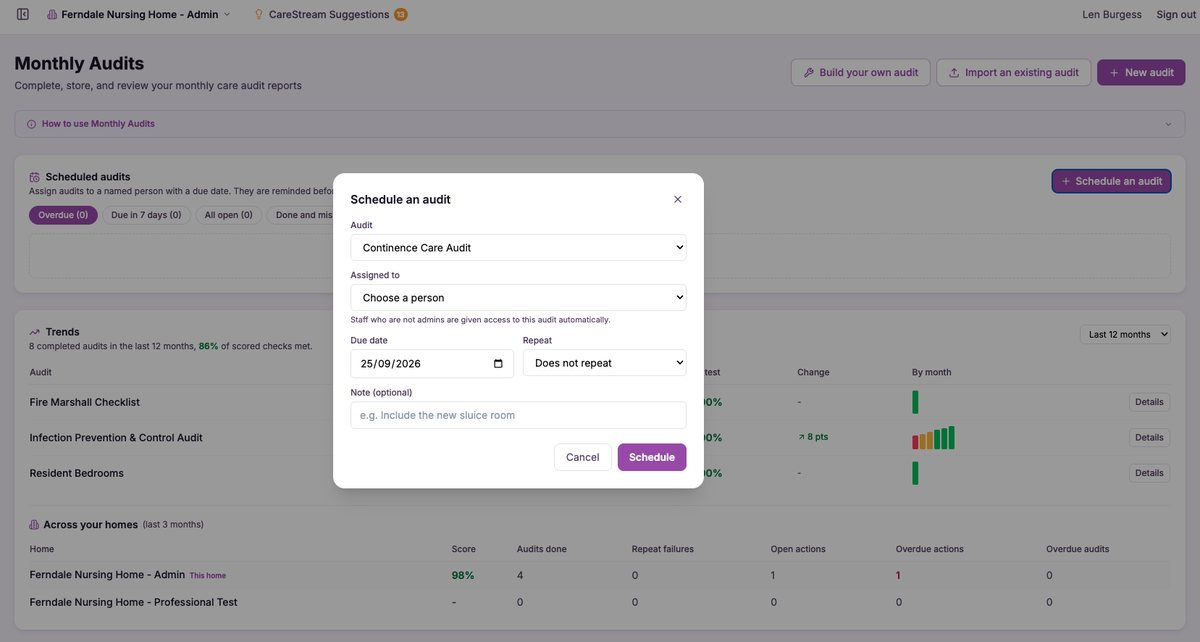
Figure: the course summary states the running time before anyone starts.
Ninety minutes is knowledge only. A learner can split it across two or three short sittings, so it fits around a shift.
Why observation takes the time
Skills for Care says workers need to be assessed on what they know and what they do. The second half cannot be rushed, because it depends on what happens on shift.
Some standards are easy to see. Hand hygiene appears on every shift. Others turn up only when the situation does. A starter may go weeks without a safeguarding concern to act on, and you cannot arrange one.
Part of the Care Certificate observation is simply waiting for real work to give the assessor something to watch. Plan for that gap from the start.
Jo finishes the course by the end of her second week and feels ready. Her assessor has seen consent, privacy and hand hygiene. Nobody has yet seen her handle a complaint or report a data breach.
That leaves those standards to find in the weeks left. The assessor writes them on a list and watches for them.
Who does the assessing?
The care certificate assessor is the person who watches the starter work and decides what they have seen. Skills for Care says anyone assessing must have a thorough understanding of, and direct experience in, what they are assessing.
In a small service that is often the manager or a senior carer. Pick the person early. The assessor's own rota sets the pace, and a manager who is also covering the floor has little spare time to watch anyone else.
Do not hand it to someone who works different shifts from the starter. They will not see the work.
What slows a starter down?
Four things stretch the twelve weeks more than the course ever does.
Free courses, an 80% pass mark assessment, certificates and a training matrix. Create a free account and start with the Care Certificate.
Create a free account- Few shifts: someone on two shifts a week gives the assessor fewer chances.
- Different rotas: the starter and the assessor never work together.
- Late start: the learning begins in week four, not week one.
- Missing records: a standard was seen but nobody wrote it down.
Each one can be fixed in the first week, by choosing the assessor and the shifts together before the starter has met a single resident. None of them needs more hours of e-learning. Care certificate sign off cannot happen on time if the observations never get booked.
How should part time and bank staff plan?
The wording from NHS Employers offers one limit for everyone. Fewer shifts means fewer chances to be observed in the same twelve weeks.
For care certificate new starters on few hours, book observation visits in week one. Ask the assessor to cover the shifts when the harder standards, such as moving people safely, are likely to come up.
If you still use a care certificate workbook, time how long it takes to fill in. A workbook that eats a week of a starter's time is a poor use of the twelve.
What counts as sign off?
Care certificate assessment ends in sign off, which is a decision by the employer that each standard has been seen and met. A certificate from an online course does not make that decision for you.
CareStream does not award the Care Certificate. Our course holds back the certificate until a manager has ticked the practical observation, so the record shows both halves.
For each standard, we suggest you keep four things:
- the standard
- what the assessor saw
- the date of the observation
- the assessor's signature
Benefits of CareStream for how long the care certificate takes
So, how long does the care certificate take with the free course? The 90 minute free Care Certificate course takes the knowledge learning out of the twelve weeks, so the time left goes on observation. It is CPD certified and free to every member of staff on the free plan.
- The course covers all 16 standards.
- The certificate waits for the practical sign off.
- The training matrix lists which starters have done the learning.
How do you keep the record straight?
An inspector will not ask how fast you were. They will ask whether the file shows what was learned, what was seen and who decided.
Keep the learning record and the observation record side by side. A starter's certificate from the course, plus a signed list of observed standards, tells the whole story in one place.
If a standard was seen late, write the real date. A late and honest entry beats a tidy and wrong one.
Your next step
Look at your last starter's file. Count the weeks between the course and the final signature. That number tells you where your time goes, and it is rarely the course.
Then fix the first day: a start date, a twelve week point and a named assessor. Our complete guide to Care Certificate training covers the rest of induction, including the Care Certificate induction pack.
Regulation 18 (the duty to give staff appropriate training and support) sits behind all this. Read Regulation 18 on staffing in full and check your plan against it.
Sources
- NHS Employers: Care Certificate · nhsemployers.org
- Skills for Care: Care Certificate standards · skillsforcare.org.uk
- legislation.gov.uk: Regulation 18 (Staffing), Health and Social Care Act 2008 (Regulated Activities) Regulations 2014 · legislation.gov.uk
Frequently asked