Who leads infection prevention and control here, and where is that written down? An inspector can ask it on the day. A weak answer is a name offered from memory and a search through folders. A good infection prevention and control policy answers it on one page.
This is our reading of the rules, not an official Care Quality Commission list.
Typing infection prevention and control policy care home into a search engine brings up plenty of documents. Few say who does what. Here are eight questions, hardest first, each with the evidence that answers it: a policy section, a record, an audit or a training log.
Who leads on infection control, and who covers their leave?
The answer must exist on paper and in people's heads. The Code expects a lead who is accountable directly to the registered provider. Appendix A says someone with appropriate knowledge and skills becomes the designated lead.
Government guidance for adult social care managers adds that the lead is responsible for practice. That includes cleanliness. We call it the managers' guidance below.
The lead does not carry the legal duty alone. Under Regulation 12, the duty sits with the registered person. That means the service provider or the registered manager.
In our view the lead does the daily work, from keeping the policy current to running audits, advising colleagues and reporting upwards.
Evidence: a roles section naming the lead and a deputy, one line on cover during leave, and a record of the lead's own training.
Which infection control legislation applies to a care home?
Regulation 12(2)(h) sits under safe care and treatment. It lists "assessing the risk of, and preventing, detecting and controlling the spread of, infections, including those that are health care associated". The exact wording is in the full text of Regulation 12 on safe care and treatment.
The Code sits behind it. It is the Health and Social Care Act 2008 code of practice on the prevention and control of infections. Many managers call it the code of practice on infection prevention and control.
Providers do not by law have to comply with the Code. The regulations say they must have regard to it. In our view an inspector will expect your policy to reflect it. You may meet the regulation another way only if that way is equivalent or better.
Have your policies read against the regulations to see what is missing or out of date. No card needed.
Create a free accountAppendix A gives examples for adult social care, and is blunter: "Providers must have IPC policies in place."
Evidence: the policy, with a scope section naming the services and people it covers. We suggest agency staff and visitors are named too.
Does your infection control policy for care homes answer each of the ten criteria?
The Code sets out ten criteria. Our summary follows, so check the full text of the Code, including Appendix A for adult social care before relying on it.
- Systems to manage and monitor the prevention and control of infection, using risk assessments.
- A clean and appropriate environment that helps prevent and control infection.
- Appropriate antimicrobial use and stewardship.
- Suitable, accurate and timely information on infections for people using the service, their visitors and anyone else involved in their care.
- A policy to identify people who have or are at risk of an infection promptly, so they receive the right care and others are protected.
- Systems so every care worker, including contractors and volunteers, knows and discharges their responsibilities.
- The provision, or the ability to secure, adequate isolation facilities.
- The ability to secure adequate access to laboratory support as appropriate.
- Policies, followed in practice, that help prevent and control infections.
- A system to manage staff health and wellbeing, and the organisation's duty to manage infection risk.
Criterion seven asks for isolation facilities, which need not mean a spare room. Appendix A says care homes do not need dedicated isolation facilities. The policy should still explain how a person with an infection is cared for and how contact with others is limited.
Evidence: a single page mapping each criterion to the policy section that answers it. It is also the fastest way to find your own holes.

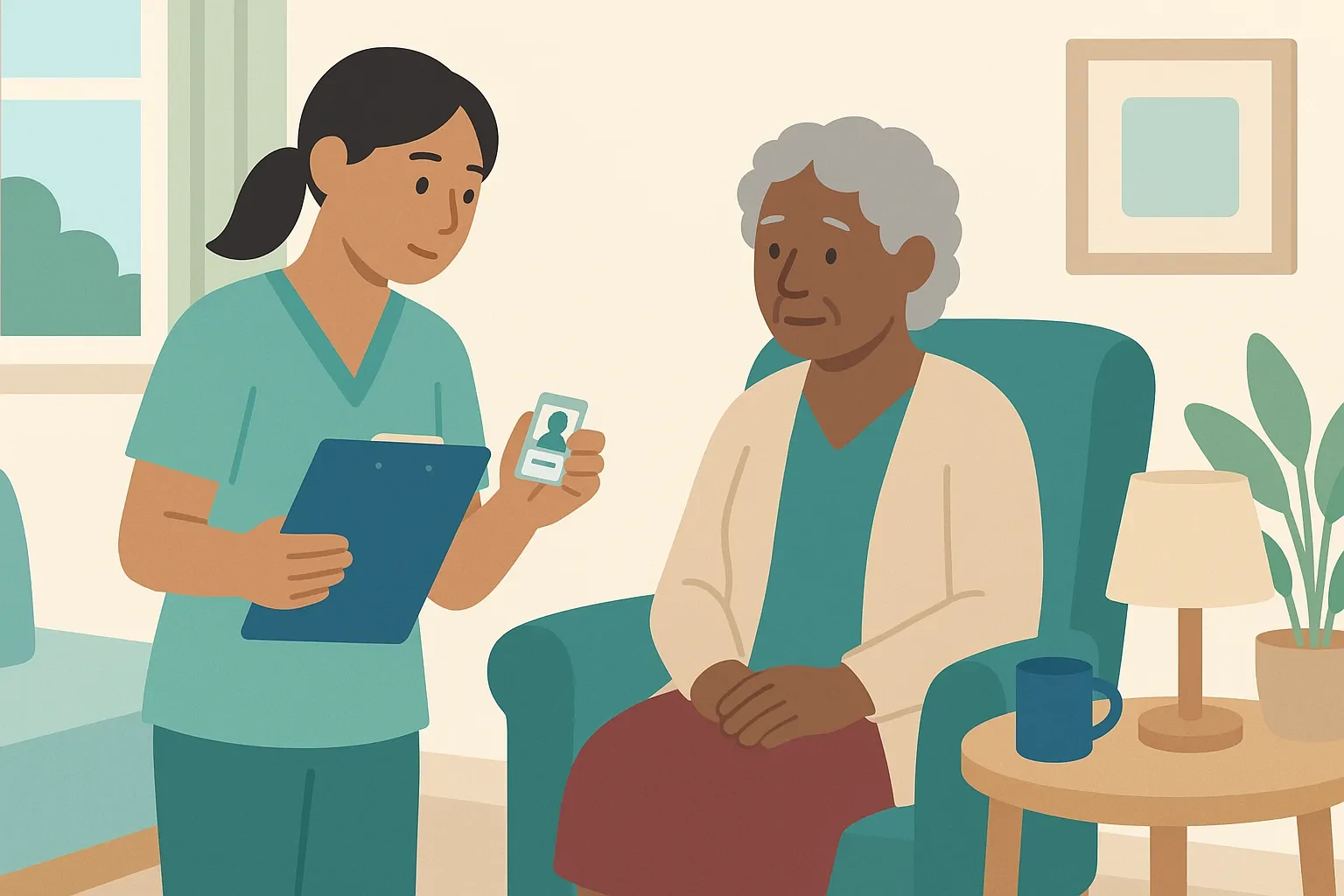
Figure: the Code applies where care is given, in a resident's own room as much as in a clinic.
Which infection control policies and procedures does a care worker follow on an ordinary shift?
"Staff must wash hands" gives an inspector nothing to test. A policy that survives questioning says who does what and how often. We suggest headings taken from the criteria above:
- Purpose, scope and the people it applies to.
- Roles: provider, registered manager, lead, senior staff, every care worker.
- Standard precautions: hand hygiene, personal protective equipment, sharps, spillages, waste, respiratory and cough hygiene.
- Cleaning and the environment: schedules, shared equipment, laundry, the kitchen.
- Staff health: sickness and return to work, vaccination offers, exposure to blood or body fluids.
A hand hygiene policy can be its own document or a section of the main policy. Either way it says when hands are cleaned, with what, and how that is checked. The managers' guidance lists hand hygiene as an area to audit.
Evidence: cleaning schedules signed daily, personal protective equipment stock checks, and a care worker who can describe the routine without reading it.

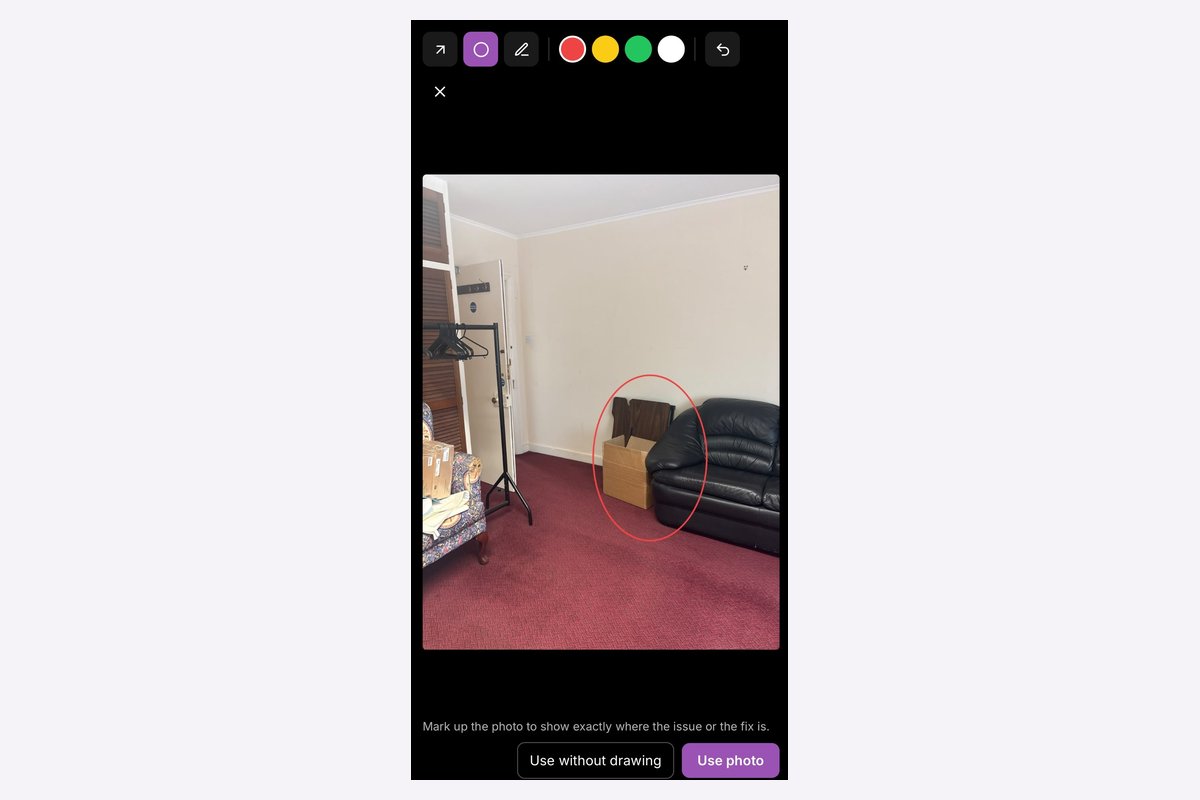
Figure: care and cleaning happen side by side, so the policy has to cover both.
What happens when two residents are unwell by breakfast?
This is the outbreak question. The policy says who is told, who decides whether to close an area, how visiting changes and how the event is logged and reviewed.
It also says how a person with a suspected infection is identified, cared for and kept apart from others. Families need information too, because criterion four asks for it.
NHS England publishes the National Infection Prevention and Control Manual for England. Its page says NHS settings, or settings delivering NHS services, should adopt it as mandatory guidance. All care settings should apply its principles.
We suggest the policy names the version you rely on, so you know when to look for changes. It should also list who to call for outbreak advice.
Evidence: a written outbreak plan, a log from the last outbreak or practice run, and a note of when families were told. The log shows what was decided and why.
The free policy check shows where a policy falls short of the regulations. Create a free account to begin.
Create a free accountHow do you know staff follow it?
An audit. The Code says there should be evidence of a rolling programme of audit and a stated date for revision.
The managers' guidance names four areas to audit. They are hand hygiene, a clean environment and clean care equipment, correct use of protective equipment and outbreak readiness. Auditors should be trained.
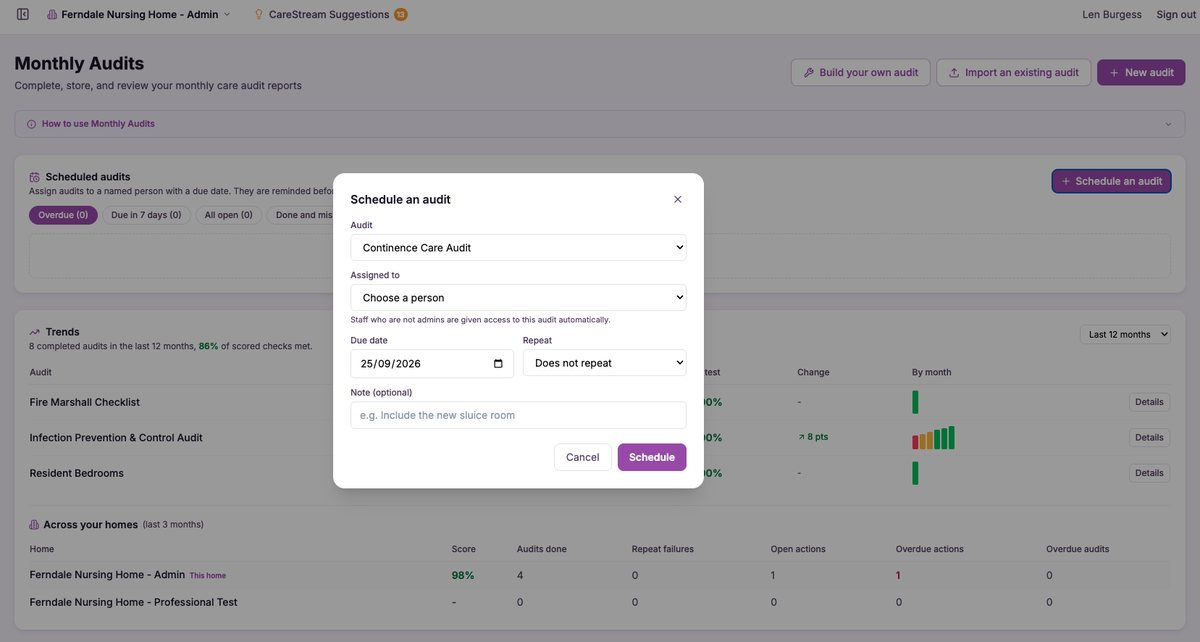
The infection control audit is one of the free audit templates on CareStream. It scores each section and takes a drawn signature. When manager approval is switched on, the finished audit goes to the care manager to review and sign off. Actions are assigned to named staff with due dates.
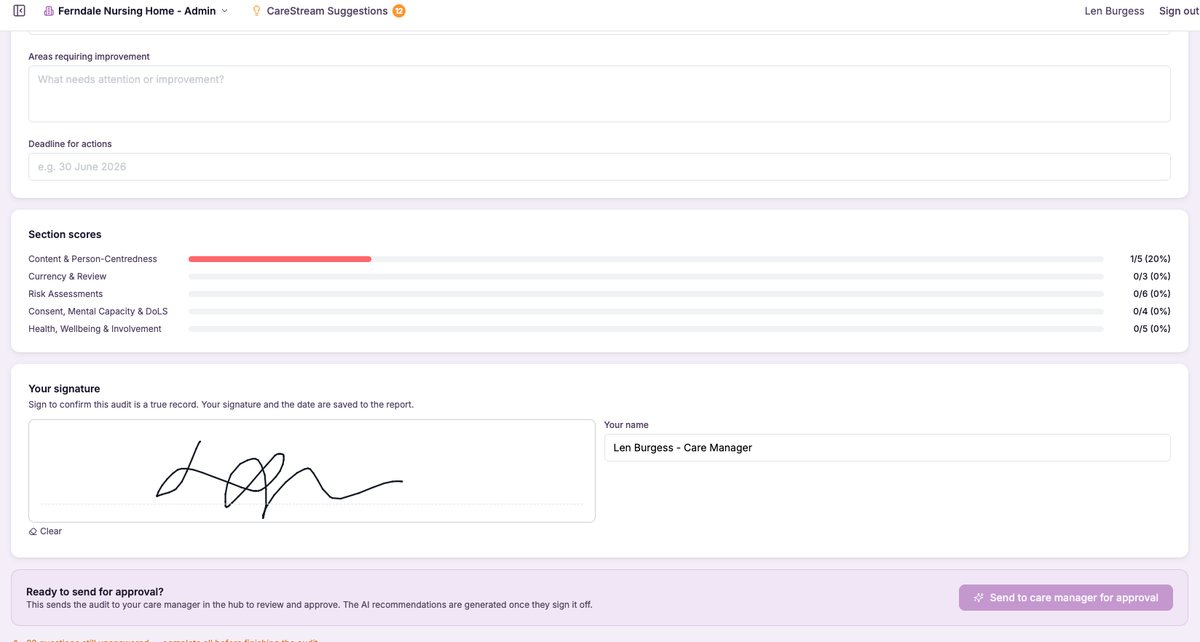
Figure: the sign off step on a care plan audit, where section scores and a signature turn a checklist into a record.
Evidence: the last three completed audits, the actions raised, who closed them and when.
Can you show who is trained?
The Code expects every member of staff to get enough infection control training and supervision for their role. The managers' guidance says training should happen at induction. It should be refreshed to match local policy, national guidance and learning needs.
The CareStream Infection Prevention and Control course is free for every member of staff on the free plan. It takes about 60 minutes. It ends with a 32 question assessment, an 80 percent pass mark and a named, dated certificate.
The course is designed to be repeated yearly, and it is CPD certified by The CPD Certification Service. Our guide to infection control training for care staff shows how to use it.
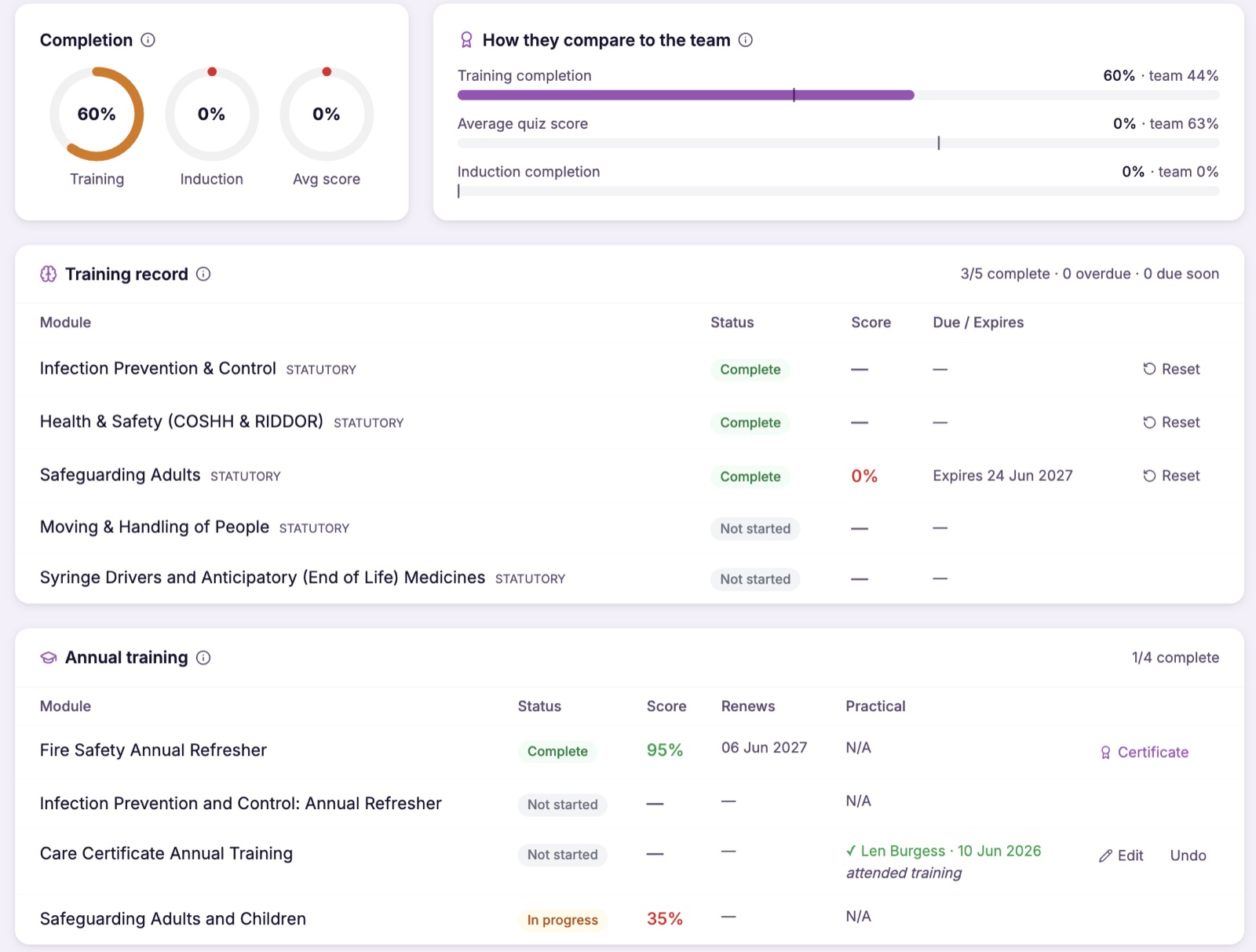
Each member of staff has a record, and a gap shows against their name.
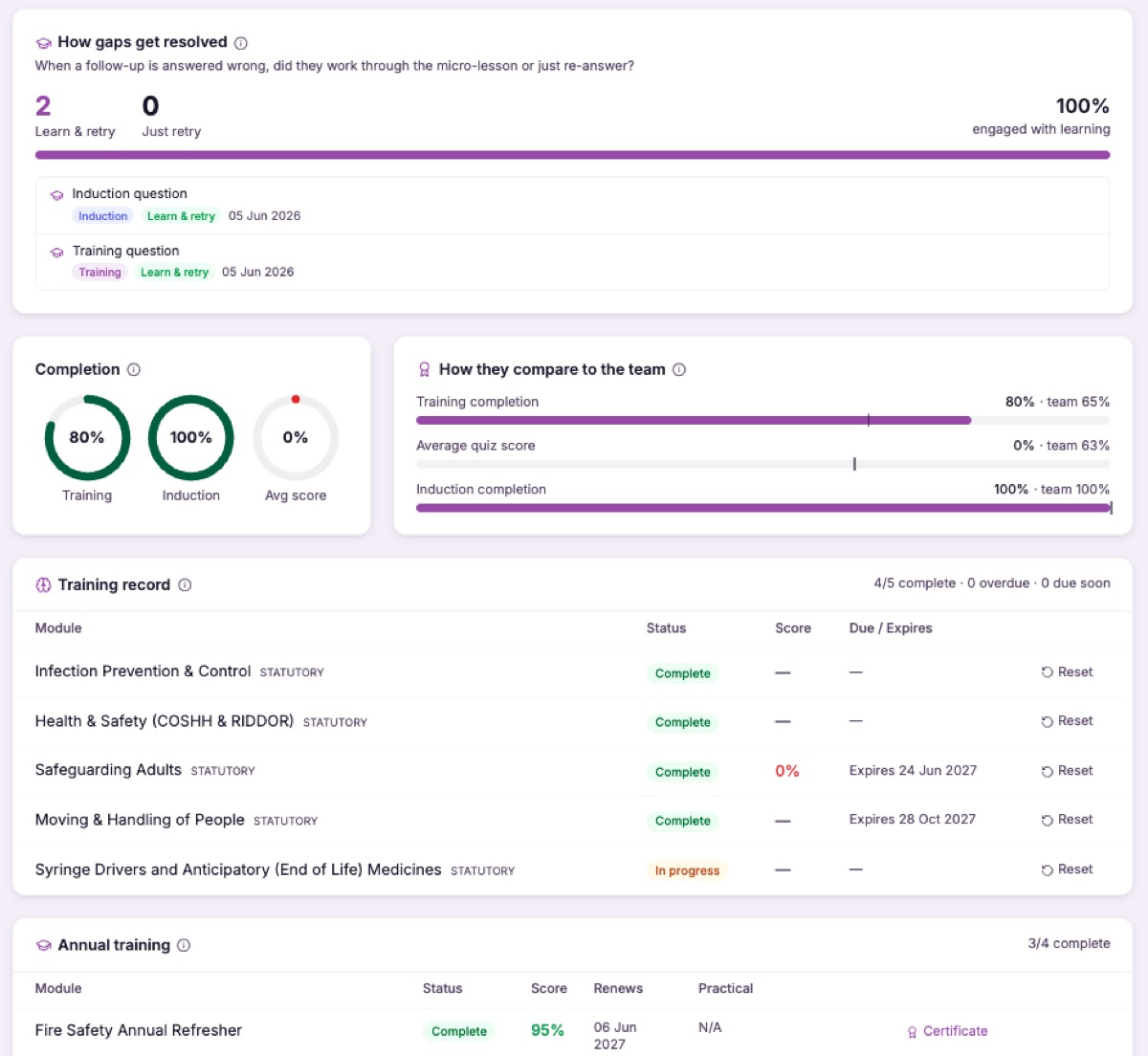
Figure: an example record, with each statutory module, its status and when it expires.
Evidence: the training matrix and the certificates behind it.
Neither training nor an audit promises an outcome. They show the policy is lived and not only written.
When did you last review the policy, and what changed?
The managers' guidance says infection prevention and control policies should be regularly reviewed and monitored. It gives no fixed interval.
In our view yearly is sensible, and straight after an outbreak, a serious audit finding or a change in national guidance. That is our suggestion, not a rule.
Record each review and how staff heard about it. Our post on how often care policies should be reviewed sets out the reasoning.
Evidence: a version block with the reviewer, the date and a one line summary of the change.
Benefits of CareStream's free policy check and infection control audit for this inspection
Running the eight questions on yourself shows where an infection prevention and control policy is thin. CareStream helps with the evidence behind each answer:
- The free policy gap check reads your policy against the regulations and the Code, so the lead, outbreak and review sections are tested before an inspector asks.
- The free infection control audit scores each section, and each action goes to a named person with a due date.
- The free Infection Prevention and Control course gives each member of staff a dated certificate, so the training question has a record behind it.
Start with the free policy gap check for care home policies. It needs no card.
Next steps: run the inspection on yourself first
Take your policy and put the questions in order:
- Is the lead named, with a deputy?
- Does each criterion have a home?
- Is the outbreak plan written down?
- Has an audit been completed this quarter?
- Is the review recorded?
Can you use an infection control policy template? Yes, as a starting point, if you then add your lead's name, your cover arrangements and your own outbreak plan. A template written for no one in particular rarely answers the first question in this post.
For a second pair of eyes, try the free policy gap check from CareStream reads your first 5 policies against the regulations, with no card. It reports coverage, old wording and clashes between documents.
Where it finds a gap, a written infection prevention and control policy costs £69. It is built from your answers, read by a person and delivered within two working days. It adds to your evidence, and it cannot stand in for it.
Sources
- Regulation 12, Safe care and treatment (legislation.gov.uk) · legislation.gov.uk
- The Health and Social Care Act 2008 Code of practice on the prevention and control of infections and related guidance (GOV.UK) · gov.uk
- Code of practice, full text including Appendix A for adult social care (GOV.UK) · gov.uk
- Infection prevention and control in adult social care, additional information for managers (GOV.UK) · gov.uk
- Regulation 2, Interpretation (legislation.gov.uk) · legislation.gov.uk
- National Infection Prevention and Control Manual for England (NHS England) · england.nhs.uk
Frequently asked