Policy collection
Medicines Policies for CQC-Registered Care Services
Medicines policies set out how your service orders, stores, gives, records and disposes of medicines, and who is accountable at every step. Our medicines policies are written for your registered service, with your company name, your Care Quality Commission (CQC) provider and location IDs, your registered manager and your named medicines lead merged into the text rather than left as blanks. Each policy answers Regulation 12 of the Health and Social Care Act 2008 (Regulated Activities) Regulations 2014, which requires the proper and safe management of medicines, and follows the National Institute for Health and Care Excellence (NICE) guidance for your type of service. Whether you run a residential care home, a nursing home, a domiciliary care agency or a supported living service, the document describes how medicines actually move through your service. A member of the CareStream team reads every policy before it is sent, and it reaches you within two working days, print-ready on your own letterhead with a sign-off block. Single policies are priced from £39 to £79, with no subscription and no contract.

Ordering, storage, administration, recording and disposal of medicines, including errors and self-administration.
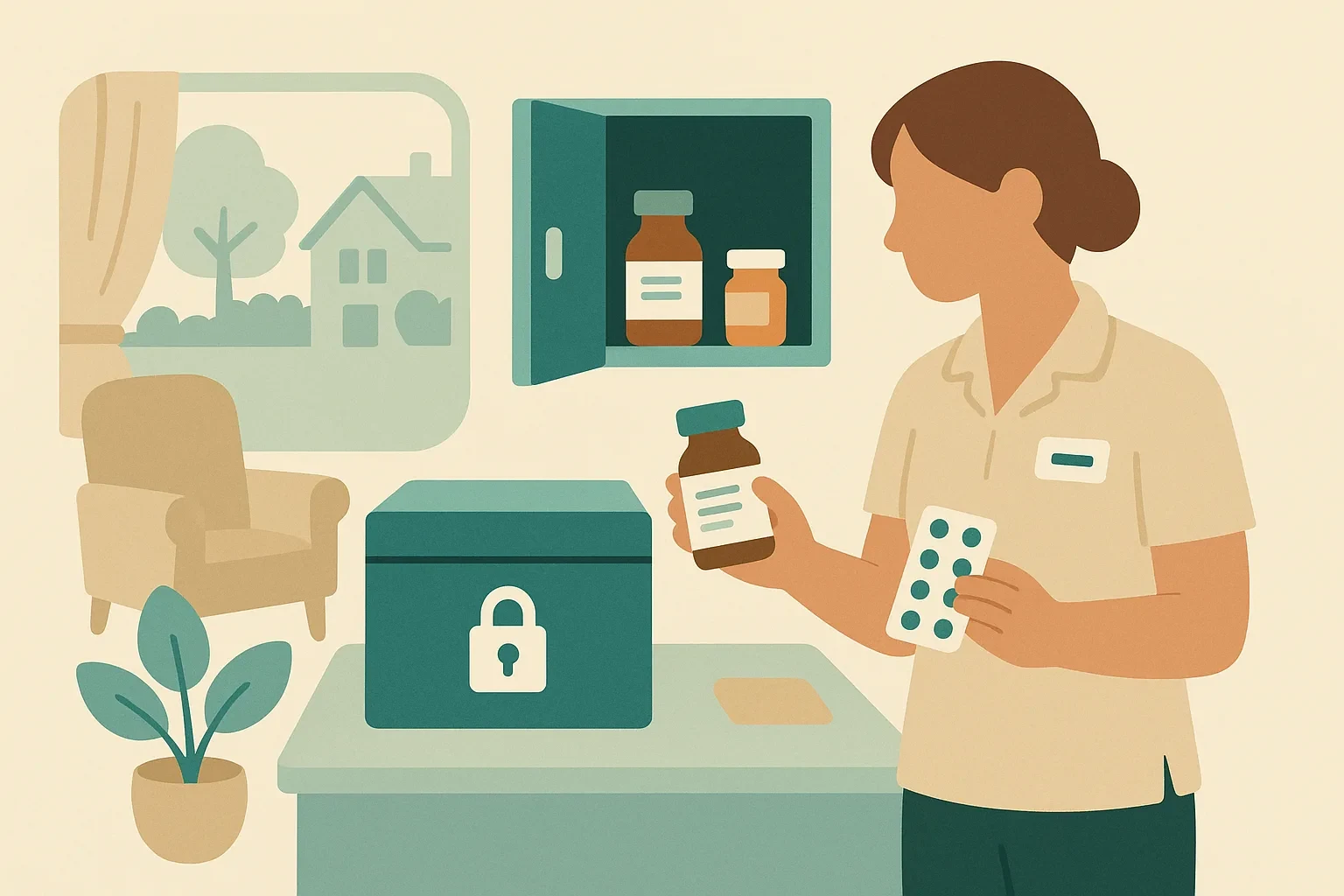
Receipt, storage, administration, recording and destruction of controlled drugs.

Seeking, recording and reviewing consent, including where capacity fluctuates.

How clinical quality is led, measured, audited and improved.

The Regulation 12 umbrella: risk assessment, safe premises, medicines and infection prevention brought together.

Person-centred assessment, planning, review and involvement under Regulations 9 and 12.
Hand Your Inspector a Medicines Policy That Names Your Service and Your Leads
What a medicines policy is and what ours contains
A medicines policy is the written procedure your staff follow whenever they handle medicines on behalf of the people you support. It covers ordering and repeat prescriptions, checking medicines in, storage and temperature monitoring, administration, and recording on the medication administration record (MAR). It also sets out how staff give "as required" medicines, often called PRN medicines, using individual protocols, how homely remedies are agreed with a GP or pharmacist, and how a person is assessed to manage their own medicines safely. Further sections deal with covert administration, time-sensitive medicines such as those for Parkinson's disease, medicines errors and near misses, returns and disposal, and staff training and competency. Services that hold controlled drugs usually keep a separate controlled drugs policy covering storage, register entries and witnessed destruction alongside this one, and we write the two so that they agree with each other.
The regulations and guidance each policy answers to
Regulation 12(2)(g) requires every registered provider to manage medicines properly and safely, and Regulation 17 requires the records and audits that show you do. For residential and nursing settings, the NICE guideline Managing medicines in care homes (SC1) recommends that every provider has a medicines policy and lists what it should cover. For domiciliary care and supported living, NICE guideline NG67, Managing medicines for adults receiving social care in the community, does the same. Controlled drugs sections reflect the Misuse of Drugs Act 1971, the Misuse of Drugs Regulations 2001 and the Misuse of Drugs (Safe Custody) Regulations 1973, and covert administration follows the Mental Capacity Act 2005. Under the Single Assessment Framework, medicines optimisation sits within the Safe key question. No policy can promise a rating, but a clear, current document gives an inspector firm ground to start from.
How each policy is personalised to your care setting
A medicines policy written for a nursing home reads very differently from one written for a home care agency, and an inspector notices when a document describes the wrong service. In a nursing home, registered nurses administer, clinical rooms hold stock, and syringe drivers may be in use. In a residential care home, care staff administer after competency assessment, and the relationship with the supplying pharmacy carries more weight. In domiciliary care, the policy has to define the levels of support your staff give, whether prompting, assisting or administering, and who is responsible for the medicines a person keeps in their own home. Supported living and hospices bring their own questions about tenancy rights and anticipatory medicines. We ask which regulated activities you carry out and write only what applies to you.
What an inspector looks for in your medicines documentation
When an inspector reviews how a service handles medicines, the policy is usually the first document they request and the one everything else is measured against. They check that it names your service and the people accountable, that it reflects current guidance rather than guidance withdrawn years ago, and that what it says matches what staff actually do on the medicines round. They will compare it with your MAR charts, your PRN protocols and your audit records, and they may ask a member of staff to explain the process for a refused dose or a missed one. A policy that still says insert name here, or that describes a clinical room your service does not have, invites closer scrutiny. Ours are written so that the document, the records and the staff all tell the same story.
Buy a Medicines Policy Written for Your Service
Who these policies are perfect for
These documents are written for registered managers, owners and nominated individuals of smaller CQC-registered services, typically running one or two locations without a compliance department or in-house HR. Most people who order medicines policies from this collection are responding to a specific moment. An inspection may have been booked, or a report may have named medicines as an area for improvement. You may be preparing a registration application or adding a regulated activity such as nursing care. A local authority or integrated care board (ICB) contract may be asking for evidence, or a medicines error may have shown that the current procedure was thin. Often a new manager has inherited a folder nobody has opened in three years. You know your service and your regulations well. What we save you is the time it takes to write the document properly.
Why our policies stand up better than templates and packs
Free templates leave blanks for your name and your leads, and a template written for every type of service rarely describes yours accurately. Large policy packs can cost hundreds of pounds when you needed one document, and many come with an annual subscription you did not ask for. Consultants may charge a day rate to adapt a file you could have read yourself. CareStream takes a different approach. Each policy is written for the setting you tell us about, checked against the regulations and NICE guidance that apply to it, and hand-checked by a person before it is sent. We cross-reference it with the policies it sits beside, so your medicines, consent and controlled drugs documents do not contradict each other. The language is plain enough for a care worker on a night shift to follow.
Price, delivery and what you receive
A single medicines policy costs between £39 and £79, depending on the document and your setting. If you need several related policies, a themed pack starts at £295, and the twenty statutory documents most services are asked for come to £495. Every price is shown before you order, with no quote needed and nobody to call. Once you place your order, we write the policy, a person reads it through, and it reaches you within two working days. It arrives print-ready on your letterhead, with your service details merged in, a version number, a review date and a sign-off block for your registered manager. The policy sets out what staff must do, and our medication administration training and competency courses for care staff give you evidence that they have understood it.
Keeping your policy current after you buy it
Most services review their medicines policy at least once a year, and sooner after a medicines error, a change of pharmacy supplier, a new regulated activity or a change in national guidance. Because there is no subscription, nothing renews automatically and nothing is charged unless you order again. If your circumstances change and you want the policy rewritten, you order an updated version at the listed price, and we write it with your new details in place. Services that want a wider view of their documents can use the CareStream platform to check an existing policy set for gaps against the regulations, which shows where a medicines procedure is missing or out of date before an inspector finds it. The single policy and the platform work independently, so you can use either one.
Medicines Policies for CQC-Registered Care Services FAQs
What is a medication policy in a care service?
It is the written procedure that tells staff how to order, receive, store, give, record and dispose of medicines for the people your service supports. It names who is accountable, sets out what staff may and may not do, and explains what happens when something goes wrong. NICE recommends that every provider handling medicines has one, and it is usually among the first documents an inspector asks to see.
What are the 7 rights of medication administration?
The seven rights most often taught in care are the right person, the right medicine, the right dose, the right time, the right route, the right to refuse and the right documentation. They are a training aid rather than a legal requirement, but a good medicines policy builds each one into the administration procedure so that staff check them every time.
What are the 5 rights and the 10 rights of medication administration?
The five rights are the original core checks: person, medicine, dose, time and route. Longer lists of eight or ten add checks such as the reason for the medicine, the person's right to refuse, accurate recording and reviewing the effect afterwards. The numbers vary between training providers. What matters is that your policy spells out the checks your staff actually make.
What are high-risk medicines in a care setting?
High-risk medicines are those where an error is more likely to cause serious harm. In care settings, these commonly include anticoagulants such as warfarin, insulin, opioids, methotrexate, lithium and some anti-epileptic medicines. A medicines policy should explain the extra checks, monitoring and communication with prescribers that these medicines need.
What medicines issues do inspectors and pharmacists treat as red flags?
Common concerns include gaps or unexplained codes on MAR charts, PRN medicines given without a protocol, handwritten MAR entries that nobody has checked, medicines stored above the recommended temperature, controlled drugs balances that do not reconcile, and covert administration without a documented best interests decision. Your policy should set out how staff prevent and report each of these.
Browse the rest of the library
Most services need more than one. These are the collections people buy alongside this one.
Policies are one part of it.
CareStream is the compliance system underneath: your policies, your staff training, your audits and your evidence, kept current and ready for the day somebody asks to see them.
- Policies written and kept updated for you
- Staff training that records itself against the standard
- Gap analysis showing what you are missing before an inspector does
- Everything in one place, for one price