Get a new starter safe, trained and signed off in their first week
Staff onboarding is the moment a service is most exposed. New people are on the floor before the paperwork catches up, and the evidence that they were ready is scattered across a folder, an inbox and somebody's memory.
14 day free trial · Set up in a day · UK data residency
An inspector will ask how you knew they were ready
Not whether you inducted them. How you can show it, for this person, on this date.
Nothing quietly gets missed
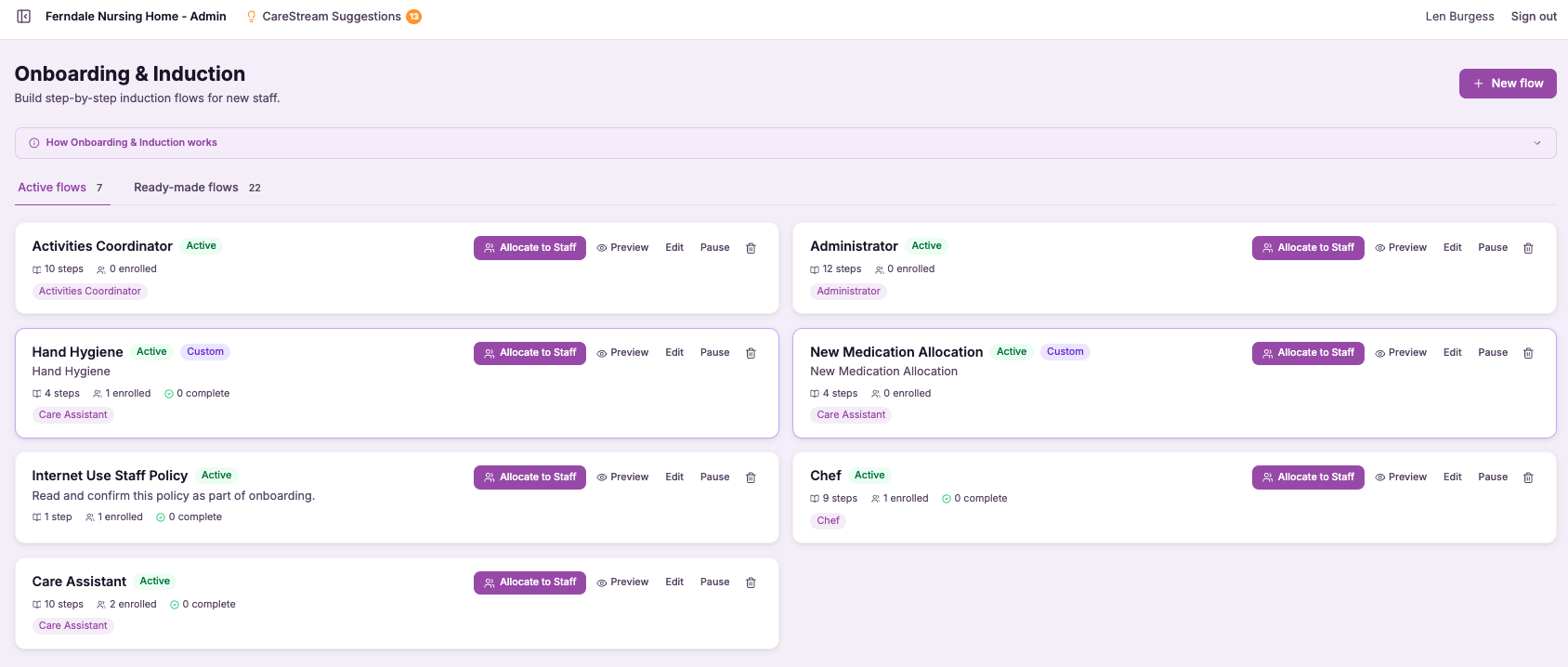
The role decides the pack. A nurse, a care assistant and a kitchen assistant each get what applies to them, assigned on their start date.
They can actually read it
A new starter whose first language is not English reads every policy in their own, on their own phone, without asking anyone for help.
Evidence assembles itself
Every read, score and observation lands in the matrix as it happens. Nobody reconstructs the first week six months later.
What CareStream actually does here
The first day pack builds itself
- Policies assigned by role, not a blanket send to everyone
- Read receipts against the exact version live that day
- On their own phone, no work email needed
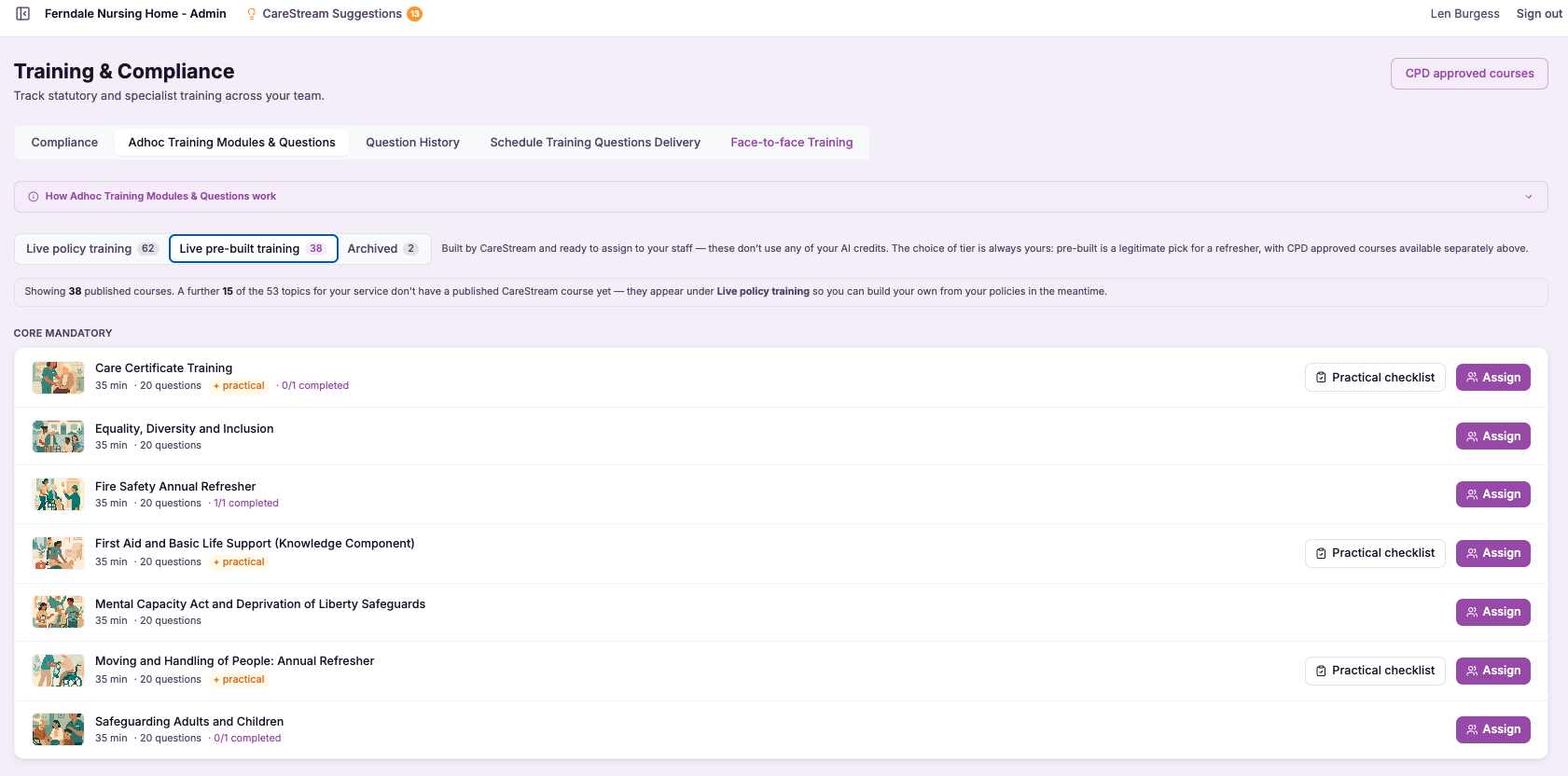
Training built from your own policies
- Adhoc modules generated from the policy they have just read
- CPD accredited annual courses for the statutory subjects
- Face to face sessions recorded on the same record as the online ones
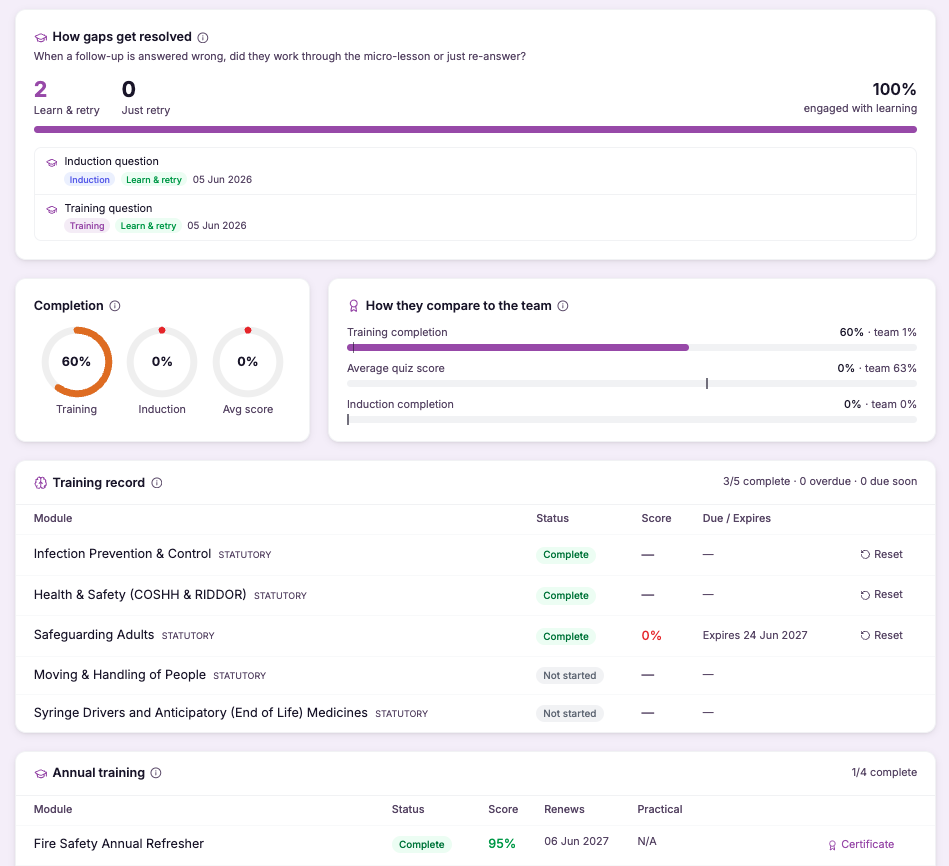
Sign off you can put in front of an inspector
- The training matrix shows the whole team and the gaps, live
- Competency observations sit alongside the completions
- CQC prep questions matched to the role, so they are ready to be asked
Staff Onboarding, answered
Getting started
How long does it take to set up a sequence?
An afternoon. Pick a role, tick the policies and modules that apply, set the day each is due, and every new starter in that role gets it automatically.
Do we have to upload our policies first?
Yes, and you can bulk upload the whole set in one go. Most services are through this in a session.
What if we already use a paper induction booklet?
Keep it. Face to face sessions and observed competencies are recorded against the same staff record, so the two do not live apart.
For the new starter
Do they need a work email address?
No. The staff hub works on their own phone and they can sign in without a password.
Which languages are supported?
More than sixty. They pick one and everything arrives in it.
What if they cannot find the answer in a policy?
They can ask in plain language and get an answer drawn from your policies with the source shown.
Evidence
What can we show an inspector?
The policies they were given, the version live at the time, when they read it, what they scored and who observed their competency.
Does it prove understanding or only that they opened it?
Both are recorded separately. A read receipt is a read receipt. Understanding is evidenced by the score and, for practical subjects, an observed competency.
What happens if a policy changes mid induction?
The new version goes to everyone it applies to and the record keeps both.
A complete guide to onboarding a new care worker
Induction is the process a service repeats most and improves least. It is usually built around whoever happens to be on shift, and the record of it is whatever survived in the folder. This guide sets out what has to happen before a new starter works alone, in what order, and what you need to keep.
Four jobs, not one
There are four separate things happening in a new starter's first fortnight, and services get into trouble by treating them as one. Legal: the checks that must be complete before the person works at all. Safety: the small number of things they must know before they are near a resident. Competence: the point at which they can work unsupervised. And belonging, which nobody documents and everybody feels.
Only the first two are urgent. Trying to complete all four in week one produces a heavy induction the new starter half remembers and the manager cannot evidence.
Before their first shift
These belong before someone starts, not during their first week. If any are outstanding, the person should not be on the rota.
- Proof of identity and right to work in the UK
- An enhanced DBS check at the level the role requires
- References covering recent employment, with gaps explained
- Professional registration confirmed where the role requires it
- A signed contract and a job description the person has read
Sign off should be a decision
Sign off is too often the absence of a complaint. Three questions make it a decision. Has every safety critical subject been completed and, where practical, observed? Is there anything the person still does not do unsupervised, and is that written where the team can see it? And would the senior who watched them be comfortable with that person working a night shift?
If the answer to the third is no, the person is not signed off, whatever the paperwork says.
Where CareStream fits
The sequence is held once and assigned by role on the start date, so the pack is the same whoever is on shift that morning. Policies arrive in the new starter's own language on their own phone, and training is generated from the policies you actually use rather than a generic course.
Read receipts, scores and observations land on one record, so producing the evidence for one person takes a moment rather than an afternoon.
General guidance, not legal advice. Regulatory requirements change and vary by service type. Check the current CQC guidance and your own registration conditions before relying on any of the above.
General guidance, not legal advice. Regulatory requirements change and vary by service type. Check the current CQC guidance and your own registration conditions before relying on any of the above.