Gwen, the registered manager, waits in the kitchen doorway with last month's action list in one hand and a tablet in the other. The cook is ladling soup into a hot box and has not been told what she will check first.
That is on purpose: it is how to run a care home kitchen audit that shows an ordinary day.
Start with the old actions
Two items are still open. A freezer seal was cracked, and one week of the cleaning schedule had no signature.
Gwen checks both before she looks at anything new. The seal has been replaced, so she closes that action. The signatures are still missing, so the item goes straight into this month's findings.
The lesson is simple. An audit that never revisits its own actions is a form, not a check. She also chose the hour on purpose, in the build up to lunch. An empty kitchen, freshly cleaned for her visit, would say very little about a normal day.
Look at the room, then the cold store
She begins with what her eyes can tell her: surfaces, sinks, floors, bins and the cleaning sheet.
Then she turns to storage. Can she see a label and a date on every tub? Are raw and cooked foods kept apart? Is anything that could contaminate food sitting near it?
In the cold store she reads the thermometer herself before she opens the record. The display and the sheet agree. Had they differed, that gap would be a finding in its own right.
A care home kitchen audit checklist works best when its order matches the walk. The CareStream Kitchen Audit runs from general cleanliness through storage to the fridge and freezer, so nothing makes her backtrack.
The wording of every question is on the Kitchen Audit template page. We suggest reading it before your own morning and using that kitchen audit template as your starting point.
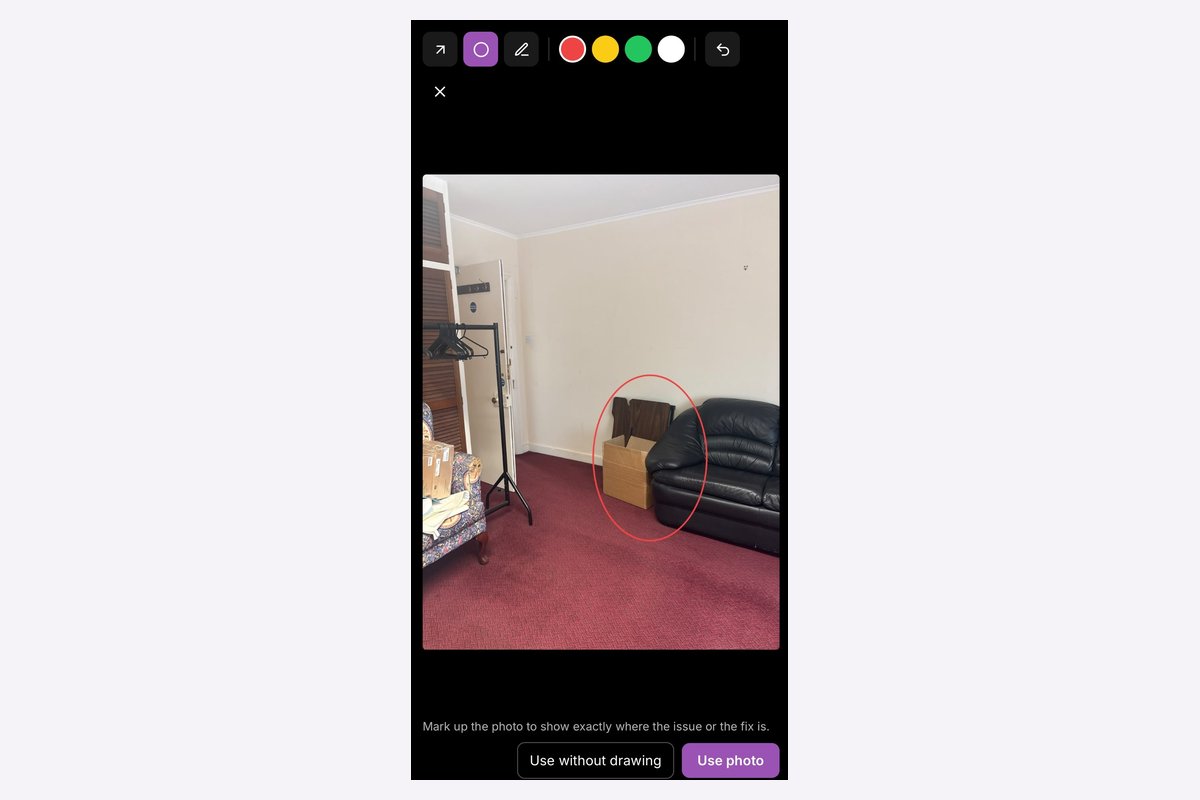
Figure: a phone photo with the problem circled, the kind of evidence an auditor can attach to an answer. This example comes from a bedroom check.
Watch the probe and the hot hold
A food hygiene audit has to test what people do, not only what the paperwork says.
Every audit in the library is free to run, with scoring, actions and a report. No card needed.
Create a free accountThe cook is making a casserole. Gwen asks to watch the probe being used. It is wiped before and after, and the reading goes on the sheet.
Then she asks about the stretch people forget, between the cooker and the dining room. What was the temperature when service began? The cook has it written down.
She turns the sheet back a few weeks. Several days show identical readings, down to the decimal. That could be habit, or it could be filling in from memory. She makes a note to ask, not to accuse.
What she learns is that the record can be perfect and the practice still weak. The only way to know is to stand there while it happens.
Ask someone other than the cook
This part works as a small allergen audit. The allergen chart is on the wall and looks current. Gwen does not ask the cook which residents have allergies. She asks a kitchen assistant and gets the right answer, which tells her more than the chart does.
Next come textures. If a resident has a texture or fluid requirement in their care plan, the plate must match it. She lays one plated meal beside one care plan and compares them.
She watches handwashing, uniform and protective kit. She also asks the newest team member when food hygiene training was last refreshed.
Equipment, pests and the plate
A kitchen hygiene audit also looks beyond the cooker.
The extractor fan is clean. The dishwasher reaches the sanitisation temperature the audit asks for. The faults log has one entry, already fixed, and she asks when the electrical equipment was last tested.
At the outside door she looks for droppings, gnawing and insects, then asks about the pest monitoring stations. The contract is in date.
She leaves the food until last, because the plate is the reason for everything else. Does the menu suit the people eating it? Can they get a drink or a snack at any hour? Is the plan for anyone losing weight actually being followed in the kitchen?
Score it from the office
Back at her desk, Gwen scores what she saw and not what she meant to see. Each answer is a pass, a fail or not applicable, and CareStream shows a score for each section. On paper, divide the passes by the passes and fails together, leaving not applicable out. That method is ours, not a rule.
A percentage shows a trend and can also mislead. One fridge out of range matters more than four missing signatures. Anything that could harm a resident is marked as a priority whatever the score says.
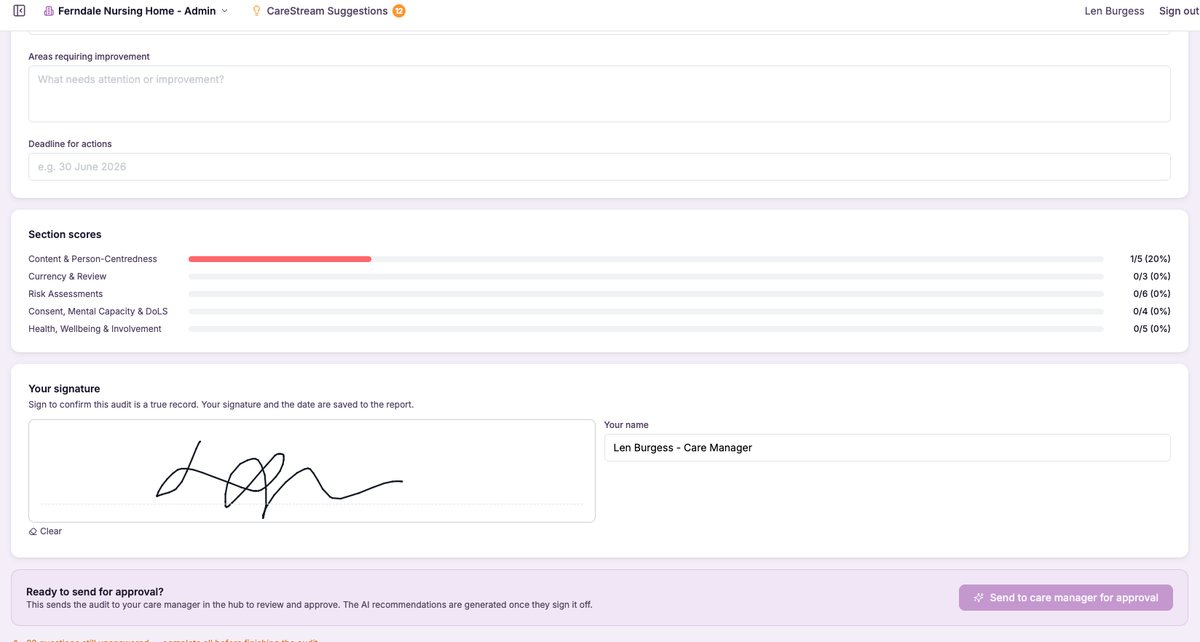
Figure: section scores, the auditor's signature and a button to send the audit to the care manager.
Write actions that someone can close
Every No becomes a finding, and every finding needs an owner, a due date and the evidence that will show it is done.
A weak action reads "improve fridge checks". Gwen writes something else.
"Head cook to check fridge 2 each morning and sign the sheet. Manager to look at the sheet weekly for four weeks. Due within two weeks."
That is only the shape to copy, not a real record.
She sorts what she has into three piles.
- Same day: anything that puts food safety or residents at risk.
- A week or two: repairs, retraining and gaps in the records.
- Longer: replacing equipment, changing a menu or altering the layout.
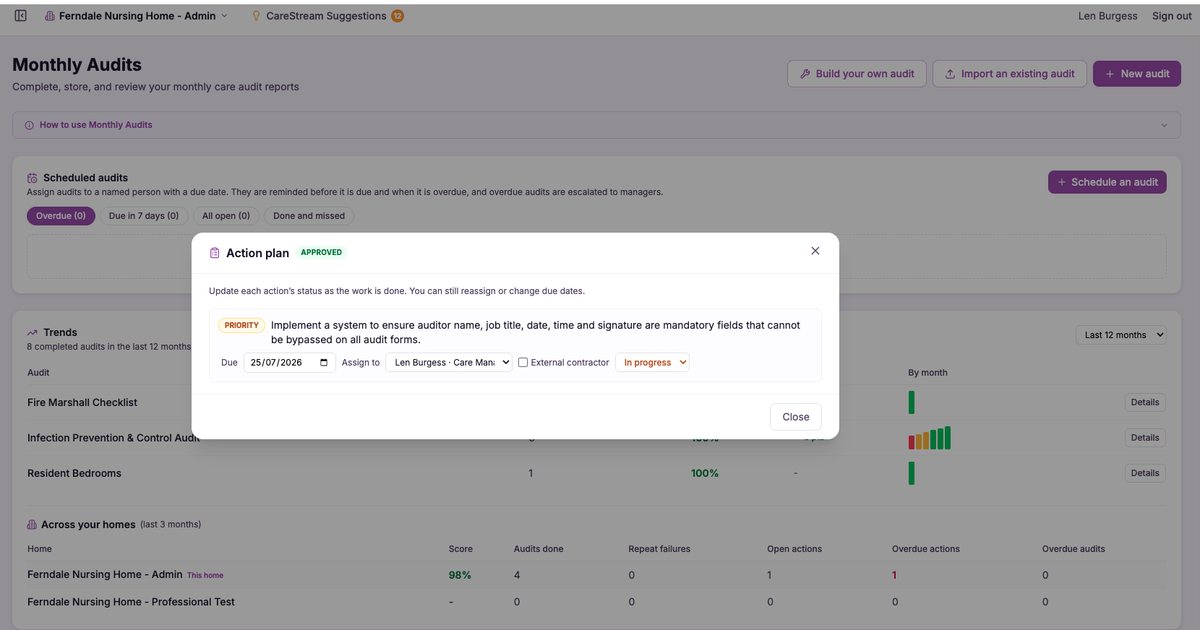
Figure: an action plan with a priority flag, a due date, a named owner and a status that changes as the work is done.
Sign, file and plan the next one
Gwen signs. The record now shows who ran the audit, the date, every answer, the score, the findings and the actions, with their outcomes to follow.
Regulation 17 is the duty of good governance. It expects systems that assess, monitor and improve quality and safety.
Read the full text of Regulation 17 on good governance.
A dated series of audits with closed actions is one way to show that. Our guide to digital audits for care services covers record keeping across the whole library.
She names the person who will run the next audit and agrees when it repeats.
Pick an audit, assign it, score it on a phone and close the actions. Create a free account to start.
Create a free accountHow often should a kitchen audit take place?
There is no set interval in the regulations we read. We suggest a full audit once a month. The kitchen keeps its own daily records between audits.
Add an extra audit after a change, such as a new cook, new equipment or a failed check. That is our recommendation, not a rule. The CareStream Kitchen Audit is set up as a monthly audit.
Our wider piece on how often care home audits should be done covers the rest of the schedule.
When a kitchen fails: three different situations
An audit finding, a failed inspection and a repeating pattern call for different responses.
- An audit failure. Make it an action, fix it and recheck it. If food may have been unsafe, remove it, record what happened and tell whoever leads on food safety. If residents may be affected, follow your incident and infection control procedures.
- A failed inspection. After a council food safety officer visits, the business gets a food hygiene rating from 0 to 5. If you think it misses the real state of the kitchen, GOV.UK says you can appeal. If you appeal within 21 days of receiving the rating, the official guidance on appealing a food hygiene rating says it is held back from online publication until the council has reviewed the appeal. You can also publish a written right to reply. After improvements you can ask the council for a new inspection, and most councils charge a fee. Speak to your local food safety team before you act.
- A pattern. When the same item fails month after month, the cause is usually training, equipment or workload, not carelessness. Take it to your governance review instead of repeating the action.
What the two visitors ask
A council food safety officer inspects food businesses against food hygiene law. Expect questions about your system, your records, your training and the state of the room.
The law behind this is Article 5 of Regulation (EC) 852/2004 on food hygiene procedures. It requires food businesses to keep procedures based on Hazard Analysis and Critical Control Points. They must also give the authority evidence that they follow them.
The Food Standards Agency publishes a safer food better business supplement for residential care homes. It is for small homes that cook for residents. It is not meant for nursing homes, which need other procedures.
The Care Quality Commission
The Care Quality Commission regulates the care, not the food business. Its guidance on Regulation 15 names kitchens as services that must be kept clean and maintained.
The kitchen also falls under four regulations of the Health and Social Care Act 2008 (Regulated Activities) Regulations 2014.
- Regulation 12: safe care and treatment.
- Regulation 14: meeting nutritional and hydration needs.
- Regulation 15: premises and equipment.
- Regulation 17: good governance.
The Single Assessment Framework asks whether a service is safe, effective, caring, responsive and well led. In our view an assessor may reasonably ask how you check your own kitchen.
A record with closed actions is useful evidence. It is not a promise of any rating.
Benefits of CareStream's free Kitchen Audit for a monthly kitchen walk
Gwen's morning ran on the free Kitchen Audit in CareStream. It suits any manager who wants to know how to run a care home kitchen audit without building a form first.
- Nine sections follow the walk, from the doorway to the cold store, so the auditor never backtracks.
- Each answer is scored, and a failed item becomes an action with an owner and a due date.
- Photos can be circled in red and attached to the answer they support.
- The auditor signs on screen and sends the record to the care manager.
The audit is part of the free plan, with no card needed. Read how care home audits with reports, signatures and action tracking fit together.
Before the next morning
Pick your own auditor. Give the audit to a named person, agree the repeat, and tell them the first thing they will be asked next time is whether the actions were done.
Sources
- Safer food, better business supplement for residential care homes, GOV.UK · gov.uk
- Appeal, explain or improve your food hygiene rating, GOV.UK · gov.uk
- Regulation 12: Safe care and treatment, legislation.gov.uk · legislation.gov.uk
- Regulation 14: Meeting nutritional and hydration needs, legislation.gov.uk · legislation.gov.uk
- Regulation 15: Premises and equipment, legislation.gov.uk · legislation.gov.uk
- Regulation 17: Good governance, legislation.gov.uk · legislation.gov.uk
- Article 5, Regulation (EC) 852/2004, legislation.gov.uk · legislation.gov.uk
- Regulation 15: Premises and equipment, Care Quality Commission guidance · cqc.org.uk
- Food hygiene rating scheme guidance for businesses, GOV.UK · gov.uk
- Our new single assessment framework, Care Quality Commission · cqc.org.uk
Frequently asked