The reminder has popped up on the deputy's phone, and the laundry room is on the far side of the building. She has a tablet, forty minutes and a feeling that last quarter's infection control audit was mostly ticks. What should she actually look at, and what happens to a No once she has marked it?
This walk follows the free Infection Control audit in CareStream in the order you would do it on your feet. It ends with scoring and actions, because a list of findings that goes nowhere is the commonest weakness in an infection control audit.
Start where the law starts
The main rule is Regulation 12, on safe care and treatment. It comes from the Regulated Activities Regulations made under the Health and Social Care Act 2008. Providers must assess the risk of infections and stop them spreading, as the text of Regulation 12(2)(h) sets out.
A separate code of practice covers preventing and controlling infections. The Health and Social Care Act 2008 code of practice on infections says the Care Quality Commission must take it into account. It is not mandatory.
Neither the regulation nor the code says "audit". Your audit, which many managers call an ipc audit, checks that the rules on paper are the rules on shift.
Every audit in the library is free to run, with scoring, actions and a report. No card needed.
Create a free accountBefore you leave the office
Open the audit and read the set of sections once. The Infection Control audit has eight: General, Specimens, Waste, Laundry, Pest Control, Staff Health, Food Safety and Hygiene, and MRSA.
MRSA is a germ that resists several antibiotics. Not every section applies everywhere. A supported living service may have no specimens, so mark those questions not applicable rather than skipping them.
Take the tablet if you can. Answering on the spot beats typing from memory at your desk.
Stop 1: the sink and the hands
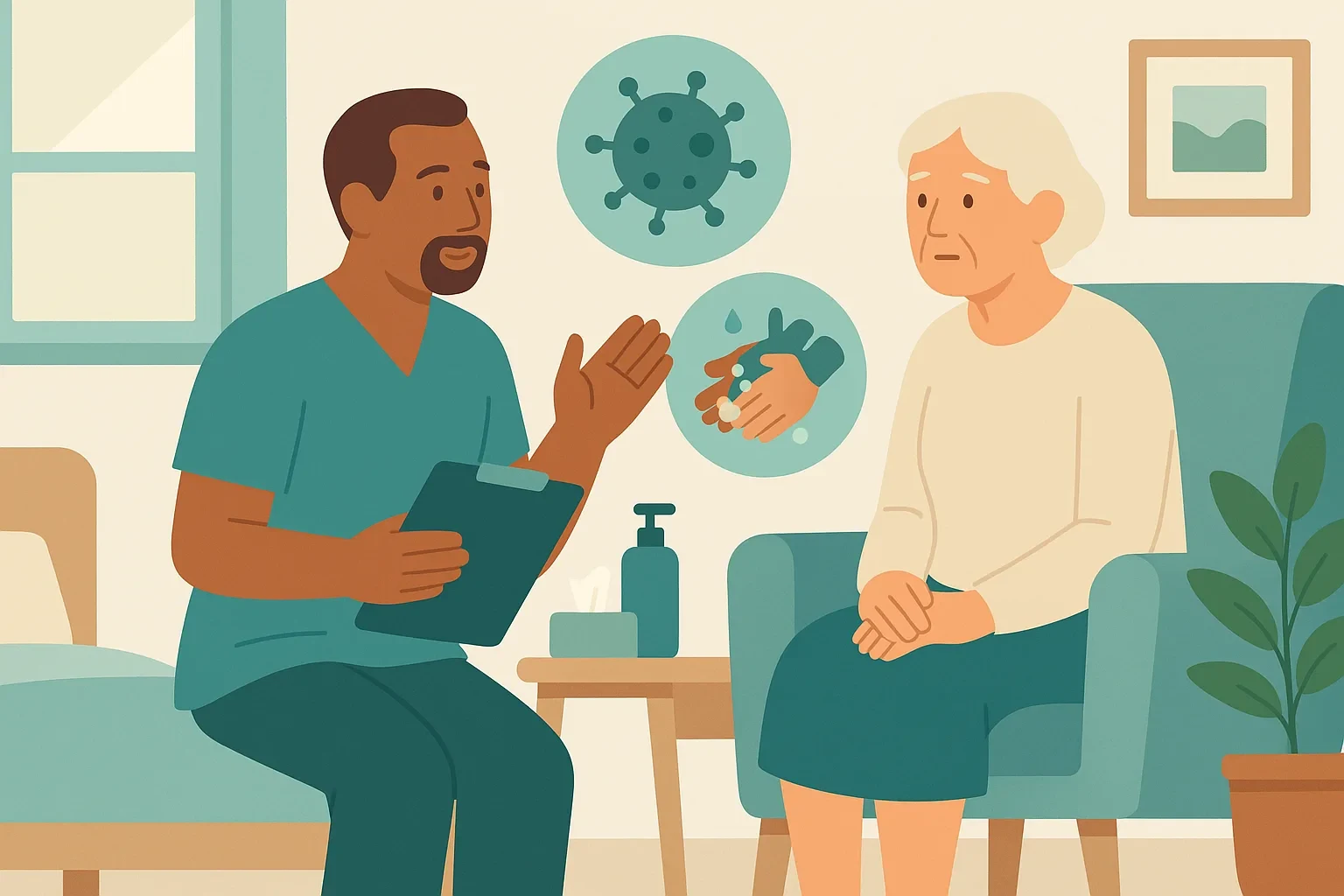
General is the longest section, and its first real test is hand hygiene. Does the policy exist, yes. Do staff wash before, after and between care tasks? That one you cannot answer from a folder.
Stand in a corridor and watch. Watch the technique, not just the act. Check disposable towels, liquid soap and the notice by the sink.
If you want a stand alone hand hygiene audit tool, these questions are the heart of one. The same section asks about covering cuts, protective clothing, sharps, spillages of vomit or blood, and the plan for an outbreak.
Stop 2: the sluice, the bins and the laundry room
Specimens, Waste and Laundry are short sections and quick to do together. Look at how things are labelled, sealed, bagged and kept apart. Is dirty laundry kept separate from clean? Is the bag big enough that nobody has to push it down?
Ask a care worker to show you, rather than tell you. A walk through the real route a bag takes from a bedroom to the machine will find more than any question will.
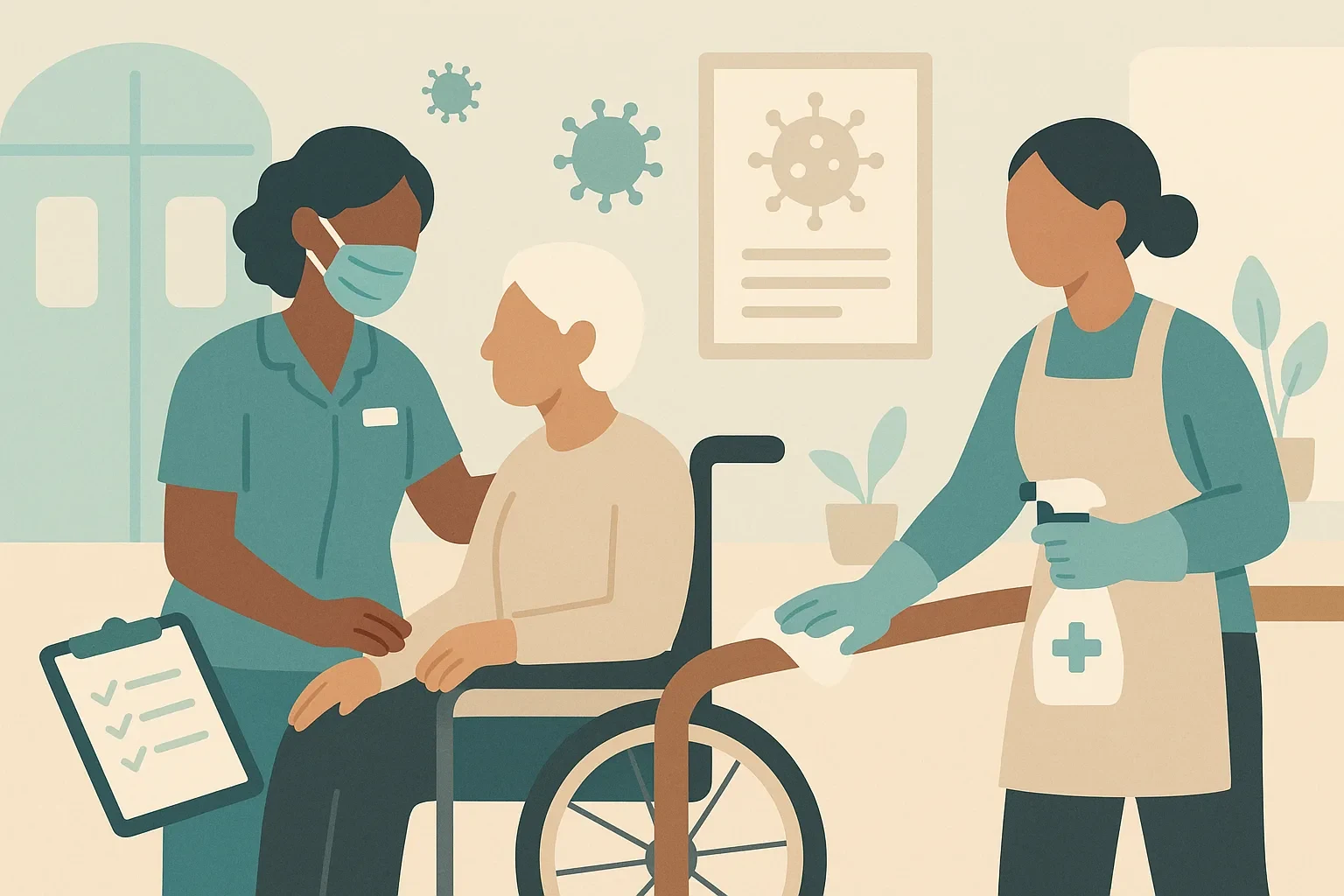
Figure: the habits to watch for on the walk, protective equipment worn and surfaces wiped.
Stop 3: the kitchen door and the storeroom
Pest Control and Food Safety and Hygiene sit inside this audit, and that surprises some managers. Leftovers cleared, food covered, droppings absent, drains protected. These are infection risks as much as hygiene ones.
The food section also asks whether infection control training for cooks and food handlers is up to date. If it is not, the free infection prevention and control course for staff is one place to close that gap, free for every member of staff.
For the full food audit, we keep a separate Kitchen Audit. Run this one for the infection angle only.
Stop 4: the people, then the records
Staff Health asks about screening, immunisation, early follow up of infectious illness and whether staff stay off work until safe to return. The answers sit in files, not on walls, so ask to see them.
MRSA asks whether a policy exists and whether the notes record people known to be infected. It also covers pressure sores, catheters, wounds and lines.
For guidance to put in front of staff, see the UKHSA resource on infection prevention and control in adult social care. It covers precautions, outbreaks and staff health.
How to score it
Each check is answered Yes, No or Not applicable. A No has one more step: you say whether it was the correct answer or a gap, and the audit cannot be completed until you do.
Each section then shows a count and a percentage. The colour is green at 80 per cent or above, amber from 60 and red below.
No rule sets a pass mark, so these bands are ours. We suggest you read the colour second and the individual Nos first.
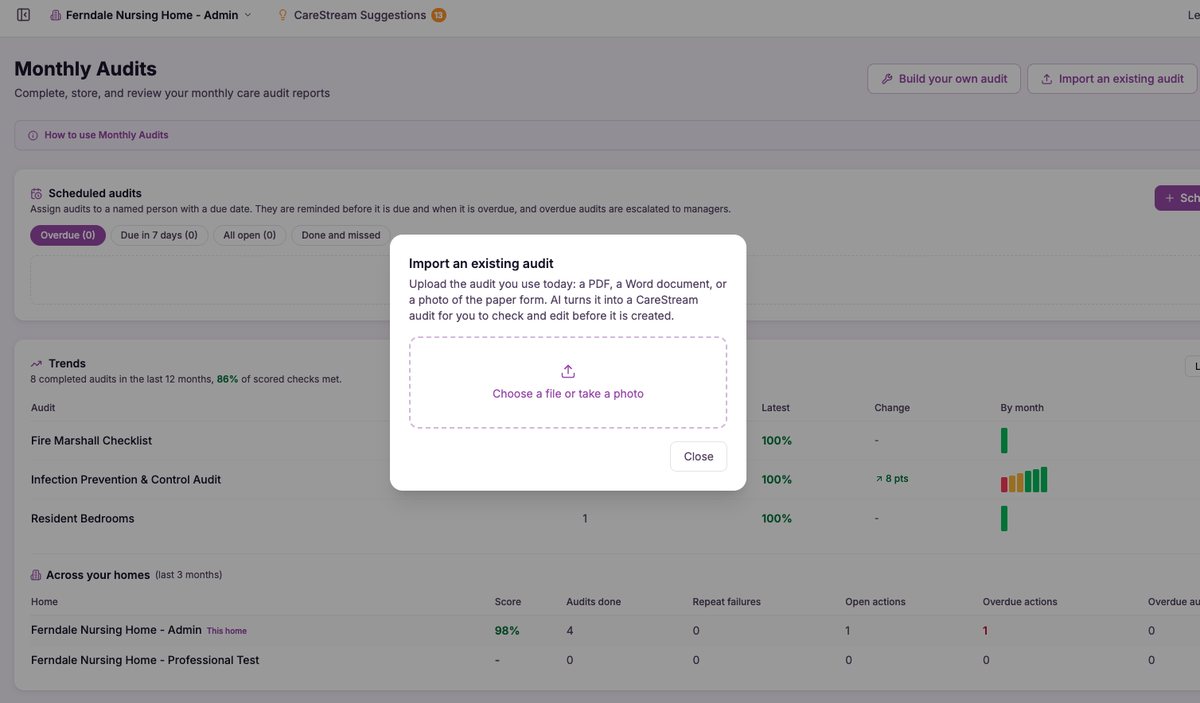
Pick an audit, assign it, score it on a phone and close the actions. Create a free account to start.
Create a free accountFrom a No to a named action
Every check has a box for what was found and a box for actions to be taken. The audit also holds a deadline for actions and fields for strengths and improvements.
We suggest each action carries four things: what will change, who owns it, a due date and a way to prove it was done. Anything that puts a resident at risk is fixed that day, not at the next audit.
Close each action in writing. Providers must assess, monitor and improve the quality and safety of the service, and Regulation 17 on good governance says so. An open action is an unanswered question.
How often to repeat it
The template is set to quarterly, so that is a sensible starting rhythm for infection control audits for care homes. We know of no regulation that fixes the interval.
We would repeat a failed section sooner, and check again after any outbreak. Daily and weekly checks, such as a quick look at hand gel and PPE stocks, sit underneath the quarterly audit rather than replacing it.
Start the next audit by checking last time's actions. If the same No comes round twice, change the fix, not just the date.
What an inspector can read in your record
The Care Quality Commission has a quality statement on infection control. It sits under the question on whether a service is safe. It begins "We assess and manage the risk of infection", as the list of 34 quality statements shows.
An audit record can feed that evidence for CQC infection control questions. It cannot promise a rating.
What helps is a dated trail: the audit, the scores, who owned each action and when it closed.
Benefits of CareStream for your infection control audit
If you want an infection control audit template you can use today, CareStream has one.
- The Infection Control audit is one of the free audits on a free account, with no card needed.
- It works as an infection control audit tool on a tablet, with an actions box on each check.
- You can copy it and edit it, or build your own audit from scratch.
- Staff can take the infection prevention and control course free, so training and audit sit together.
See the free audit library to open it.
Run the walk on your own service
Pick one section, not all eight. Start with General, because hand hygiene shows more than any other check. Do it this week, with a colleague, and write down every No on an infection control audit checklist of your own, or on screen.
Then give each No an owner and a date. That is your infection prevention and control audit working as it should.
For the training side, our guide to infection control training for care staff shows what staff need to know before you test them.
Sources
- Regulation 12, Safe care and treatment (legislation.gov.uk) · legislation.gov.uk
- Regulation 17, Good governance (legislation.gov.uk) · legislation.gov.uk
- Health and Social Care Act 2008, code of practice on the prevention and control of infections (GOV.UK) · gov.uk
- Infection prevention and control resource for adult social care (UKHSA and DHSC, GOV.UK) · gov.uk
- The 34 quality statements, including Infection prevention and control under Safe (Care Quality Commission) · cqc.org.uk
Frequently asked