A service can run every audit in the book and still fail to prove it. The manager is asked how she/he knows the medicines round is safe, and the answer lives in her head. Nothing is wrong with the care, but there is no record to put on the table.
That gap is why a CQC audit matters. We take the questions an inspector can ask, name the audit that answers each, and say what to keep.
What do CQC inspectors look for first?
They start with the people. These are the five key questions CQC uses on every service: is it safe, effective, caring, responsive and well led? The assessment framework sets out those five key questions, and everything else hangs beneath them.
Under the CQC key questions sit 34 quality statements. Think of these CQC quality statements as the detail of what good looks like. Short, and checkable.
A CQC inspection checklist found online is only a prompt. It cannot know which of your risks an inspector will pick up first.
Is there a CQC audit I must show you?
No. The CQC audit requirements are short. Regulation 17 on good governance says systems must work well. It is one of the regulations that govern registered care.
Those systems must help a provider assess, monitor and improve the quality and safety of the service. They must also help it assess and reduce risks to people's health, safety and welfare.
So an inspector does not ask for a particular form. The question is whether your checks work and whether you can show it.
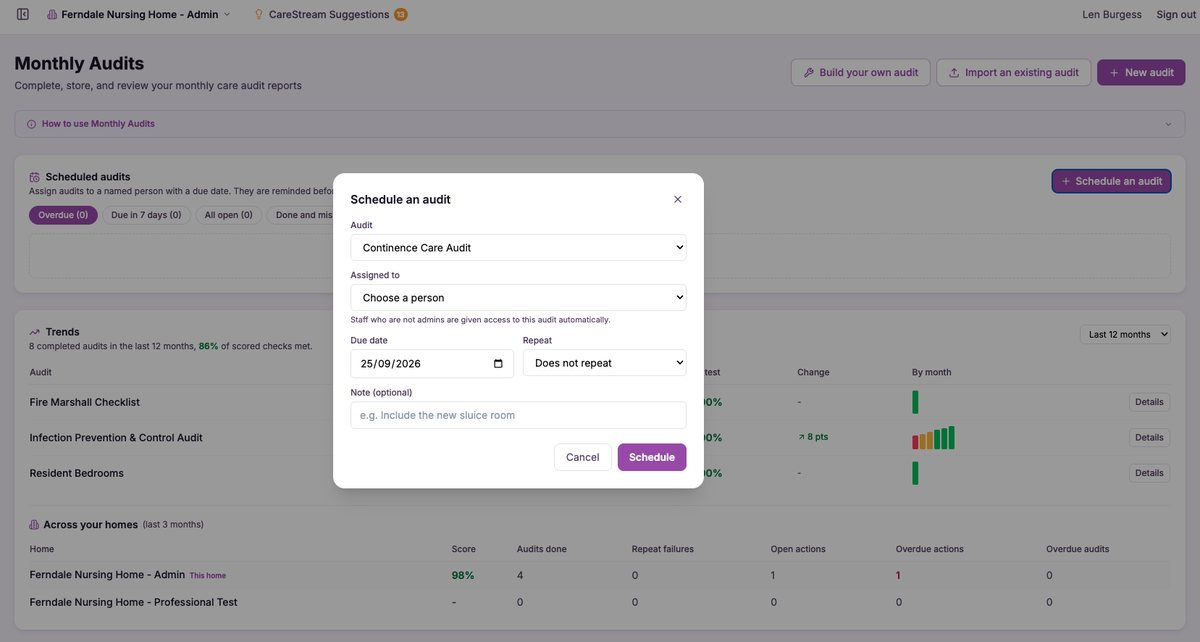
A good answer here is a calendar of audits that fits your service, with a named owner for each. We suggest keeping that schedule on one page.
Every audit in the library is free to run, with scoring, actions and a report. No card needed.
Create a free accountHow do the five key questions map to your audits?
The mapping below is ours, not the Care Quality Commission's. The regulator lists 34 quality statements grouped under the five key questions, and no audit is attached to any of them. We pair them with the audits that give the best evidence.
- Safe (eight statements, including medicines optimisation and infection prevention and control): Medicines Management, Daily Medication Audit, Infection Control and Health and Safety.
- Effective (six statements, including assessing needs and consent): Care Plan Review and Update, Staff Training and Compliance, and Fluid Intake and Hydration.
- Caring (five statements, including kindness, compassion and dignity): Resident Feedback Round.
- Responsive (seven statements, including listening to and involving people): Resident Feedback Round and Quality Assurance, a summary of family and resident questionnaires.
- Well-led (eight statements, including governance and learning): Monthly Governance Review and Single Assessment Framework Review.
Nothing stops one audit serving two questions. Resident feedback is the obvious case.
Which question is hardest to answer from paper?
Caring. A form cannot show kindness. An inspector will watch how staff speak to people and ask the people themselves.
Your audit evidence helps in a smaller way. It shows that you ask people what they think, and that you act when they tell you.
The Resident Feedback Round asks about choice and control, dignity and respect, and how the service listens. Keep the answers, and keep what changed because of them. A comment with no action beside it looks like a service that does not listen.
How do you show where the evidence comes from?
The regulator sorts evidence into six categories. The evidence categories page lists them:
- People's experience of health and care services.
- Feedback from staff and leaders.
- Feedback from partners.
- Observation.
- Processes.
- Outcomes.
Audits mostly feed two of these: processes and outcomes. They cannot stand in for the other four, so a thin evidence base needs more than a folder of completed forms. We explain the gaps in our guide to CQC evidence categories.
What must one audit record show?
An inspector who opens a completed audit should find answers without being told how to read it. We suggest the record holds:
- The date, the audit name and who completed it.
- Each question and its answer, scored.
- A note or photograph behind every failed item.
- An action with an owner and a due date.
- A signature, and proof the action was closed.
Regulation 17 also asks for an accurate, complete and contemporaneous record of the care given. Contemporaneous means written at the time, not reconstructed later. A CQC audit checklist that is filled in on Friday for the whole week fails that test.
Who closes the findings?
An audit nobody owns produces findings nobody closes. The fix is a name, not a bigger form.
The Monthly Governance Review exists for this. It asks if incidents were analysed and safeguarding concerns tracked to an outcome. It also asks if statutory notifications went in.
Here is the idea in practice.
Pick an audit, assign it, score it on a phone and close the actions. Create a free account to start.
Create a free accountPriya runs a residential home of twenty four beds. Her daily medication check shows two gaps on a MAR chart, the medication administration record. She logs both and names a senior to find out why, with a due date. At the monthly review she shows the cause and the date the gaps stopped.
Nothing in it is clever. It is a record that moves from finding to action to closure, which is all the governance question asks.
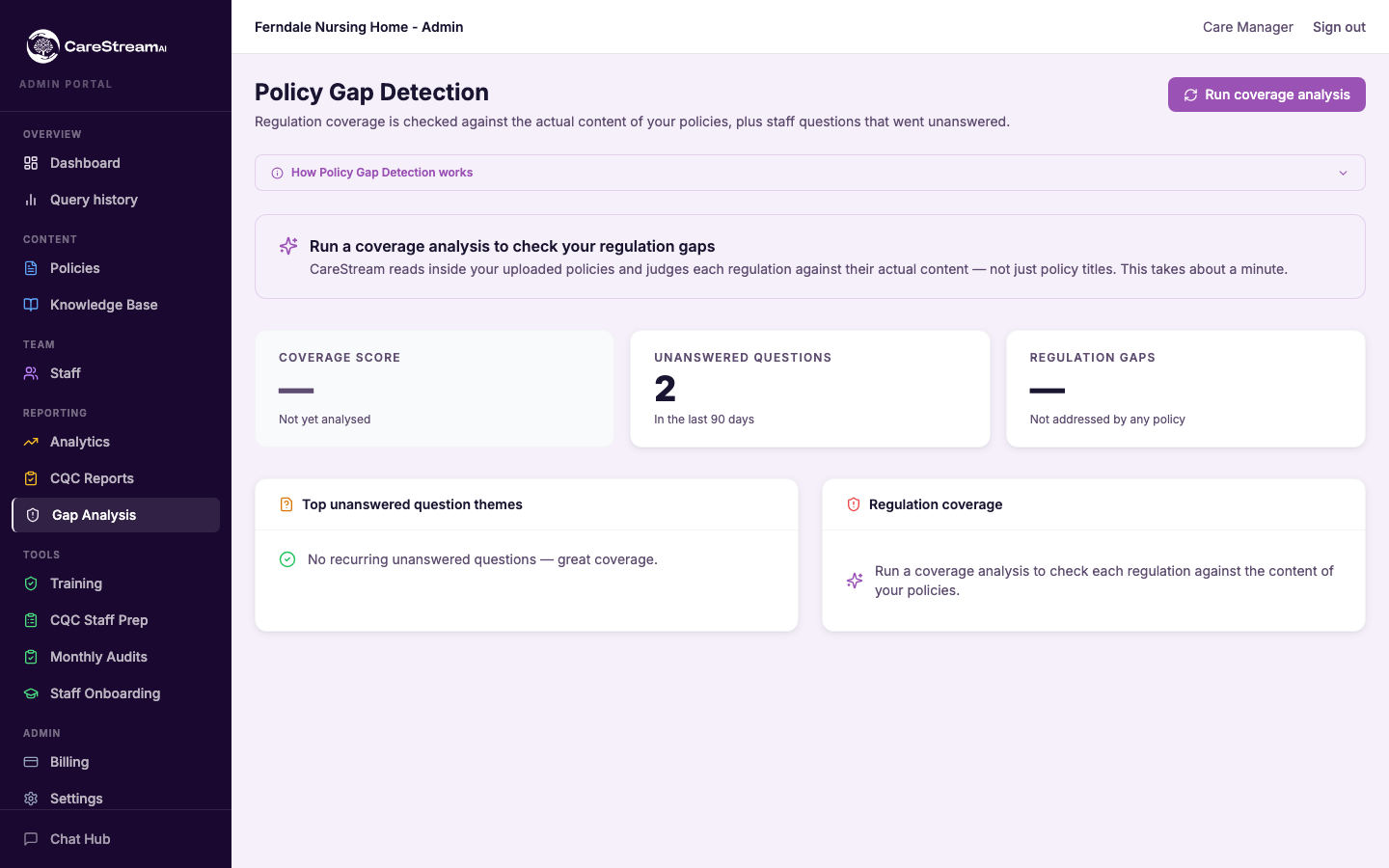
Figure: a gap check reads policies against the regulations, giving the written side of the evidence a place to start.
Will your staff give the same answer?
Inspectors talk to staff as well as read files. They may ask a care worker what she would do if she saw a bruise, or who is covering the lead today.
If two people answer differently, the policy is not embedded, however good the audit looks. The Single Assessment Framework Review is a quarterly self assessment that works through every quality statement under each key question. It asks you to record how you meet each one and what you will do next.
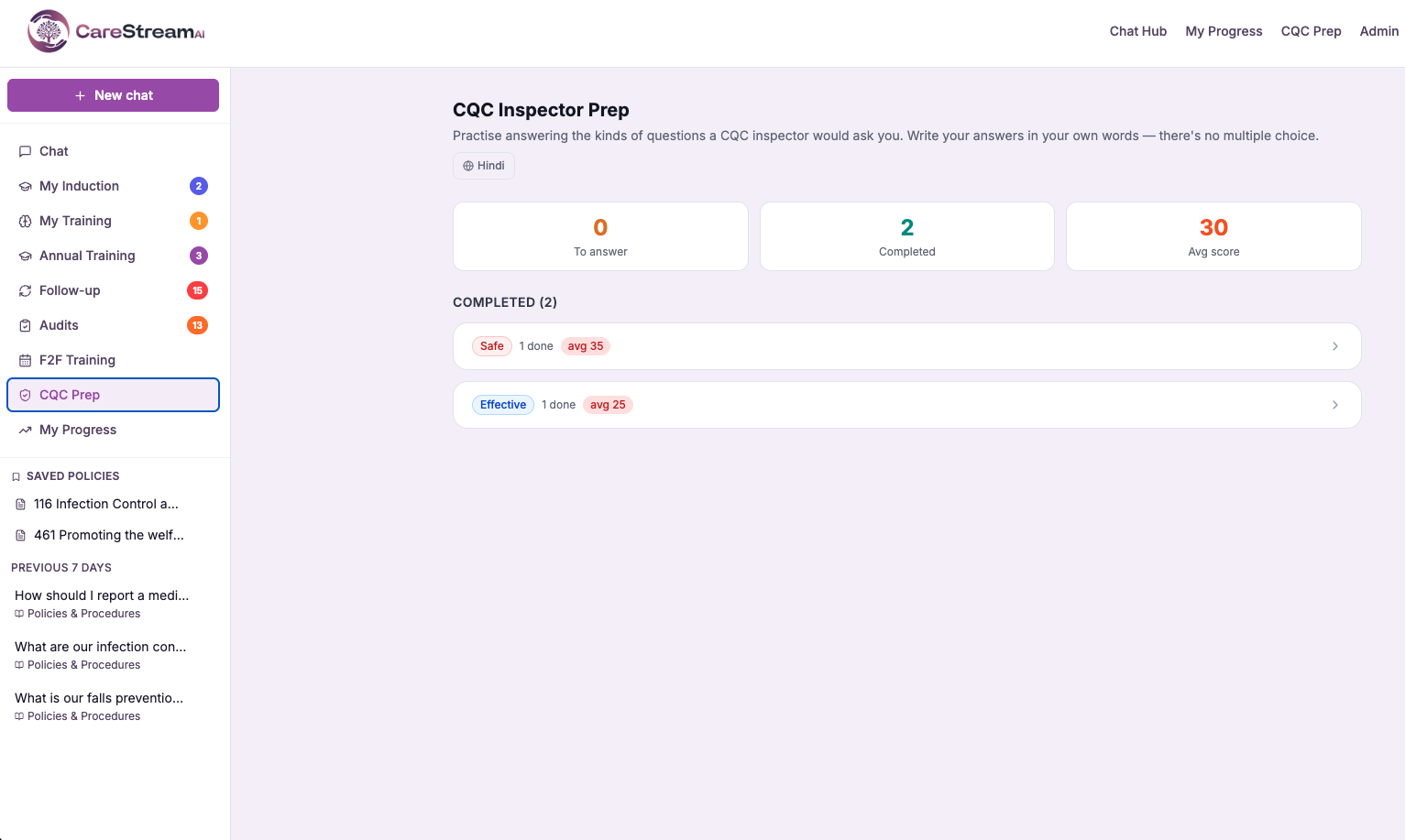
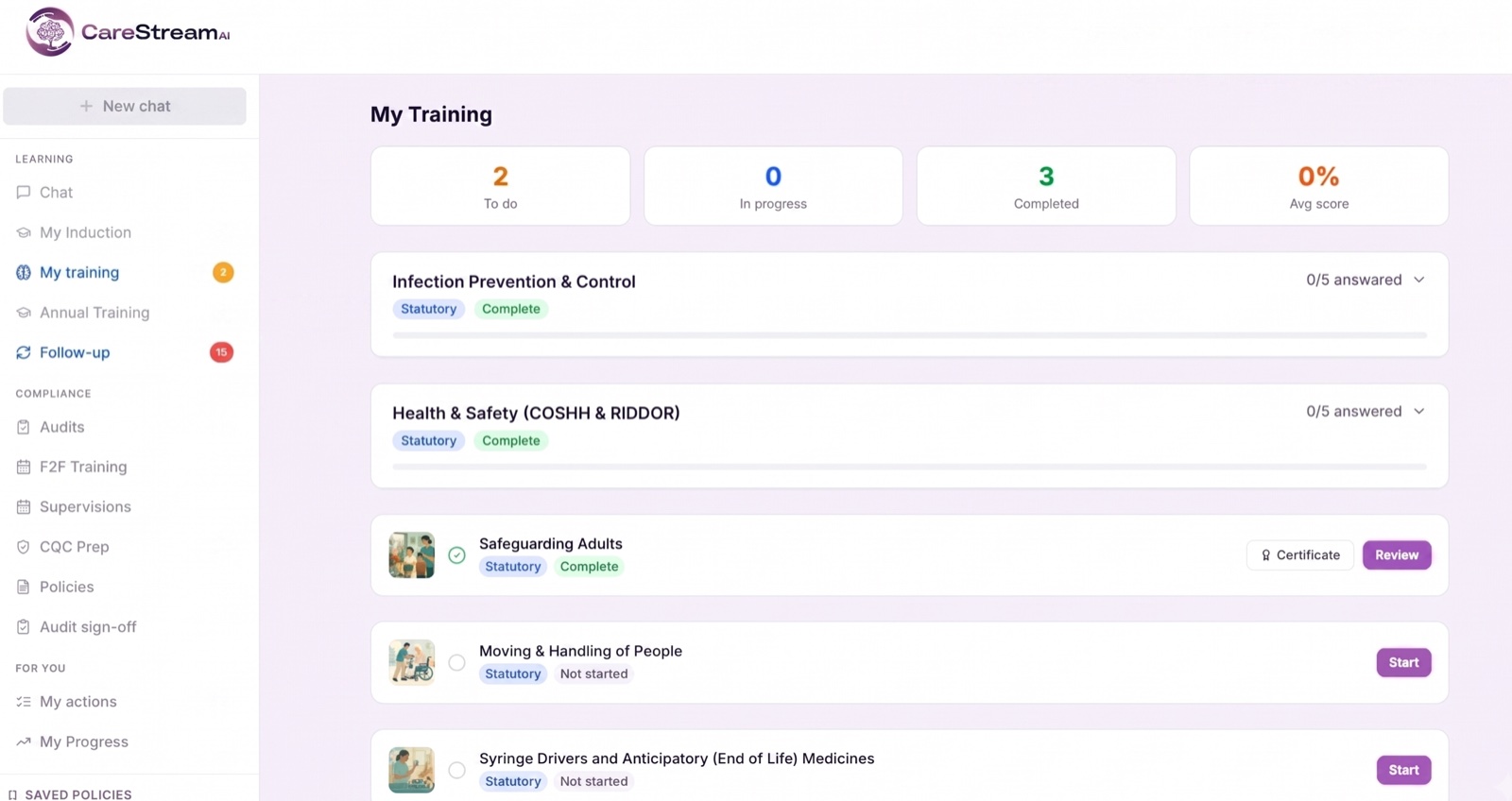
Figure: staff practise answering questions in their own words, grouped by key question, in the hub.
Practice helps. On the CQC staff preparation questions page CareStream shows how staff write answers, see the model answer and try again. It prepares people to explain their work. It does not predict a result.
What does Well-led add?
This key question is about leaders, culture and learning. The Well-led page describes effective governance. It says information on risks and outcomes should be used to improve care.
Audits are one way to meet that. The page itself does not mention audits, so treat them as a means, not the point.
Ask yourself one thing about each audit. Did what it found change anything?
Benefits of CareStream's free audits for your CQC audit trail
If you want a CQC audit trail an inspector can follow, the free audit library gives you the structure.
- There are 100+ ready made audits, all included on the free plan, with no card.
- Each audit is scored and signed, and produces a report.
- Failed items become actions with an owner and a due date.
- You can add photographs as evidence to a question.
- You can build your own audit when a built in one does not fit.
The audits record what you did. They do not decide a rating.
Run the five questions on your own audits
Take one audit from each key question and open its last completed record. Is the date there? Is a person named? Is every failed item tied to an action that was closed?
Where the answer is no, you have found the gap before an inspector does. Start with the audit that covers your highest risk.
Our guide to the single assessment framework shows how the quality statements fit together.
A written policy for each risk is the other half of the evidence. CareStream's free policy gap check shows where yours are thin.
Sources
- Regulation 17, Good governance (legislation.gov.uk) · legislation.gov.uk
- Assessment framework and the five key questions (Care Quality Commission) · cqc.org.uk
- The 34 quality statements, grouped by key question (Care Quality Commission) · cqc.org.uk
- Evidence categories (Care Quality Commission) · cqc.org.uk
- Well-led key question (Care Quality Commission) · cqc.org.uk
Frequently asked