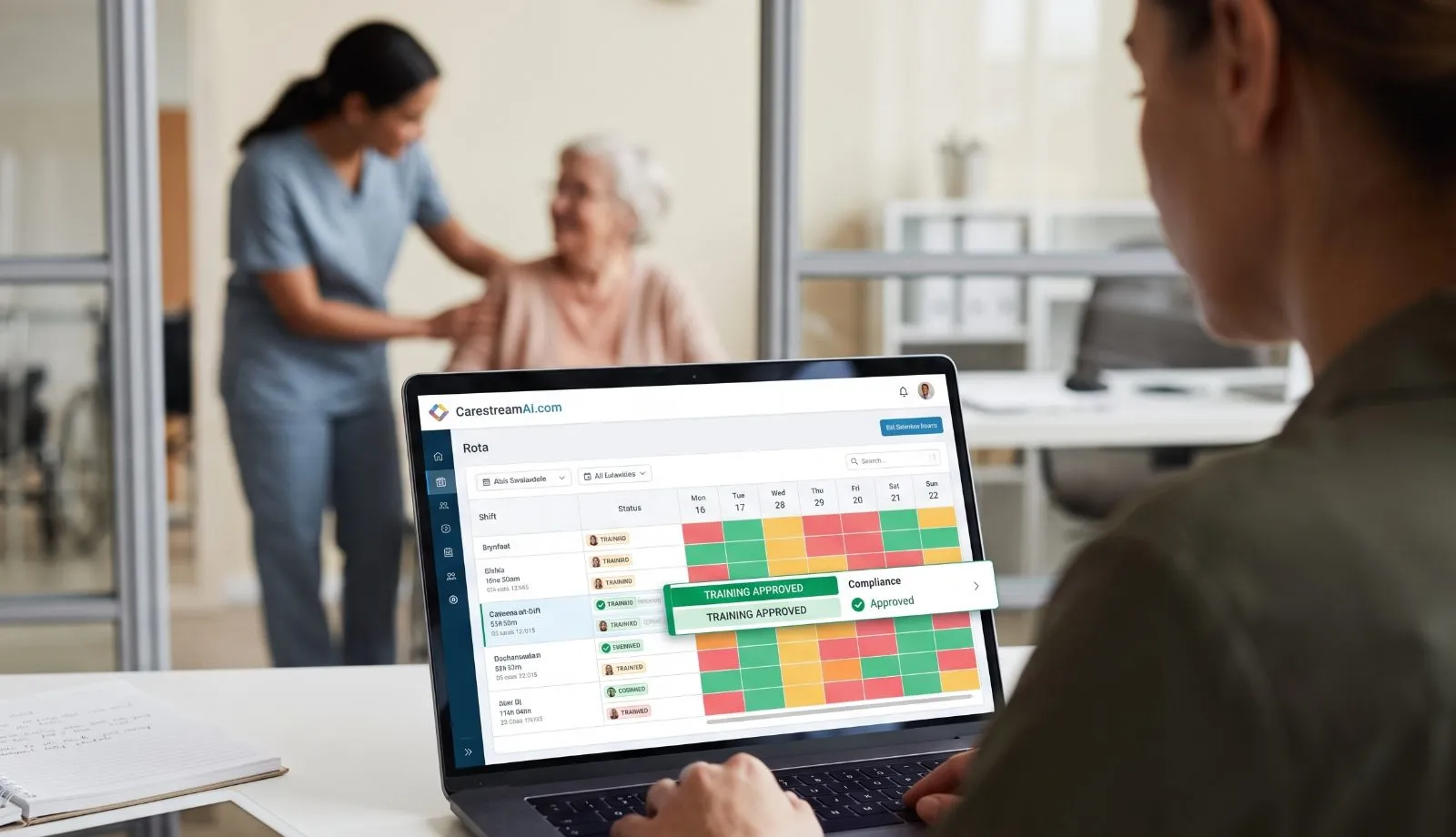
The rota is the constraint, not the training. Any plan that ignores minimum staffing, skill mix and night cover will collapse by week three. The practical method is to name the constraints first, then build the training calendar around the shifts that can actually release someone.
This article sets out that method in the order it has to happen: constraints, releasable shifts, cover, patterns, evidence and a realistic monthly rhythm.
What has to be true before you move a single training date?
Start with the constraints, not the calendar. Before any training date is agreed, you need to know the minimum staffing numbers per shift, the registered nurse cover required on site 24 hours a day in nursing homes, and the skill mix each shift needs to stay safe. These are the fixed boundaries. Training slots only exist inside them.
The UK has no fixed legal staff-to-resident ratio in care homes, according to Papershift. Your own dependency tool and commissioning contracts set the real floor. That makes local judgement the deciding factor, which is why a training plan written by someone who does not know the rota is not worth publishing.
Adult social care staff turnover was around 23.1% in 2024/25, as reported by The Access Group. The rota is a moving target, so any training plan needs slack built in from the start. A plan that assumes perfect attendance will fail the first time someone leaves or goes off sick.
Ask three questions before you release anyone for training. Who covers this shift? What skill is lost? What does the cover cost? If you cannot answer all three with a named person and a known cost, the training date is not ready.
Which shifts can actually release a person for training?
Map the rota week by week and mark every shift as releasable, releasable with cover, or locked. Use the same logic you would apply to annual leave approval. A locked shift is one where releasing the person would drop you below safe staffing or remove a skill the shift cannot function without.
Treat 12-hour shifts with little downtime as a hard boundary. Care staff often work 12-hour shifts with little downtime and unpredictable workloads, according to eCert Training. Training bolted onto the end of a long shift gets skipped or resented. It also produces poor evidence, because the person is too tired to retain anything.
Identify the natural windows instead. Quiet midweek mornings, double-staffed shifts and the lull before a late shift starts are the slots that survive contact with reality. These are the shifts where cover is cheapest, and the person is most likely to be present and alert.
Protect the slots you create. An unprotected training hour is the first thing sacrificed when sickness hits. Publish the training slot alongside the rota and treat it as a staffing commitment, not a nice-to-have.
How do you cover training without paying agency rates?
Work through the cover ladder in order. Internal bank staff come first, then overtime at the lowest tier that keeps people willing, then cross-site cover, then agency as the last resort. Agency is the most expensive option and the one that most quickly erodes the training budget.
Stagger training across a week rather than blocking a whole team into one day. Staggering spreads the cover cost instead of concentrating it. A team of six released one at a time across six days costs far less in cover than six people released on the same Tuesday.
Book a short demo and see how CareStream keeps your policies, training and CQC evidence in one place.
Book a demoThe prize is measurable. Better rota management can cut planning time by two-thirds, reclaiming around 170 hours a year, according to RotaCloud. Those hours go back into planning cover properly, which is the work that stops training from becoming a crisis.
Avoid the trap of training the same reliable people repeatedly because they are the easiest to release. That hollows out the rest of the team and leaves you with a skills gap that only becomes visible when the reliable people leave. Rotate who gets released, even when it costs more in cover.
What scheduling patterns work for nights, weekends and part-time staff?
Run night staff training at shift handover or in the hour before a night shift begins. Never schedule it in the middle of their rest day. A night worker asked to attend training on a day off is being asked to work a second shift, and the training will not stick.
Rotate weekend training fairly so the same people are not always giving up Saturdays. Log the rotation so it is defensible when someone asks why they have been asked again. A visible rotation is also the simplest way to show an inspector that training is distributed, not concentrated.
Build part-time and bank staff into the plan from the start. They often hold the skills that make cover possible, and leaving them out of the training calendar creates a hidden compliance gap. Part-time staff need the same statutory training as full-time staff, just scheduled differently.
Accept that some staff will need more than one attempt at a slot. Design the calendar with repeat windows rather than single dates. A person who misses one session should have a second option already in the plan, not a manager scrambling to find one.
How does a training matrix and the rota calendar work together?
The matrix shows who is due what and when it expires. The rota shows who can be released. The plan only exists where the two overlap. A training date that works on the matrix but not on the rota is a wish, not a plan.
CareStreamAI keeps both sides visible in one place. Monthly training module allocations per plan sit alongside standard modules and tailored ones built around your setting, with scenario-based statutory training. The calendar and the matrix show the same information at the same time, so the overlap is visible before you commit a date.
Every training completion is logged automatically into an audit trail and CQC evidence pack. Releasing someone for training therefore produces the evidence that they attended, without a separate admin step. The record exists because the training happened, not because someone remembered to file a form.
Face-to-face training options are available on higher tiers for the modules that genuinely need a room and a trainer. This removes admin and guesswork. It does not replace your trainers, your supervision or your judgement.
How do you prove training happened when an inspector asks?
The audit trail is the answer. A live record of who completed what, when, and which shift they were released from is the evidence an inspector wants to see. It shows that training was planned around the rota, not bolted on afterwards.
Paper rotas give no real-time visibility, are slow to update and leave a thin audit trail, according to The Access Group. That is exactly the gap inspectors probe. A paper rota cannot show why a person was released on a particular Tuesday or who covered their shift.
A quick demo shows exactly how CareStream would work for your service. Book a time that suits you.
Book a demoSpreadsheet rotas add no automated notifications, no mobile access and no workforce analytics, as noted by The Access Group. Evidence has to be assembled by hand, which is slow and error-prone. The audit trail becomes a retrospective exercise rather than a live record.
Run a monthly check that training completion, the matrix and the rota tell the same story. Do it before anyone else asks. A manager who can show the join between the three has answered the question before it is fully formed.
What is a realistic training schedule for one month?
A realistic monthly rhythm has four steps. Pick the slots, publish them alongside the rota, confirm cover, then review what slipped. The review is the step most plans skip, and it is the step that keeps the plan honest.
For a typical residential or domiciliary team, a handful of protected slots per week clears a backlog without agency spend. Two midweek morning slots, one handover slot for night staff and one weekend rotation covers most statutory and mandatory training needs across a month.
Build in one catch-up window per month for the people whose shifts changed or who were off sick. The catch-up window is not a luxury. It is the slack that stops one bad week from derailing the whole plan.
Keep the plan short enough to survive a bad week. A plan that only works in a good month is not a plan. The test is simple: if two people go off sick on the same day, does the training calendar still hold?
Conclusion
Written by
 Len BurgessSenior Care Advisor
Len Burgess has worked in the care sector for over 8 years, with hands-on experience across residential, nursing and community settings. Having supported teams through CQC inspections and the day-to-day reality of keeping a service compliant, he writes about regulation, quality and best practice in a way that's grounded in what actually happens on the floor, not just what the guidance says.