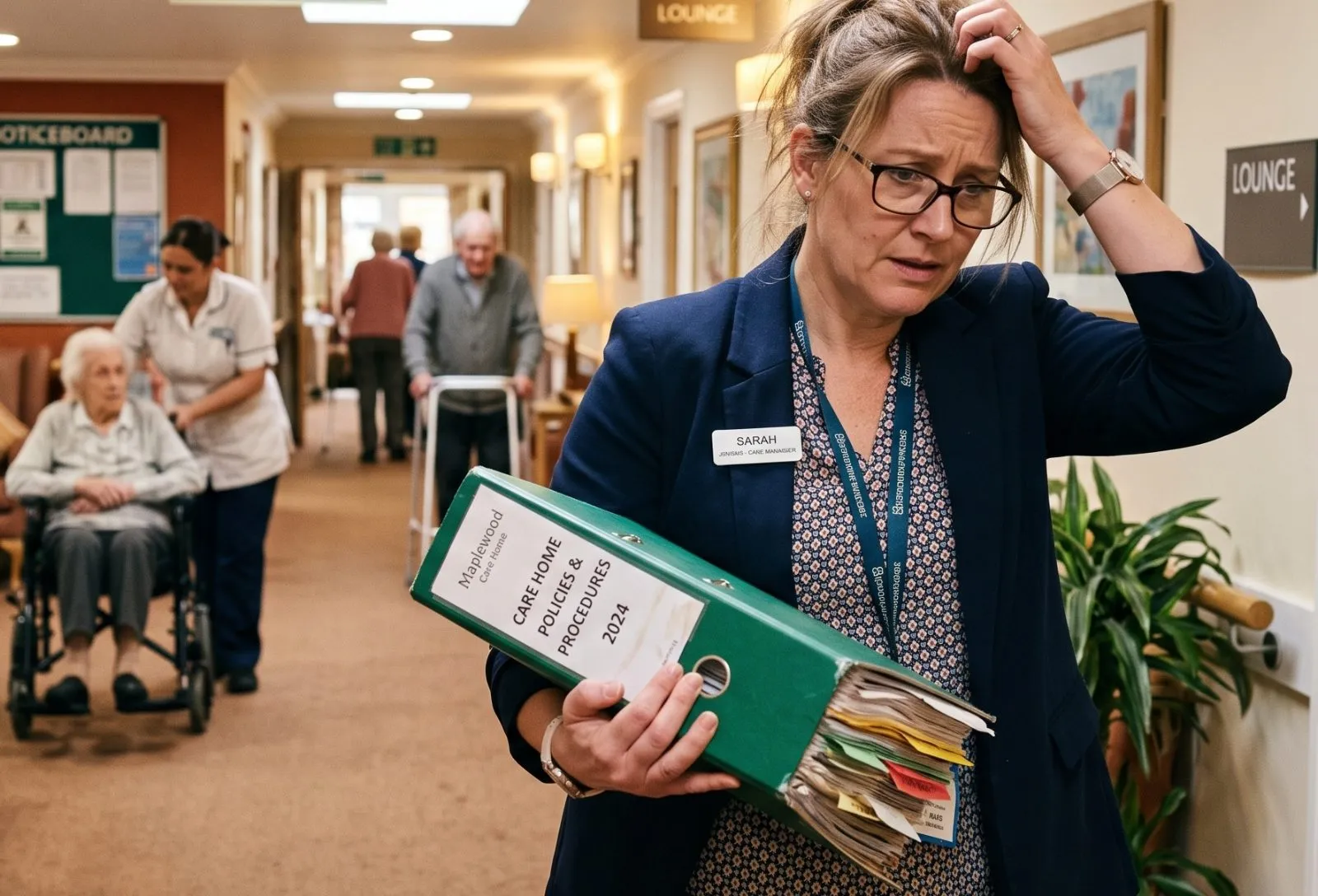
How often should care policies be reviewed?
The honest answer is that no UK regulation sets a fixed statutory interval. The Care Act 2014 does not specify a frequency, and CQC Regulation 17 requires evidence that your policies are current, relevant, understood (this word is so important) and followed, without prescribing a calendar.
The sector baseline has settled on annual review for most core policies. That is the defensible starting point, but it is not the whole answer. The off-cycle triggers are where the real risk sits.
Keep reading to get all the details and then see how CareStream can help you
There Is No Legal Answer, and That Is the Point
Registered managers looking for a clear legal rule on policy review frequency in care home settings will not find one, because none exists. The Care Act 2014 is silent on the matter. CQC Regulation 17, the Good Governance regulation, requires providers to assess, monitor and improve the quality and safety of services. It does not say "review every policy every 12 months". It says something harder to satisfy: prove that your policies are current, relevant, understood and followed.
That absence is not a loophole. It is a test of your judgement. An inspector will not ask whether you found the magic number in a regulation. They will ask how you decided on your review schedule, whether you followed it, and what changed as a result. A defensible schedule, consistently applied and properly recorded, survives scrutiny. A calendar full of review dates with no evidence behind them does not.
Wales operates under its own framework. Regulation 7 and 12 of the Regulated Services (Service Providers and Responsible Individuals) (Wales) Regulations 2017 apply to CIW-regulated services, and the same principle holds: the regulator wants evidence of currency and staff understanding, not a fixed date.
What matters is not the date on the policy. It is the gap between the written policy and what staff actually do. That gap is where inspections fail.
What the Regulators Actually Look For
CQC Regulation 17 is the primary framework in England. It requires providers to have systems in place to assess, monitor and improve the quality and safety of services, which includes keeping written policies current and making sure staff understand them. Inspectors do not ask "when did you last review this policy?" as a standalone question. They ask, "How do you know staff are following it?" Your review schedule is part of the evidence, not the whole answer.
Regulation 13, which covers safeguarding, and Regulation 12, which covers safe care and treatment including medication management, are always assessed. These policies carry higher scrutiny and should be treated as non-negotiable annual reviews. The Health and Social Care Act 2008 (Regulated Activities) Regulations 2014 underpins the CQC framework. It does not list policies or set review dates, but it sets the duties your policies must evidence.
For care and support plans specifically, the Care Act statutory guidance is more prescriptive. An initial review should happen within 6 to 8 weeks of a new service commencing, then at least annually thereafter. NICE guidance QS123 reinforces the 6-week review window for older people using home care services. This is a distinct review from the annual policy cycle. It checks whether the plan works in practice, not whether the document is current.
The 6 to 8 Week Review Window That Catches People Out
New care and support plans need an initial review within 6 to 8 weeks of the service starting. This is statutory guidance, not best practice. The 6-week window also appears in NICE guidance for older people using home care services. It is a distinct review from the annual cycle. It checks whether the plan works in practice, not whether the policy document is current. Missing this window is a common finding, and it is entirely avoidable with a schedule that treats the initial review as a separate event from the annual one.
Off-Cycle Triggers: When Annual Review Is Not Enough
The annual review is the baseline. The off-cycle trigger is where real risk sits, and it is the part most guidance skips.
Book a short demo and see how CareStream keeps your policies, training and CQC evidence in one place.
Book a demoReview a policy immediately when legislation changes. Updated guidance on restrictive practice or Deprivation of Liberty Safeguards, for example, should trigger a review of the relevant policy that week, not at the next annual date. Review when a serious incident occurs, when a safeguarding alert is raised, or when a complaint reveals a gap between policy and practice. These are signals that the written policy and the lived reality have drifted apart.
Review when your service changes. A new service user group, a new location, a new clinical procedure, or a change to your staffing model all require a fresh look at the policies they touch. Mergers, acquisitions and restructuring are also triggers, though rarely covered in sector guidance.
Review when staff behaviour shows the policy is not working. If the same question keeps coming up at shift handover, or if a policy is routinely bypassed, the policy is the problem, not the staff. An annual review that ignores this evidence is a paperwork exercise, not a governance activity.
Every off-cycle review must be recorded with the same rigour as the annual one. An unrecorded review is, for inspection purposes, a review that did not happen.
How to Evidence Your Review Schedule for CQC
The evidence is the record: who reviewed the policy, when, what changed, and how staff were told about the update. A policy with a new date but no change log is weak evidence. Version history matters. Inspectors want to see a clear trail from the old policy to the new one, including what was updated and why.
Staff understanding is part of the evidence. A policy that sits in a folder is not a policy that is followed. Your review process should include a communication step, not just a document edit. Training records should link to policy updates. If a policy changes, the staff who follow it need to be trained on the change, and that training needs to be logged.
CareStream's audit trail does this automatically. Every policy review is dated and attributed, every staff question about a policy is logged, and the CQC Readiness Report pulls the evidence together when you need it. The platform holds the review date per policy, surfaces what is due on the dashboard, and resets the clock with a record of who did the review when you mark it complete. That is the difference between a schedule that exists in a spreadsheet and one that survives contact with an inspector.
Building a Review Schedule That Survives Contact with Reality
A policy register is the backbone of a defensible schedule. List every policy, its owner, its last review date, its next due date, and its regulatory anchor. If you do not have one, start there. It does not need to be complicated. It needs to be complete and current.
Assign ownership. A policy with no named owner is a policy that will drift. The registered manager carries accountability, but review work can be delegated to senior staff with the right competence. The key is that someone is named, and that the named person knows they are named.
Set reminders that fire before the due date, not on it. A review that starts late is a review that finishes later, and a review that finishes late is a review that did not happen on schedule. CareStream's dashboard surfaces what is due before it becomes overdue, which is a small operational detail with a large inspection impact.
Use the light touch review where appropriate. A stable policy with no changes, no incidents and no new guidance can be reviewed proportionately, with the reasoning recorded. The Care Act framework applies this concept to care plans, and it translates well to policy review. Not every review needs a full committee meeting. Some need a competent person to confirm the policy is still fit for purpose and to log that confirmation.
The Cost of Getting It Wrong
The realistic risk is not enforcement action. It is a rating that reflects the gap between your paperwork and your practice, and the slow erosion of staff confidence in policies that are clearly out of date. An outdated policy is worse than no policy. If staff follow a policy that no longer reflects current guidance, the organisation is exposed on two fronts: the practice and the document.
Small providers feel this most. A single manager juggling clinical duties, rotas and audits has limited time for policy review, and the cost of a missed review is invisible until it is not. The fix is not more hours. It is a mechanism that tracks the schedule, flags what is due and records the evidence. CareStream is built for exactly this: the review date is held per policy, the dashboard shows what is due, and marking a policy as reviewed resets the clock with an audit trail. The schedule stops being something you remember and becomes something you can prove.
A quick demo shows exactly how CareStream would work for your service. Book a time that suits you.
Book a demoThe Bottom Line
Review core policies annually, operational policies every 12 to 18 months, and supportive policies every 2 years, unless a trigger event says otherwise. The 6- to 8-week initial review for new care plans is a statutory expectation, not a suggestion. Record everything. An unrecorded review does not exist for inspection purposes.
The question is not "how often should care policies be reviewed?" It is "how do you know your policies are current, understood and followed?" Your review schedule is the first part of that answer. The second part is the evidence that you followed it.
Conclusion: A Schedule You Can Prove
The argument running through this guide is that the absence of a fixed legal interval puts the burden on your judgement, and judgement only counts when it is recorded.
That is where a spreadsheet starts to fail, not because it cannot hold dates but because it cannot hold the rest of the answer: who reviewed the policy, what changed, how staff were told, and whether they understood the change.
CareStream holds the review date against each policy, surfaces what is due on the dashboard before it becomes overdue, and resets the clock with an attributed record when you mark a review complete.
Alongside that, every staff question about a policy is logged, which quietly supplies the evidence Regulation 17 actually asks for. Currency you can schedule. Understanding you have to observe, and a query log is the closest thing to observation that runs continuously without anyone administering it.
When the same question surfaces three times at handover, you have an off-cycle trigger announcing itself rather than waiting for an incident to reveal it. None of this replaces the named owner, the competent reviewer, or the registered manager's accountability. It means the schedule stops being something you remember and becomes something you can show.
Sources
- CQC: Regulation 17: Good governance · cqc.org.uk
- CQC: Regulation 9: Person centred care · cqc.org.uk
- CQC: Regulation 12: Safe care and treatment · cqc.org.uk
- CQC: Regulation 13: Safeguarding service users from abuse and improper treatment · cqc.org.uk
- GOV.UK: Care and support statutory guidance · gov.uk
- Legislation.gov.uk: Health and Social Care Act 2008 (Regulated Activities) Regulations 2014, Part 3 · legislation.gov.uk
- CQC: Regulations for service providers and managers · cqc.org.uk
Frequently asked
Is there a legal requirement to review care policies annually?
No. No UK regulation sets a fixed interval for policy review. Regulation 17 requires you to have systems that keep policies current, relevant, understood and followed, and leaves the schedule to your judgement. This is harder than a fixed rule, not easier, because you have to justify the schedule you chose rather than point at a number someone else set.
So what interval should we actually use?
The sector baseline is annual for core policies, with longer cycles for stable supportive documents. Safeguarding and safe care and treatment should stay on an annual cycle regardless, because they are always in scope at assessment. What matters more than the interval is that you can explain how you arrived at it, show you followed it, and show what changed as a result.
What counts as an off cycle trigger?
Legislative or guidance change, a serious incident, a safeguarding alert, a complaint that reveals a gap between policy and practice, and any material change to your service, including a new service user group, a new location, a new clinical procedure, a staffing model change, or a merger or restructure. The fifth trigger is the one most often ignored: staff behaviour showing the policy is not working, such as the same question recurring at handover.
Does an off cycle review need the same paperwork as an annual one?
Yes. An unrecorded review is, for inspection purposes, a review that did not happen. The record needs to show who reviewed it, when, what changed, and how staff were told. A new date on a document with no change log is weak evidence, because it demonstrates activity rather than judgement.
Can we do a light touch policy review?
Yes, where it is proportionate. A stable policy with no incidents, no new guidance and no service change can be confirmed as still fit for purpose by a competent person, provided the reasoning is recorded. The recording is the whole point. A light touch review that leaves no trace is indistinguishable from a review you skipped.
Written by
 Len BurgessSenior Care Advisor
Len Burgess has worked in the care sector for over 8 years, with hands-on experience across residential, nursing and community settings. Having supported teams through CQC inspections and the day-to-day reality of keeping a service compliant, he writes about regulation, quality and best practice in a way that's grounded in what actually happens on the floor, not just what the guidance says.