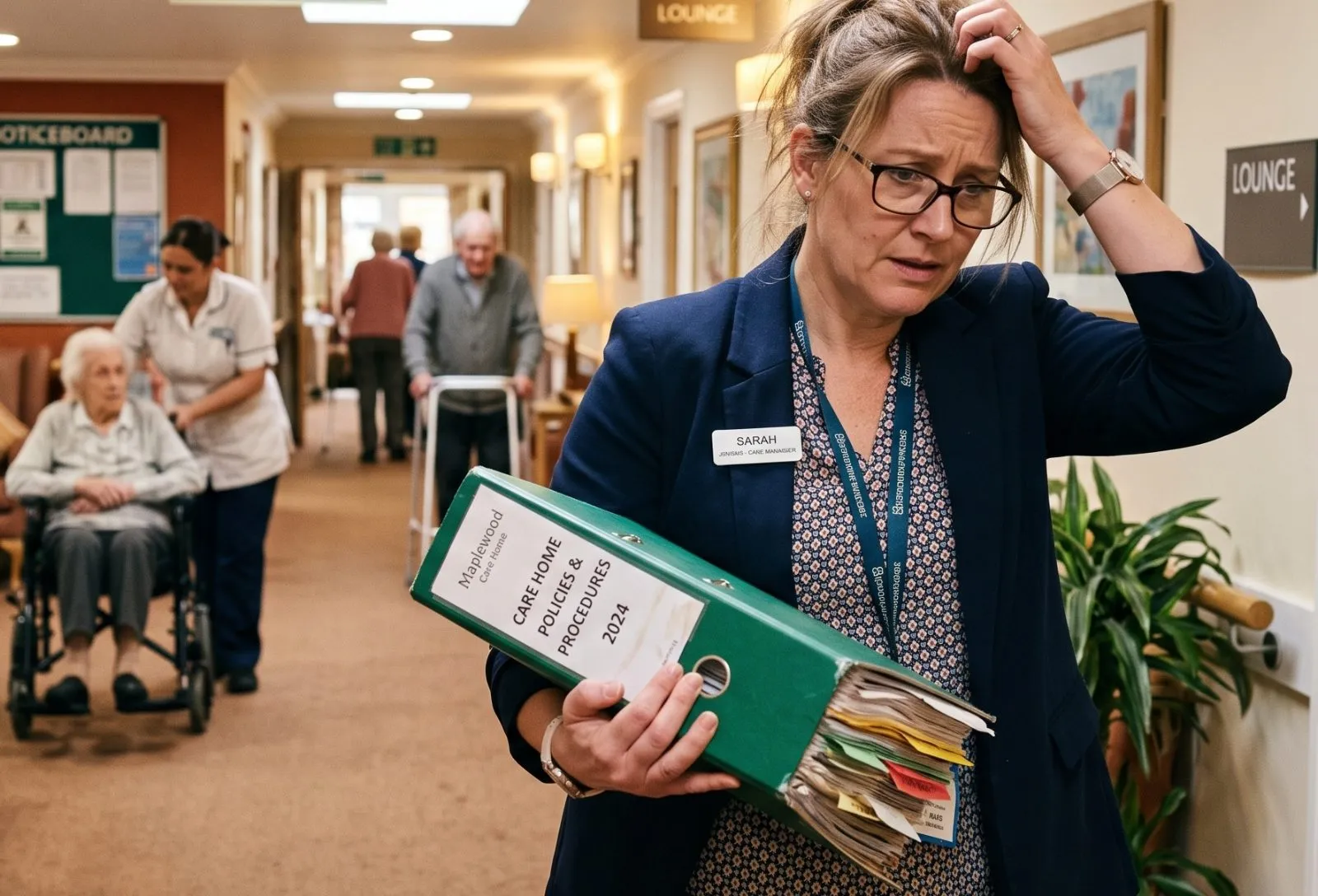
Your night shift has a question at 3am. Who answers it?
Most policies fail this test. They live in a folder, written in dense English, structured for nobody in particular and on a shelf in the manager's office. The carer who needs the answer cannot find it. The inspector who needs to trace it to a quality statement cannot see the thread. Both walk away with the same conclusion: the policy is not doing its job.
The fix is not more writing. It is better structure. This guide is for the person who actually writes the policies: the registered manager, the compliance lead, the director who has sat through an inspection and watched an inspector flick through a folder.
By the end, you will know how to write or revise a policy so an inspector can trace it to a quality statement within seconds, without the document reading like it was drafted for a regulator rather than your staff.
The Policy That Passes the 3am Test Fails the Inspector's Test
Your policies are written for two audiences. The first is a night-shift carer who needs an answer at 3am. The second is an inspector who needs to trace that answer to a quality statement. Most policies fail one of them. Some fail both.
The uncomfortable truth is this: if a policy is written purely for the inspector, staff will not read it. If it is written purely for staff, the inspector cannot map it. The craft is doing both in one document, and that craft is learnable.
The 2026 context matters here. CQC is moving from the Single Assessment Framework to sector-specific models later in 2026 (at the point of writing this post). The 34 quality statements are not disappearing overnight, but the evidence expectations are tightening. Policies written now should survive that transition, not need a full rewrite in twelve months.
The Dr Penny Dash review found the average assessment uses only 9.2 of the 34 quality statements. That is a useful number. Your policy set does not need to map to all 34. It needs to map to the ones your service actually touches. The practical question every writer should ask is simple: if an inspector picked up this policy cold, could they name the quality statement it evidences within 30 seconds?
If not, the mapping is not working.
What Quality Statements Actually Are (and What They Are Not)
Quality statements replaced the Key Lines of Enquiry and roughly 300 prompts in November 2023. There are 34 of them across the five key questions: Safe (S1 to S8), Effective (E1 to E6), Caring (C1 to C5), Responsive (R1 to R7), and Well-led (W1 to W8).
Each statement uses two voices. The "We statements" describe what your service commits to do. The "I statements" describe what a person using your service should experience. Your policies are the "we" side of that contract.
Quality statements are not regulations. They sit beneath the Health and Social Care Act 2008 (Regulated Activities) Regulations 2014. A policy maps to a quality statement, but it must also satisfy the underlying regulation. Know which regulation sits beneath each statement you write for. The Safe domain, for example, maps to Regulations 12 to 18. The Effective domain maps primarily to Regulations 9, 11, 12, 17, and 18. If you cannot name the regulation, you cannot defend the policy.
The six evidence categories are how CQC checks your claims: people's experience, feedback from staff and leaders, feedback from partners, observation, processes, and outcomes. Your policy is a "process" document. It becomes evidence only when staff can show they use it. A policy that sits in a folder is not evidence. It is a document.
The 2026 shift to sector-specific models means the universal 34 statements will be tailored to care settings. The mapping habit you build now will transfer. The specific statements may change.
The Mapping Method: Structure Before Words
Start with the statement, not the policy. Choose the quality statement your service actually needs to evidence, then write the policy to meet it. Do not write a policy and hunt for a statement to attach to it afterwards. That is how false mappings happen.
Use a simple mapping table at the top of each policy: quality statement reference, the regulation beneath it, the evidence categories it feeds, and the date of last review. This is a signpost, not a bureaucratic barrier. An inspector should be able to see the map before they read the first procedure.
The policy structure care home writers should use is consistent across every document: purpose, scope, responsibilities, procedure, training requirements, and references. The inspector should find the same skeleton in every policy. Consistency is a form of respect for the reader.
One policy can map to multiple quality statements, but one quality statement should not need six policies to evidence it. If it does, your policy set is fragmented. Consolidate. Keep a live register of which policies map to which statements. When CQC publishes the sector-specific frameworks later in 2026, that register is your gap analysis tool. You will re-map in days, not months.
Book a short demo and see how CareStream keeps your policies, training and CQC evidence in one place.
Book a demoBefore and After: Seeing the Mapping, Not Reading About It
Here is a sentence from a typical policy: "Staff will ensure that residents receive appropriate nutrition and hydration in line with their assessed needs." This sentence is true, safe, and useless. It maps to nothing an inspector can verify.
Here is the same sentence after mapping: "Staff will support each resident to eat and drink in line with their personal care plan, recording intake where a risk of malnutrition has been identified. This policy evidences quality statement E1 (assessing needs) and S8 (nutrition and hydration)." The meaning is the same. The trace is now visible.
Another example. Before: "The home will maintain a safe environment for all residents." After: "Staff will complete daily environmental safety checks using the checklist in Appendix A. Completed checklists are stored in the safety folder and reviewed monthly by the registered manager. This policy evidences S1 (learning from safety events) and S2 (safe environments)."
The difference is not more words. It is naming the behaviour, the record, and the statement. An inspector can verify the behaviour, find the record, and tick the statement. The trap is writing "this policy evidences S1" without changing the content. The mapping must be structural, not a label slapped on the first page.
Writing for the Night Shift and the Inspector in One Document
The 3am test still applies. A policy that maps beautifully but cannot be understood by a night-shift carer whose first language is not English has failed its primary purpose.
Use plain English throughout. Short sentences. Active voice. Define every term a new starter would not know. Your workforce includes staff born outside the UK. The failure is English-only paperwork, not their language skills. The policy should meet them where they are.
Put the procedure first, the regulatory mapping second. A carer needs the steps. An inspector needs the trace. Both can be in the same document if the structure is right. The carer reads the procedure. The inspector reads the mapping table and the references. Neither has to wade through the other's material.
Consider how staff will actually access the policy. A 14-page PDF in a shared folder is not accessible. Staff need to ask a question in their own language and get the answer from your policy within 30 seconds. That is what makes a policy live rather than filed. If your staff cannot answer a question from your policy at 3am, the policy is not evidence. It is a document. The CQC evidence category "processes" only counts when the process is followed.
The CQC Wording Alignment Review: Mapping What You Already Have
You do not need to rewrite your entire policy set to map to quality statements. The CQC wording alignment review in CareStream checks your existing policies against the framework's language and proposes edits you can approve or reject. The point is preservation. Your policies contain the operational truth of how your service runs. The review adds the mapping language around that truth, so the inspector can trace it without you starting from a blank page.
Every proposed edit is yours to accept or decline. Nothing changes in your documents until you approve it. The CareStream technology does not make things up. It works from what you have uploaded, and it cannot invent a quality statement reference that is not there.
The review also flags policy gaps: questions staff ask that your current documents do not answer, and legal changes your policies have not caught up with. That gap detection feeds your mapping register. The outcome is a policy set that maps to quality statements because the language aligns, not because you have forced a square peg into a round hole.
Keeping the Mapping Honest: What Not to Do
Do not claim a policy evidences a quality statement it does not actually meet. An inspector will test the claim. A false mapping is worse than no mapping.
Do not write policies for the inspector alone. If the document reads like a regulatory submission, staff will not use it, and the inspector will notice the disconnect between the policy and the practice.
Do not overload one policy with every quality statement you can find. Map to the statements your service genuinely touches. The average assessment uses 9.2 statements. Your policy set should reflect your reality, not the full 34.
Do not ignore the "I statements". Your policies should show how the service user's experience is designed in, not just what the service does. The Caring and Responsive domains are under-covered in most policy sets. That is an opportunity, not a burden.
Do not treat the 2026 sector-specific framework as a reason to wait. The mapping habit you build now transfers. The statements may change. The discipline does not.
The Evidence That Builds Itself
A policy is only as good as its audit trail. When staff ask questions through CareStream, every query is logged. When they complete training, every completion is recorded. That log becomes your CQC evidence pack. You can see, before an inspection, where your evidence is thin.
A quick demo shows exactly how CareStream would work for your service. Book a time that suits you.
Book a demoThe auto-generated CQC Readiness Report pulls your policies, staff questions, training completions, and audit results into one view. The policy gap detection flags unanswered staff questions. If three staff have asked the same question and your policies do not answer it, that is a gap you can close before an inspector finds it.
Training modules can be built around your own policies, so staff learn the document they will actually need to use. Scenario-based statutory training reinforces the mapping in practice. The promise is simple: your compliance evidence builds itself. You write the policies, staff use them, and the trail appears.
The 2026 Question: What Changes, What Does Not
CQC is moving to sector-specific assessment models later in 2026. The universal 34 quality statements will be tailored to care settings, with supporting questions closer to the old KLOE structure. The target of 9,000 assessments published by September 2026 means more providers will be inspected under the current framework before the transition completes. Your policies need to work for both regimes.
What changes: the specific statements, the evidence categories, and the way CQC tailors questions to your setting. What does not change: the need for policies that are readable, traceable, and actually used.
Build your mapping register now. When the sector-specific frameworks are published, you can re-map your policies to the new statements in days, not months. The providers who treat 2026 as a reason to improve their policy craft now will be the ones who sail through the transition. The ones who wait will be writing under pressure.
The Bottom Line
A policy that maps to a quality statement is not a different document. It is the same document, structured so the inspector can trace it and the night shift can use it.
Start with the statement, write the procedure, name the behaviour, and keep the record. That is the whole method. You do not need to rewrite everything. You need to align what you have, close the gaps, and keep the evidence trail alive.
The 2026 transition is coming. The providers who map their policies now will treat it as a refresh. The ones who do not will treat it as a crisis. Your policies are the voice of your service on paper. Make them speak to the inspector and the night shift alike.
Conclusion: Align What You Have, Then Keep it Alive
The method in this guide is sound, and it does not require a blank page. Your existing policies already contain the operational truth of how your service runs, and that truth is the hard part.
What is usually missing is the trace: the visible thread that lets an inspector move from a procedure to the statement it evidences without having to reconstruct your reasoning.
CareStream's wording alignment review works on the documents you have uploaded, checks their language against the framework, and proposes edits you can accept or decline. Nothing changes until you approve it, and nothing is invented, because the review can only work from what is actually in your policies. The gap detection sits alongside it, flagging the questions your staff keep asking that your documents do not answer, and the legal changes your policies have not caught up with.
Both feed the mapping register, which is the artefact that matters most as the framework moves. And underneath all of it, the audit trail accumulates while your team works: every query logged, every training completion recorded, so you can see where your evidence is thin before an inspector does. The craft this article describes is real and learnable.
What software removes is the part that does not reward craft at all, which is maintaining the register by hand every time the labels change.
Sources
- CQC: Appendix 1: The 34 quality statements · cqc.org.uk
- CQC: Single assessment framework: Safe · cqc.org.uk
- CQC: Review of CQC's Single Assessment Framework and its implementation · cqc.org.uk
- GOV.UK: Review into the operational effectiveness of the Care Quality Commission · gov.uk
- CQC: Give your views on draft sector-specific assessment frameworks · cqc.org.uk
- Legislation.gov.uk: Health and Social Care Act 2008 (Regulated Activities) Regulations 2014, Part 3 · legislation.gov.uk
- CQC: Regulations for service providers and managers · cqc.org.uk
Frequently asked
Do I need to map every policy to all 34 quality statements?
No, and trying to do so actively weakens your position. Assessments draw on a subset, not the full set. Map to the statements your service genuinely touches, and let the register show that honestly. A policy claiming to evidence eight statements will be tested against all eight, and the weakest claim is the one that gets examined.
What is the difference between a quality statement and a regulation?
The regulation is the law. The quality statement is how CQC frames its assessment of whether you meet it. Statements sit beneath the Health and Social Care Act 2008 (Regulated Activities) Regulations 2014, so a policy that maps neatly to a statement but fails the underlying regulation achieves nothing. If you cannot name the regulation, you cannot defend the policy, which is why the regulation belongs in the header table alongside the statement reference.
Where does the mapping table go, and does it put staff off?
At the top, as a header block, with the procedure immediately after. The two readers use different parts of the document. A carer reads the steps and never needs the table. An inspector reads the table and the references and can then verify the steps. The mistake is threading regulatory language through the procedure itself, which is what makes policies unreadable at 3am.
What actually makes a mapping structural rather than cosmetic?
Naming the behaviour, the record, and the reviewer. "Staff will ensure appropriate nutrition" is unverifiable. "Staff record intake on the food and fluid chart where a malnutrition risk has been identified, and the senior on duty reviews charts at handover" is verifiable because an inspector can ask to see the chart and ask the senior about handover. Adding a statement reference to the first sentence changes nothing. Rewriting the sentence is the work.
Should I wait for the new framework before mapping anything?
No. The five key questions have survived every framework change since 2014, and the discipline of naming the behaviour and keeping the record transfers regardless of what the labels become. What is worth deferring is a full re-labelling exercise, since the sector frameworks were still being refined after the consultation closed. Build the register now so the re-map is a short job rather than a project.
Written by
 Len BurgessSenior Care Advisor
Len Burgess has worked in the care sector for over 8 years, with hands-on experience across residential, nursing and community settings. Having supported teams through CQC inspections and the day-to-day reality of keeping a service compliant, he writes about regulation, quality and best practice in a way that's grounded in what actually happens on the floor, not just what the guidance says.