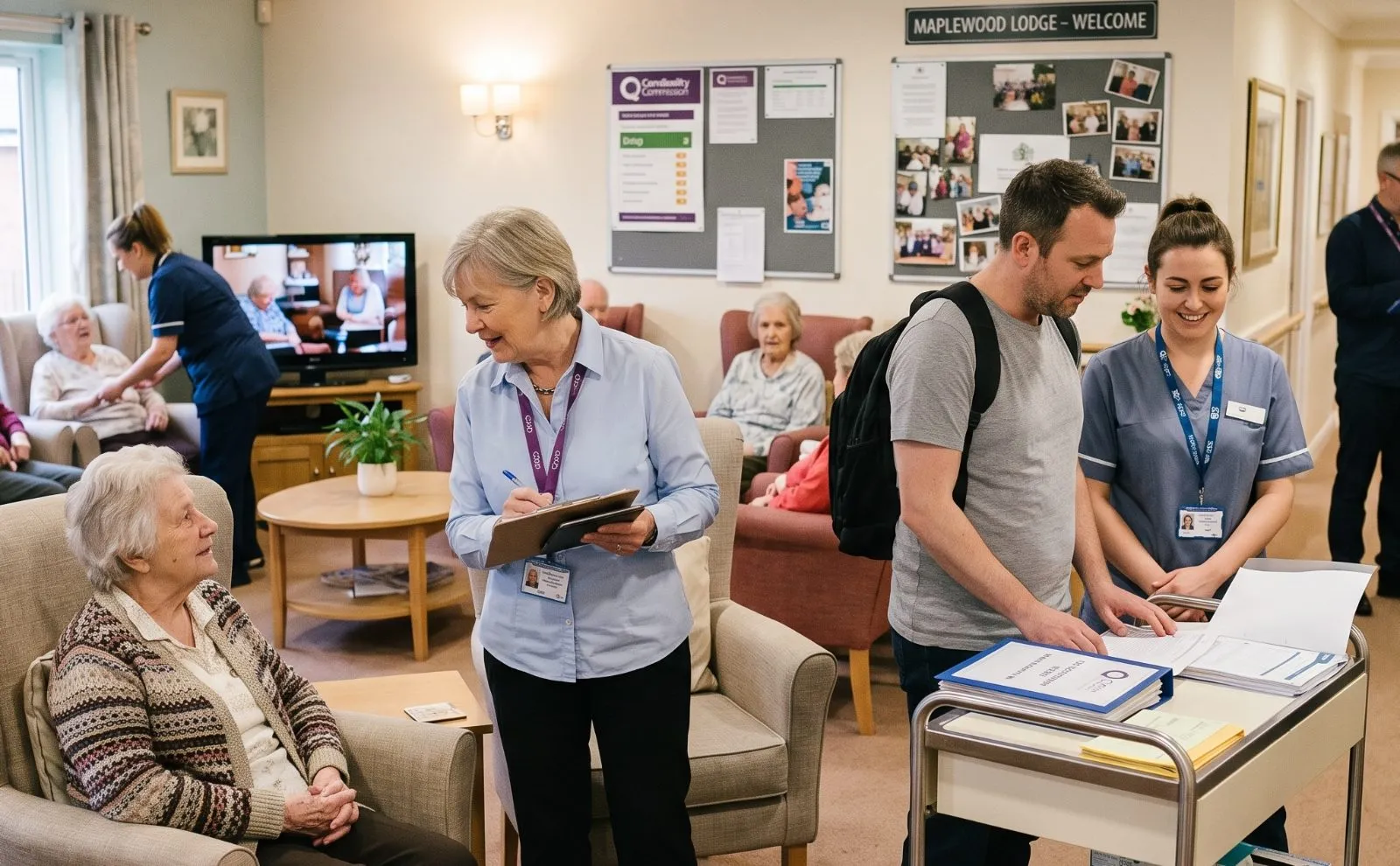
The CQC has changed its assessment framework twice in three years, and many providers are still trying to work out what inspectors actually look at. This piece is a straight guide to CQC quality statements.
By the end, you will understand what the quality statements are, how they replaced the old KLOEs, and what the 2026 return to KLOEs means for your evidence.
No hype, no product pitch. Just the facts, set out clearly.
What is the single assessment framework?
The Single Assessment Framework, known as the SAF, was formally introduced in November 2023, with a phased roll-out across all regions during late 2023 and early 2024. It is built around the five key questions that have anchored CQC assessment for years: Safe, Effective, Caring, Responsive, and Well-led.
What changed in 2023 was the detail beneath those five questions. The previous Key Lines of Enquiry, the KLOEs, were replaced by 34 quality statements. These are distributed unevenly across the five key questions: Safe has 8, Effective has 6, Caring has 5, Responsive has 7, and Well-led has 8.
The word "single" deserves a note. In theory, the SAF is one framework for all sectors. In practice, different sectors assess different numbers of quality statements. Adult social care initially selected 5 per inspection, now typically 10 to 12. Primary care advocates 18. A&E and emergency departments advocate 21. The framework is single in structure, but not in application.
The SAF is not a tick-box list. It is built around six evidence categories: people's experience, feedback from staff and leaders, feedback from partners, observation, processes, and outcomes. Inspectors gather evidence across all six, then use professional judgement to reach a rating.
The "I" and "We" statements, explained
Each quality statement is written from two perspectives. The "We" statement describes what the provider commits to do. The "I" statement reflects what the service user should experience.
A concrete example helps. A "We" statement might read: "We make sure there are always enough suitably qualified staff on duty." The matching "I" statement might read: "I am supported by staff who know me and have the right skills."
The practical implication is that your evidence needs to speak to both perspectives. A policy document covers the "We" side. A resident's account, a family's feedback, or an observation covers the "I" side.
The most common mistake providers make is evidencing only the "We" side, because it is easier to produce. Policies are written down. Experiences are harder to capture. But inspectors want to see both, and they will ask for the "I" side explicitly.
How the quality statements replaced the KLOEs
Before November 2023, the KLOEs were the framework. Providers built evidence libraries around them, mapped policies to them, and trained staff to speak to them. The SAF replaced the KLOEs with 34 quality statements.
The change was driven by a desire for a more person-centred, evidence-led approach that worked across all care sectors, not just adult social care. The CQC wanted a framework that could assess a dental practice and a care home using the same underlying structure.
What carried over was the spine. The five key questions remained. The quality statements were a reorganisation of the detail beneath them, not a clean break. Much of what sat under the old KLOEs could be mapped across to the new quality statements, but the mapping was not always obvious.
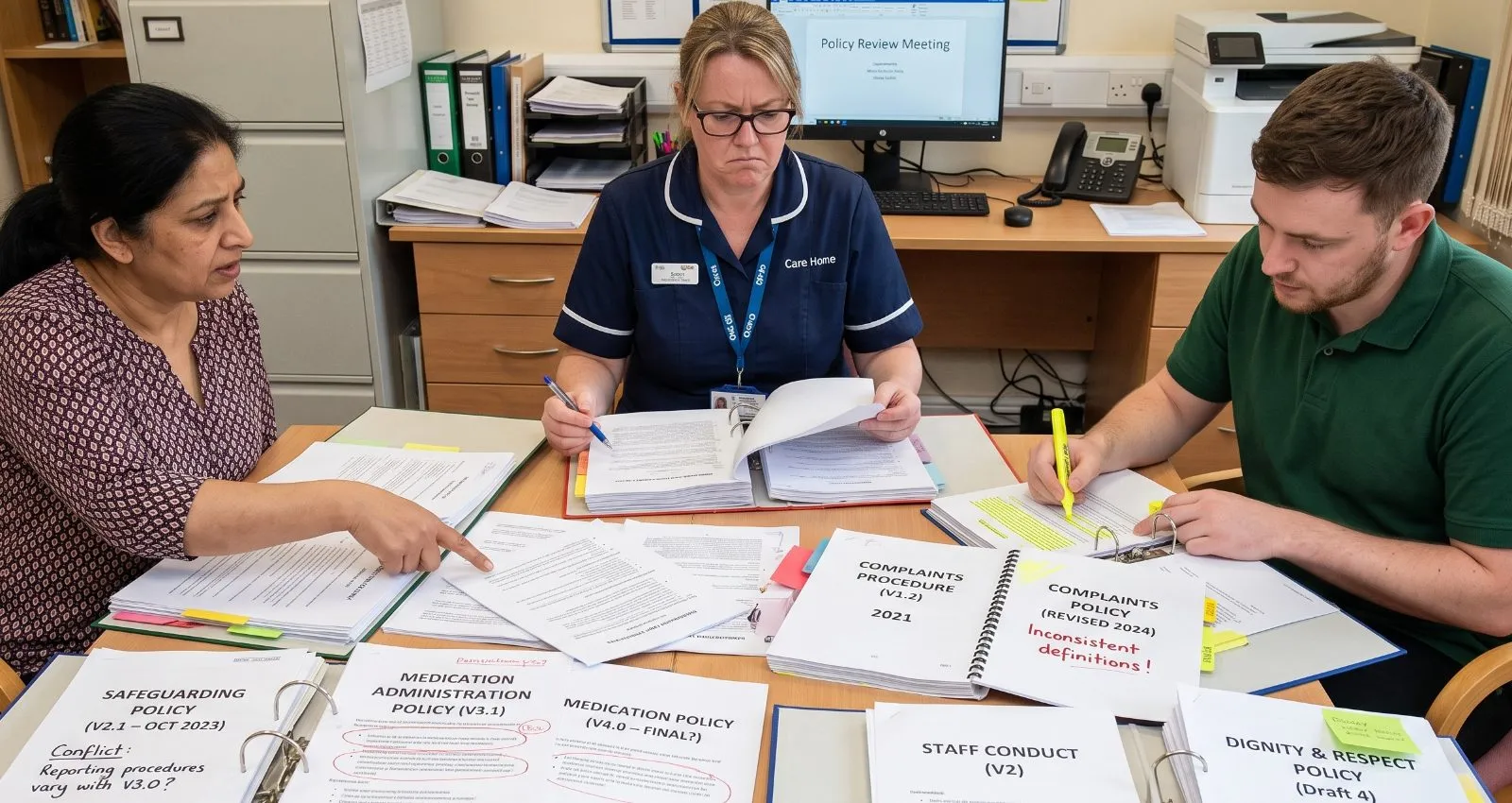
The practical reality for many providers was significant. Evidence libraries built around the old KLOEs had to be re-labelled, re-filed, and re-learned. Staff who had been trained to speak to one set of prompts had to adjust to another.
There is an irony here that most registered managers will already feel. The 2026 changes now reverse part of that shift. The KLOEs are coming back, in a new form.
Book a short demo and see how CareStream keeps your policies, training and CQC evidence in one place.
Book a demoWhat the 2026 changes mean for your service
On 24 March 2026, the CQC published four draft sector-specific assessment frameworks. The 34 quality statements are being replaced by 24 KLOEs. The new breakdown is: Safe (7), Effective (4), Caring (3), Responsive (4), Well-led (6).
The consultation on the 2026 framework closed on 12 June 2026 at 5pm. Pilots are expected through the summer, with the new framework going live towards the end of 2026.
The most significant change is the removal of scoring. Under the new framework, scoring is replaced with professional judgement against rating characteristics at key question level. Inspectors will no longer allocate numerical scores to evidence. They will weigh the evidence as a whole and reach a judgement.
Three independent reviews drove this change. Penny Dash, Mike Richards, and the Care Provider Alliance all concluded that the SAF was too generic, lacked scoring transparency, and left providers guessing what "good" looked like. The CQC has accepted that critique and is now moving in a different direction.
The practical implication for providers is that the evidence you are collecting now is not wasted. The six evidence categories remain relevant. The five key questions remain. But you will need to re-map your evidence against the new KLOEs when the framework goes live. If your evidence library is currently organised around the 34 quality statements, start planning for that re-mapping now.
What providers most often misunderstand
The first misunderstanding is that all 34 quality statements are assessed every time. They are not. The CQC selects a subset per inspection, and the number varies by sector. Adult social care inspections typically assess 10 to 12. Primary care advocates 18. A&E departments advocate 21. Preparing for all 34 is sensible. Expecting all 34 to be assessed is not.
The second misunderstanding is that the quality statements are a checklist. They are not. They are prompts for professional judgement. Two providers with identical paperwork can receive different ratings because the inspector's judgement of the evidence differs. The quality statements guide the conversation. They do not determine the outcome.
The third misunderstanding is that the 2026 changes mean starting from scratch. They do not. The five key questions remain. The evidence categories remain. The shift is from 34 quality statements to 24 KLOEs, and much of your existing evidence will map across. The work is re-mapping, not rebuilding.
The fourth misunderstanding is that the "single" framework is truly single. It is not. Different sectors assess different numbers of quality statements, and the CQC's own review acknowledged this makes key question ratings potentially unreliable. The 2026 move to sector-specific frameworks is a direct response to that problem.
The fifth misunderstanding is that the new framework fixes everything. The reviews identified real problems with the SAF, but the 2026 framework brings its own uncertainties, including the removal of scoring and the return to professional judgement. Providers who found scoring opaque may find pure judgement equally difficult to predict.
How to prepare for the 2026 framework now
Do not wait for the final framework. The consultation closed on 12 June 2026, and the direction of travel is clear. Start mapping your evidence against the 24 KLOEs now, even in draft form. The earlier you start, the less disruptive the transition will be.
Audit your current evidence library against the six evidence categories. Identify gaps where you have processes but no outcomes, or policies but no people's experience. Those gaps will be harder to close under time pressure.
Pay attention to the sector-specific frameworks. The four draft frameworks cover adult social care, hospitals, primary care, and mental health. The days of one generic framework are ending. Make sure you are preparing for the right one for your service type.
Watch the placement of evidence. The CQC's own review noted that some quality statements sit under the wrong key question. For example, "workforce wellbeing and enablement" is under Caring when it might be better placed under Well-led. Be ready to move evidence between key questions as the new framework clarifies.
A quick demo shows exactly how CareStream would work for your service. Book a time that suits you.
Book a demoUse the consultation period to feed back. The CQC is listening, and the reviews show it is responsive to provider concerns. If the draft KLOEs create problems for your service, say so before 12 June.
Keep your evidence live. The worst position is to be caught with a static evidence library that reflects the 2023 framework, not the 2026 one. Evidence that is updated regularly is evidence that survives a framework change.
The bottom line
The KLOEs were replaced by quality statements in 2023. The quality statements are now being replaced by a new set of KLOEs in 2026. The five key questions remain constant throughout.
The changes are significant but not a reset. Your evidence, your policies, and your people's experience all carry forward. For a detailed look at how to align your wording and evidence with the new KLOEs, see our guide on wording alignment.
Conclusion: The Spine Holds. The Labels Move.
The lesson of the last three years is not that CQC keeps changing its mind. It is that the five key questions have survived every change, and the labels underneath them have not.
Providers who built a static evidence library around 34 quality statements are now facing their second re-mapping exercise in three years, and the ones who will find it easiest are those whose evidence was never really filed under a label in the first place. That is the practical takeaway.
Evidence that is generated continuously by the running of the service, rather than assembled retrospectively against a framework, survives a framework change because it was never organised around the framework to begin with.
A logged staff query about a medication procedure is evidence of governance whether it sits under a quality statement or a key line of enquiry. A record of what your team searched for, found, and could not find speaks to both the "We" side and the "I" side without being re-labelled.
This is where a system like CareStream earns its place: not by predicting what CQC will do next, but by making the evidence trail a byproduct of daily work rather than a project that has to be rebuilt each time the structure moves.
The five key questions will still be there at the end of 2026. Build for those, keep the evidence live, and the re-mapping becomes an afternoon rather than a quarter.
Sources
- CQC: Give your views on draft sector-specific assessment frameworks · cqc.org.uk
- CQC: Assessment framework guidance · cqc.org.uk
- CQC: Review of CQC's Single Assessment Framework and its implementation (Sir Mike Richards) · cqc.org.uk
- GOV.UK: Review into the operational effectiveness of the Care Quality Commission (Dr Penny Dash) · gov.uk
- Mills and Reeve: CQC consults on sector specific assessment framework for hospitals and specialist care · mills-reeve.com
- Legislation.gov.uk: Health and Social Care Act 2008 (Regulated Activities) Regulations 2014, Part 3 · legislation.gov.uk
Frequently asked
Which framework am I being assessed under right now?
The Single Assessment Framework. Nothing has changed operationally. Four draft sector frameworks were published in March 2026, consultation closed in June, and piloting has been running over the summer, with implementation expected towards the end of 2026. Until then, the 34 quality statements are still the live structure, and preparing exclusively for the new KLOEs would leave you ready for an inspection you are not yet having.
Are all 34 quality statements assessed at every inspection?
No. CQC selects a subset, and the number varies by sector. Adult social care assessments typically cover a fraction of the full set. Preparing across all 34 is sensible because you cannot predict which ones will be chosen. Expecting all 34 to be assessed is different, and it leads providers to over-prepare in breadth and under-prepare in depth.
What is the difference between an "I" statement and a "We" statement?
The "We" statement is the provider's commitment, and it is evidenced by things you write down: policies, procedures, training records. The "I" statement is what the person receiving care should actually experience, and it is evidenced by things other people say: resident accounts, family feedback, and what an inspector observes. Most providers are strong on the first and thin on the second, because the first is easier to produce on demand.
Why is CQC scoring being removed?
Because three independent reviews found it opaque. Providers could not see how numerical scores at evidence-category level translated into a rating, and the same scores appeared to produce different outcomes in different services. Under the new approach, judgement is made directly at the key question level against published rating characteristics describing what outstanding, good, requires improvement and inadequate look like in each sector. Whether that proves more predictable than scoring is genuinely open.
When should I start preparing for the new framework?
Now, but in draft. Read the adult social care framework rather than a summary of it, audit your evidence against the six categories to find where you have processes but no outcomes, and identify which of your current evidence maps cleanly across. What is not worth doing yet is a full re-labelling exercise, because the frameworks are still in draft and were refined after the consultation closed.
Written by
 Len BurgessSenior Care Advisor
Len Burgess has worked in the care sector for over 8 years, with hands-on experience across residential, nursing and community settings. Having supported teams through CQC inspections and the day-to-day reality of keeping a service compliant, he writes about regulation, quality and best practice in a way that's grounded in what actually happens on the floor, not just what the guidance says.