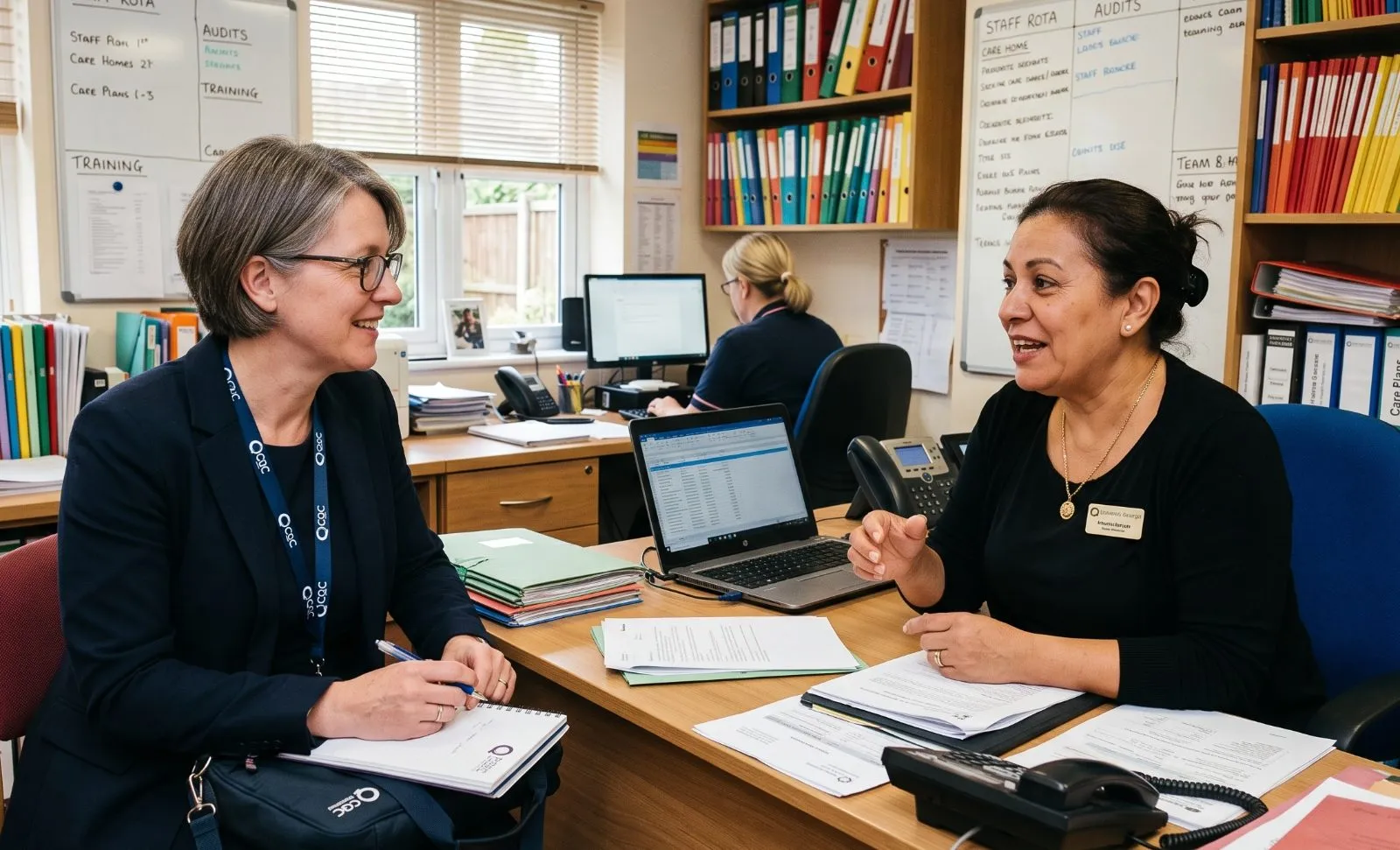
Most providers use CQC vocabulary loosely in everyday conversation. A manager says "we need to notify CQC" when they mean they should mention something in an email.
A team leader calls a quick corridor chat "supervision". A policy says staff must follow "regulations" when it actually means internal guidance. None of this feels like a problem until an inspector sits across the table and starts asking precise questions. Then the looseness shows.
This post is a working glossary of the regulatory terms social care providers most often get wrong. It is not a full dictionary. It is a judgement call on which words carry genuine weight in an inspection conversation, with the CQC meaning set against the loose provider usage.
If you have been through at least one inspection, you already know the feeling of realising you and the inspector were not quite speaking the same language. This is the translation guide.
Why the Words You Use Matter More Than You Think
Inspectors listen for how you talk about your service as much as what you say about it. When a manager uses "evidence" to mean a strong feeling, or "notification" to mean a casual update, the inspector hears something specific: this provider does not fully understand the framework they are being assessed against. That is rarely a conscious judgement. It is simply the gap between everyday usage and regulatory meaning, and it costs providers credibility without them realising it.
Your policies, your team meetings, and your supervision notes all feed the inspector's picture of your service. The vocabulary runs through everything. A policy that uses "personal care" loosely, a supervision record that describes an informal chat as structured support, a notification log that does not exist because nobody knew it was required. Each one is a small signal. Together they form a pattern.
This is not about sounding clever. It is about being precise enough that your evidence and your conversation match the regulator's framework. The cost of getting it wrong is not enforcement. It is being misunderstood. A good inspection conversation depends on speaking the same language.
The Five Key Questions: The Spine of Every Inspection
Safe, Effective, Caring, Responsive, Well-led. These five questions structure every CQC inspection and every rating decision. They are the spine of the Single Assessment Framework, and they will remain the spine under the 2026 reforms. If you remember nothing else from this post, remember that these are not adjectives. They are assessment categories.
Providers often use these words as descriptions of intent. "We're a caring team." "We're responsive to families." The inspector uses them as a framework with specific evidence requirements. Safe means more than physical safety. It covers infection control, medicines management, safeguarding, and staffing levels, all evidenced against clear benchmarks. Caring means dignity, compassion, and respect shown in records and observed practice, not just in the manager's description of the culture.
Well-led is the one providers most often misunderstand. It is not about having a nice manager or a stable team. It is about governance, leadership, and a culture of learning. Inspectors look for how the service identifies problems, responds to them, and improves. They look at meeting minutes, audit cycles, and how complaints feed into change. A service can be warm and well-intentioned and still fail on Well-led because the systems are not there.
When you use these words in conversation with an inspector, use them as categories of evidence, not as descriptions of intent. Say "our evidence for Safe includes our medicines audit trail and our safeguarding log", not "we're a very safe service". The first sentence invites the inspector to look at your records. The second invites them to test your claim.
The 2026 Shift: From Quality Statements Back to KLOEs
The Single Assessment Framework introduced 34 quality statements in 2023. Under reforms announced in 2026, these are being replaced by key lines of enquiry, or KLOEs, framed as structured questions. This matters for your vocabulary because the inspector's questions will change shape. Your answers need to match the new structure.
The underlying evidence requirements are not disappearing. The framework is being reorganised, not relaxed. If your policies and your team's language still reference quality statements, now is the time to start aligning with the KLOE structure. The practical takeaway is simple: when an inspector asks a question, answer the question directly, then point to your evidence. That rhythm works under any framework.
The Terms Providers Misuse Most Often
This is the heart of the post. Each term below gets the CQC meaning set against the loose provider usage, so the gap is explicit. The terms chosen are the ones that carry regulatory weight, not the general care vocabulary. If a word does not affect an inspection outcome, it is not here. Think of this as a CQC language glossary for the terms that actually matter.
Book a short demo and see how CareStream keeps your policies, training and CQC evidence in one place.
Book a demoPersonal Care
CQC meaning: physical assistance with eating, drinking, toileting, washing, bathing, dressing, oral care, and skin, hair, and nail care, plus prompting and supervising these activities.
Loose usage: any help a carer gives a resident, including medication prompts, companionship, or housekeeping.
Why it matters: the legal definition of personal care determines whether a service needs to be registered with CQC at all. Using it loosely blurs a boundary that has legal consequences. When you talk about your service's regulated activities, use "personal care" in its precise sense.
Regulation
CQC meaning: the specific regulations made under the Health and Social Care Act 2008 that set out the legal requirements providers must meet.
Loose usage: any rule, guideline, or good practice recommendation, often used interchangeably with "guidance" or "best practice".
Why it matters: regulations are legally enforceable. Guidance is not. Calling guidance a regulation inflates its status, and calling a regulation guidance underplays it. If you are not sure whether something is a regulation or guidance, check before you say it in an inspection conversation.
Notification
CQC meaning: a legal duty to tell CQC about specific events, such as deaths, injuries, abuse, or changes to the service, within set time limits.
Loose usage: any informal update or conversation with the regulator.
Why it matters: failing to submit a required notification is a breach of regulation in itself, separate from the incident that triggered it. Keep a log of every notification you submit. If an inspector asks, you can show the trail.
Evidence
CQC meaning: the documented proof that a provider meets a regulation or quality statement. It is what inspectors look for when they test a rating.
Loose usage: anything that supports a claim, including anecdote, memory, or intention.
Why it matters: an inspector cannot rate a service on what the manager says they do. They rate it on what the records show. If it is not written down, it did not happen. That is the standard your evidence needs to meet.
Supervision
CQC meaning: a formal, recorded process of structured support and review for staff, with specific expectations around frequency and content.
Loose usage: any conversation between a manager and a staff member, including informal check-ins or catch-ups.
Why it matters: inspectors look for supervision records as evidence that staff are supported and developed. Informal chats do not count. Make sure your supervision records are dated, signed, and show a clear structure. That is what the inspector expects to see.
How to Check Your Whole Policy Library for Loose Usage
Reading through every policy term by term is the thorough way to catch loose usage, but it takes time your team does not have. The faster route is to check how often the loose terms appear across your documents, and where they sit in context. A policy that uses "supervision" correctly in one paragraph and loosely in the next is still a problem, because the inspector reads the whole document.
CareStream's policy access platform can scan your uploaded policies and handbooks for the loose usages covered in this post, flagging where the language drifts from regulatory meaning. The policy gap detection flags unanswered staff questions and tracks legal changes, so you know when a policy has drifted out of date. The point is not to rewrite everything. It is to know where the gaps are before an inspector finds them. Your policies are the foundation of your evidence. If the vocabulary in them is loose, the evidence built on top of them will look shaky.
Building a Vocabulary That Survives Contact With an Inspector
Consistency matters more than perfection. If your team uses the same terms in the same way across policies, meetings, and records, the inspector sees a coherent service. If one document says "notification" and another says "update" for the same legal duty, the inspector sees a service that has not settled its vocabulary.
Make the glossary part of your induction and supervision conversations, not a one-off handout. The terms in this post are the starting point, not the whole dictionary. Build your own local glossary for terms specific to your service type. A domiciliary care provider will have different inspection vocabulary priorities than a nursing home or a supported living service.
When you are unsure of a term, check the CQC's own guidance rather than guessing. The regulator publishes its definitions openly, and they are the ones your inspector will be using. The goal is not to sound like a regulator. It is to be precise enough that your evidence speaks clearly.
The Shortcut: Let the Platform Do the Checking
CareStream's AI answers staff questions in 60+ languages in under 30 seconds, drawn only from your own uploaded policies and handbooks. Every query is logged automatically, building an audit trail that shows inspectors how your team actually accesses policies. The CQC Readiness Report pulls your evidence together automatically, so when an inspector asks, you have the record ready.
A quick demo shows exactly how CareStream would work for your service. Book a time that suits you.
Book a demoThe platform does not replace your judgement. It removes the admin that gets in the way of it. Set up in under an hour, no app download, no password friction. The compliance evidence builds itself while your team gets answers in their own language.
What This Means for Your Next Inspection
The vocabulary you use tells the inspector how your service thinks about compliance. Precision signals a service that understands the framework. Loose usage signals a service that has not quite internalised it. The gap between loose usage and regulatory meaning is closing across the sector as the 2026 reforms take shape. Get ahead of it now.
You do not need to memorise the entire CQC dictionary. You need to know the terms that carry weight in your service, and use them consistently. Bookmark this post. Share it with your team. Use it as a reference when you are writing policies or preparing for inspection. The inspection conversation is easier when you are speaking the same language as the inspector. This glossary is your translation guide.
Conclusion: Precision Is a System, Not a Memory Test
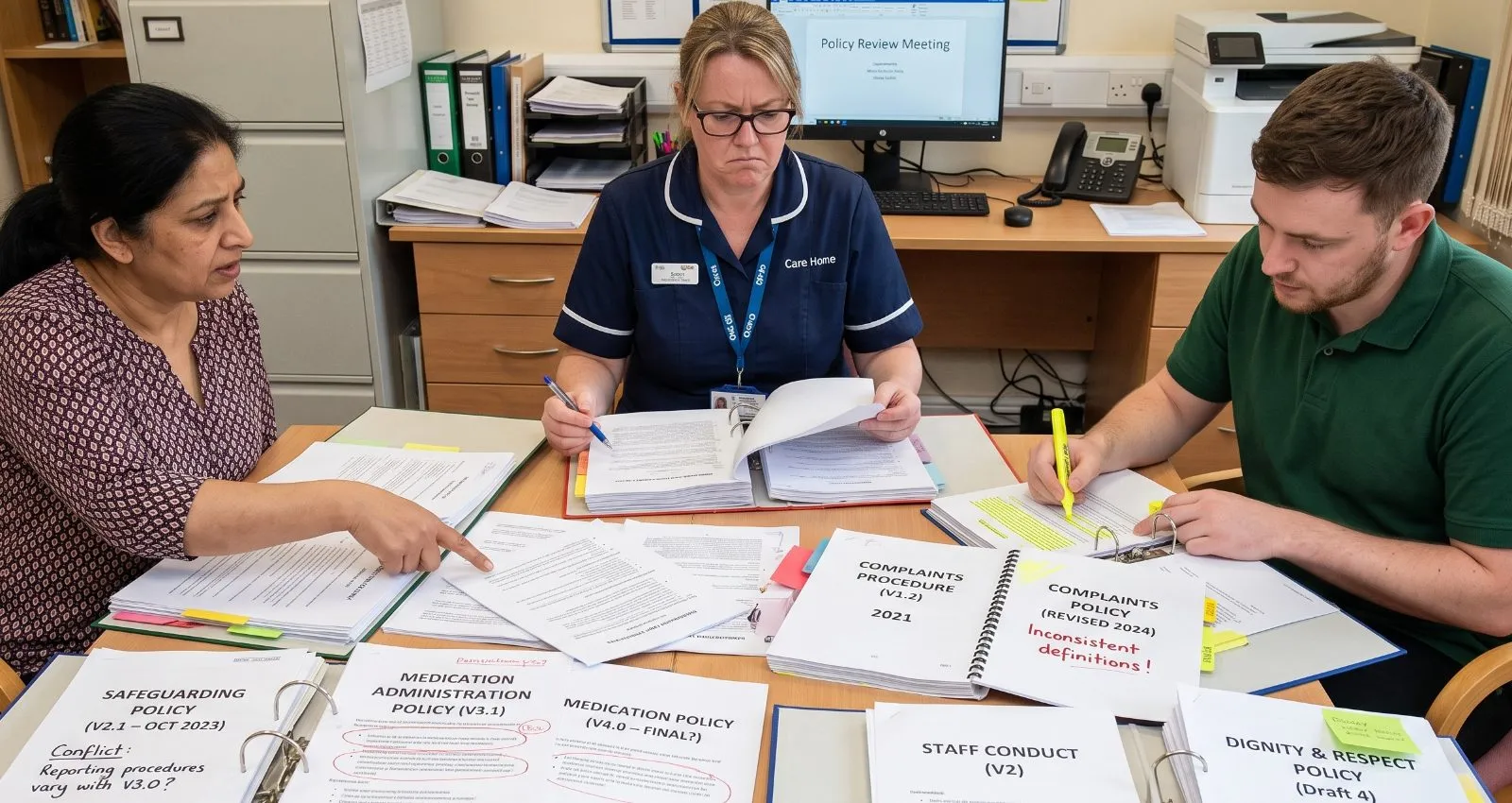
A glossary works if the whole team reads it and nobody drifts. In practice, drift is the default. A policy written in 2021 says "supervision" one way, a handbook added last year says it another, and a new starter learns whichever version they happened to read first.
That is the problem CareStream is built for. The platform scans your uploaded policies and handbooks and flags where the language slips away from regulatory meaning, so you can see the drift as a list rather than discovering it mid-conversation with an inspector.
Gap detection sits alongside it, surfacing the questions your staff keep asking that your documents do not answer, and the legal changes your policies have not caught up with. And because staff get their answers from your live documents, in the language they think in, the vocabulary they use is the vocabulary you approved rather than the vocabulary they half remember from induction.
Every query is logged, which quietly answers the harder question underneath this entire post: not whether your team knows the right words, but whether they can find the right answer when it matters.
The point was never to sound like a regulator. It is that your evidence and your conversation should describe the same service.
Sources
- CQC: Regulation 18: Notification of other incidents · cqc.org.uk
- CQC: Regulation 16: Notification of death of service user · cqc.org.uk
- CQC: Regulations for service providers and managers · cqc.org.uk
- CQC: Regulation 18: Staffing (2014 Regulations) · cqc.org.uk
- CQC: Assessment framework guidance · cqc.org.uk
- Legislation.gov.uk: Health and Social Care Act 2008 (Regulated Activities) Regulations 2014, Schedule 1 · legislation.gov.uk
Frequently asked
Why does vocabulary affect an inspection outcome at all?
It does not directly. What it affects is whether the inspector can follow your account of the service you provided. When a manager uses "notification" to mean an email and "supervision" to mean a corridor chat, the inspector has to keep translating, and translation invites verification. Precision is not about sounding impressive. It shortens the distance between what you do and what the inspector can confirm you do.
What counts as a notification, and what does not?
A notification is a legal duty under the CQC (Registration) Regulations 2009 to tell the CQC about specified events, including deaths, serious injuries, abuse and allegations of abuse, police involved incidents, DoLS outcomes, and events that stop the service from running safely. Most must be sent without delay, using CQC's own forms. An email to your inspector is not a notification. Failing to submit one is a prosecutable offence in its own right, separate from whatever triggered it.
Does an informal chat count as supervision?
No, and this is one of the most common gaps in an evidence pack. Supervision is a recorded, structured process of support and review, evidenced by dated records that show what was discussed and agreed. A useful five-minute conversation in the corridor may be better support than a formal session, but it is not something an inspector can examine. Both can happen. Only one is evidence.
Why does the precise meaning of "personal care" matter?
It determines whether a service needs to be registered with CQC at all. The statutory definition covers physical assistance with, or prompting and supervising, activities such as eating and drinking, toileting, washing and bathing, dressing, oral care and care of skin, hair and nails. Using it loosely to mean any help a carer gives blurs a boundary that has legal consequences, particularly for services near the registration threshold.
What is the difference between a regulation and guidance?
Regulations are legally enforceable and some carry criminal liability. Guidance describes how to meet them and does not. Inflating guidance to regulation status makes your service look uncertain about its own obligations; downgrading a regulation to guidance is the more dangerous error. If you are unsure which you are dealing with, check before the inspection rather than during it.
Written by
 Len BurgessSenior Care Advisor
Len Burgess has worked in the care sector for over 8 years, with hands-on experience across residential, nursing and community settings. Having supported teams through CQC inspections and the day-to-day reality of keeping a service compliant, he writes about regulation, quality and best practice in a way that's grounded in what actually happens on the floor, not just what the guidance says.