A set of domiciliary care policies and procedures is not a care home set with the words changed. A care home controls its building, its corridors and its medicines room. A home care agency controls none of them, because every visit happens in a place the person owns or rents.
That single difference opens five gaps. Lone working, key safes, travel time, missed visits and medicines in a person's own home each need rules of their own.
The five gaps at a glance
The list below is the short version. Each item has its own section after it.
- Lone working: nobody else is in the room, so the policy must say how a worker stays in touch.
- Key safes: a code is a key to someone's home, so the policy must say who holds it.
- Travel time: the rota decides whether visits can start and end when they should.
- Missed visits: the agency must define one, detect it and act on it.
- Medicines: they belong to the person, so the policy must say what support a worker gives.
Lone working: the policy has to work when nobody is watching
In a care home a colleague is usually a shout away. In a person's home the worker is alone for most of the visit.
Have your policies read against the regulations to see what is missing or out of date. No card needed.
Create a free accountThe Health and Safety Executive says an employer must manage health and safety risks before people can work alone. It describes a lone worker as someone who works by themselves without close or direct supervision.
Its leaflet on protecting lone workers lists training, supervision, monitoring and support as the employer's tools. A lone working policy domiciliary care managers rely on should turn each into something a worker can follow.
We suggest it answers five questions:
- How does a worker check in, and with whom?
- What happens when a check in is missed?
- Who is reachable out of hours, and by what number?
- What is assessed about a person's home and household before the first visit?
- When do two workers attend instead of one?
Lone working in social care also carries road risk. Workers drive or walk between visits. The same policy should say what to do after an incident on the way.
Key safes: who holds the code?
A key safe is the usual way into the home of someone who cannot get to the door. Its code is therefore a key, and the policy must treat it that way.
No regulation tells an agency what a key safe policy should say, so what follows is our suggestion. It should name who may hold a code and how it is passed on.
It should also say how a code is changed when a worker leaves, and what a worker does when the safe will not open. The hardest case is a person who does not answer the door. The policy needs a step by step route for that moment, ending with who is called and when.
Travel time is a policy matter, not only a pay matter
A visit rota that ignores travel time between visits produces late arrivals and short visits. Both land on the people being supported.
On pay, the GOV.UK guidance on minimum wage working hours counts driving from one client to another between appointments as time worked. Travel from home to the first visit does not generally count.
Staffing is a separate duty. Under Regulation 18 (the duty on staffing), a service must deploy enough skilled and experienced staff.
In our view the travel section of a policy should say how travel is planned into each round. It should say who may change a round on the day, and how late and shortened visits are recorded with their cause.
Missed visits: define one before you count one
Ask three managers what a missed visit is and you may hear three answers. A visit that never happened is one. A visit that came hours late may or may not be. A visit cut to half its length is a third case.
No regulation fixes the definition, so the agency must. We suggest the policy separates missed, late and shortened visits. It should also set the point at which a visit is declared missed.
It should also say how a miss is detected, who rings the person, and who rings the family where the person agrees. The record should end with what was learned. That is the step most often skipped.
The free policy check shows where a policy falls short of the regulations. Create a free account to begin.
Create a free accountRegulation 12 requires care to be provided in a safe way. A missed visit is where that duty is easiest to test, because the person may be alone with a need that was not met.
Medicines in a person's own home
In a care home the service holds the medicines. At home they belong to the person. The worker supports a routine the person already has. That is medicines support, and it needs a policy of its own.
NICE guideline NG67 covers adults who get social care in the community. Care homes have a separate NICE guideline. NG67 says a provider that supports medicines should have a documented medicines policy.
NG67 also asks for the care plan to record what support each medicine needs. It records how the support is given, who gives it and when it is reviewed.
In our view a medication policy domiciliary care agencies can show an inspector names three levels of support. They are prompting, assisting and administering. Each needs its own competency check and recording rule.
Regulation 12 of the 2014 Regulations lists the proper and safe management of medicines among its requirements.
What carries over from a care home set
Not everything changes. Home care agency policies share a core with any regulated service. Safeguarding, complaints, data protection, whistleblowing and duty of candour all apply to a home care agency in the same way.
Parts of those policies still need the home care detail. A safeguarding policy, for example, must work for a worker alone with someone in their house. Review each shared policy for that change in setting.
Benefits of CareStream for domiciliary care policies and procedures
If you are reviewing domiciliary care policies and procedures, CareStream can test the set you already hold before anyone else does.
- The free policy gap check takes up to 5 of your policies and rates each regulation that applies as covered, partly covered or a gap.
- It compares policies with each other and flags contradictions, which helps when a care home template has been adapted.
- It is free, with no card needed.
- Where there is a gap, a written policy costs from £39, is written for your service and arrives within two working days.
- Staff take the Care Certificate and the Medication Administration and Competency course free.
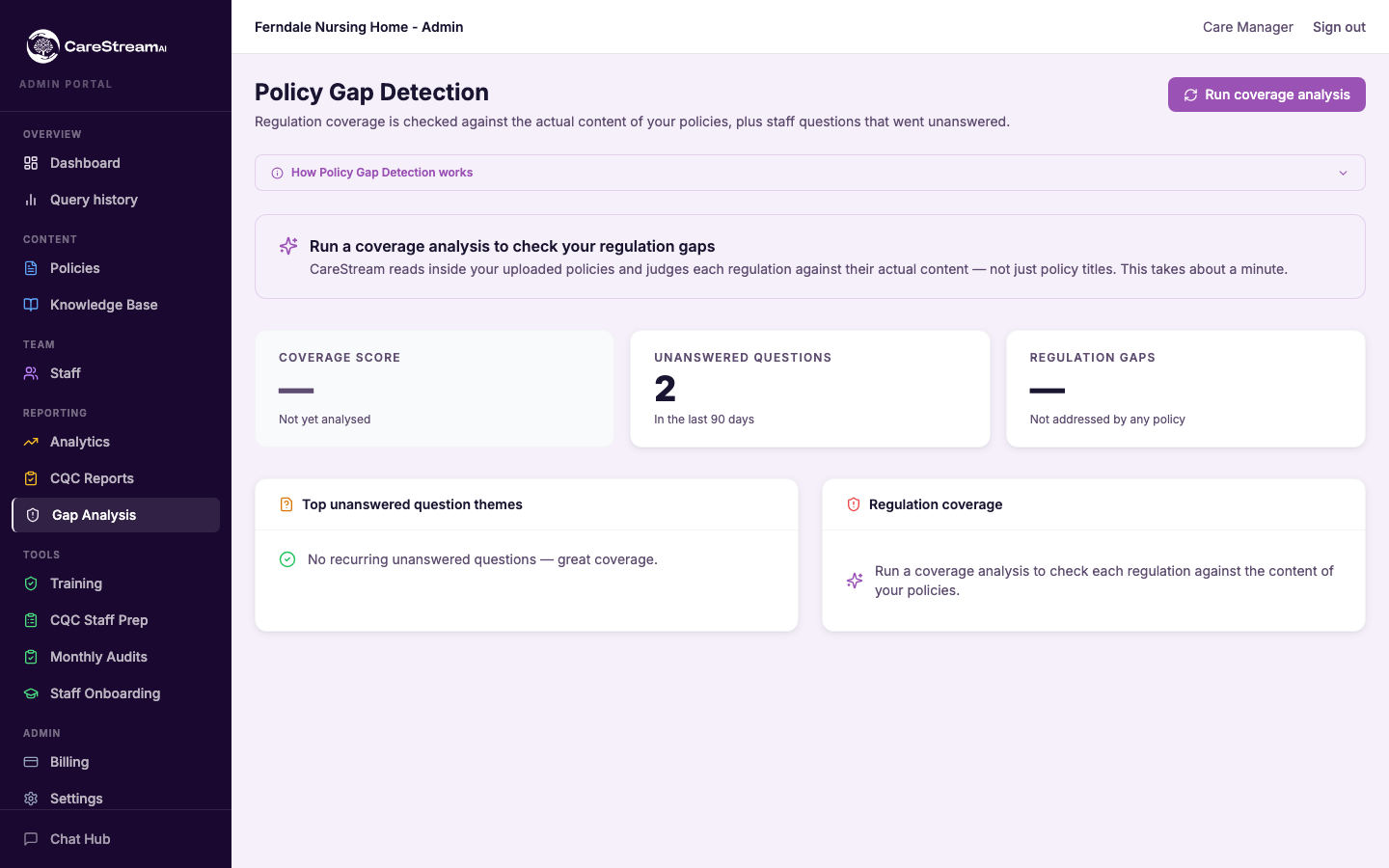
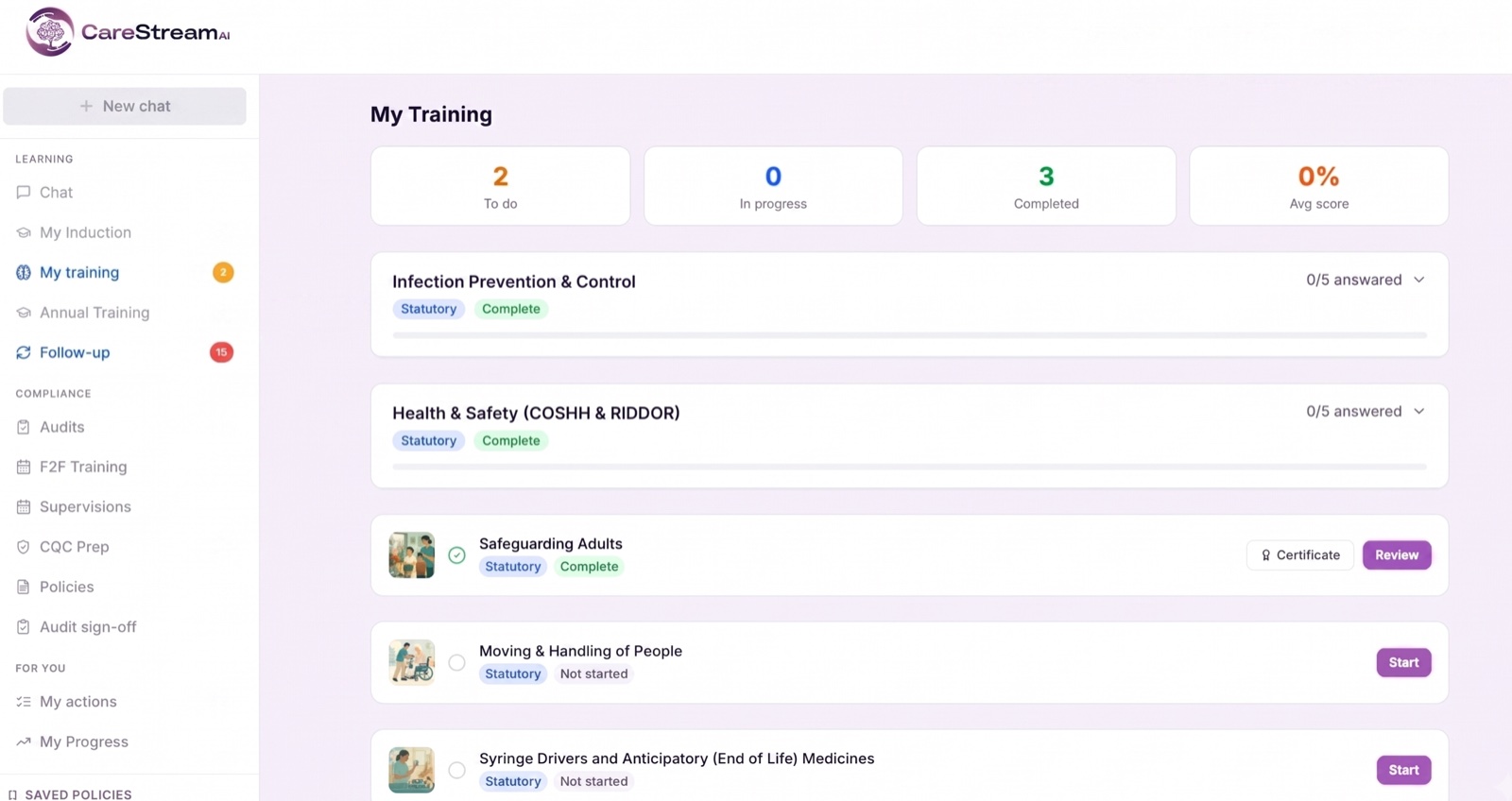
Figure: the gap check screen, where a coverage run marks each regulation against your own policies.
Hold your own set against the five gaps
Open your policy folder and search for five words: lone, key safe, travel, missed and medicines. A word with no match is a gap in your domiciliary care compliance. A match that only mentions care homes is nearly as useful to find.
Write the missing rules in your own words, name an owner for each and record a review. Then ask two workers what they would do when a person does not answer the door. If their answers differ, the policy is not yet doing its job.
CareStream has a page for domiciliary care providers. For a list of policies and procedures for domiciliary care, start with the medicines policy.
Holding the right policies does not decide an inspection. It shows that the five hard parts of home care work have been thought through.
Sources
- Regulation 12, Safe care and treatment (legislation.gov.uk) · legislation.gov.uk
- Regulation 18, Staffing (legislation.gov.uk) · legislation.gov.uk
- Lone working, guidance for employers (Health and Safety Executive) · hse.gov.uk
- Protecting lone workers, INDG73 (Health and Safety Executive) · hse.gov.uk
- Calculating the minimum wage, working hours for which it must be paid (GOV.UK) · gov.uk
- Managing medicines for adults receiving social care in the community, NG67 (NICE) · nice.org.uk
Frequently asked