Care Certificate training that gets your team CQC-ready
- CQC-aligned, mapped to the Care Certificate framework
- Completed in the hub in over 60 languages
- A certificate for every staff member, for your CQC evidence
- A wrong answer triggers a follow-up lesson, so gaps are closed
- CPD Certified Course
No subscription needed. Bulk discounts from 10+ licences.
From £25.99 per staff member, one-off. No subscription needed.
Trusted by UK care providers
Specialists in the technology behind it all
The same technology behind the world's best products powers CareStream, so your team's care certificate training stays accurate, always up to date with the latest guidance, and is delivered in over 60 languages.
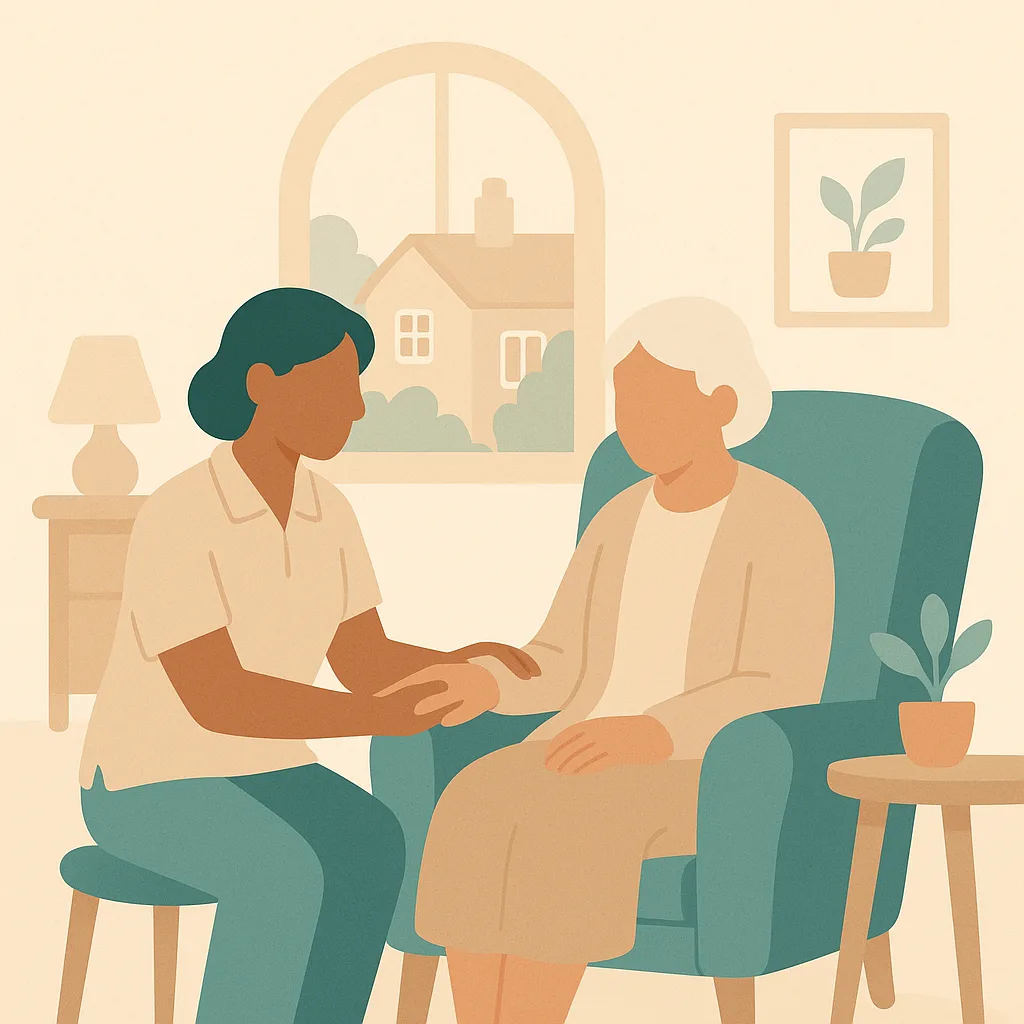
Standard 1: Understand your role
Your role is defined by your job description, your agreed ways of working, and the standards and codes that apply to care work, including the Code of Conduct for Healthcare Support Workers and Adult Social Care Workers. Working to your agreed ways of working matters because they translate legislation and your employer's policies into what you actually do on shift.
Know your main duties and responsibilities, and equally know the limits of your role: doing something you are not trained or authorised to do puts people at risk, however well meant.
Your relationships at work are professional ones. That means reliability, honesty, respecting boundaries with the people you support and their families, and working in partnership with colleagues and other agencies. Your own experiences, attitudes and beliefs will shape how you see situations. Being aware of that, and not letting it override a person's own choices, is part of professional practice.
When you are unsure about any part of your role, ask. Your supervisor, your policies and your induction materials are your agreed sources of guidance.
Working within the limits of your role means:
In the hub, a wrong answer sends the staff member a short follow-up lesson and a fresh question on the same point. They close the gap before they can finish the module, and every attempt is recorded for your CQC evidence.
That is how the training works. Give your whole team the full Care Certificate module.
Avg. Duration
About 1.5 hours
Certificate
For every staff member
Available Languages (60+)
CPD Certified Course

A clear, practical grounding in care certificate.
This annual refresher revisits all 16 Care Certificate standards updated in March 2025. Work through each standard in order. Every section ends with a scenario from a real care setting and a quick check. The course closes with a 32 question assessment with a pass mark of 80%, and an observed competency assessment completed with your manager.
By the end, your staff will be able to:
- Refresh working knowledge of every one of the 16 Care Certificate standards (March 2025)
- Apply the standards to everyday situations through workplace scenarios
- Identify what changed in the March 2025 update, including the new learning disability and autism standard
- Show your knowledge in the final assessment, and apply it in practice during an observed assessment by your employer
A closer look at the care certificate module.
The module is built in short, practical sections. Each one teaches a part of the topic, then applies it to a real care scenario and checks understanding before moving on.
Standard 1: Understand your role
Your role is defined by your job description, your agreed ways of working, and the standards and codes that apply to care work, including the Code of Conduct for Healthcare Support Workers and Adult Social Care Workers. Working to your agreed ways of working matters because they translate legislation and your employer's policies into what you actually do on shift. Know your main duties and responsibilities, and equally know the limits of your role: doing something you are not trained or authorised to do puts people at risk, however well meant. Your relationships at work are professional ones. That means reliability, honesty, respecting boundaries with the people you support and their families, and working in partnership with colleagues and other agencies. Your own experiences, attitudes and beliefs will shape how you see situations. Being aware of that, and not letting it override a person's own choices, is part of professional practice. When you are unsure about any part of your role, ask. Your supervisor, your policies and your induction materials are your agreed sources of guidance.
Standard 2: Your personal development
Care work changes: guidance is updated, people's needs change, and your own role develops. A personal development plan, agreed with your manager, records your objectives and how you will meet them. It is a live document, not a form filled in once a year. Feedback from others, in supervision, after incidents, and informally from colleagues and the people you support, is one of the most valuable sources of learning you have, because it shows you what you cannot see yourself. Reflection is the other: taking a few minutes after a difficult shift or an unfamiliar situation to ask what went well, what did not, and what you would do differently. This course itself is part of your development record. Completing your annual refresher, recording it, and acting on anything you found difficult keeps your knowledge current, which is exactly what CQC inspectors and your employer mean by continuing professional development. Functional skills matter here too: reading care plans accurately, writing clear records and using your service's digital systems are all part of doing the role well.

Standard 3: Duty of care
Duty of care is your legal and professional obligation to act in the best interests of the people you support, to keep them safe from harm, and to act within your competence. Duty of candour is its partner: being open and honest when things go wrong, telling the person and your employer promptly, and supporting an honest account of what happened. Dilemmas are part of care. A person's right to make their own choices can conflict with your duty to keep them safe, for example when someone with capacity chooses to do something risky. Your duty is not to prevent every risk but to make sure the person understands it, to reduce it where they agree, and to record and escalate your concerns. Know where support sits when a dilemma arises: your line manager, your policies, and where relevant advocacy services. Complaints and incidents are part of this standard. Respond to comments and complaints in line with your agreed ways of working, never obstruct them, and treat them as information the service needs. Recognise adverse events, incidents, errors and near misses, report them promptly, and be honest about your own part in them. Sorry, said early and sincerely, is part of candour, not an admission that ends your career.
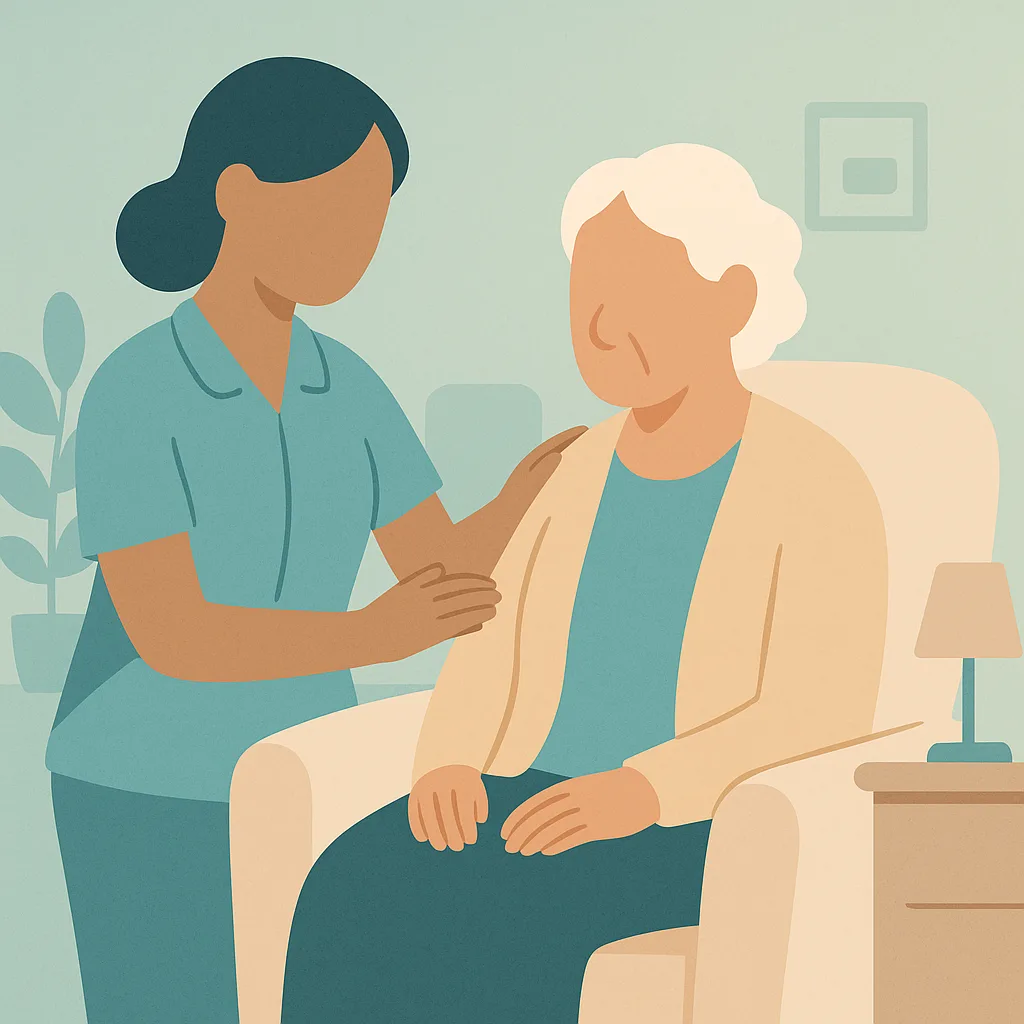
Standard 4: Equality, diversity, inclusion and human rights
This standard was strengthened in March 2025 to add inclusion and human rights explicitly. Equality means fair treatment and equal opportunity, underpinned by the Equality Act 2010 and its nine protected characteristics, which include age, disability, race, religion or belief, sex and sexual orientation. Diversity means recognising and valuing difference. Inclusion means people are not just present but genuinely involved: their voice shapes their own care. Human rights, protected by the Human Rights Act 1998, include dignity, respect for private and family life, and freedom from degrading treatment, and they belong to every person you support regardless of their needs. Bias can be conscious or unconscious, and discrimination can be deliberate or happen by neglect, for example when information is only ever provided in ways a person cannot use. Reduce the likelihood of discrimination by knowing the people you support as individuals, challenging exclusionary practice when you see it, and using your agreed ways of working. If you witness or suspect discrimination, report it: staying silent lets it continue. Where you need support on equality or inclusion questions, your manager, your policies and organisations such as the Equality and Human Rights Commission provide it.
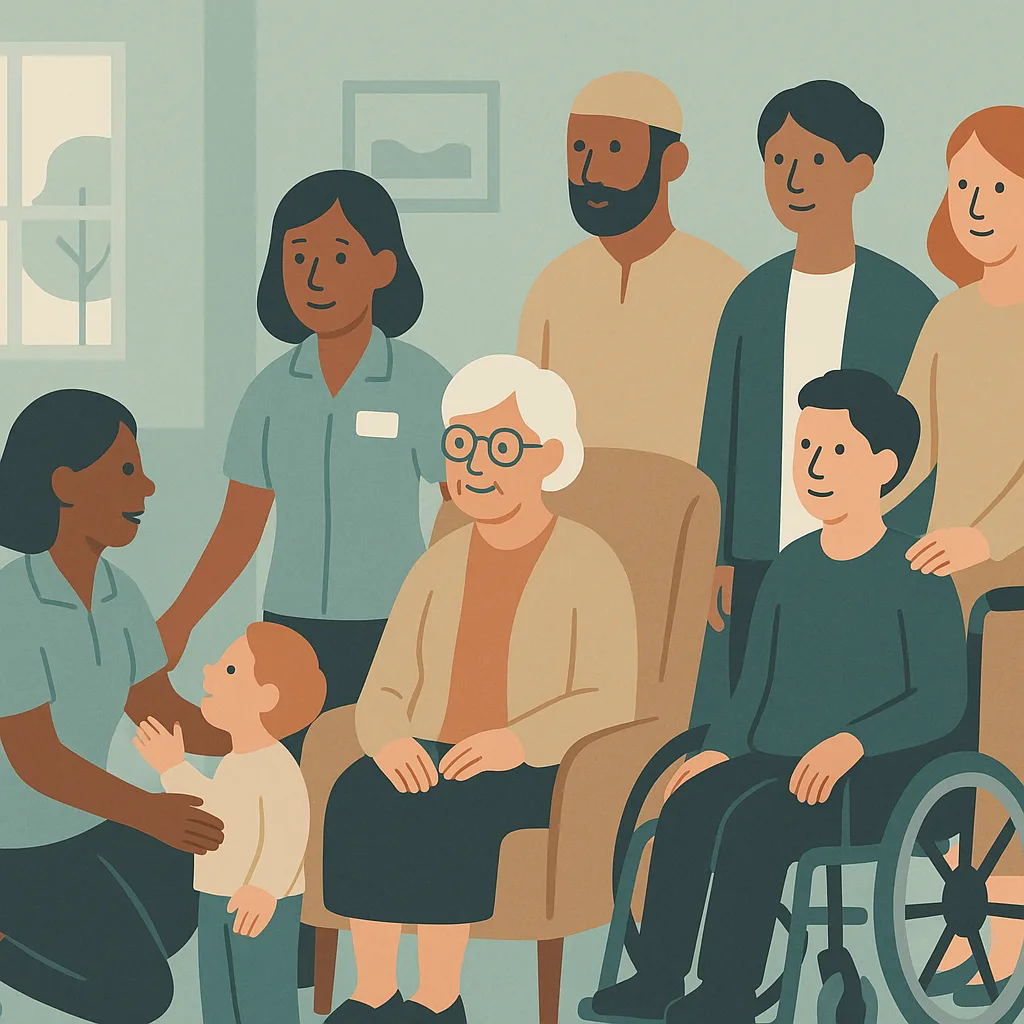
Standard 5: Work in a person-centred way
Person-centred values put the individual at the centre of everything: individuality, independence, privacy, partnership, choice, dignity, respect and rights. In practice that means care built around the person's history, preferences, wishes and needs, not around the routine of the service. Care plans are the tool for this, and they only work when they are current: report changes in a person's needs or wishes so the plan stays true to them. Working in a person-centred way includes supporting people in distress, being aware of their emotional and spiritual wellbeing, not only their physical needs, and recognising the environment matters, from noise levels to whether their room feels like their own. Promote dignity in every interaction. Support people to maintain their identity and self-esteem: use the name they choose, involve them in decisions at their pace, and support their relationships. Minimising environmental discomfort, pain and distress is part of this standard: notice, ask, act and report. Independence is a value, not a risk: supporting a person to do what they can for themselves, even when doing it for them would be quicker, is person-centred care working as intended.
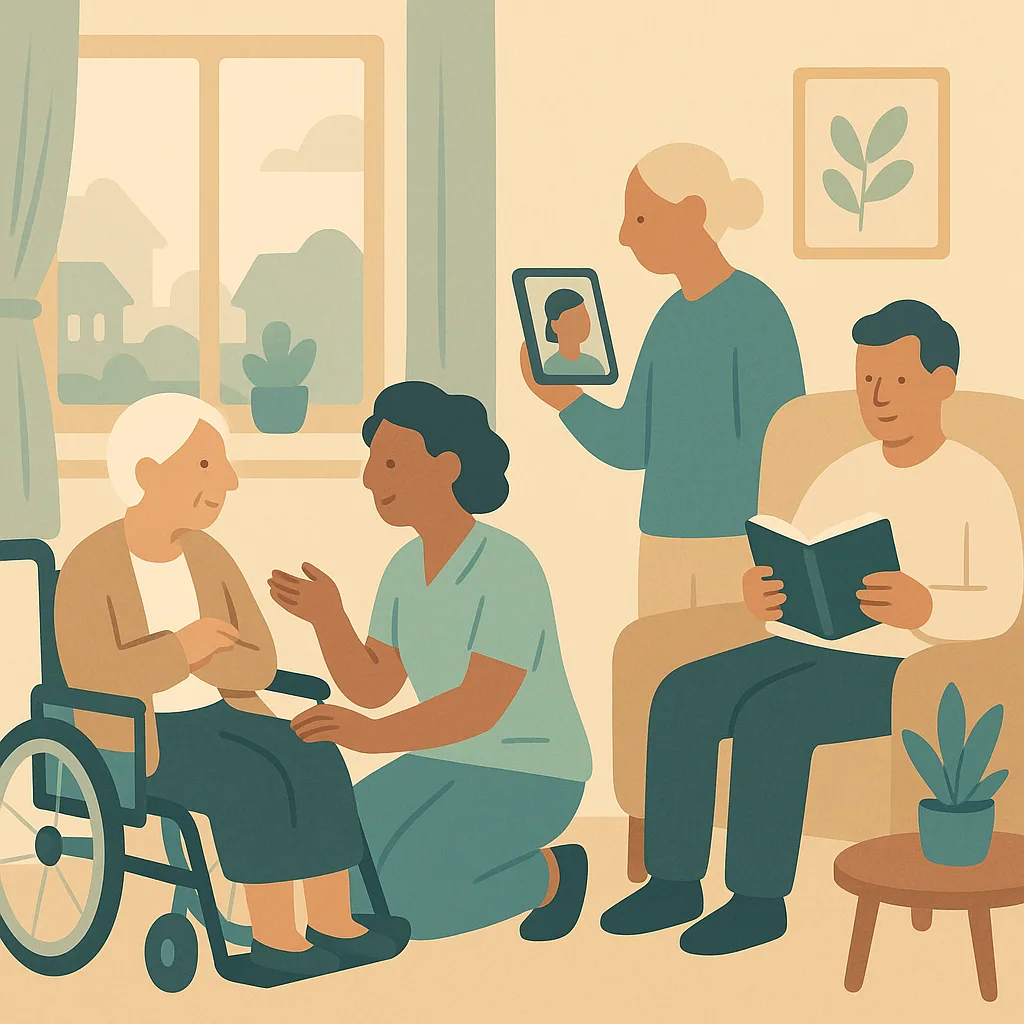
Standard 6: Communication
People communicate in many ways: speech, tone, facial expression, body language, touch, behaviour, writing, pictures and technology. In care, communication is not an extra skill, it is the work: it builds trust, prevents errors, and is how you learn what a person needs and wants. Establish each person's communication and language needs, wishes and preferences from their care plan, from the person themselves, and from those who know them. Barriers include noise and environment, sensory impairment, language, cognitive conditions such as dementia, pain, and your own assumptions. Reduce them: face the person, get to their level, allow time, use plain language, check understanding, and use aids the person relies on, from hearing aids and glasses to communication boards and interpreters. Never invent your own workaround for a need that requires expertise: know how to access extra support such as speech and language therapy, translation and advocacy services. Confidentiality is part of this standard: share information about a person only with those who need it for their care, in line with your agreed ways of working, and understand that confidentiality has limits, for example when someone is at risk of harm.
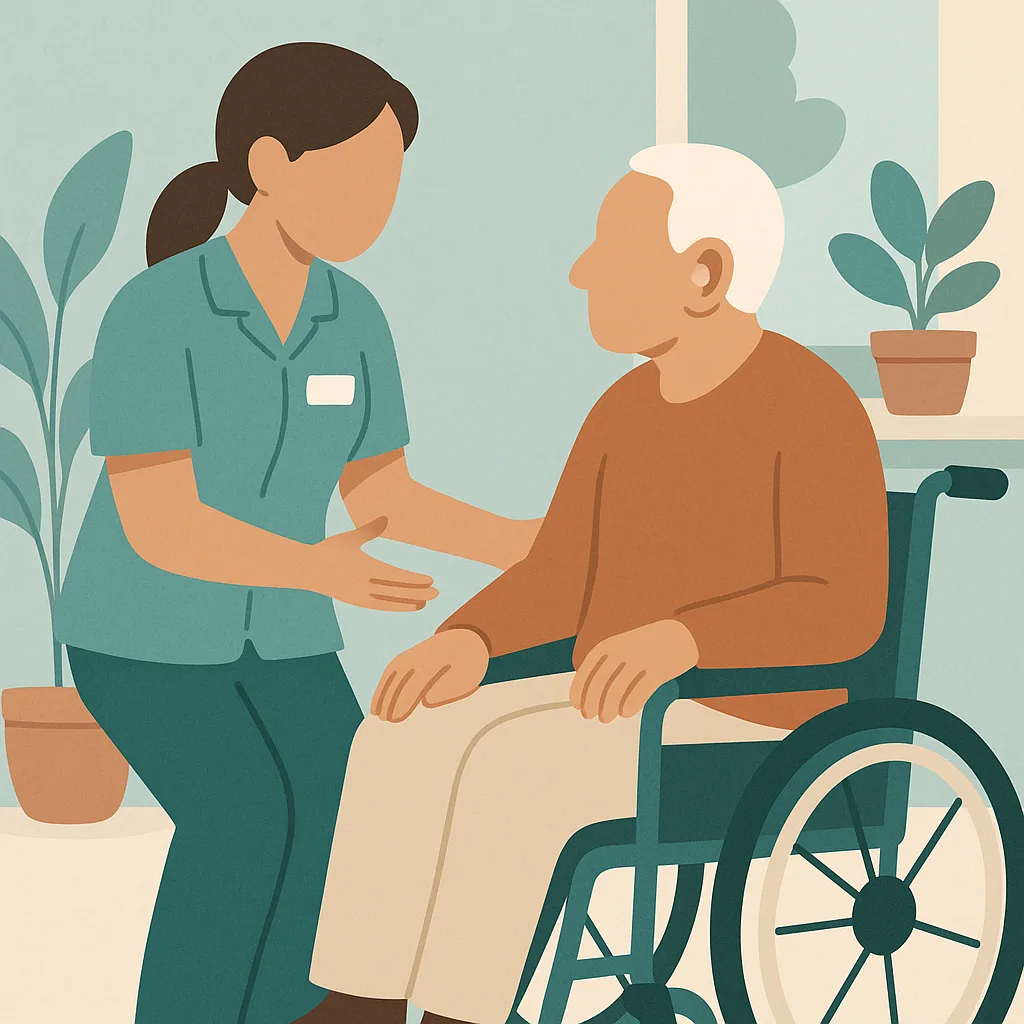
Standard 7: Privacy and dignity
Privacy is a person's right to control who sees them, their body, their space and their information. Dignity is being treated as a person of worth in every interaction. The situations where these are most easily compromised are everyday ones: personal care with a door ajar, talking across a person as if they were not there, discussing someone's continence needs in a corridor, entering a room without knocking. Maintain privacy and dignity actively: knock and wait, close doors and curtains, keep the person covered during care, explain what you are doing and seek agreement as you go, and keep personal information out of public spaces and conversations. Support people's active participation in their own care: involve them in decisions, offer real choices, and respect the choice they make even when you would choose differently, including risk decisions where the person has capacity, which should be discussed, understood and recorded rather than overridden. Where a person's choice creates a risk to themselves or others, report and record your concerns through your agreed ways of working. Supporting active participation is also how independence is maintained: every decision made for a person that they could have made themselves takes something from them.
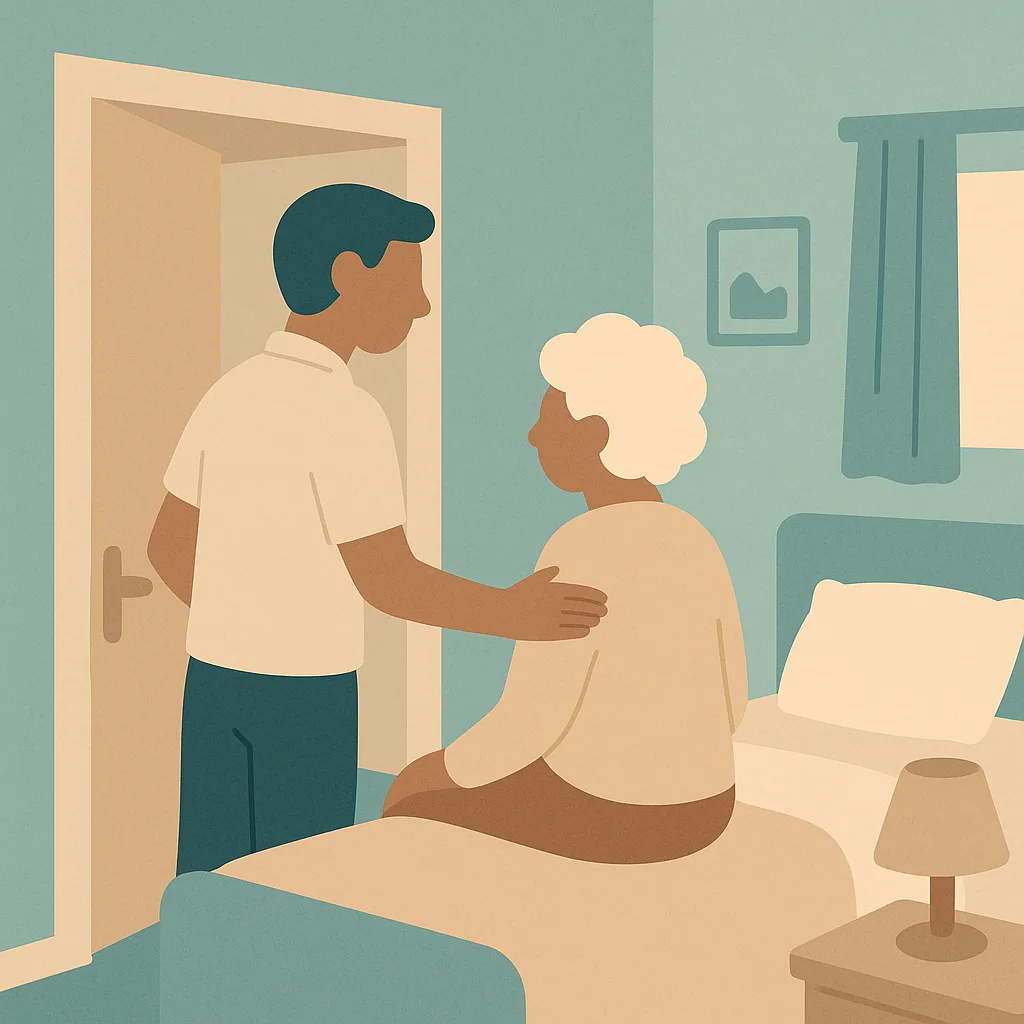
Standard 8: Fluids and nutrition
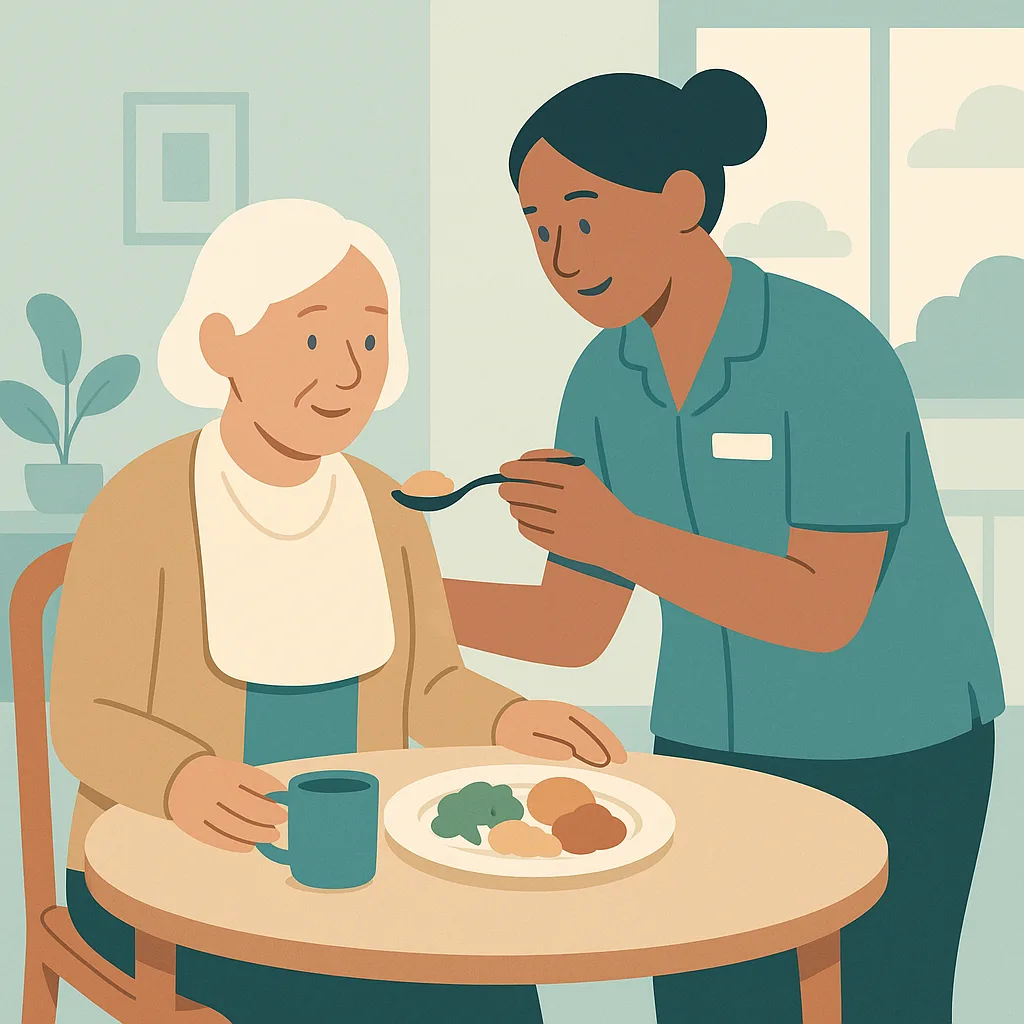
Good nutrition and hydration protect health, wound healing, energy, mood and dignity. Poor nutrition shows as weight loss, loose clothing, tiredness, poor wound healing and increased falls and infections. Dehydration shows as dark urine, headaches, dizziness, confusion, dry mouth and urinary tract infections, and in older people confusion is often the first visible sign. Know the signs, and report concerns promptly: changed appetite, swallowing difficulty, meals left unfinished and refused drinks are all reportable observations, not personal choices to ignore. Support people to eat and drink in line with their care plan: correct consistency where a speech and language therapist has prescribed it, correct positioning, the right pace, and equipment that supports independence. Ensure drinks are within reach and offered often, not only at set times. Food safety and hygiene in the preparation and handling of food protects people whose immunity may already be low: clean hands, clean surfaces, correct storage temperatures, and awareness of allergens against each person's documented needs. Mealtimes are social and cultural events, not just fuel: protecting them from interruption and honouring preferences is person-centred care.
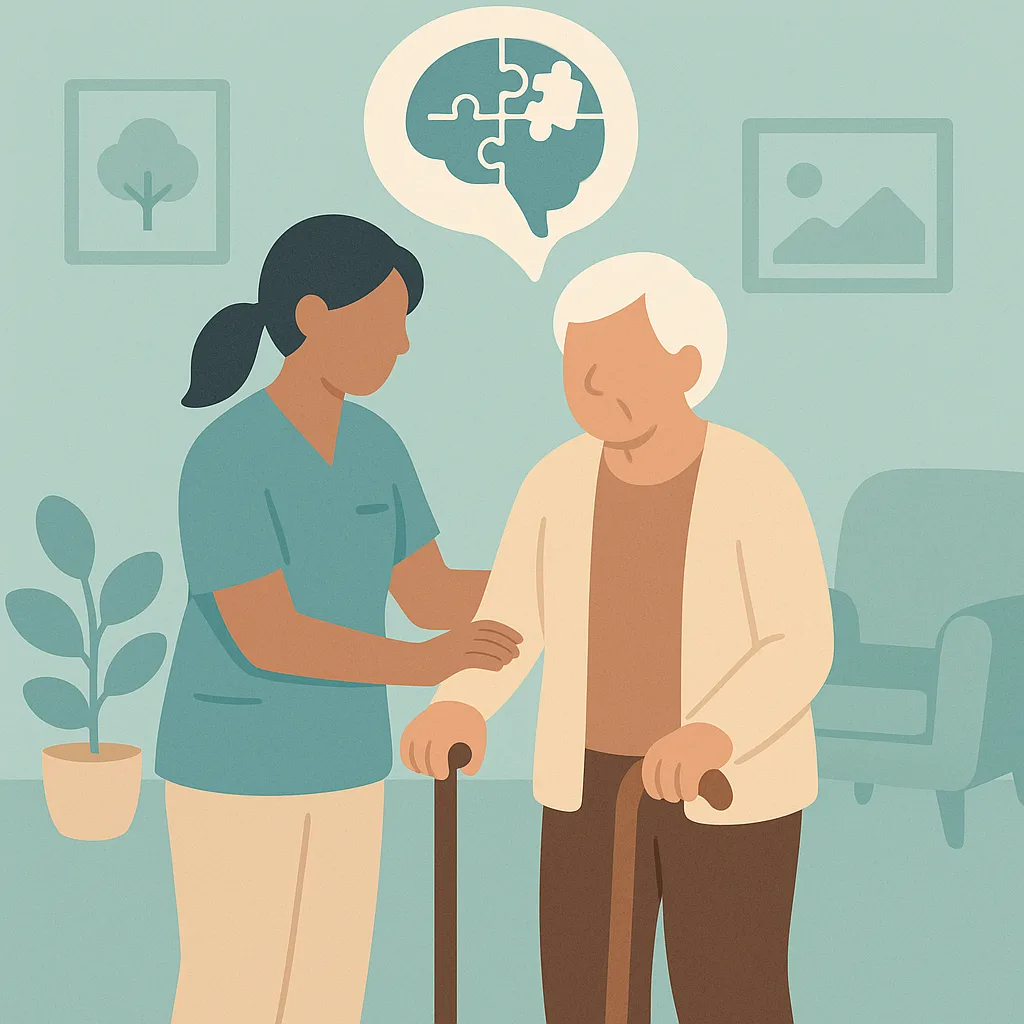
Standard 9: Awareness of mental health and dementia
Since March 2025 this standard focuses on mental health and dementia, with learning disability and autism moved to its own standard 16. Mental health describes how we think, feel and cope; mental wellbeing can be good or poor in anyone, including people receiving care and the colleagues beside you. Common conditions include depression, anxiety, bipolar disorder, schizophrenia and post-traumatic stress disorder. Dementia is not one disease but a group of progressive conditions, Alzheimer's disease being the most common, affecting memory, reasoning, communication and the ability to manage daily life. These conditions can influence a person's needs and the support they require, and two truths must be held together: the condition explains behaviour, and the person remains an individual whose history, preferences and rights are intact. Early signs matter: withdrawal, changed sleep or appetite, new confusion or uncharacteristic behaviour should be reported, because early support changes outcomes, and in the case of confusion may indicate a treatable physical cause such as infection. Care must adjust to the person's reality: arguing a person with dementia back to the present usually increases distress. Legal frameworks, including the Mental Capacity Act 2005, promote wellbeing by requiring that people are assumed to have capacity, supported to decide, and protected by best interests decision making only when a specific decision genuinely exceeds their capacity.
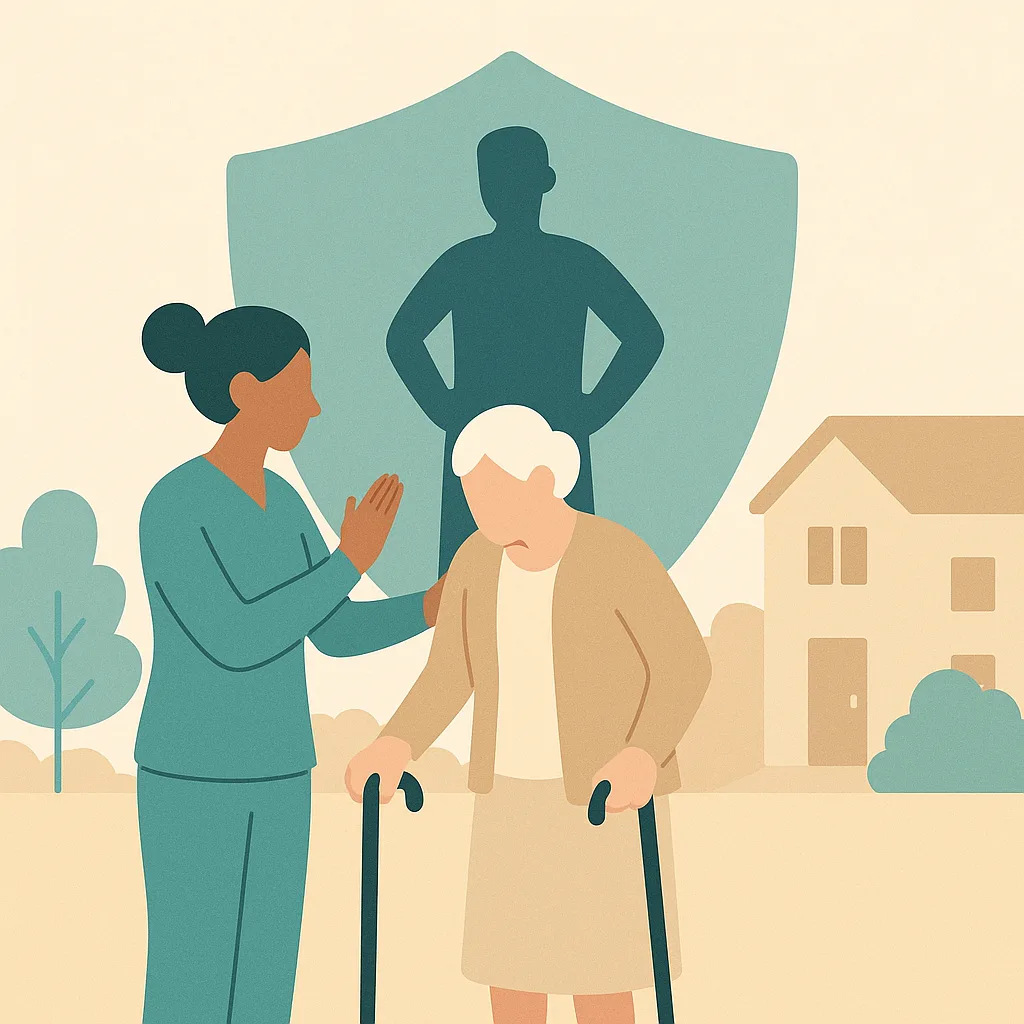
Standard 10: Adult safeguarding
Adult safeguarding means protecting an adult's right to live in safety, free from abuse and neglect. The legal definition of an adult at risk is an adult who has needs for care and support, is experiencing or at risk of abuse or neglect, and as a result of those needs cannot protect themselves. The main types of abuse are physical, sexual, psychological or emotional, financial or material, discriminatory, organisational, domestic abuse, modern slavery, and neglect including self-neglect. Harm includes ill treatment, impairment of health or development, and the impact of witnessing the ill treatment of others. Abuse happens anywhere, and the abuser can be anyone, including staff, family and other residents. Signs may be physical, behavioural or environmental: unexplained injuries, fearfulness around a particular person, missing money, poor living conditions, withdrawal. Reduce the likelihood of abuse through person-centred care, active participation, robust recruitment and training, and a culture where concerns are speakable. Your role: recognise, respond, record and refer. If someone discloses abuse, listen, take it seriously, do not promise secrecy, do not investigate yourself, preserve evidence, and report it immediately through your agreed ways of working. If the concern involves your manager, go above them or to the local authority safeguarding team directly; whistleblowing law protects you. In an emergency, or if a crime is in progress, contact the police.
Standard 11: Safeguarding children
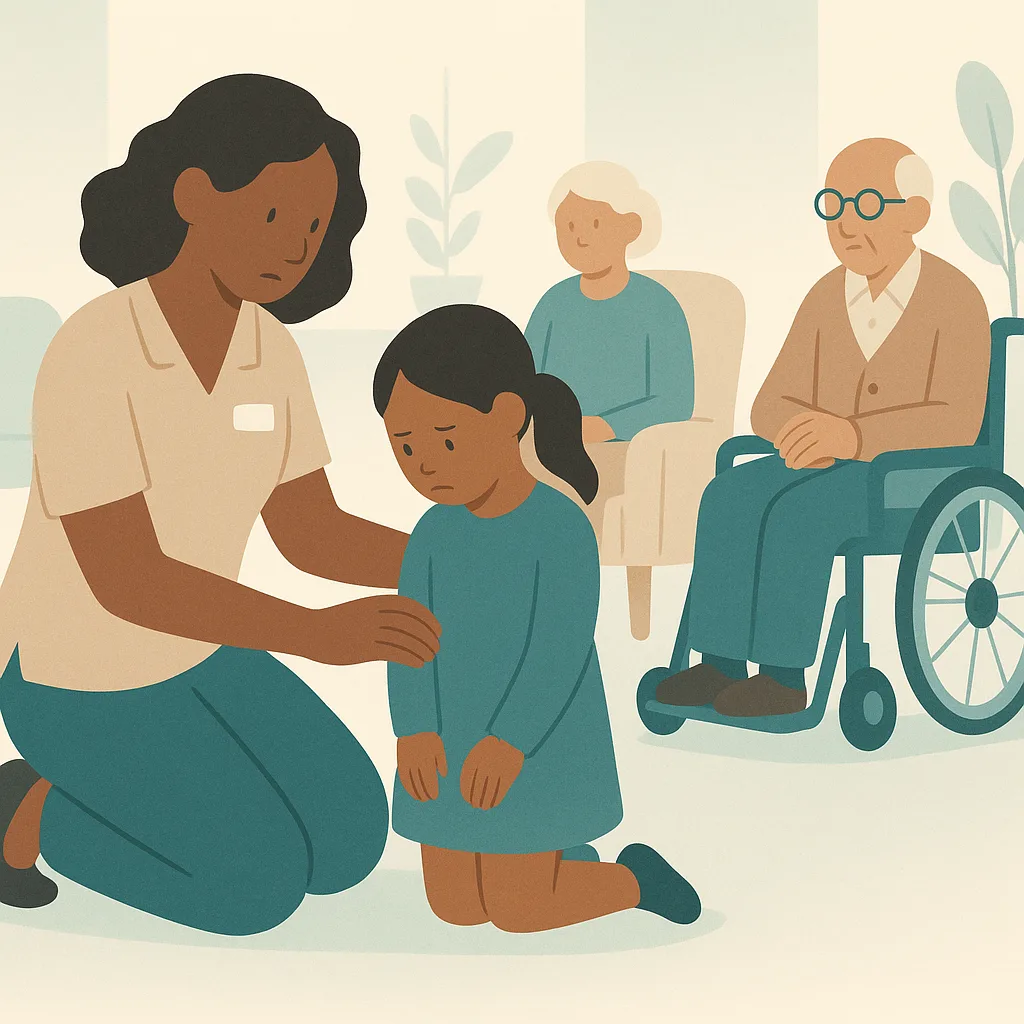
Even in adult services, children are part of the picture: they visit relatives, they accompany families, some staff work across settings, and the people you support may have contact with children in the community. Safeguarding children means protecting anyone under 18 from abuse, neglect and harm to their health or development. The categories of child abuse are physical, emotional, sexual abuse and neglect, and children can also be harmed by witnessing abuse of others, by exploitation including online, and by radicalisation. In social care your duty is clear: if you have concerns about a child, or a child discloses to you, you must act. Listen without leading, do not promise secrecy, and report immediately through your agreed ways of working to your safeguarding lead, or directly to local authority children's services or the police where the concern is urgent. Record what you saw or heard factually and promptly. If you work in a health setting, national minimum training standards for safeguarding children apply at the level appropriate to your workplace, in line with the intercollegiate guidance. The principle is the same as adult safeguarding: it is not your job to be certain, it is your job to report concerns to the people whose job it is to find out.
Standard 12: Basic life support
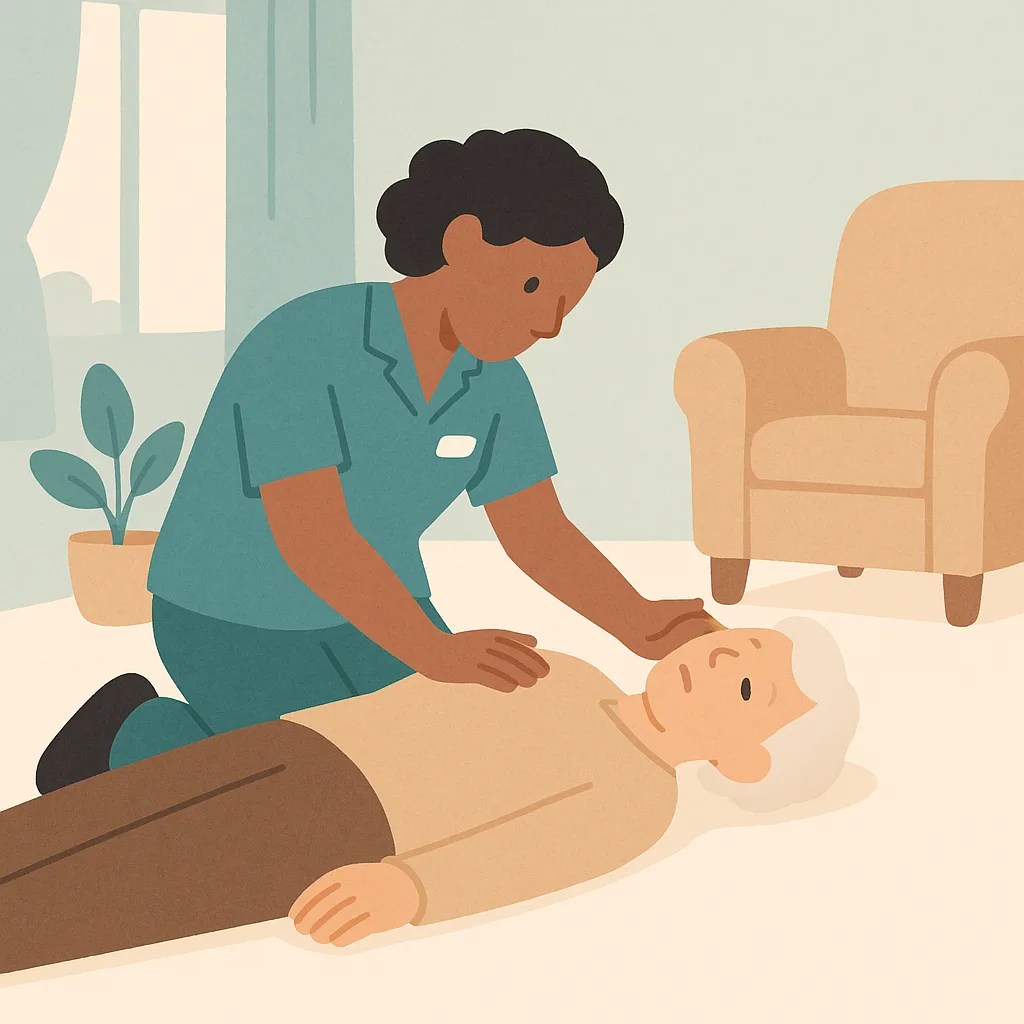
This standard requires practical training that meets UK Resuscitation Council guidelines, refreshed regularly and assessed face to face: this online section refreshes the knowledge that underpins your practical certificate, it does not replace it. The chain of survival: early recognition and call for help, early CPR, early defibrillation, and post-resuscitation care. Approach using DRSABC: check for Danger, check Response, Shout for help, open the Airway, check Breathing for no more than 10 seconds, and start Compressions if the person is not breathing normally. Call 999, or delegate the call clearly by naming a person, and send for the defibrillator (AED) if one is available; in a care setting know where yours is kept before you ever need it. Adult compressions: centre of the chest, 5 to 6 centimetres deep, 100 to 120 per minute, allowing full recoil, with rescue breaths at 30 to 2 if trained and able, or continuous compressions if not. Use the AED as soon as it arrives and follow its prompts: it will not shock a heart that does not need it. For choking: encourage coughing, then up to five back blows, then up to five abdominal thrusts, alternating, and call 999 if it is not relieved. Finally, remember DNACPR: know before an emergency which of the people you support have a documented decision, and where it is recorded.
Standard 13: Health and safety
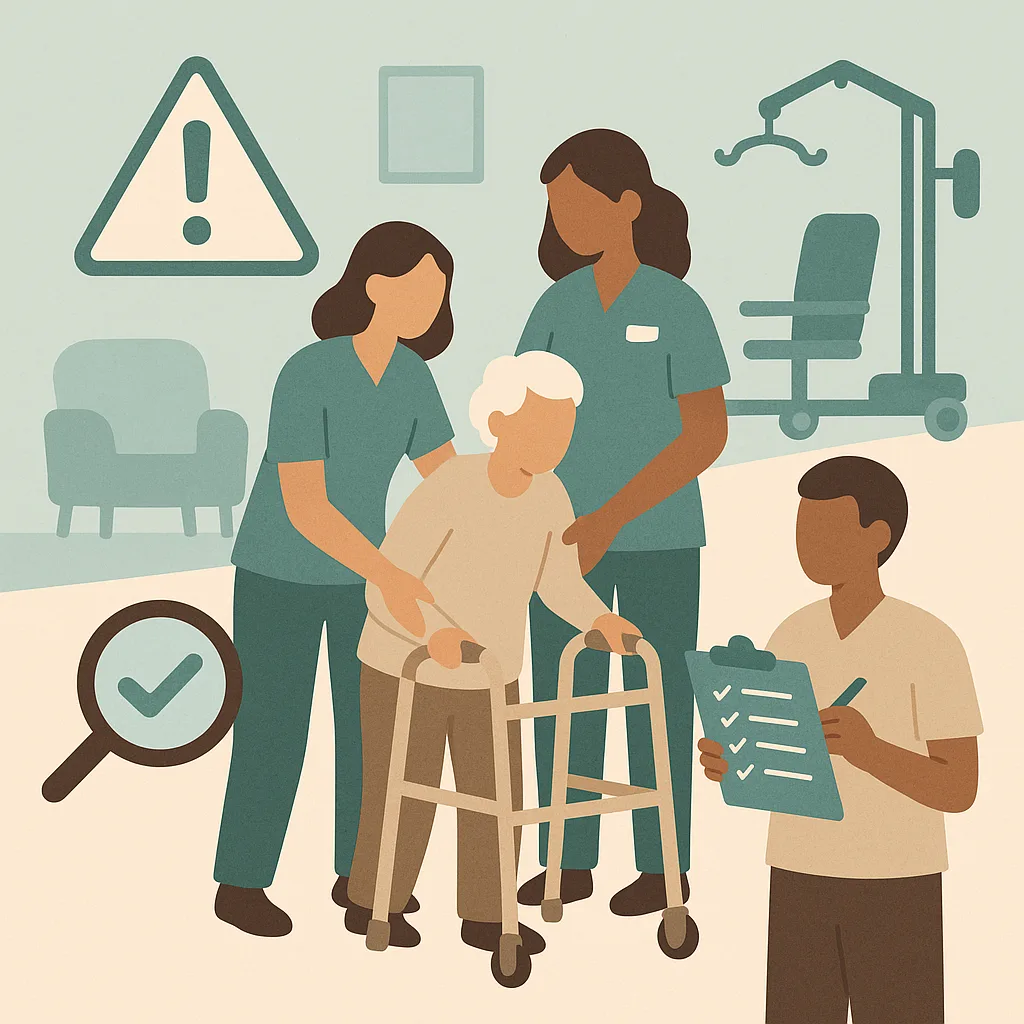
The Health and Safety at Work etc. Act 1974 places duties on your employer to provide a safe workplace, safe equipment, training and policies, and on you to take reasonable care of yourself and others, to follow training and procedures, and to report hazards. Supporting legislation includes COSHH for hazardous substances, RIDDOR for reporting specified injuries and dangerous occurrences, and the Manual Handling Operations Regulations. Know the tasks you must not carry out without special training: moving and handling of people, medication, emergency first aid, and the use of specific equipment. Risk assessment is how hazards become manageable: read the assessments that apply to your work, follow them, and report anything that has changed. Accidents, injuries and sudden illness must be responded to within your competence and reported and recorded promptly. Moving and assisting people and objects safely protects you as much as them: assess, prepare, use the equipment prescribed, and never lift manually where equipment is specified. Medication and healthcare tasks require specific training and agreed ways of working. Hazardous substances must be stored, used and disposed of per COSHH. Fire safety: know your setting's procedure, evacuation strategy and your own role, and keep escape routes clear. Security: check identity of visitors, protect keys, codes and call systems, and know your lone working procedure if you work alone. Finally, stress is a health and safety matter: recognise your own signs and use the support your employer provides.
Standard 14: Handling information
The information you handle, care plans, daily notes, medication records, messages from families, is sensitive personal data protected by the Data Protection Act 2018 and UK GDPR, and governed by your agreed ways of working. Secure systems exist for a reason: paper records locked away, screens locked when unattended, passwords never shared, conversations about people held where they cannot be overheard, and information shared only with those who need it for the person's care. Your records are legal documents and care tools at once. Keep them up to date, complete, accurate and legible, write factually and respectfully, distinguishing what you observed from what you were told or concluded, and record at the time or as soon as possible afterwards, because contemporaneous notes are both safer for the person and more credible if ever examined. If you notice records are missing, wrong or have been accessed inappropriately, report it: information incidents are incidents. People have rights over their own information, including the right to access it, and questions about disclosure, for example a relative asking to read notes, should go through your manager and your policies rather than be decided on the spot.
Standard 15: Infection prevention and control
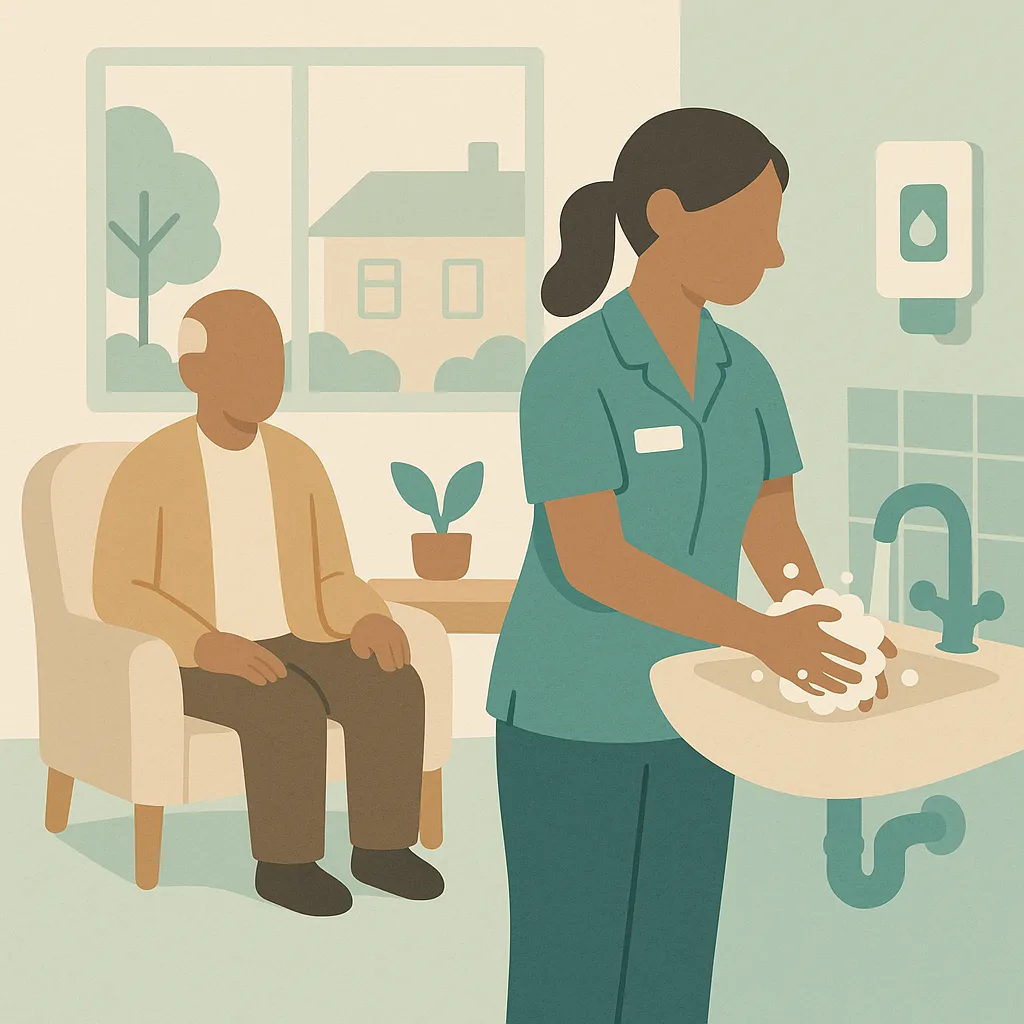
Infection needs a chain to spread: an infectious agent, a reservoir, a way out, a mode of transmission, a way in, and a susceptible person. Break any link and infection stops, and the people you support are often the most susceptible people in the building. The standard IPC precautions protect everyone, every time, regardless of known infection status: hand hygiene at the recognised moments, before and after contact with each person, after body fluids, before clean tasks and after touching surroundings; respiratory hygiene; correct use of personal protective equipment, gloves and aprons on for the task and off, safely, immediately after; safe management of the care environment, equipment and laundry; safe handling and disposal of waste and sharps; and managing blood and body fluid spillages correctly. PPE only works with the right technique: donning clean, doffing dirty to clean, hand hygiene after removal, and never reusing single-use items. Your employer's policies and the national IPC manual set out the detail for your setting, including outbreak procedures, when transmission-based precautions are added, and how to report and record infections. If you are unwell yourself, especially with diarrhoea, vomiting or fever, report it and stay away in line with policy: presenteeism spreads outbreaks.
Standard 16: Awareness of learning disability and autism
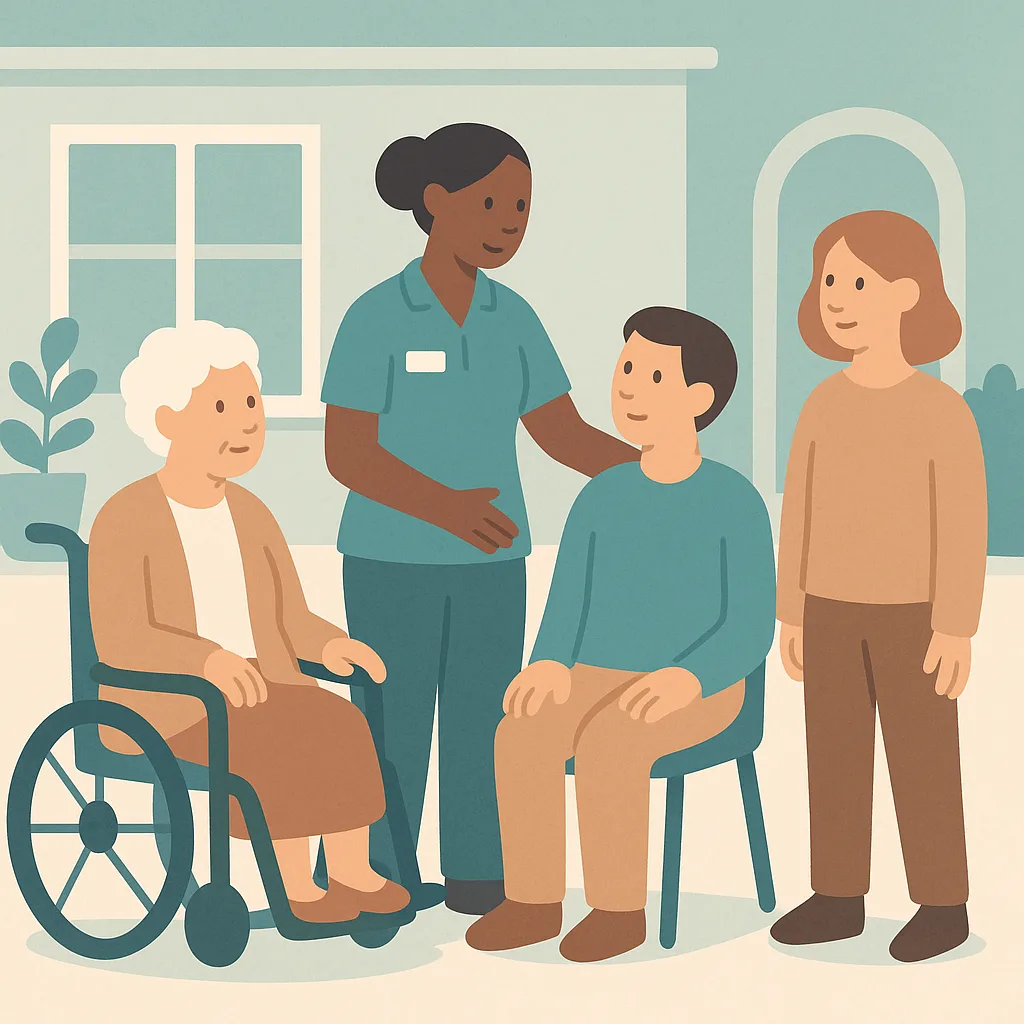
This is the new standard added in March 2025, and it reflects a legal requirement: all staff in CQC regulated services must undertake training in how to interact appropriately with people with a learning disability and autistic people, at a level appropriate to their role, with the Oliver McGowan Mandatory Training the government's preferred package. A learning disability is a reduced ability to understand new or complex information and to learn new skills, starting before adulthood and lasting throughout life, affecting people to very different degrees. Autism is a lifelong difference in how people communicate, process information and experience the world, including sensory experiences; it is not an illness, and autistic people's needs and strengths vary enormously. Neither means a person cannot make decisions: assume capacity, communicate in the way that works for the person, allow processing time, and involve people fully in their own care. Reasonable adjustments are a legal duty under the Equality Act 2010: clearer information, longer appointments, quieter environments, consistency of routine and staff, whatever removes the barrier for that individual. Diagnostic overshadowing, attributing physical symptoms to the disability or autism instead of investigating them, contributes to avoidable deaths and is exactly what this standard exists to prevent: changes in behaviour are communication, and often the only accessible way a person can tell you something is wrong.
Not a slideshow once a year. Training that sticks.
CareStream delivers care certificate training in the hub your team already uses, grounded in best practice and your own policies, so it fits your care setting and not a generic template.
Short teaching sections and a real care scenario, then an assessment that checks understanding.
Staff complete it in over 60 languages, while your records stay in English.
A wrong answer triggers a short follow-up lesson and a fresh question, so the gap is closed.
Automatic reminders at 90, 30 and 7 days, with a live compliance dashboard.
From your dashboard to your team, in the CareStream hub.
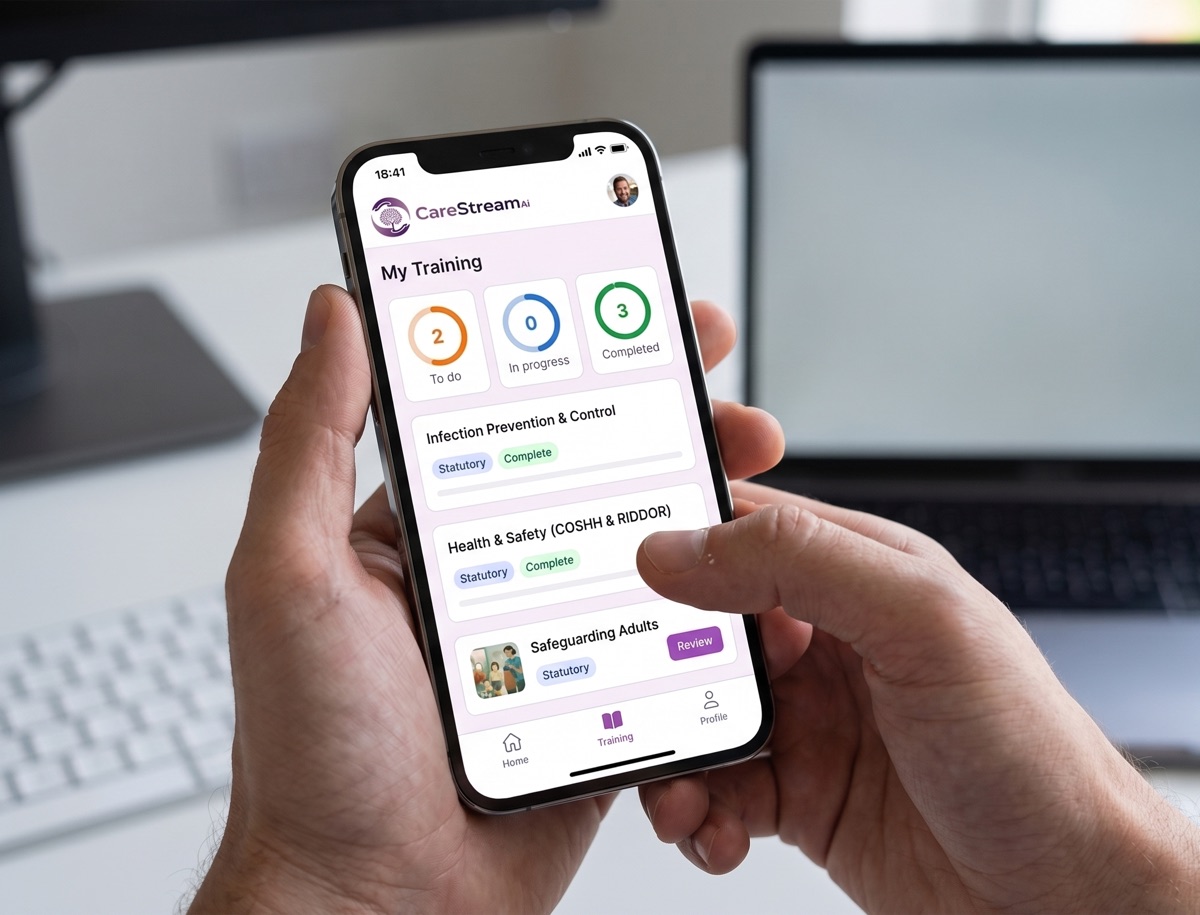
Training is delivered in the hub each staff member logs into. You allocate the modules, they complete them in their own language, and you get the completion records and certificates for your CQC evidence, with any gaps closed by automatic follow up training.
Assign Care Certificate to each staff member in seconds. No course builder and no setup for each person.
Staff work through the module on any device, in over 60 languages, teaching then checking understanding. A wrong answer sends a short follow up lesson.
See live completion status and a certificate for every person, ready as evidence for CQC.
Any step, in their language, in one tap.
Care teams are diverse and training should not leave anyone behind. On any lesson or question, a staff member taps the language button and the whole step flips into the language they think in. They understand it properly, and your records stay in English.
- One tap flips any lesson or question into their language, instantly.
- Over 60 languages, with no setup and no separate versions to manage.
- Completions and certificates stay in English for your CQC evidence.
Try the language buttons in the preview above.
Built for real learning, not box ticking
Every CareStream course goes further than a lesson and a quiz. These features come as standard on every course, giving your staff a richer way to learn and giving you the evidence to prove it.
Every course is built on recognised UK guidance and cites its sources, from NICE and Skills for Care to the NHS and the legislation itself.
A plain English glossary of the technical terms in each course. A simple way to support every learner, including staff with English as a second language.
A quick knowledge check before the lesson is compared with the final assessment, so every certificate comes with evidence of how much the course actually taught.
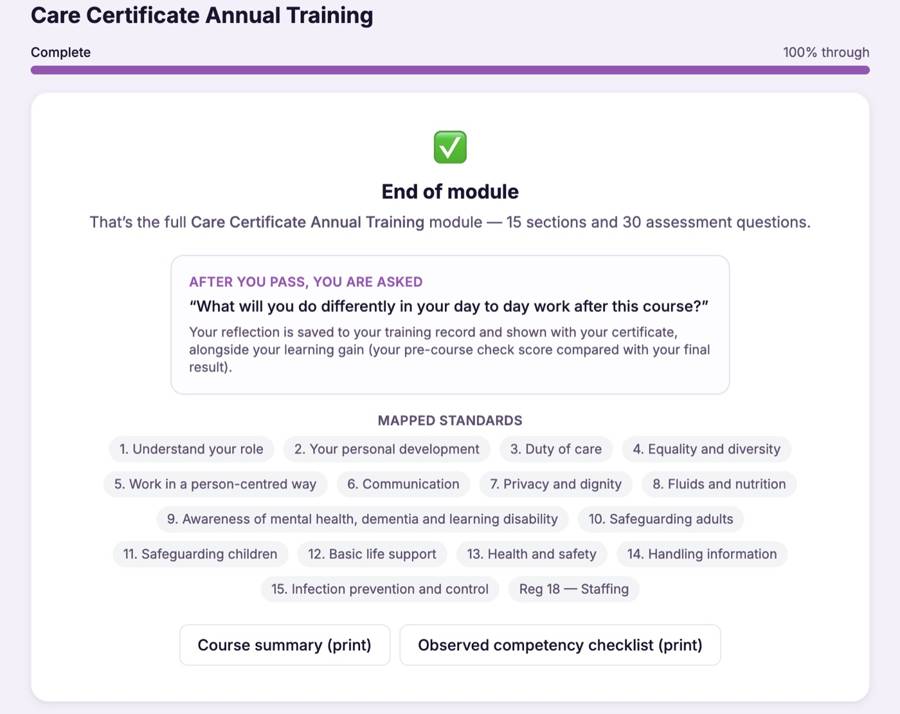
After passing, staff record what they will do differently in their day to day work. Their reflection is saved to their training record and shown with their certificate.
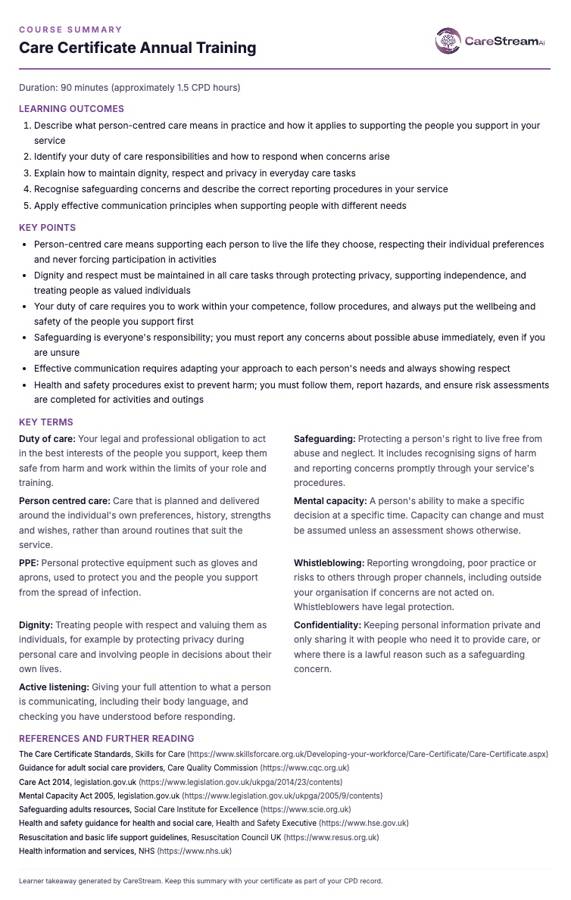
A printable one page takeaway of the outcomes, key points and key terms. Perfect for staff files, supervision conversations and the staff room wall.
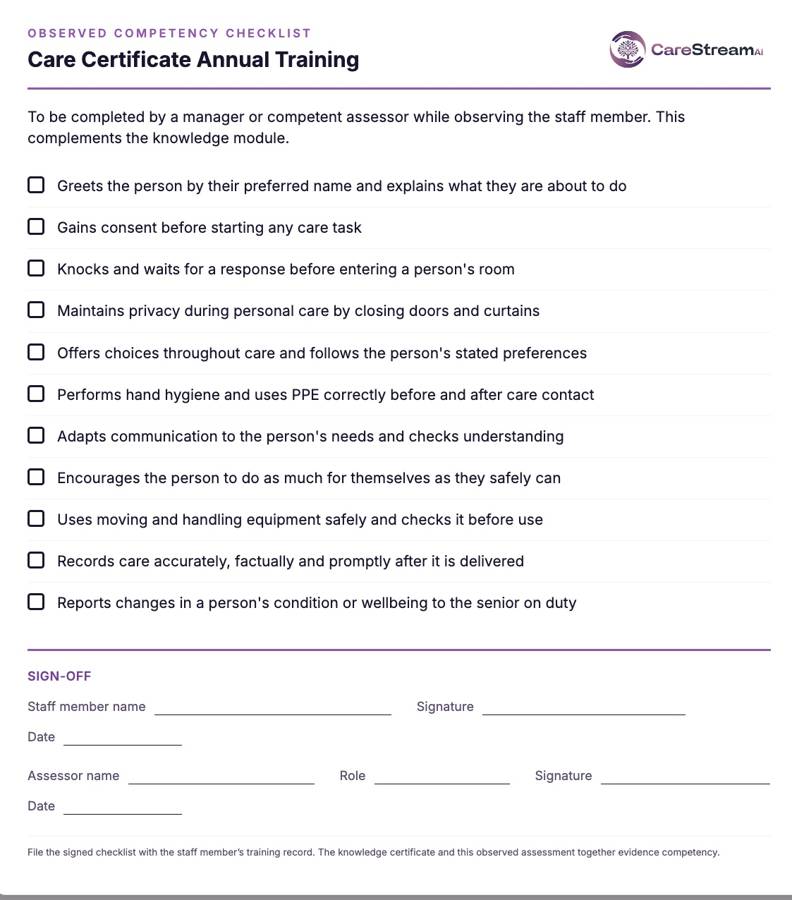
A printable checklist for managers to confirm skills in practice, with a sign off section. It completes the picture beyond the knowledge assessment.
Wrong answers become lessons, not failures
Most e learning marks an answer wrong and moves on. CareStream does not. Every wrong answer triggers an automatic follow up loop that teaches the point again and rechecks it, so no knowledge gap is left behind.
A wrong answer immediately opens a short lesson explaining the point, so the gap is closed there and then.
A fresh question on the same point checks the lesson has landed. The loop repeats until it has.
Staff move on to the next module and their certificate once they genuinely know the answer, not just after one lucky guess.
Why choose CareStream?
Training built for the care sector, delivered the way busy teams actually learn.
- 90+ care-specific training courses
- Bitesize, engaging lessons your staff actually finish
- Mapped to the Care Certificate & CQC standards
- Available in 60+ languages
- Instant certificate on completion
- Flexible learning, anytime, on any device
- Content kept up to date with UK care regulations
- Time to complete: 1.5 hours
Frequently asked questions.
Is Care Certificate training mandatory in care settings?
How often should staff complete Care Certificate training?
Can CareStream deliver Care Certificate training in other languages?
Does the training include an assessment?
More training your team may need
More mandatory and role-specific training CareStream delivers to your team, in the hub, in any language. Add any of these to your basket.
 Every 2 yrs Certificate
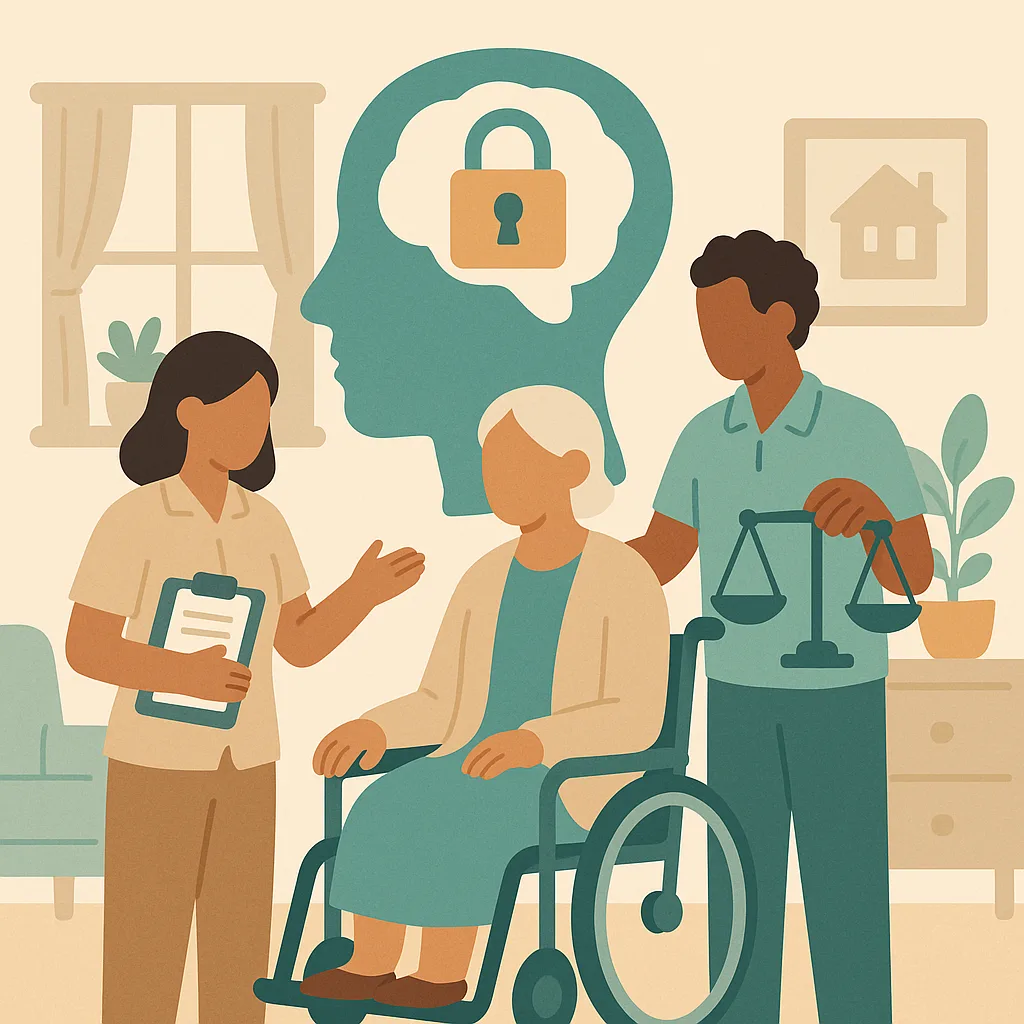
Mental Capacity Act and DoLS
This training covers how we assess mental capacity, make decisions in someone's best interests when they cannot decide for themselves, and protect the rights of people who may be deprived of their liberty. Understanding these legal duties protects residents and ensures we provide lawful, person centred care.
Bulk discounts from 10+ licences
 Every 3 yrs Certificate
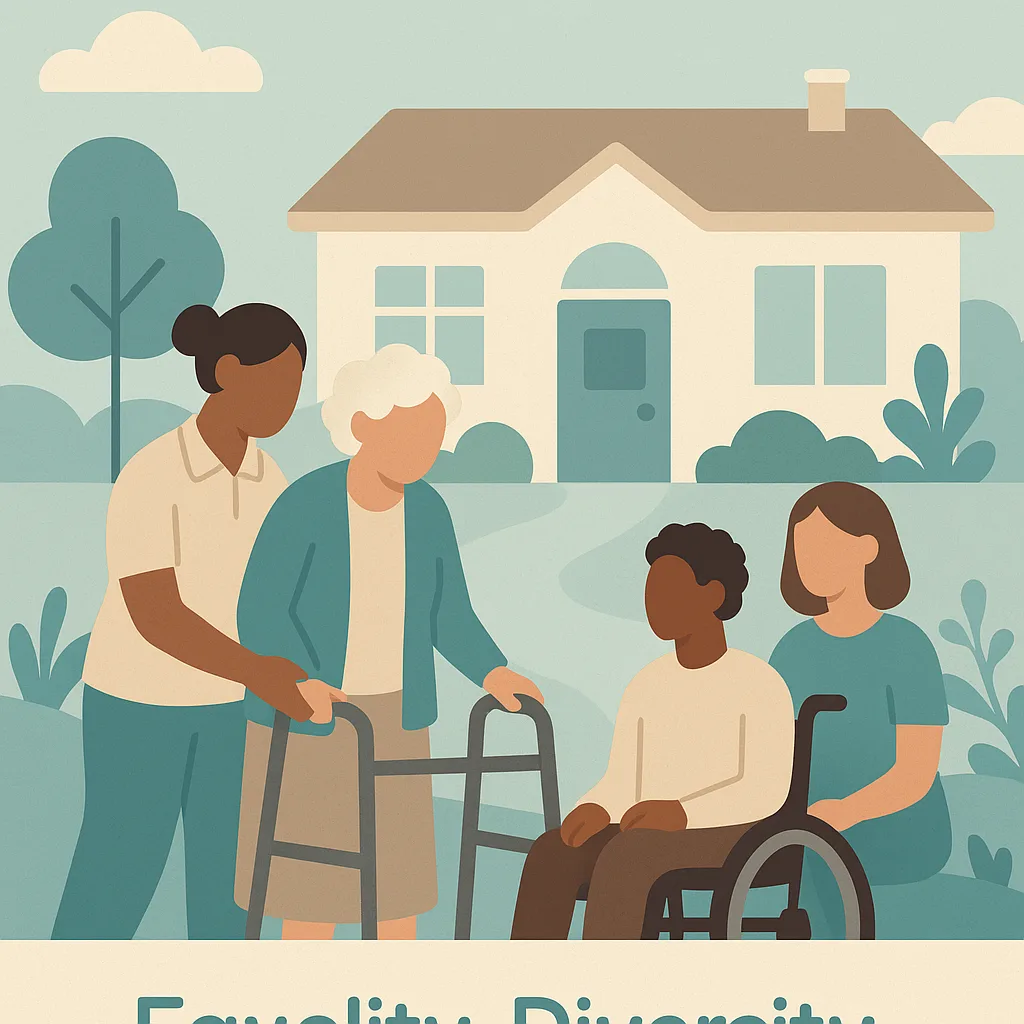
Equality, Diversity and Inclusion
This training covers how we respect and celebrate the differences between residents and staff at our home. You will learn how our policies protect everyone's rights and dignity, and how to support residents to live fulfilling lives in their community without discrimination.
Bulk discounts from 10+ licences
 Every 3 yrs Certificate
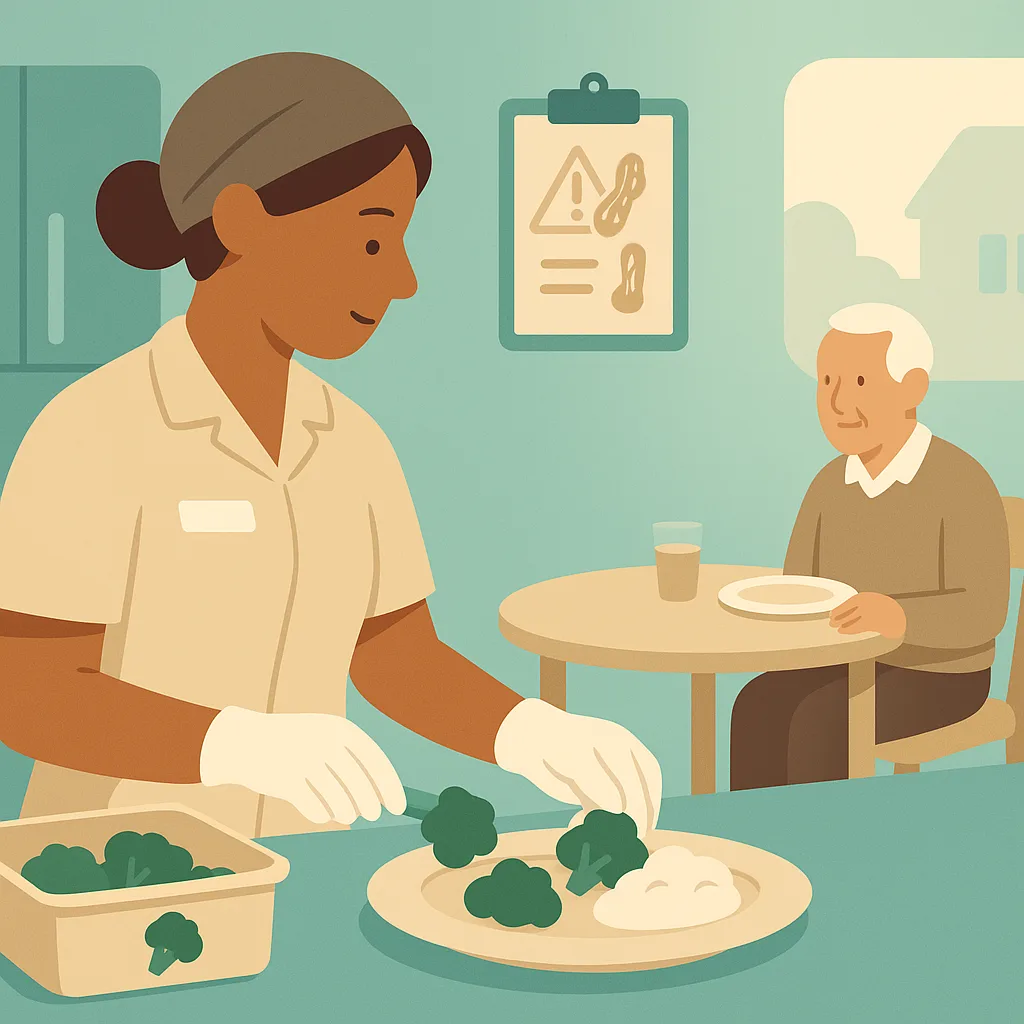
Food Hygiene
This training covers how to keep food safe and prevent illness in a care setting. You will learn about storing, preparing and serving food safely, preventing contamination, and protecting residents with food allergies. These practices protect everyone's health and meet legal requirements.
Bulk discounts from 10+ licences
 Annual Certificate
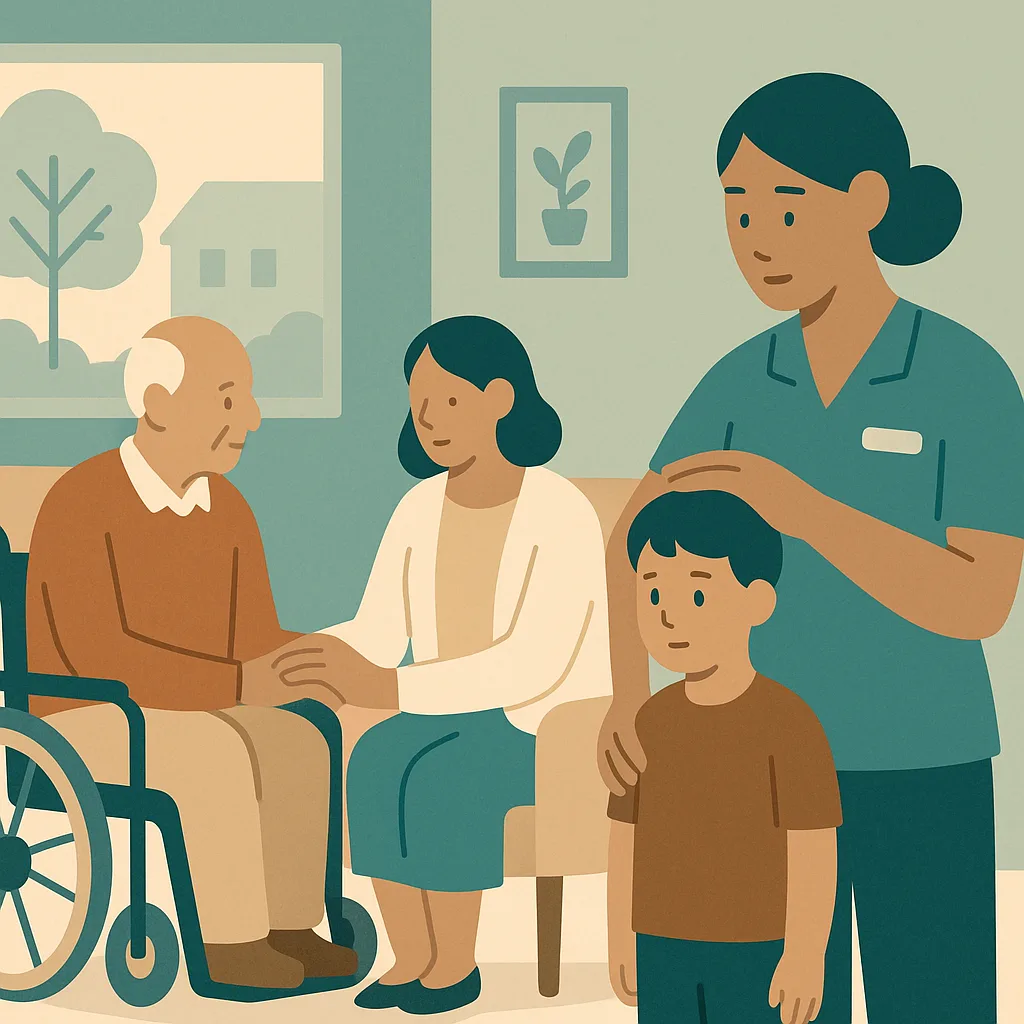
Safeguarding Adults and Children
This training covers how we protect vulnerable adults and children from abuse, harm and neglect at our home. You will learn to recognise signs of abuse, understand our reporting procedures, and know how to respond to challenging behaviour and potential radicalisation risks. This is essential knowledge for keeping everyone in our care safe.
Bulk discounts from 10+ licences
 Annual Certificate
Moving and Handling of People
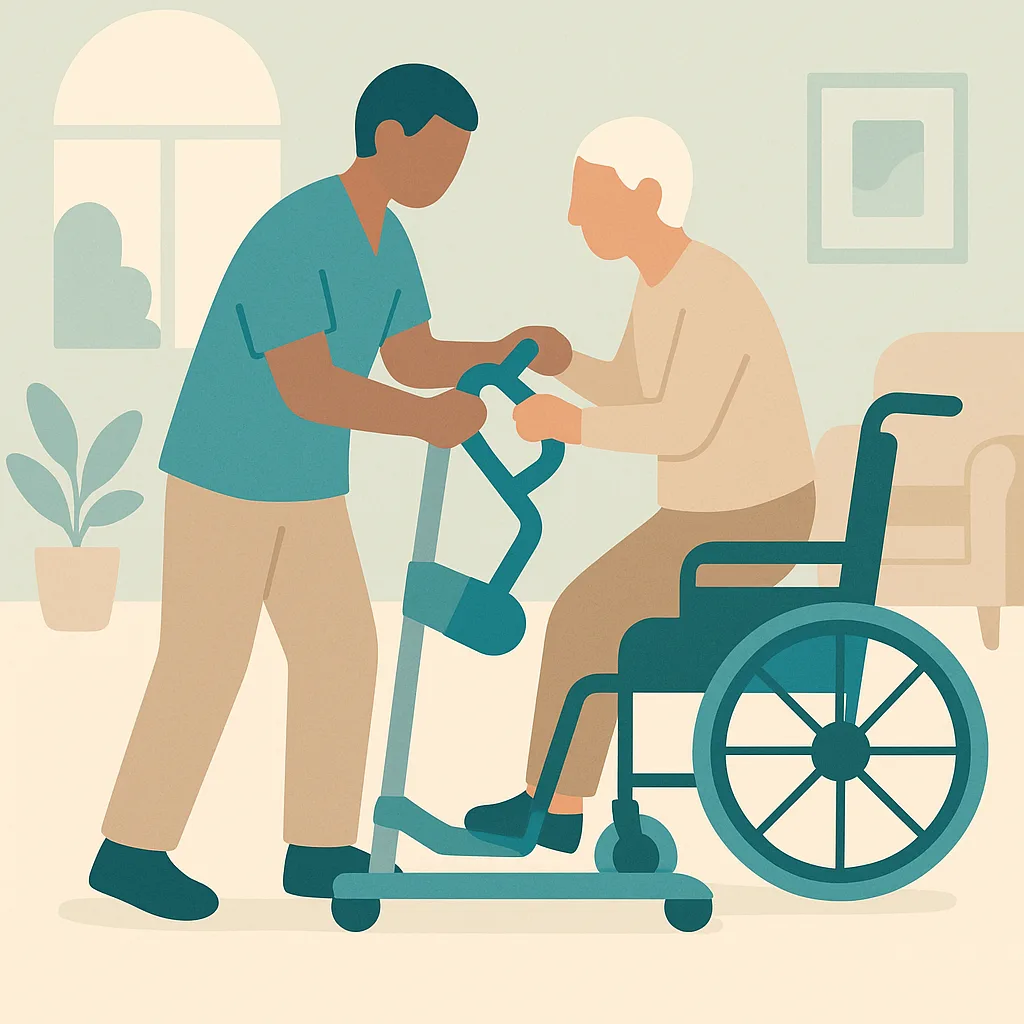
This annual refresher covers the essential knowledge you need to move and handle people safely in our home. It reviews why safe moving and handling matters, the principles we follow, how to assess and plan moves, and how to protect both the people we support and yourself from injury. Remember: this module covers knowledge only. You must also complete practical competency assessments with your supervisor.
Bulk discounts from 10+ licences
 Annual Certificate
Fire Safety
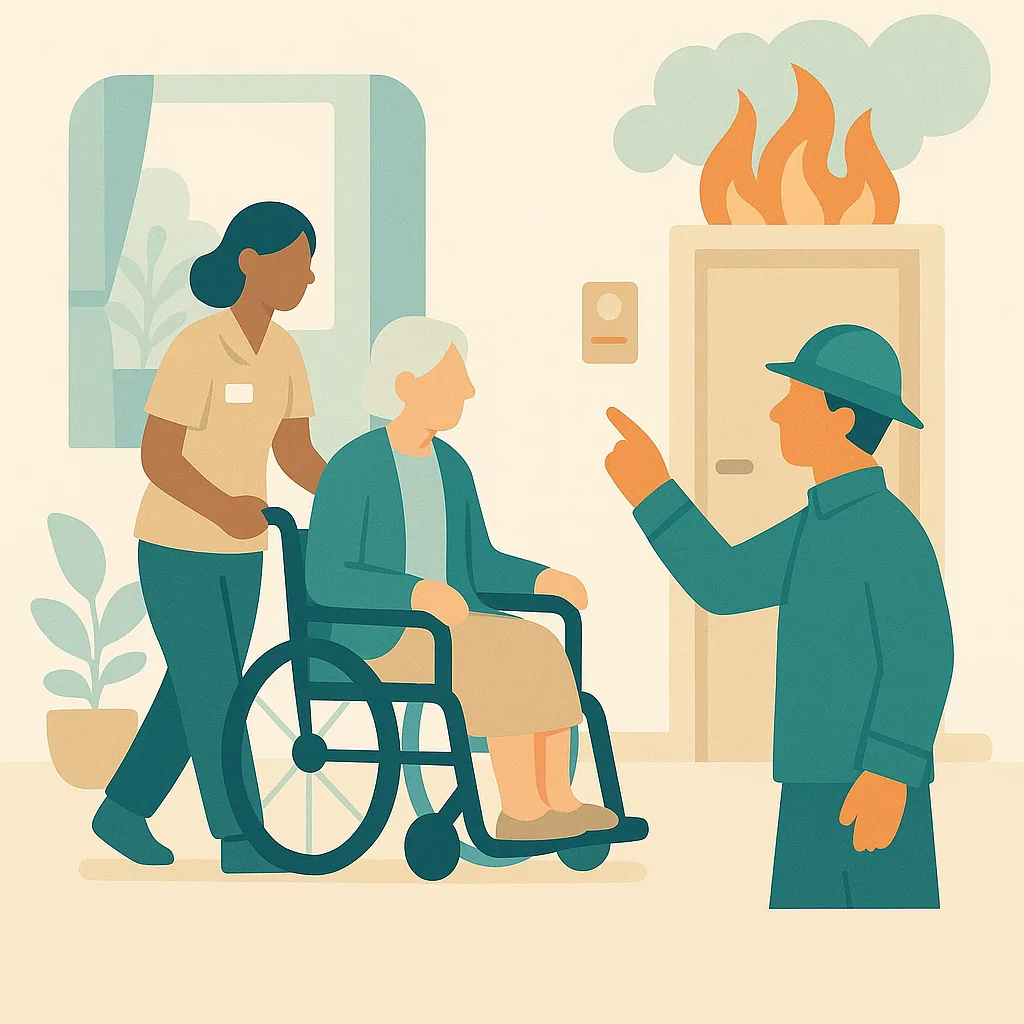
This training covers fire safety procedures at our home, including prevention, what to do if you discover a fire, evacuation procedures, and your responsibilities. Fire safety is everyone's responsibility and understanding these procedures protects residents, visitors and staff.
Bulk discounts from 10+ licences
Give your team care certificate training that actually sticks.
Add it to your basket, allocate it in seconds, and let the evidence build itself.
Compared
Three ways to train a care team.
These modules are written and kept current by us, so your managers do not have to write or maintain them. We have compared what each approach does rather than naming providers, because products change and this should still be true next year.
| CareStream | A generic e-learning library | A trainer you book | |
|---|---|---|---|
| Try a real lesson and a real question before you buy | |||
| Learning outcomes and time to complete stated up front | |||
| Written lesson sections, each with its own illustration | |||
| Interactive exercises after the lesson that teaches them, in every module | |||
| Assessment in every module, with the key points to revisit | |||
| Taken in any of sixty plus languages | |||
| A wrong answer triggers a follow-up lesson, not just a re-sit | |||
| Practical sign-off by a manager where the subject needs it | |||
| Completion files itself into your training matrix and evidence pack | |||
| Bought one module at a time, with no annual contract |
Generic libraries are often cheaper per learner. They teach a national standard rather than being built, updated and evidenced around the way a CQC-registered service is actually inspected.
Care policies
Every module is written from a policy
If the policy behind it is out of date, the training inherits that. Sixty six policies written for your service, checked against current law and read by a person before they carry your name, from £39.