
Training collection
Mental Capacity Act Training for Care Staff: Six Courses and What Each Covers
Mental capacity act training is often seen as a course for managers who sign forms. Most capacity decisions are made at a bedside or a kitchen table, long before any form exists. So mental capacity act training has to reach every carer on the team.
This collection holds six online courses for a care service. One is built on the Mental Capacity Act 2005 and the Deprivation of Liberty Safeguards (DoLS). The other five cover daily situations where capacity matters, such as dementia, distress and risky behaviour.
We are plain about the limits, because no course makes a service ready for an inspection. Each is bought per member of staff, with a named certificate and a record a manager can show.
The collection is written for managers and training leads in residential homes, nursing homes, home care and supported living. There, one missed step can affect a person's rights and freedom.

This training helps you understand dementia and how to provide person centred care to residents living with dementia at our home. You will learn to recognise signs of dementia, support residents with dignity and respect, and follow our policies to meet their individual needs.

This annual refresher covers essential dementia care principles for staff working in our nursing home. You will learn how to support people living with dementia through person centred approaches, meaningful activities, and safe, dignified care that respects individual preferences and maintains wellbeing.

This training helps you understand and respond safely to challenging behaviour in our home. You will learn how to recognise triggers, use de-escalation techniques, and follow our policies to protect residents and staff. Managing behaviour well keeps everyone safe and maintains dignity.

This module teaches you how to support residents who display behaviours that challenge, using positive approaches to prevent distress and de-escalate situations safely. You will learn how to recognise triggers, respond calmly, and follow your organisation's policies on managing antisocial behaviour while protecting everyone's dignity and safety.

This module helps you provide person centred dementia care that respects and celebrates each person's cultural background, beliefs and traditions. You will learn how cultural identity remains important throughout dementia, and how to use our policies on activities and outings to support cultural and spiritual needs in meaningful ways.
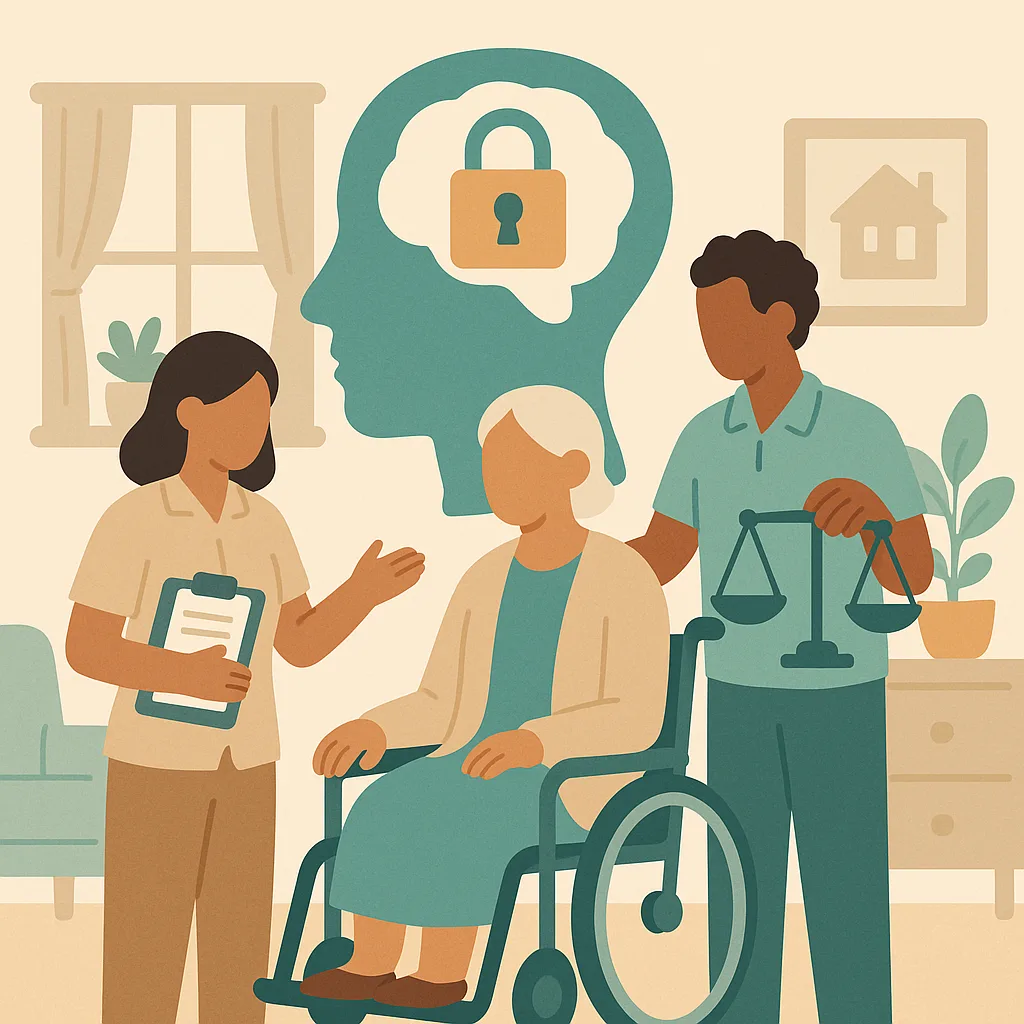
This training covers how we assess mental capacity, make decisions in someone's best interests when they cannot decide for themselves, and protect the rights of people who may be deprived of their liberty. Understanding these legal duties protects residents and ensures we provide lawful, person centred care.
What the Mental Capacity Act asks of the people giving care
The five principles behind every decision
Every decision about a person's care starts from five principles. Section 1 of the Mental Capacity Act 2005 sets them out in the list below.
- Assume the person has capacity unless it is shown that they lack it.
- Take every practicable step to help them decide before concluding they cannot.
- Do not treat a decision as incapable just because it is unwise.
- If they lack capacity, act or decide in their best interests.
- Choose the option that limits their rights and freedom least.
The second and third are easy to miss on a busy shift. Offering a choice in a quiet room takes practice. So does accepting a choice you would not make yourself.
How capacity is tested, one decision at a time
Capacity belongs to one decision at one moment. A person may choose their own clothes and still need help with a decision about treatment. Section 3 of the Act lists four abilities. The person must understand the facts, retain them, weigh them up and communicate a choice by any means.
A person lacks capacity only if they cannot decide because of an impairment of, or disturbance in the working of, the mind or brain. The assessor decides on the balance of probabilities. A diagnosis such as dementia is never proof by itself.
Good capacity assessment training gives staff the same two questions every time. Is there an impairment? Does it stop this decision being made now?
Where consent, the regulations and the Code of Practice come in
The Health and Social Care Act 2008 (Regulated Activities) Regulations 2014 set the standards that the Care Quality Commission (CQC) checks. Three of them point back to the Act.
- Regulation 11, the need for consent: if an adult cannot consent because they lack capacity, the provider must follow the Act.
- Regulation 13, protection from abuse: nobody may be deprived of liberty for care without lawful authority.
- Regulation 18, staffing: staff must receive the training, supervision and appraisal their duties need.
Paid carers and professionals must also have regard to the Code of Practice. Read the published Mental Capacity Act Code of Practice, issued by the Office of the Public Guardian.
Compare the six courses and see where they stop
Each course costs £25.99 plus VAT for each member of staff, with no subscription. None of the six is CPD certified, so none is part of the free CPD set. Staff complete them in the hub, and each learner who passes gets a named certificate.
The Mental Capacity Act and DoLS course in detail
This is the mental capacity act and dols training in the grid. Many managers who ask for MCA training for care staff mean this one. It has six lessons and takes about 35 minutes.
- The five principles of the Mental Capacity Act
- When mental capacity must be assessed
- The two stage test for mental capacity
- Making best interests decisions
- Understanding deprivation of liberty
- The Deprivation of Liberty Safeguards process
The assessment has 20 questions and a pass mark of 80 percent. A wrong answer triggers a short follow-up lesson and a fresh question, and every attempt is recorded. The course page offers a real lesson, question and matching activity to try first.
The five courses around it
The other five meet capacity questions from the side. We list only what each one teaches.
- Dementia Awareness has a lesson on rights, dignity and decision making, and an outcome on applying the principles of the Act when supporting residents with dementia. About 35 minutes.
- Dementia Care and Cultural Diversity in Dementia Care are written for nursing home staff. They cover choice, independence, culture and faith, and do not teach the Act itself.
- Challenging Behaviour Management covers triggers, de-escalation, respecting rights and recording incidents.
- Positive Behaviour Support and De-escalation takes about 48 minutes and 30 questions. It has a lesson on restrictive practice and the least restrictive approach, and links mental health, capacity and behaviour.
Figure: from the Dementia Awareness course.
What the six courses do not teach
Tell your team this at the start. None of the six courses mention lasting powers of attorney, court appointed deputies, independent advocates or the Court of Protection. They do not walk through the Code of Practice.
They are knowledge courses with a scored assessment. They cannot show how well a person fills in a capacity assessment on your forms, or speaks to a family in a best interests meeting. For that, use supervision, observed practice and file audits.
Figure: from the Challenging Behaviour Management course.
The definition of deprivation of liberty has been reset
The Supreme Court has replaced the earlier acid test. The Department of Health and Social Care guidance on the change says the assessment is now wider, and no single factor decides it.
The Department of Health and Social Care tells providers that the safeguards still apply to adults in hospitals and care homes. It asks them to train staff on the new definition, update policies and refer unclear cases to the local authority. Court processes apply in the community, such as home care.
Our Mental Capacity Act and DoLS course was written in the terms of the earlier test. Treat it as the grounding in the Act, and brief staff on the government guidance separately. Anyone who finishes Deprivation of Liberty Safeguards training should hear that the definition has moved.
Who this training suits, and what sits beside it
Who this is perfect for
It suits a registered manager who runs training on top of a full job, with no learning team. It suits a senior carer who carries out capacity assessments. It suits a new starter who has met the five principles only as a list.
Residential and nursing homes should care most about the lessons on authorisation, because the safeguards apply there. A mental capacity act course matters just as much in home care and supported living. Staff there work alone in the person's own home, and the court route replaces the safeguards.
Managers who inherit a training matrix with no entry for capacity can fill that gap with one course. Teams of ten or more can read the team pricing for care staff training.
Figure: from the Dementia Care course.
Why a service might choose this over the usual alternatives
The usual routes are a classroom day from a training company, a per learner online course, or a large library bought by subscription. A classroom lets staff argue real cases with a trainer, and nothing here replaces that.
CareStream adds a price per person with no subscription, a follow-up lesson after a wrong answer, and one record of who passed and when. A classroom day often leaves absent staff and renewal dates to a spreadsheet.
You can run a classroom session and still use the courses for the people who missed it. The two work well together, and the courses give you a record of both.
A free audit and a written policy to sit beside the courses
Training shows what staff know. Records show what they do. The Mental Capacity Act and consent audit has 44 checks in 7 sections, run quarterly on one person's file at a time. It is free to run on every plan, with no card needed.
Its sections cover capacity assessments, best interests decisions, consent, restrictions and the safeguards. One checks that two staff on duty can explain the principles. Each gap becomes an action with an owner.
If you hold no written policy, the Mental Capacity and DoLS policy is £79 one off. A person reads it before it carries your name, and it arrives within two working days.
Benefits of CareStream for mental capacity act training
- Six courses, with the Mental Capacity Act and DoLS course at the centre, for one price per member of staff.
- A scored assessment, with a follow-up lesson after any wrong answer.
- A named certificate for each learner who passes, kept on the training record.
- A manager dashboard showing who has finished, their score and their certificate.
None of this promises a rating. It gives you evidence of what staff completed.
Get started: pick the course, then try the audit
With CareStream you can open the Mental Capacity Act and DoLS course page and try the sample lesson. Add the courses you need and allocate a licence to each person.
Create a free account to run the audit and to give every member of staff the CPD certified courses at no cost. Then use the audit findings to decide which of the six courses each person needs next.
Mental Capacity Act Training for Care Staff: Six Courses and What Each Covers FAQs
Who needs mental capacity act training?
Anyone who supports a person to make a decision, or makes one on their behalf, needs to understand the Act. That means care assistants, senior carers, nurses, deputies and registered managers in care homes, nursing homes, home care and supported living. No regulation names the course, but the staffing regulation requires the training each person's duties call for.
Is mental capacity act training mandatory?
No law names a course by this title or sets how often it is repeated. Regulation 18 requires staff to receive the training their duties need. The Skills for Care statutory and mandatory training guide lists mental capacity among the additional training that an employer decides on, according to the needs of the service.
How long does the Mental Capacity Act and DoLS course take?
It has six lessons and takes about 35 minutes. It ends with a 20 question assessment with a pass mark of 80 percent. A wrong answer sends the learner a short follow-up lesson and a fresh question on the same point.
What does the course cover?
Its six lessons cover the five principles of the Act, when capacity must be assessed, the two stage test, how best interests decisions are made, what deprivation of liberty means and the Deprivation of Liberty Safeguards process. It does not cover lasting powers of attorney, court appointed deputies or independent advocates.
What does it cost?
Each course is £25.99 plus VAT for each member of staff, with no subscription. The team pricing page shows what a larger group pays. A learner who passes receives a named certificate that they keep.
Is the training free?
No. The Mental Capacity Act and DoLS course and the other five in this collection are paid. The ten CPD certified courses are free for every member of staff on a free account, and these six are not among them. The Mental Capacity Act and consent audit is free to run on every plan.
How often should staff repeat it?
The Skills for Care guide gives no refresher interval for mental capacity, so the employer decides. On our training record the Mental Capacity Act and DoLS course shows a renewal date two years after completion, and the other five show one year. Write down why you chose your interval.
What is the difference between the Mental Capacity Act and DoLS?
The Act sets out how capacity is assessed and how decisions are made for someone who lacks it. The Deprivation of Liberty Safeguards are the process for authorising a deprivation of liberty for people aged 18 and over in care homes and hospitals. Staff need both.
What is the two stage test for capacity?
Stage one asks whether the person has an impairment of, or disturbance in the functioning of, the mind or brain. Stage two asks whether that stops them making this particular decision at this time, by understanding, retaining, weighing up or communicating. Assessors decide on the balance of probabilities.
Does the course teach the current definition of deprivation of liberty?
No. The Supreme Court has replaced the earlier acid test with a wider assessment where no single factor decides. Our deprivation of liberty lesson describes the earlier test. Use the course for the principles of the Act, and brief staff on the government guidance on the new definition.
What are the five principles of the Mental Capacity Act?
Assume capacity unless it is shown that a person lacks it. Take all practicable steps to help them decide first. Do not treat a decision as incapable because it is unwise. Act in the person's best interests if they lack capacity. Choose the least restrictive option.
Does a certificate show that a member of staff is competent?
No. The certificate shows the named person completed the course and passed the assessment. It is not a government recognised qualification and does not certify competence for a role. The employer stays responsible for judging competence and for training that meets the regulations.
Will this training make us compliant with the Care Quality Commission?
No. Training supports your practice and gives you a record, but no course can promise a rating or an inspection outcome. The Care Quality Commission judges what it sees and hears about how people are supported.
What happens if we stop buying or move to a paid plan?
Each learner's certificate is in their own name and they keep it. You pay per licence, so there is no subscription to cancel. A free account can be upgraded at any time without losing what is in it. Paid plans from Starter at £85 a month add 60+ languages and AI recommendations on audits.
Is there a policy or an audit to go with the training?
Yes. The audit has 44 checks in 7 sections and is free to run on every plan. A written Mental Capacity and DoLS policy is £79 one off, written for your service and delivered within two working days.
More on training
Guides and collections that go with this page, and the full libraries.
Policies are one part of it.
CareStream is the compliance system underneath: your policies, your staff training, your audits and your evidence, kept current and ready for the day somebody asks to see them.
- Policies written and kept updated for you
- Staff training that records itself against the standard
- Gap analysis showing what you are missing before an inspector does
- Everything in one place, for one price




