He or she "Likes tea." It is a line a night carer meets in a This is me document, and it tells her almost nothing.
Strong or weak? Which mug? Sweet or not? Six times a day, or at bedtime only?
The mistake is not leaving a This is me document blank. It is filling it with categories instead of particulars, and then filing it where nobody looks. Here is what a good one holds, and how a home keeps it alive.
But first, what is a 'This is me' document?
A “This is Me” profile is a short record of who a resident is, covering their life story, likes and dislikes, daily routines and what comforts them. A care plan sets out what someone needs. A “This is Me” profile is about the person: the music they love, how they like their tea, the name of the dog they grew up with, and what helps when they’re feeling unsettled. Because it focuses on the person rather than their care needs, new or agency staff can quickly learn what the regular team already knows, so even an unfamiliar face can offer care that feels familiar.
In CareStream, each profile is kept separate from the care plan, so medical, medication and safeguarding information stays where it belongs. Families and friends can add to the profile through a simple private email link, with no account or password needed. A manager reviews every family contribution before staff can see it, which keeps the record accurate and trustworthy.
What the Alzheimer's Society leaflet is
The Alzheimer's Society publishes a leaflet called This is me. It is their resource, and the name is theirs. We describe it only as they do.
They call it a simple leaflet and a support tool to enable person-centred care. It is for people receiving professional care who have dementia, delirium or other communication difficulties.
The page says it records a person's background, important events and the people and places in their life. It also records their preferences and routines.
The aim, they say, is to help professionals tailor care, reduce distress and overcome communication problems. They also name malnutrition and dehydration as things it can help prevent.
It can be used at home, in hospital, in respite care or in a care home. The page does not say who should complete it, or how often to revisit it.
This post is about the habit behind a document like this, not about that leaflet. If you want the leaflet itself, search for this is me alzheimer's society and you will find it on their website, under the same name.
Why a document like this is more than a nicety
The law asks for the thing a document like this holds. Care must meet a person's needs and reflect their preferences.
The rule is Regulation 9 (person-centred care). The full text of Regulation 9 on person-centred care says the assessment of needs and preferences is done together with the person.
The Care Quality Commission says to review the assessment regularly. Its guidance on Regulation 9 says providers must consult families and advocates where appropriate.
For dementia, NICE is specific. Its guideline NG97 says to consider a structured tool. The tool covers likes and dislikes, routines and personal history.
Book a short demo and see how CareStream keeps your policies, training and CQC evidence in one place.
Book a demoIt also says staff training should cover the person as an individual, and their life story. Anyone searching for life story work dementia guidance is usually after exactly this: a person's history put to use in daily care.
Eleven headings, and what a good entry looks like
The headings below are the ones we use in CareStream resident profiles. They are a sensible frame for any home's own document. Under each is the test: could a stranger act on this at three in the morning?
- Life story and background. Where they grew up, work, family, the big moments. Test: does it name places and jobs, not just "worked hard"?
- Interests and hobbies. What they love doing, past and present. Test: is the detail there, such as a railway built in a loft?
- Likes. The small things. Test: how is the tea made?
- Dislikes. What to avoid. Test: is it specific enough to prevent a bad moment?
- Food and drink they enjoy. Test: does it say what they refuse as well as what they like?
- Daily routine. Test: when do they wake, wash, nap and settle?
- What helps when they are upset or anxious. Test: a person, a song, a place, a phrase?
- How they like to communicate. Test: what they like to be called, and how they like to be spoken to.
- Important people and pets. Test: who visits, who has died, whose name causes distress?
- Faith, culture and traditions. Test: is anything needed on a day of the week or a season?
- Anything else. The room for what does not fit elsewhere.
Gathering a person's life history feeds the first three headings. We suggest it is done with the person and their family, not for them.
Why most of these go stale in a folder
The usual pattern is simple. A form is filled in during admission, from whatever a relative could recall that day. It goes in the care file. After that it is read once, perhaps, by the person who wrote it.
Three things go wrong. The detail is thin, because nobody had time to ask the gentle follow-up question. It is hard to find on a busy shift. And nothing prompts anyone to add what staff learn later, such as which song actually works.
That last point matters most. The best facts about a person often arrive months after admission, in a corridor, from a daughter who visits on Sundays.
Four habits that keep one alive
- Ask family one small question at a time. A blank page asks too much. "When they are worried or upset, what helps?" gets a real answer.
- Review what comes in before staff use it. A relative's note can be wonderful and still need a gentle edit.
- Keep it out of the clinical record's way. A person's life story is not the place for medication or safeguarding detail. Those belong in the care plan, which sets goals and a review date.
- Make it findable at the point of need. If staff must open a folder, they will not. If they can ask a question, they will.
For the care plan side, we have written about person centred care planning training and a person centred care policy. A profile and a person centred care plan work as a pair: one says who the person is, the other says what care they need.
A quick demo shows exactly how CareStream would work for your service. Book a time that suits you.
Book a demoBenefits of CareStream for a this is me document
CareStream has a separate tool for a home's own records: resident profiles, with a This is me topic in the Chat Hub. It is not the Alzheimer's Society leaflet, and it is not connected to or endorsed by them.
Resident profiles are on the Professional and Enterprise plans. The pricing page shows what each plan includes.
An admin adds a resident from the Residents button at the top of the Knowledge Base page. They fill in the eleven sections above, plus a preferred name.
A banner says the profile is for what makes the person who they are. It must not hold medical, medication or safeguarding information.
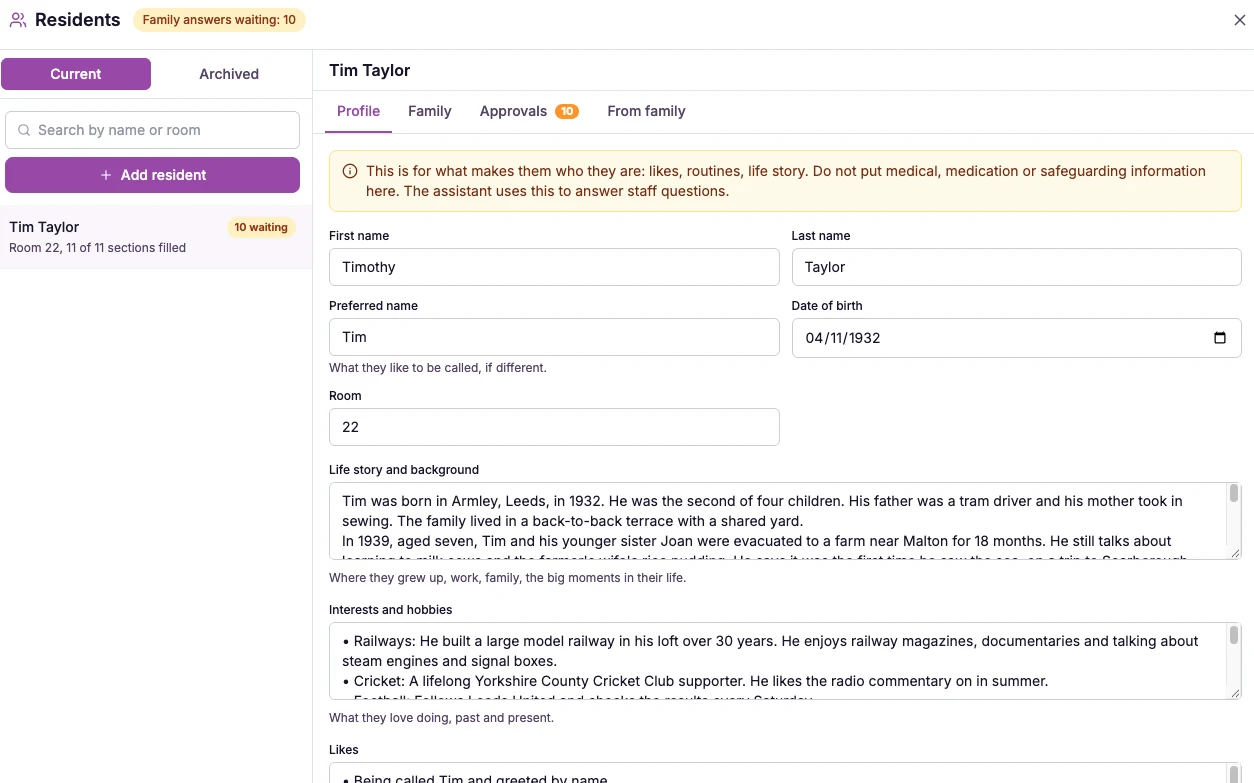
Figure: the profile screen. The screens in this post show an imaginary resident, Tim Taylor.
How family answers reach staff
The admin can invite up to ten family and friends by email. Each gets a private link to a short form, with no login and no password, and the link works for 14 days. The form asks one gentle question per section, for example how they like to be spoken to and what they like to be called.
What they write does not reach staff. It waits on an Approvals tab, where the admin can approve it, edit then approve it, or reject it. Approved answers join the profile with the person's name and relationship after them.
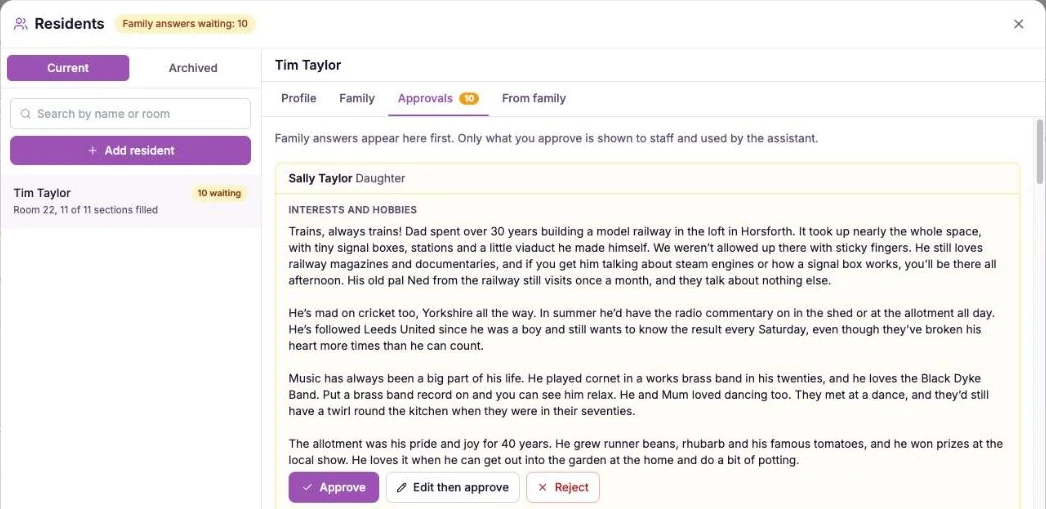
Figure: a family answer waiting for approval. Only what the admin approves is shown to staff.
Asking the question at the point of need
Staff ask a question in the This is me topic, the way they would ask about a policy. The answer comes only from profiles the home has written and approved, and the sources are shown. If something is not recorded, the chat says so rather than guessing, and for anything clinical it points to the care plan.
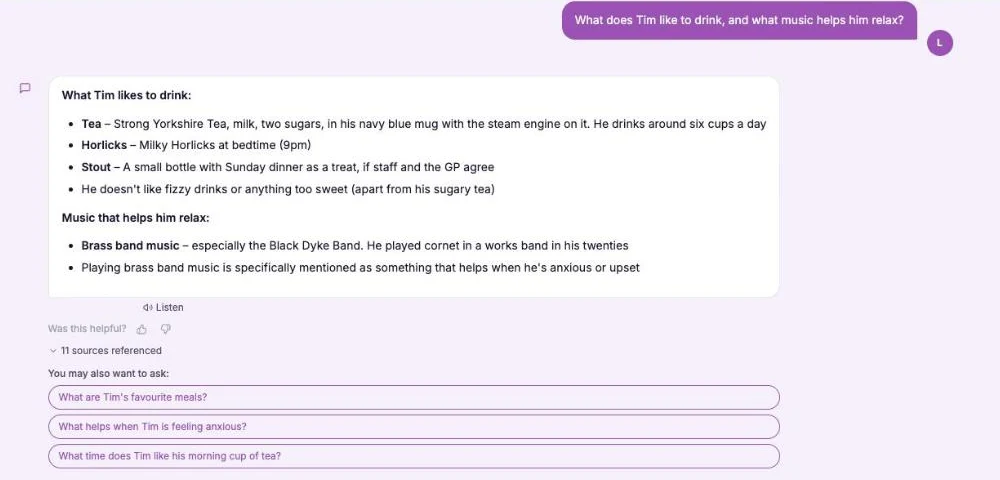
Figure: a staff question answered from an approved profile.
Staff can ask about one person, or across everyone, for example who enjoys music. When a resident dies or moves on, the admin marks it. The profile leaves the hub and the assistant straight away, and family links are cancelled. It is archived, with a log of every view, download and deletion.
Each home is responsible for fitting the feature to its own data protection approach.
Start with one resident and one question
Pick a resident whose entry says "likes tea" and nothing else. Ask their family one question: when they are upset, what helps? Write the answer down in words a stranger could act on, and put it where the night shift can find it.
If you want the wider picture first, our post on dementia care training in the UK covers what staff learn alongside it.
Sources
- Alzheimer's Society: This is me · alzheimers.org.uk
- NICE guideline NG97: Dementia, assessment, management and support (recommendations) · nice.org.uk
- legislation.gov.uk: Regulation 9 (Person-centred care), Health and Social Care Act 2008 (Regulated Activities) Regulations 2014 · legislation.gov.uk
- Care Quality Commission: Regulation 9, person-centred care · cqc.org.uk
Frequently asked