When searching for effective dementia care training in the UK, most providers offer a single session and a certificate. CareStreamAI takes a different approach.
The market is crowded with generic programmes, many imported from the United States, that promise competency in a day. For care home managers, HR leads, and training coordinators, the challenge is not finding a course; you only have to Google to find loads.
It is finding training that actually changes how staff behave on the floor, month after month. This article explains why standard certification models fall short, what the research reveals about gaps in current provision, and how structured follow-up training delivers measurable, lasting improvements in care quality and CQC compliance.
Keep reading and get all the details about our Dementia Care Training.
The Problem with Standard Dementia Care Training
The typical dementia care training experience in the UK care sector follows a predictable pattern. Staff attend a workshop, complete an online module, or sit through a seminar. They receive a certificate. The training is logged for compliance purposes. And within weeks, the knowledge begins to fade. This model persists not because it works, but because it is administratively convenient.
The US-Centric Trap
A striking finding from any review of dementia care training options is how many top-ranking programmes originate in the United States. For a UK care home manager, this creates an immediate compliance gap. Training mapped to US assisted living regulations does not align with the CQC’s Key Lines of Enquiry. It does not reference the Care Certificate, Skills for Care standards, or the Mental Capacity Act 2005. Staff may learn about HIPAA, but nothing about Deprivation of Liberty Safeguards (DoLS). The content feels foreign because it is foreign, and that disconnect undermines both engagement and practical application.
The Certification Illusion
A six-hour seminar or a single online module generates a certificate, and that certificate satisfies a superficial audit trail. But certification is not competence.
Research on knowledge retention consistently demonstrates that without reinforcement, learners forget approximately fifty per cent of new information within days and up to ninety per cent within a month.
In dementia care, where staff face complex behavioural situations under pressure, this forgetting curve has real consequences. A carer who cannot recall de-escalation techniques during a moment of resident distress reverts to instinct, and instinct is rarely person-centred. The certificate on the wall offers no protection against that reality.
No Measurable Outcomes
The research pack accompanying this analysis revealed a telling absence. Among the major training providers, only CARES makes specific outcome claims, citing increased observable person-centred care and decreased use of antipsychotic medications. Most programmes offer no data on whether their training reduces agitation, improves communication, or lowers incident rates. Without follow-up, there is no mechanism to measure impact, even if a provider wanted to. The training is delivered, the invoice is paid, and the relationship ends. Managers are left with a stack of certificates and no insight into whether anything changed for residents.
The Cost of Doing Nothing
The hidden cost of one-off training is substantial. Inconsistent care practices lead to escalated behaviours, which increase staff stress. Stressed staff burn out faster and leave. The UK care sector already faces a retention crisis, with turnover rates exceeding thirty per cent in many organisations. When training fails to equip staff with genuine skills, it accelerates this cycle.
CQC inspectors, meanwhile, are increasingly sophisticated in distinguishing between training that happened and training that stuck. A home that cannot demonstrate ongoing competency development risks falling short on the Well-led CQC evaluation.
Why CareStreamAI Is Different: A UK-First, Outcome-Driven Approach
Most care training is bought off the shelf. Generic modules, written for a general audience, that teach staff what good practice looks like in theory but never reference how your home actually works. CareStreamAI takes the opposite approach. Every training module is built directly from your own policies, procedures and the UK regulatory frameworks your service is held to, including the CQC Fundamental Standards, the Mental Capacity Act and the Care Act. That means your team isn't learning a textbook version of safeguarding or medication management. They are learning your safeguarding procedure, your medication process, your named leads and your local steps, exactly as written and exactly as they will need to apply them on shift. Training stops being a box-ticking exercise disconnected from daily practice and becomes a direct extension of the policies your staff are expected to follow.
This design is built around outcomes rather than completion certificates. Around a third of the UK care workforce was born outside the United Kingdom, and in many homes and care settings, the majority of the team thinks in a language other than English, yet training has traditionally been delivered in English alone.
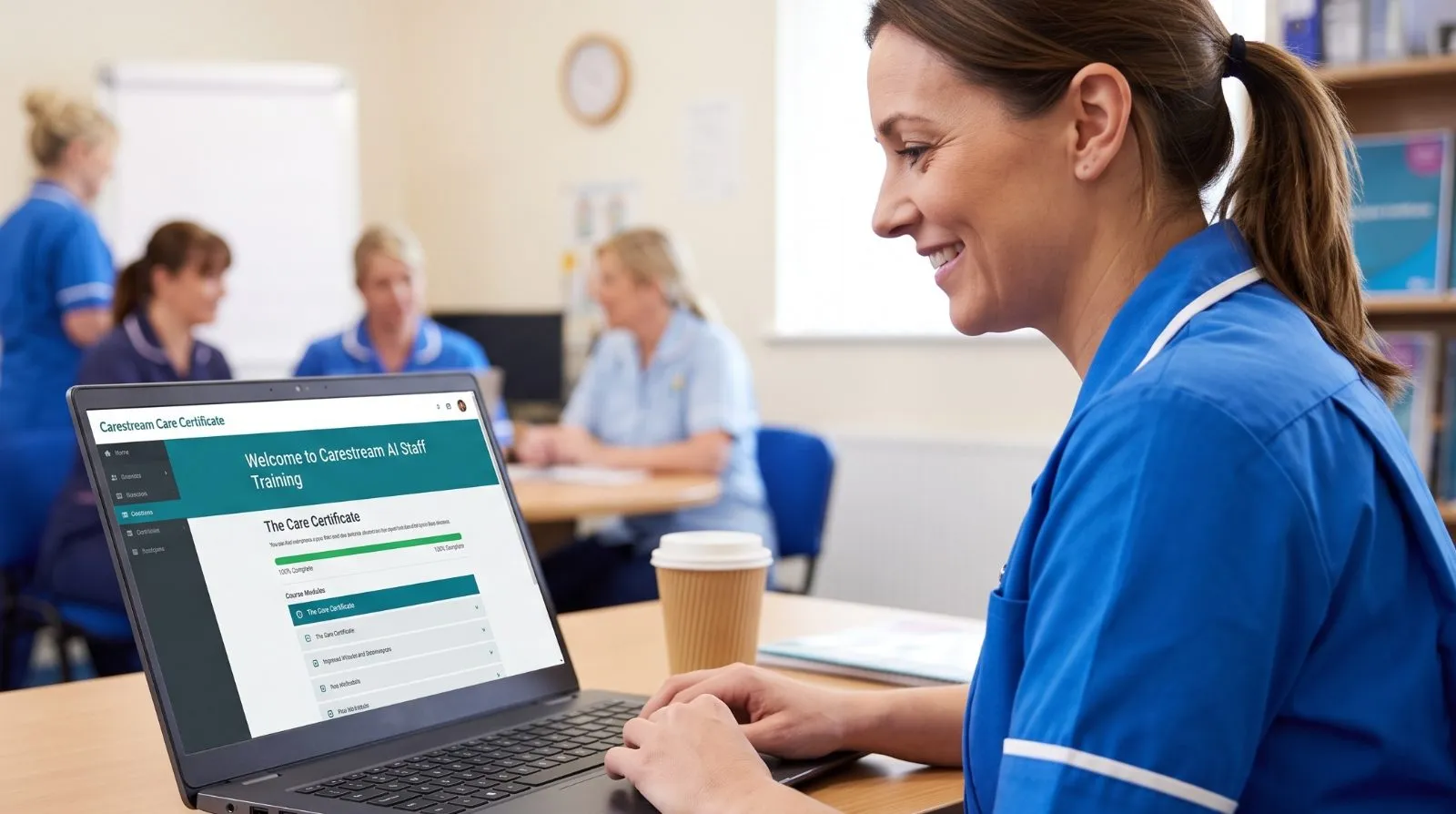
CareStreamAI delivers every module in over 60 languages, in the hub, on any device, so each member of staff genuinely understands what they are being taught rather than simply clicking through it. Renewal reminders keep the whole team current, completion tracking shows you exactly who has finished what, and all of it compiles automatically into inspection-ready CQC evidence that demonstrates not just that training was assigned, but that it was understood across your entire multilingual workforce. The result is confident, capable staff, fewer moments of hesitation when it matters, and a training record that stands up on inspection day, all built for the way UK care actually works.
Built for the UK Care System
Every module in the CareStreamAI dementia care training programme maps directly to the CQC’s Key Lines of Enquiry and the Skills for Care standards that underpin the Care Certificate. This is not a translation exercise. The scenarios, the language, the legal references, and the compliance frameworks are all native to the UK context.
Staff learn about the Mental Capacity Act because it governs their daily decisions. They learn about Deprivation of Liberty Safeguards because they will encounter them. Managers can demonstrate to inspectors that training is not just completed but relevant, and that relevance is defensible during inspection.
This is just some of the examples that make CareStreamAI different.
Beyond Person-Centred Theory
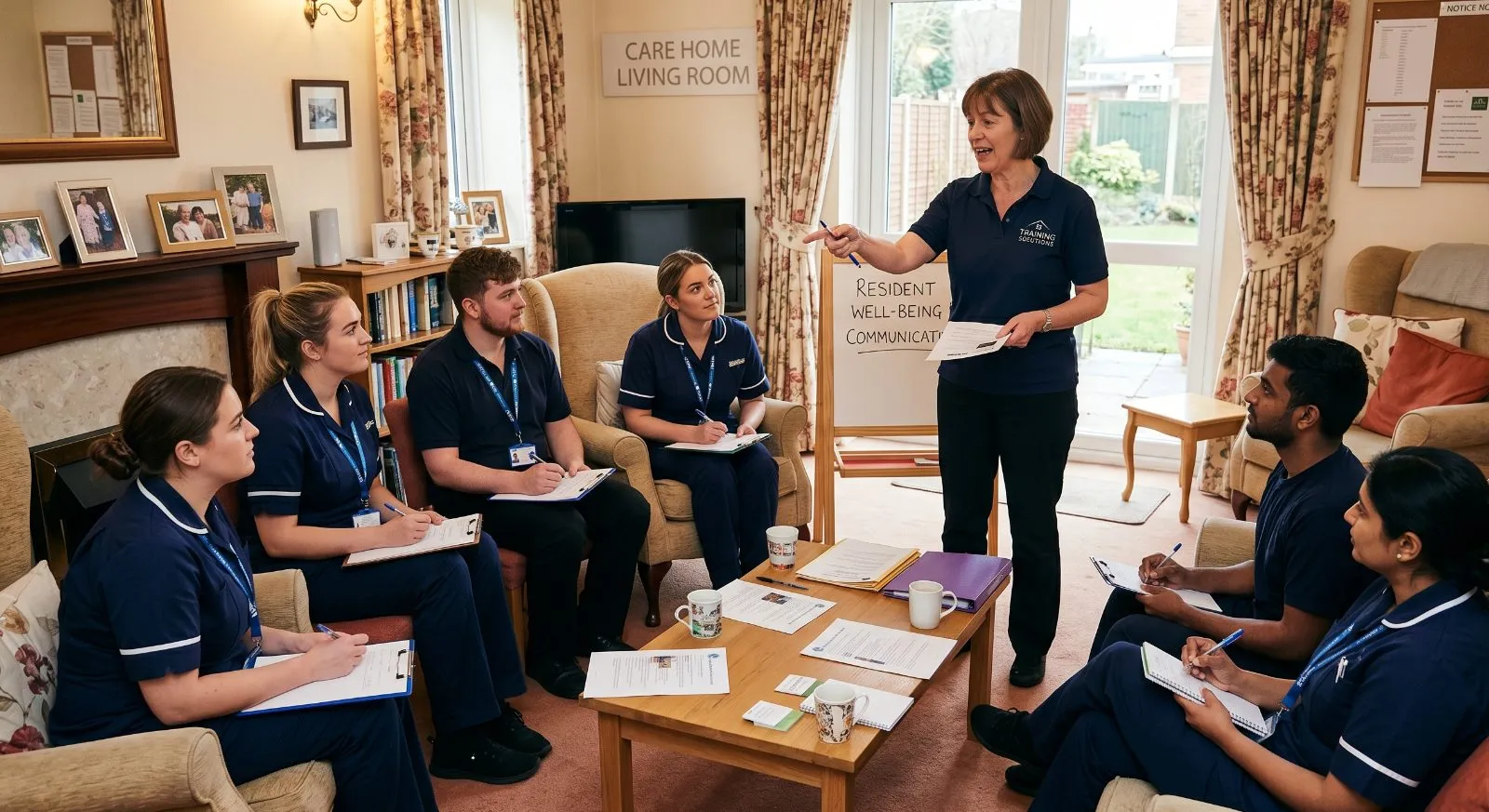
Person-centred care is the dominant philosophy in dementia care, and for good reason. But knowing the philosophy and practising it are different things. CareStreamAI uses a proprietary behavioural framework that translates person-centred principles into specific, repeatable actions. A domestic staff member learns not just that residents should be treated as individuals, but exactly how to adjust their approach when a resident with dementia refuses personal care. A registered nurse learns structured communication techniques for moments of clinical decision-making. The training is practical and scenario-based, designed for the floor rather than the screen, even when delivered digitally.
Focus on Cultural Competency
The research identified a significant gap across all major training programmes: none address cultural competency in dementia care. The UK’s ageing population is diverse. Residents come from Caribbean, South Asian, African, and Eastern European backgrounds, among many others. Dementia can strip away recently acquired language skills, leaving a person communicating in their first language.
Cultural expectations around family involvement, food, personal care, and end-of-life decisions vary enormously. CareStreamAI includes specific modules on culturally sensitive dementia care, equipping staff to recognise and respect these differences.
Technology-Enabled, Not Tech-Heavy
CareStreamAI uses artificial intelligence to track staff engagement and flag knowledge gaps, but the training experience itself is grounded in real-world application. The AI works quietly in the background, identifying which staff members are struggling with specific concepts and prompting managers with targeted coaching suggestions. There is nothing for your team to configure, and no technical knowledge is required. Staff simply complete their training in the language they think in, on whatever device they have to hand, while the intelligence that makes the system effective stays out of their way. This data layer transforms training from a one-off event into an ongoing process, and it provides the foundation for the follow-up system that sets CareStreamAI apart.
Crucially, this technology was built to support your staff, not to police them. The aim is never to catch people out or to create a record of who got something wrong. When the system notices that a concept hasn't quite landed, the response is to reinforce the learning, revisit the relevant policy and offer a gentle, practical follow-up, not to flag a failure.
A care assistant who hesitates on a question is met with another chance to understand it, in their own language, rather than a black mark against their name. This matters because staff learn best when they feel safe to admit what they don't yet know. By framing every knowledge gap as an opportunity to strengthen understanding rather than expose a shortfall, CareStreamAI builds the kind of trust that makes training genuinely effective, helping your team grow more confident over time instead of more guarded.
That same supportive principle is what turns CareStreamAI from a training tool into a continuous development partner. Managers gain a clear, honest picture of where their team needs reinforcement, and staff gain a system that quietly helps them improve rather than one that judges them. The result is a workforce that engages with training willingly, retains more of what it learns, and applies it with greater confidence on the floor, because the technology behind it was designed, at every step, to help people succeed.
The Forgetting Curve Versus the Reinforcement Cycle
Hermann Ebbinghaus described the forgetting curve in the 1880s, and its implications for workplace training have been understood for decades. Yet most training providers ignore it because addressing it requires ongoing effort and sophisticated systems. CareStreamAI’s follow-up programme uses micro-learning bursts, real-world scenario refreshers, and peer-to-peer coaching prompts to interrupt the forgetting curve and replace it with a reinforcement cycle.
Knowledge is revisited at strategically spaced intervals, each time in a slightly different format, which strengthens neural pathways and builds automaticity. A carer who has practised redirection techniques across ten short follow-up sessions over three months will respond differently under pressure than one who heard about redirection once in a workshop.
The CareStreamAI Difference: Structured Follow-Up Training in Detail
The single greatest distinction between CareStreamAI and every other dementia care training provider is the structured follow-up programme. Standard training ends when the certificate prints. CareStreamAI training begins there. Most providers treat the completion of a module as the finish line, when in reality, it is the moment the real work starts. Knowledge fades quickly when it isn't revisited, and a concept understood in a quiet training session is easily lost in the noise of a busy shift weeks later. CareStreamAI is built around this reality, turning a single training event into a sustained programme of reinforcement that keeps learning alive long after the initial module is done.
In practice, this means the system doesn't simply mark a member of staff as trained and move on. It revisits key concepts at spaced intervals, gently resurfacing the most important points from each module so they move from short-term recall into genuine, lasting understanding. When a care assistant completes dementia awareness training, for example, CareStreamAI continues to check in over the following weeks, prompting them to apply what they learned to realistic situations and reinforcing the areas where understanding was less secure. Every follow-up is delivered in the language they think in, on whatever device they have to hand, so the process feels like a natural part of their working life rather than another task to dread.
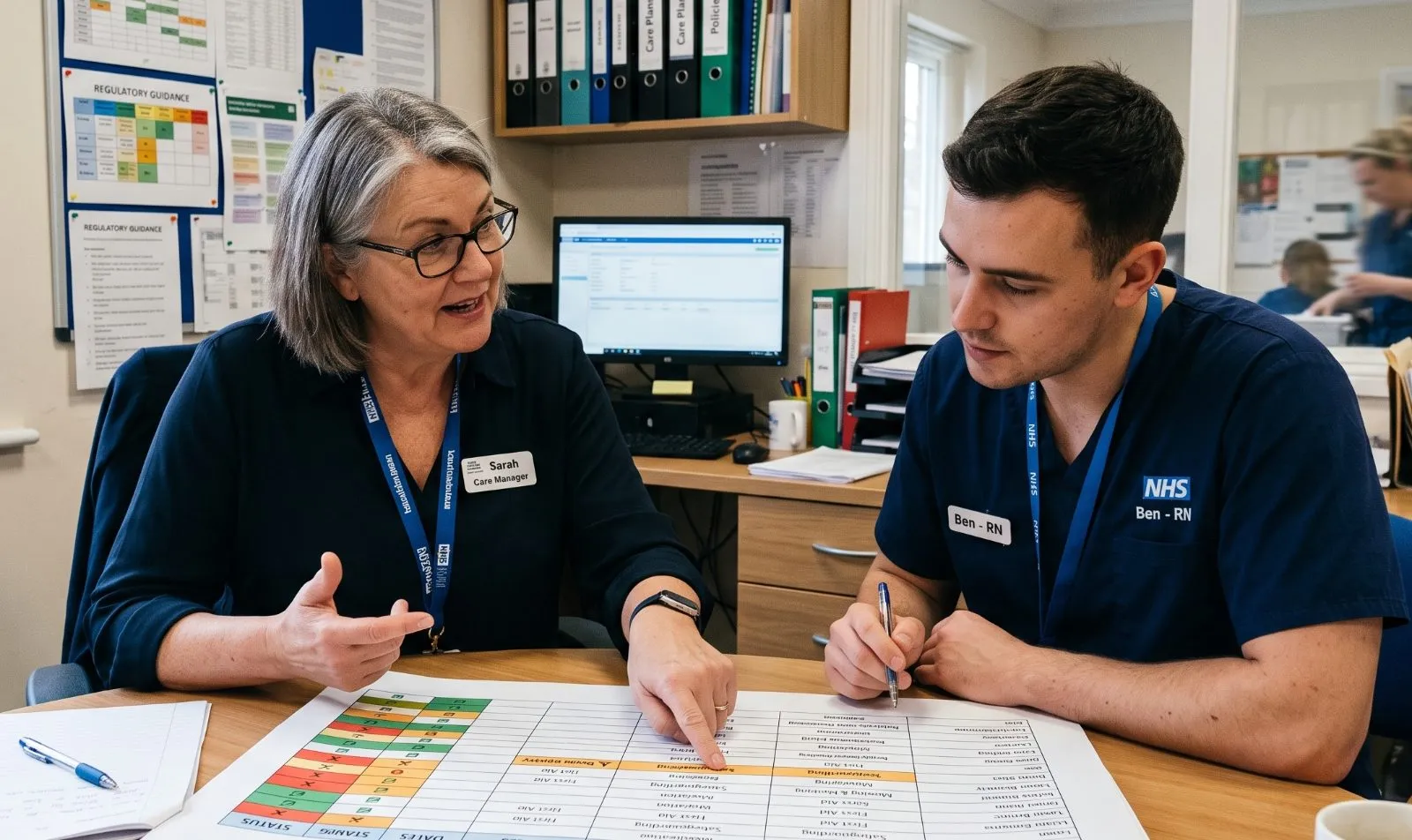
The benefits of this approach compound over time. Staff retain far more of what they learn, which means better, more consistent care for residents living with dementia and fewer moments of hesitation when a difficult situation arises. Managers gain a living picture of where understanding is strong and where it needs shoring up, allowing them to direct support exactly where it is needed instead of waiting for an annual refresher to expose a gap. Because every follow-up interaction is logged automatically, the programme also produces a continuous, inspection-ready trail of evidence showing CQC not just that training was delivered, but that it was understood, retained and applied across your whole team.
Above all, structured follow-up reflects the same principle that runs through everything CareStreamAI does. It exists to help your staff genuinely master their training and feel confident in their roles, not to test them once and leave them to manage on their own.
Staff Retention Through Mastery
The link between training quality and staff retention is well established but rarely acted upon. Care staff who feel incompetent in the face of challenging behaviours experience moral distress. They dread coming to work. They leave, and you are back to square one on the recruitment train again.
Structured follow-up training addresses this at its root. When staff master the skills to handle difficult situations, their confidence grows. They feel supported by their employer. The training becomes a career development pathway rather than a tick-box exercise, and that perception shift has a direct impact on turnover. In a sector where recruiting a single care worker can cost thousands of pounds, the retention argument for follow-up training is compelling on financial grounds alone.
How to Choose the Right Dementia Care Training for Your Home
For care home managers evaluating training options, the market can feel overwhelming. The following framework provides a practical basis for comparison. The good news is CareStream offer two different types of Dementia Care training: the standard Dementia Care and Cultural Diversity in Dementia Care, both designed either as an annual training module or using your policies to generate the internal training.
Evaluate the Follow-Up
The critical question is simple: what happens after the certificate is issued? If the answer is nothing, the training is unlikely to produce lasting change. Look for a structured plan that extends at least three to six months beyond initial training. Ask about the specific formats: micro-learning, case reviews, coaching prompts, reassessments. Follow-up is the only mechanism that converts training spend into genuine return on investment.
Move Beyond the Certificate
One-off dementia care training creates a false sense of security. It satisfies a compliance requirement without delivering the behaviour change that residents deserve and that CQC inspectors increasingly expect. Real transformation in dementia care requires a system: initial learning followed by consistent, data-driven reinforcement that embeds skills and builds confidence across the entire staff team.
CareStreamAI was designed for UK care homes that want more than a folder of certificates. The dementia care training programme combines CQC-mapped content with a structured six-month follow-up pathway that generates measurable outcomes and defensible compliance evidence. For managers seeking to improve CQC ratings, reduce staff turnover, and enhance resident quality of life, the choice is not between training providers. It is between training that fades and training that lasts.
Explore the full programme breakdown and book a demo at the CareStreamAI dementia care training page.
Sources
- NICE NG97: Dementia assessment, management and support · nice.org.uk
- Alzheimer's Society · alzheimers.org.uk
- Skills for Care · skillsforcare.org.uk
Frequently asked
Why isn't a training certificate enough to prove my staff are competent in dementia care?
A certificate confirms that training took place, but it says nothing about whether the knowledge lasted. Research on knowledge retention shows that without reinforcement, learners forget around fifty per cent of new information within days and up to ninety per cent within a month. In dementia care, where staff handle complex and high-pressure situations, that forgetting curve has real consequences. A carer who cannot recall de-escalation techniques in a moment of resident distress will fall back on instinct, which is rarely person-centred. This is why CareStreamAI treats the certificate as the starting point rather than the finish line, building reinforcement into the programme so that knowledge becomes genuine, lasting competence.
How does the structured follow-up programme actually work?
Rather than marking a staff member as trained and moving on, CareStreamAI revisits key concepts at strategically spaced intervals, each time in a slightly different format, to interrupt the natural forgetting curve and replace it with a reinforcement cycle. The programme uses micro-learning bursts, real-world scenario refreshers and peer-to-peer coaching prompts across a pathway that extends three to six months beyond the initial training. A carer who has practised redirection techniques across ten short follow-up sessions over three months will respond very differently under pressure than one who heard about it once in a workshop.
Is CareStreamAI designed to monitor and catch out staff who get things wrong?
No. The technology was built to support staff, not to police them. The aim is never to catch people out or to create a record of who got something wrong. When the system notices that a concept has not quite landed, it responds by reinforcing the learning and offering a gentle, practical follow-up rather than flagging a failure. A care assistant who hesitates on a question is given another chance to understand it, in their own language, rather than a black mark against their name. By treating every knowledge gap as an opportunity to strengthen understanding, the system builds the trust that makes training genuinely effective and helps staff grow more confident over time.
How does CareStreamAI help with staff retention and CQC compliance?
The two benefits are closely linked. When staff master the skills to handle difficult situations, their confidence grows and they feel supported by their employer, which turns training into a career development pathway rather than a tick-box exercise and has a direct impact on turnover. In a sector where recruiting a single care worker can cost thousands of pounds, that retention argument is compelling on financial grounds alone. At the same time, every follow-up interaction is logged automatically, producing a continuous, inspection-ready trail of evidence that shows CQC not just that training was delivered, but that it was understood, retained and applied across the whole team, which directly supports the Well-led evaluation.
Can CareStreamAI training be delivered in languages other than English?
Written by
 Len BurgessSenior Care Advisor
Len Burgess has worked in the care sector for over 8 years, with hands-on experience across residential, nursing and community settings. Having supported teams through CQC inspections and the day-to-day reality of keeping a service compliant, he writes about regulation, quality and best practice in a way that's grounded in what actually happens on the floor, not just what the guidance says.