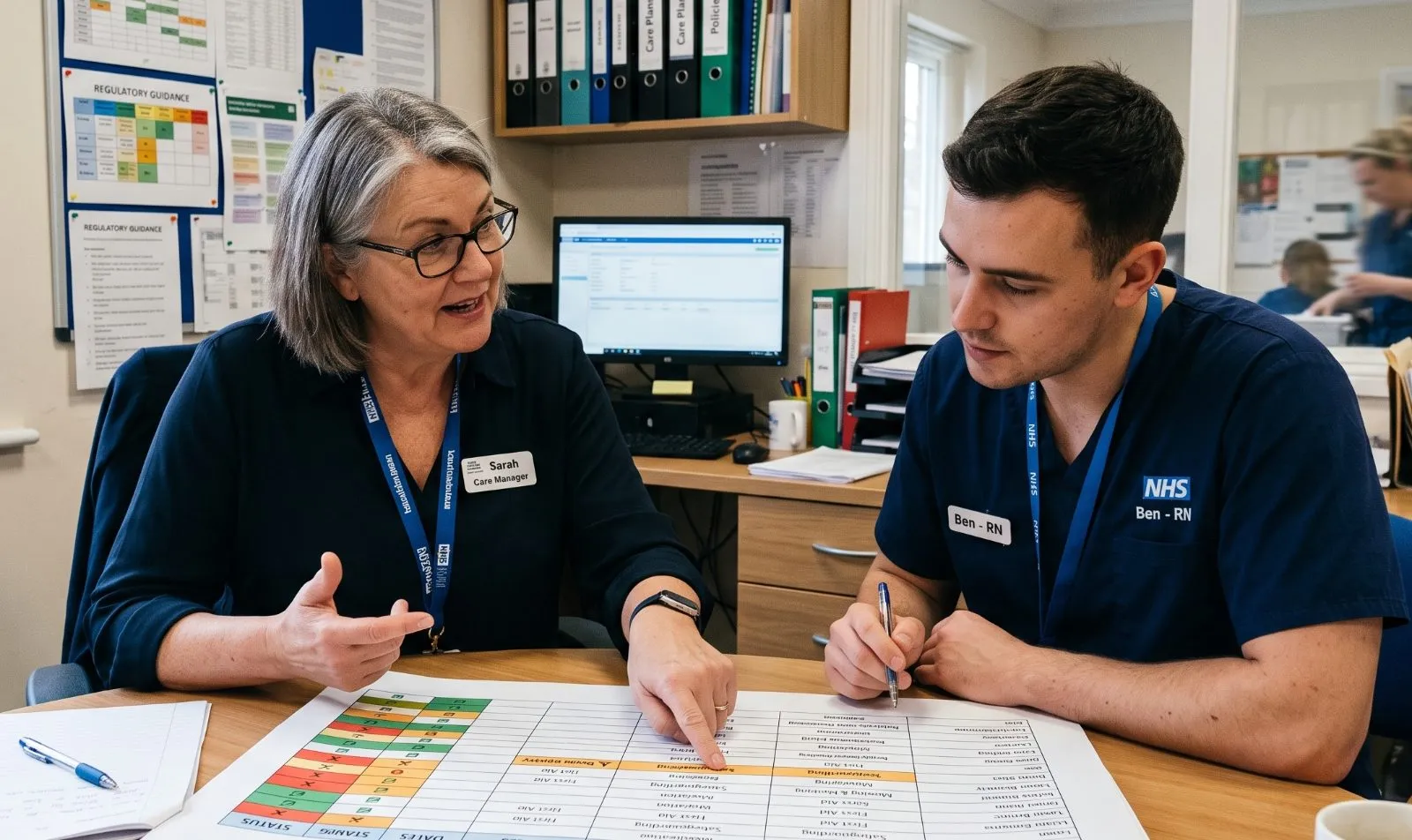
Every incident is already a training moment. The medication error, the fall, the complaint from a family member, the near miss on a night shift. Each one contains a lesson your team needs. But in most care services, that lesson dies somewhere between the investigation write-up and the next staff meeting. The report gets filed. The learning never reaches the people who need it most.
This piece gives you a practical, defensible process for turning any incident or complaint into targeted training that the right people complete, with evidence you can show an inspector. We will cover the full journey from investigation outcome to completed module, including how to keep it non-punitive, how to target the right roles, and how to record it properly. Incident-led training in care is not a new idea, but doing it quickly, specifically, and without blame is where most services struggle.
Why Most Incident Follow-Up Stops at the Report
The investigation gets written. The form gets filed. The learning stops there. The gap between what happened and what the team now knows is where repeat incidents come from.
The most common failure is that training is generic, not specific. A mandatory module on falls or medication does not address what actually went wrong in your setting, with your policies, on your shift. Your staff already sat through the generic course. What they needed was to understand the exact procedure that was missed, in the exact context where it happened.
Then there is the blame problem. If follow-up feels punitive, staff stop reporting. The learning culture dies quietly, and the next incident gets managed informally instead of logged. You cannot learn from an incident that never reaches the record.
The regulator expects to see the loop closed: incident, investigation, action, learning, evidence of completion. Skills for Care guidance is explicit that each accident and incident is an opportunity to learn from mistakes. But that only counts if you can show what changed as a result.
The practical reality for a registered manager is this: you know what should happen. The admin of building a module, assigning it, and tracking completion is why it does not get done. Learning from incidents in a care home is a process problem as much as a cultural one.
The Line Between Learning and Blame
Start from the position that most incidents are system failures, not character failures. The question is not who did this wrong. The question is what everyone should know now.
How you talk about it matters. Frame the training as this is what we now know, not this is who got it wrong. No named individuals in the module content, ever. The scenario should be recognisable as a situation, not identifiable as a person.
Involve the people involved, where appropriate. A staff member who lived through the incident often has the most useful insight into what the policy did not cover. They know where the confusion happened, because they were standing in it.
Be explicit with your team: the purpose is protection, not punishment. If staff see a colleague being publicly blamed, reporting will dry up and your audit trail will show it. Fear of blame is one of the most commonly cited barriers to incident reporting in the sector.
Psychological safety is a compliance issue, not a soft one. Your training culture is part of your evidence. An inspector can see the difference between a team that reports openly and one that manages quietly.
From Investigation Outcome to Training Module
Step 1: Identify the Policy the Incident Touched
Every incident connects to a policy: medication administration, falls prevention, moving and handling, safeguarding, communication, handover. Name the policy before you name the training.
If the incident revealed a gap in the policy itself, fix the policy first. Training people on a policy you are about to change wastes everyone's time and undermines the whole exercise.
Note which specific section or procedure was involved. The training should quote that section, not the whole document. A focused reference is more useful than a 40-page policy dump.
Step 2: Build the Module Around Your Own Policy
The training content should come from your own uploaded policies and risk assessments, not a generic external course. That is what makes it defensible in front of an inspector: it reflects your setting, your procedures, your standards. A generic course proves you bought a licence. A module built from your own policy proves you responded to what happened.
Book a short demo and see how CareStream keeps your policies, training and CQC evidence in one place.
Book a demoWith CareStream, this is an adhoc module generated from the specific policy the incident touched. You select the policy, the platform builds the scenario-based module around it, in the languages your team actually speaks. The AI does not make things up. It cannot. The content comes from your documents, nothing else.
Scenario-based beats theory-based. Present the incident as an anonymised scenario and ask what the correct action would have been, per your policy. This is how adults learn: by applying knowledge to a situation they recognise.
Keep it short. A focused 10 to 15 minute module is more likely to be completed properly than a 45 minute general course. Completion quality matters more than duration.
Step 3: Assign to the Affected Roles Only
Targeted training means targeted assignment. The night shift that worked through the incident needs it. The admin team that never touches PEG feeding does not.
Role-based assignment protects your team from training fatigue. If every incident triggers training for everyone, staff stop taking any of it seriously. They click through because they have seen it all before, and the one person who genuinely needed the learning gets lost in the crowd.
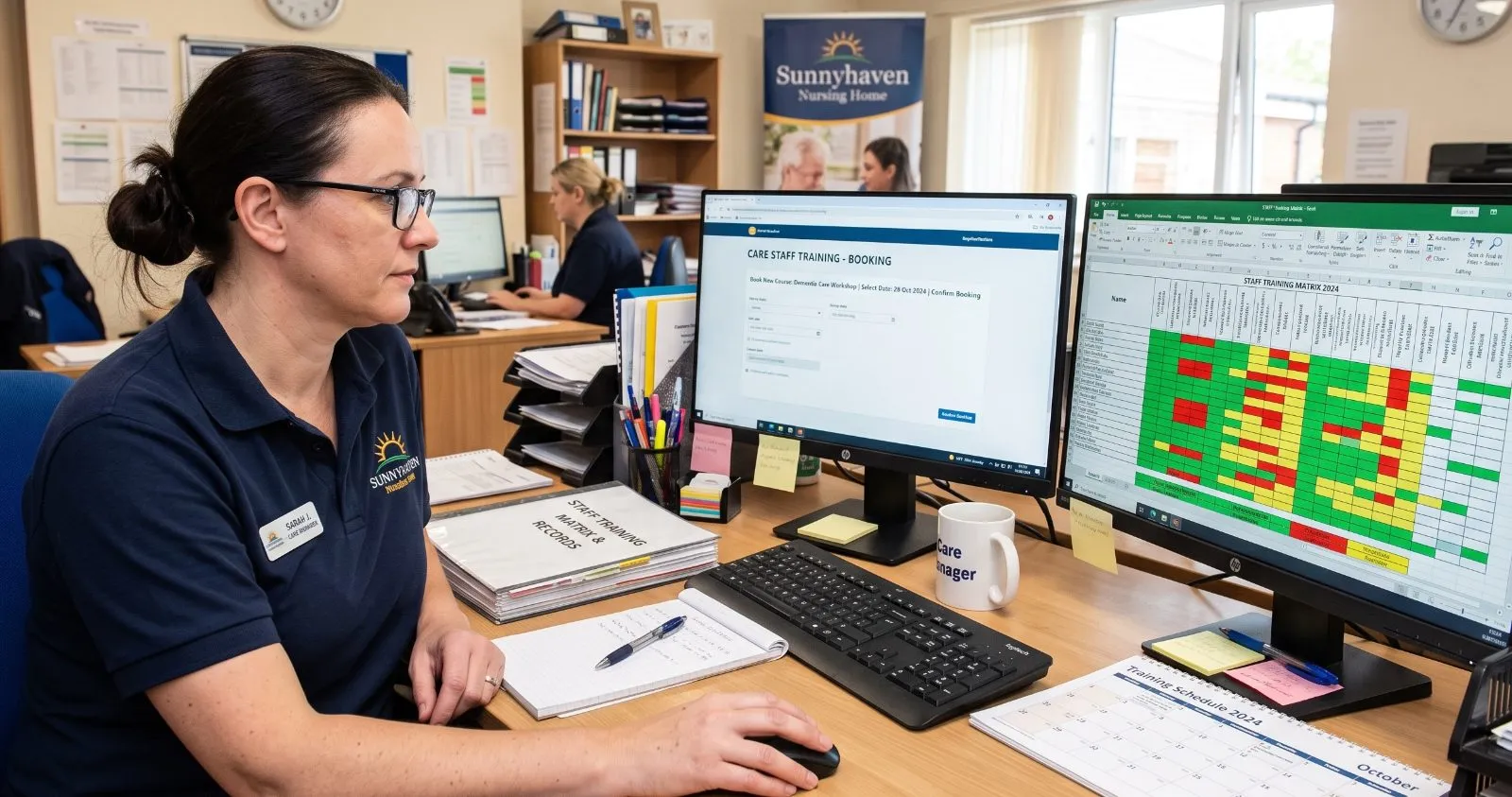
CareStream assigns the module to the affected roles only, and completion is recorded against the same staff record as everything else. Your training matrix stays current without manual chasing.
New starters in those roles should receive the module as part of their induction, so the learning outlives the moment. The incident becomes part of how your service trains, not just how it reacted.
Speed Matters: Close the Loop While It Is Fresh
The faster the training happens after the incident, the more relevant it feels. A module delivered three weeks later reads as box-ticking. One delivered within days reads as learning.
The investigation does not need to be fully closed to start the training. If the facts are clear enough to identify the policy gap, build the module. You can update it later if the investigation reveals more, but do not wait for a perfect report before you act.
CareStream can generate the ad hoc module in under an hour once the policy is selected. No waiting on a training provider, no scheduling a classroom day, no chasing a consultant.
Staff are more engaged when the incident is recent. They remember the shift, they remember the discussion, and the training lands in context. Three weeks later, the moment has passed, and the module feels like an administrative chore.
Your audit trail shows the date of the incident and the date of completion. A short gap is itself evidence of a responsive learning culture. An inspector notices that.
Keeping It Non-Punitive: What to Say and What Not to Say
Language in the module matters. Use what we learned, not what went wrong. Use the correct procedure, not the mistake. The difference sounds small. It is not.
Do not name the individuals involved anywhere in the training content. The scenario should be anonymised to the point where the team recognises the situation, not the person. If someone can identify a colleague from the module, you have failed the trust test.
If the incident involved a safeguarding concern, be careful. Training after a safeguarding incident should focus on the reporting and escalation procedure, not on the details of the case itself. The case is confidential. The procedure is not.
Tell the team why the training exists. A short opening line from the manager, recorded or written, explaining that this is about keeping everyone safe and confident, sets the tone before anyone clicks start.
If disciplinary action is also happening, keep the two processes visibly separate. Training is not punishment. It is protection for the whole team, including the person involved.
Recording It All: The Evidence That Builds Itself
The regulator will ask how you learned from incidents. The answer is not We did a training session. The answer is: here is the module, here is who completed it, here is when, here is the policy it came from.
Every query and training completion in CareStream is logged automatically into your audit trail and CQC evidence pack. You do not build the evidence. It builds itself while you get on with running the service.
The training record should connect to the incident record. An inspector should be able to follow the chain: incident report, investigation, learning outcome, module, completion records. If that chain is broken, your learning culture is a claim, not a fact.
Include the training in your supervision conversations. A follow-up discussion with the affected staff members, noted in supervision records, shows the learning was embedded, not just clicked through. The module starts the conversation. Supervision finishes it.
For groups, the multi-site console shows completion rates across services. A director can see whether one home is consistently slower to close the loop than others, and act on that before it becomes a pattern.
A quick demo shows exactly how CareStream would work for your service. Book a time that suits you.
Book a demoComplaints Are Incidents Too
A complaint from a family member is often the visible surface of a training gap. The same process applies: identify the policy, build the module, assign the roles.
Complaints carry an emotional charge that incidents sometimes do not. The family wants to know that their concern changed something. A training module, completed and recorded, is a concrete answer. It is the difference between we have noted your concerns and we have changed how we train.
CareStream handles complaints the same way as incidents: the policy is the source, the module is the output, the completion is the evidence. The process does not change because the trigger was a phone call rather than an incident form.
Responding to the complainant with " We have updated our training and all relevant staff have completed it is far stronger than we have noted your concerns. One is a promise. The other is a receipt.
The regulator will look at how complaints drive improvement. A logged training response turns a complaint from a problem into a demonstration of your learning culture. Complaint learning outcomes are not a separate category. They are the same loop, closed.
What Good Looks Like: A Worked Example
A night shift medication error: the wrong dose of a controlled drug was administered. The investigation found the staff member had not accessed the medication policy in over a year and was working from memory.
The policy gap: the medication administration policy, section on controlled drugs, was not being referenced at the point of care. The policy existed. Access to it did not.
The module: a 12-minute scenario-based module built from the medication policy, covering the checking procedure and the correct documentation, translated into the staff member's first language. The content came from the provider's own policy, not a generic course.
The assignment: all night shift staff and any bank staff who worked that unit. Completed within 48 hours. The admin team was not included, because they do not administer controlled drugs.
The evidence: incident report, investigation notes, module completion records, supervision note discussing the learning. The full chain is in the audit trail, ready for inspection. That is what good looks like.
The Bottom Line: Learning Is a Process, Not a Form
Incident-led training is not an extra task. It is the point of the investigation. Without the learning, the report is just paperwork with a signature.
The process is simple: identify the policy, build the module, assign the roles, record the completion. CareStream makes each step faster, but the process is the same whether you use software or not. The software just removes the admin that stops you from doing it.
The ethical spine matters. This only works if your team trusts that the training is about protection, not blame. That trust is built in how you talk about incidents, not in the software. The software cannot fix a culture that punishes reporting.
Your compliance evidence builds itself when the process is consistent. Every incident, every module, every completion, all in one place, all traceable. When the inspector asks, you do not have to remember. You just show.
The question is not whether your team will have another incident. It is whether the next one will be the first one or a repeat.
Conclusion: The Loop Only Counts If It Closes
The process this article describes is the whole job: identify the policy, build the module, assign the roles, record the completion. What stops most services from doing it is not disagreement with the principle but the admin sitting between the investigation and the assignment, which is exactly where the learning usually dies. CareStream removes that stretch. Select the policy the incident touched, and the platform generates a scenario-based module from that document, in the languages your team reads, in under an hour.
Nothing is invented, because nothing can be: the content comes from your uploaded policy and nowhere else, which is what makes it defensible rather than decorative. Assignment goes to the affected roles only, so the night shift gets what they need, and the admin team is not dragged through a module about controlled drugs. The completion lands on the same staff record as everything else, the module carries forward into induction for new starters in those roles, and the audit trail shows the incident date and the completion date side by side.
That gap is itself evidence, because a short one describes a responsive service in a way no policy statement can. None of this builds the culture. If your team believes reporting leads to blame, the modules will be completed, and the incidents will stop reaching you, and no software detects that. What it does is make sure that when the culture is right, the admin is never the reason the learning failed to land.
Sources
- CQC — Reporting medicine related incidents · cqc.org.uk
- CQC — Controlled drugs in care homes · cqc.org.uk
- CQC — Regulation 20: Duty of candour · cqc.org.uk
- CQC — Regulation 18: Notification of other incidents (2009 Registration Regulations) · cqc.org.uk
- CQC — Regulation 17: Good governance · cqc.org.uk
- CQC — Regulation 16: Receiving and acting on complaints · cqc.org.uk
- CQC — Regulation 13: Safeguarding service users from abuse and improper treatment · cqc.org.uk
- NICE — Managing medicines in care homes (SC1) · nice.org.uk
Frequently asked
Why does generic mandatory training not close the loop after an incident?
Because your staff already completed it. A standard falls, or a medication module covers the topic in the abstract; what the team needs is the specific procedure that was missed in your setting, referencing your policy. A generic course evidences that you bought a licence. A module built from your own policy evidences that you responded to what happened.
Should we wait for the investigation to close before building training?
No, provided the facts are clear enough to identify which policy was involved. A module delivered within days reads as learning; three weeks later, it reads as administration. You can revise the content if the investigation surfaces more, and the gap between the incident date and the completion date is itself visible evidence of a responsive service.
How do we keep this from feeling punitive?
Language and scope. Frame it as what we now know rather than what went wrong; never name individuals in module content, and anonymise the scenario so the team recognises the situation rather than the person. If disciplinary action is also running, keep the two processes visibly separate. Fear of blame is one of the most common reasons incidents stop reaching the record at all.
Who should the training be assigned to?
Only the roles the incident actually touched. If every incident triggers training for everyone, staff learn to click through and the people who genuinely need the learning disappear into the crowd. Targeted assignment is a protection against training fatigue as much as an efficiency measure. New starters in those roles should pick it up at induction, so the learning outlives the moment.
What does the evidence chain need to contain?
Incident report, investigation notes, the policy the module came from, the module itself, completion records with dates, and a supervision note showing the learning was discussed. An inspector should be able to follow that chain end to end. If any link is missing, particularly the last one, the learning culture is a claim rather than a demonstrated fact.
Written by
 Len BurgessSenior Care Advisor
Len Burgess has worked in the care sector for over 8 years, with hands-on experience across residential, nursing and community settings. Having supported teams through CQC inspections and the day-to-day reality of keeping a service compliant, he writes about regulation, quality and best practice in a way that's grounded in what actually happens on the floor, not just what the guidance says.