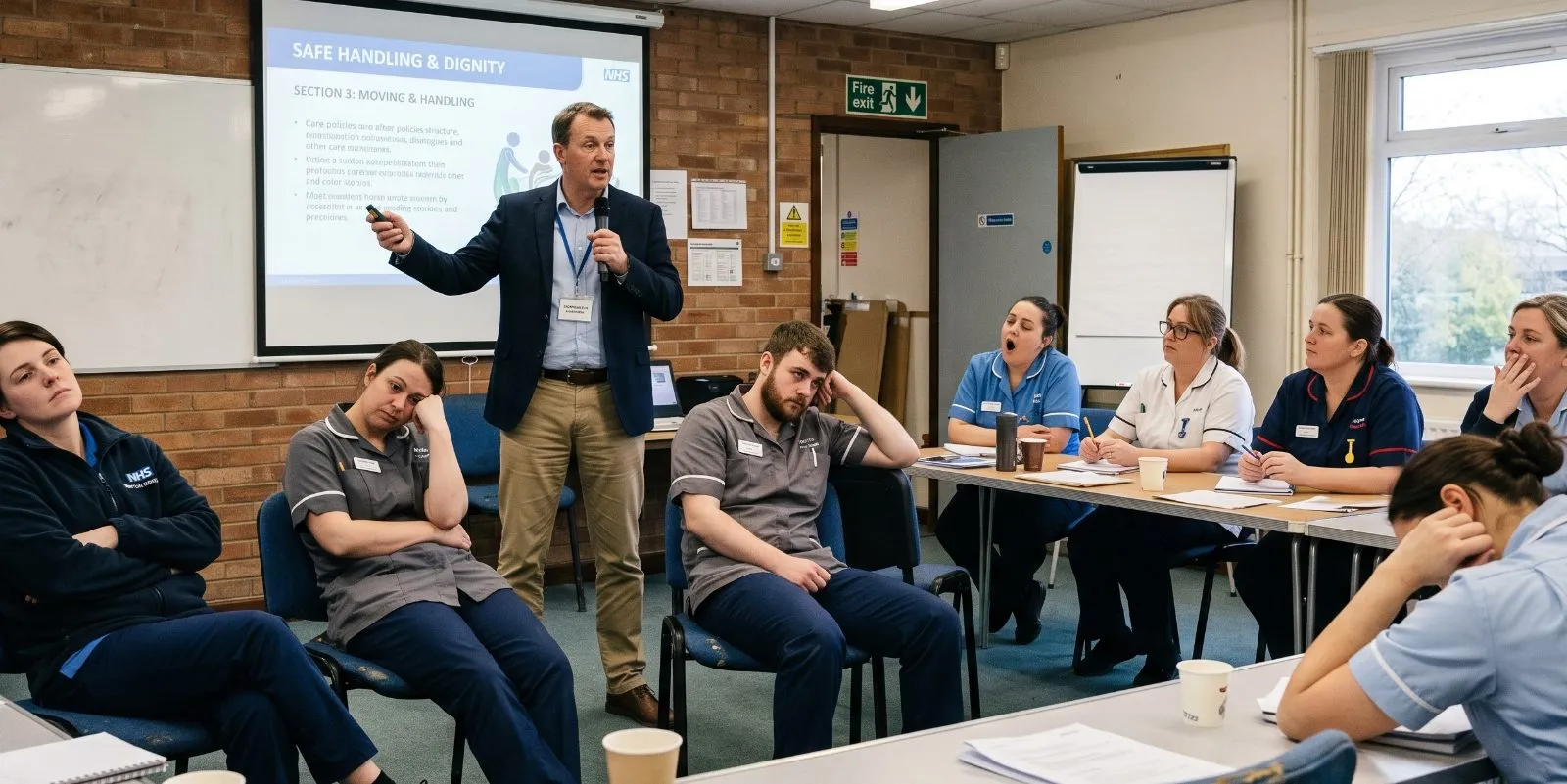
You have sat through the same moving and handling refresher four times. You have watched staff check their phones under the table. You have paid for the trainer, the backfill, the shift cover chaos, and the room that smelled faintly of cabbage. And somewhere in the middle of it, you have asked yourself the question every registered manager eventually asks: does this actually have to be face-to-face?
The answer is not what most training providers will tell you. Some of it genuinely does. Some of it genuinely does not. The problem is that most care services have never been shown where the line sits, so they default to putting everything in a room because that feels safer come inspection day. The result is a training budget spent on habit rather than requirement, and staff time lost to sessions that could have been delivered better another way.
This piece separates the two. It is not an argument for moving everything online. It is an argument for knowing the difference, so the face-to-face training you do run is the training that actually earns its place.
The Habit That Costs You Staff Time and Budget
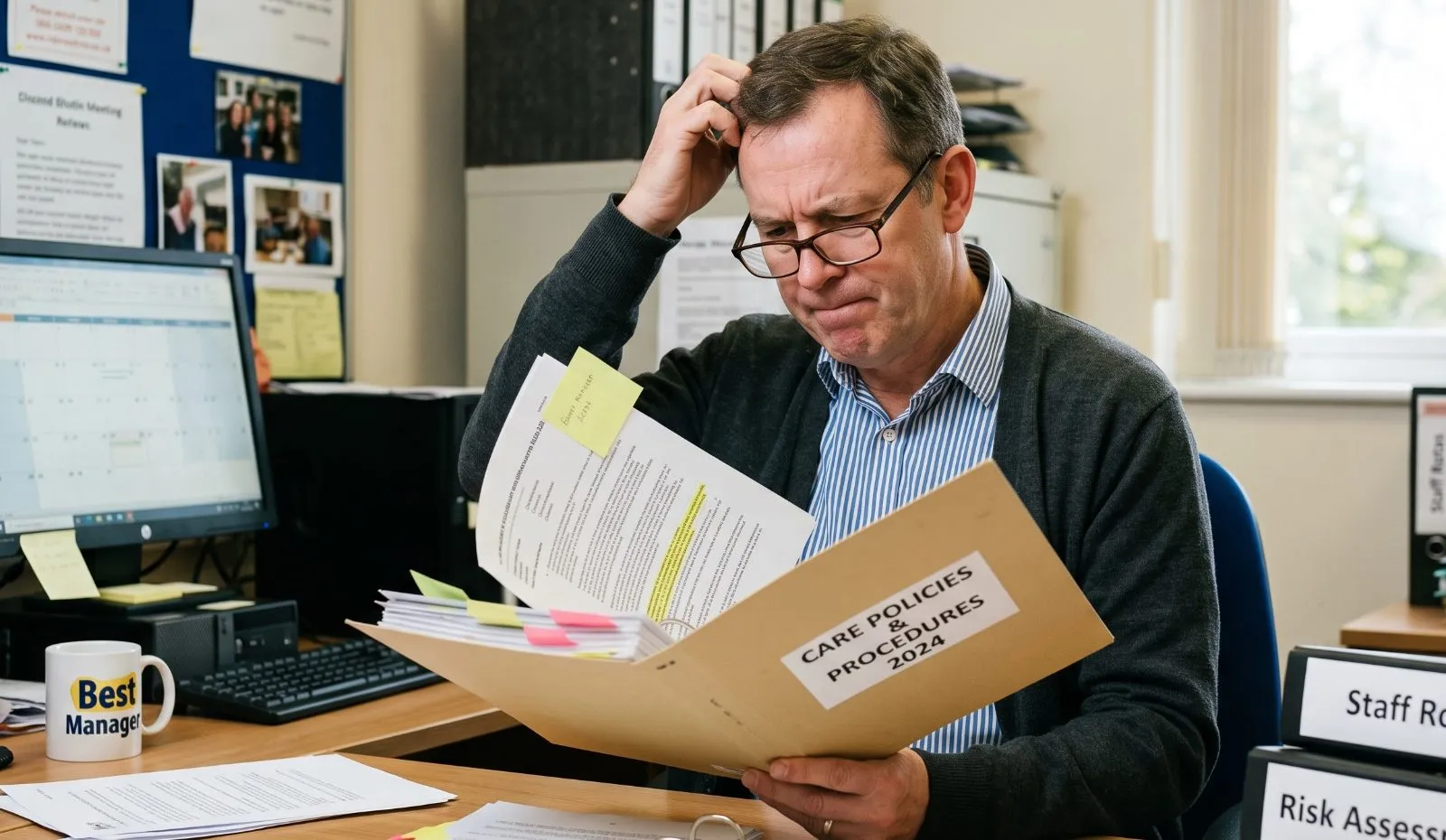
The default position in most care services is simple: if it is mandatory, it happens in a room. That is how it has always been done. That is what the last manager did. That is what feels defensible if an inspector asks.
The driver here is rarely a legal requirement. It is anxiety about CQC. Managers worry that an online module will look like a shortcut, that a blended approach will read as cutting corners, that somewhere in the Single Assessment Framework there is a clause demanding a trainer, a flipchart and a register signed in biro. There is not.
The cost of this habit is concrete. Staff hours away from residents. Backfill costs that never make it into the training budget line. Shift cover arranged at short notice. And a training model that delivers everything in a one-off block, rather than as ongoing practice that staff can revisit when they actually need it.
The Skills for Care Statutory and Mandatory Training Guide, updated in December 2025, is the reference point that settles most of these questions. It was produced in partnership with social care employers, learning providers and representative organisations, and it aligns with CQC's revised inspection framework. Most managers have not read it. That is not a criticism. It is a gap worth closing, because the guide makes a distinction that changes how you should think about training delivery.
That distinction is not online versus in person. It is theory versus demonstrated competence.
What the Law Actually Says
The legal anchors for moving and handling training are the Manual Handling Operations Regulations 1992 and the Health and Safety at Work Act 1974. Neither specifies a delivery method. Neither mentions classrooms, training rooms, or a minimum number of hours in front of a trainer.
The Health and Safety Executive's position is consistent. Training must be adequate and appropriate. It must include practical elements where the task involves physical handling of people. But the HSE does not prescribe how that practical element is delivered, only that it exists and that it is genuine.
"Adequate and appropriate" is the phrase that does the work. It means the training must match the risk, the task and the worker. It does not mean a specific number of classroom hours. It means you can show that the training prepared the staff member for the work they actually do.
The 1992 Regulations are explicit that training should include safe handling techniques. They do not dictate whether that training happens in a room, online, or in a blended format. What the law is really asking for is evidence that staff can perform the task safely. How that competence is achieved is largely your call.
That is not a loophole. It is a responsibility. The law trusts you to make the judgement, and it expects you to be able to defend it.
Where Face to Face Is Genuinely Required
Moving and handling of people is the clearest case. You cannot assess whether someone can safely use a hoist or a slide sheet from a multiple-choice question. You cannot watch a video and know whether a staff member has understood the weight distribution, the communication with the resident, the positioning of their own body. You need to see it.
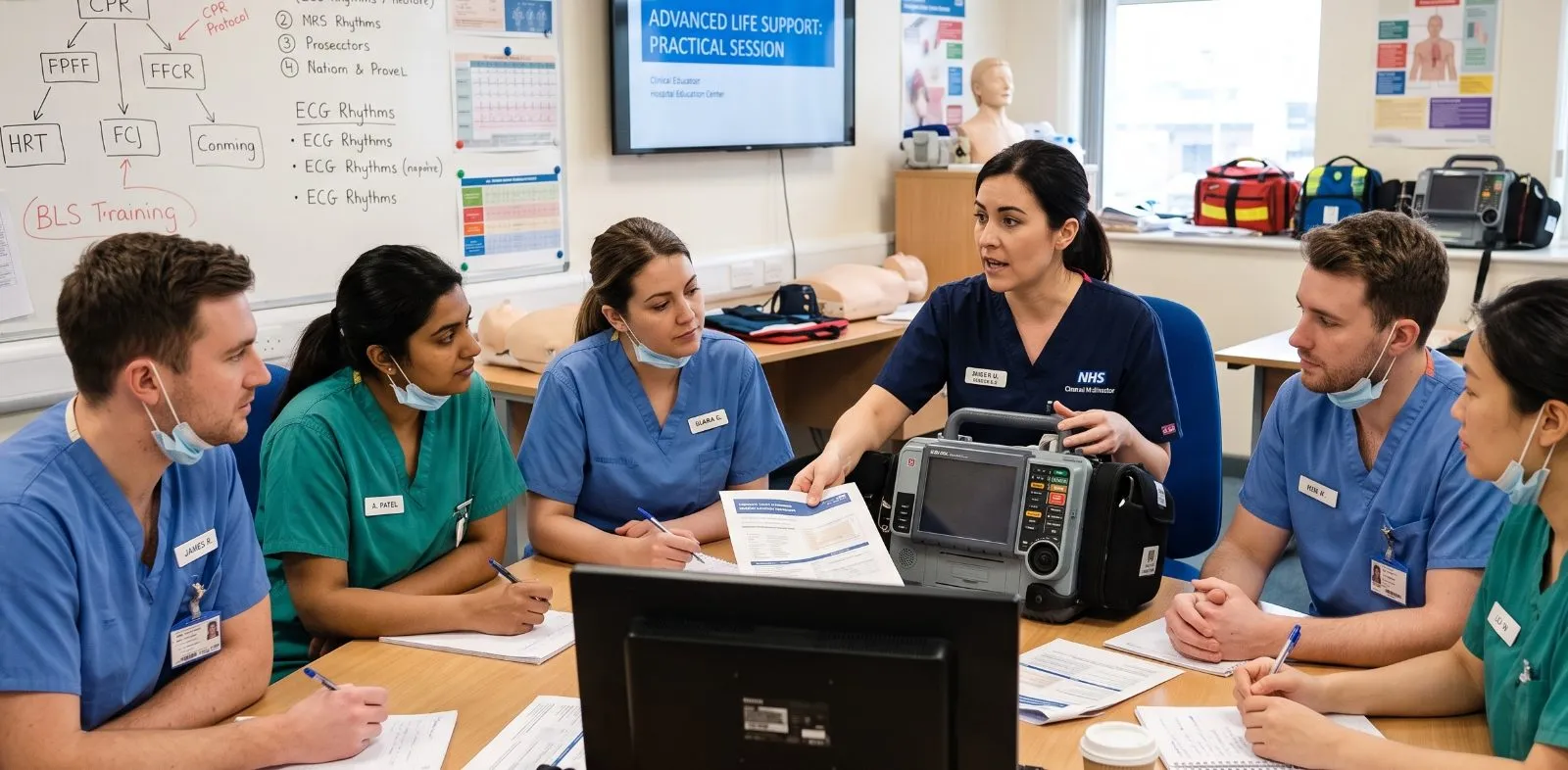
Practical assessment needs a trainer present. That might be in a classroom, a training room, or at the bedside. The setting matters less than the observation. What matters is that someone competent watched the staff member perform the task and signed off that they did it safely.
Book a short demo and see how CareStream keeps your policies, training and CQC evidence in one place.
Book a demoAnnual refresher training for staff who regularly carry out moving and handling tasks is the widely accepted standard across the UK care sector. The practical element of that refresher should be in person. This is not a box-ticking exercise. It is the moment when bad habits get caught before they become incidents.
Incident-triggered retraining is another genuine face-to-face moment. After a handling-related incident or near miss, a practical session with the staff involved is the only credible response. An online module after an incident looks like exactly what it is: a provider hoping the problem goes away.
New equipment introduction also demands hands-on training. A hoist model change or a new sling type cannot be covered by a video. Staff need to touch the equipment, practise with it, and have someone watch them do it.
The Level 1 and Level 2 Distinction
Level 1 covers general manual handling of inanimate objects: boxes, equipment, supplies. This is largely theory and can be delivered online without controversy. The risk is low, the techniques are straightforward, and the assessment does not require physical observation.
Level 2 covers people handling for care staff. This is where practical assessment becomes non-negotiable. The risk is high, the techniques are complex, and the consequences of getting it wrong are serious.
Many providers run everyone through the same course regardless of role. That is where the waste creeps in. A receptionist does not need Level 2 people handling. A senior carer does not need a refresher on lifting boxes. Matching the level to the role is both a compliance improvement and a cost saving.
Where Online Is Fine, or Better
The theory components of most mandatory training are well suited to online delivery. Fire safety, food hygiene, GDPR, equality and diversity, and the knowledge elements of moving and handling all work well as self-paced modules. The content is stable, the assessment is knowledge-based, and the delivery method does not change the outcome.
Online delivery has a concrete advantage for staff whose first language is not English. Self-paced modules can be revisited, translated and absorbed without the pressure of a room full of colleagues. A staff member who reads at their own pace, in their own language, retains more than one who sat through an English-language session nodding along. That is not a deficiency in the staff member. It is a failure of the delivery method.
The blended model that keeps appearing across the sector is the right one. Online theory first, face-to-face practical second, then workplace supervision to embed the learning. This is not a compromise. It is how adults actually learn.
The CQC's interest is in evidence of competence, not in the delivery method. A well-documented online module followed by a practical assessment holds up better than an unrecorded classroom session. The record is the point.
Some providers already run this model at scale, combining face-to-face courses with online modules in a single training package. The pattern is established, not experimental. The sector has moved. The question is whether your training matrix has moved with it.
What Inspectors Actually Look For
CQC inspectors do not ask "was this training delivered in a room?" They ask for evidence that staff are competent and that the provider can demonstrate it. The distinction matters more than most managers realise.
The Single Assessment Framework's "Safe" and "Well-Led" key questions are where training evidence lands. Inspectors want to see training records, competency sign-off, risk assessments, and equipment maintenance logs. They want to see that the provider knows who has been trained, in what, and whether the training was adequate for the role.
A training record that shows a blended approach, with theory online and practical assessment in person, is not a red flag. It is a sign of a provider that has thought about how staff actually learn. What inspectors do flag is the missing record: a staff member whose training cannot be evidenced, or a competency sign-off with no assessment behind it.
The question to ask yourself is not "will this stand up in front of an inspector?" It is "can I show this was done, by whom, and how?" If the answer is yes, the delivery method is secondary. If the answer is no, no amount of classroom time will save you.
The Evidence Problem When You Mix Both
The moment you run a blended model, you create a record-keeping problem. Online modules log themselves. Completion times, scores, dates, all captured automatically. Face-to-face sessions live in a paper folder or a spreadsheet, signed by hand, filed somewhere in the office.
A quick demo shows exactly how CareStream would work for your service. Book a time that suits you.
Book a demoWhen inspection time comes, you are stitching together two systems and hoping nothing falls through the gap. A staff member completed the online theory but missed the practical. Another attended the practical but never finished the online module. The spreadsheet says one thing, the folder says another, and you are the one who has to explain the difference.
This is where the split between online and in-person stops being a training question and becomes an evidence question. The training itself is sound. The record of it is fragile.
CareStream records face-to-face sessions against the same staff record as online modules, so the blended split stops being an administrative burden. One staff record, every training event on it, ready for audit. The point is not that CareStream replaces your trainer. It is that the paperwork around your trainer finally looks after itself. Your trainer still runs the practical session. Your staff still demonstrate competence in person. The difference is that the record of that session sits alongside the online completions, in one place, without you having to chase it.
Building Your Training Matrix
Start from the Skills for Care guide updated in December 2025. It is the most current sector reference and aligns with CQC's revised inspection framework. If your training matrix predates it, it is time for a review.
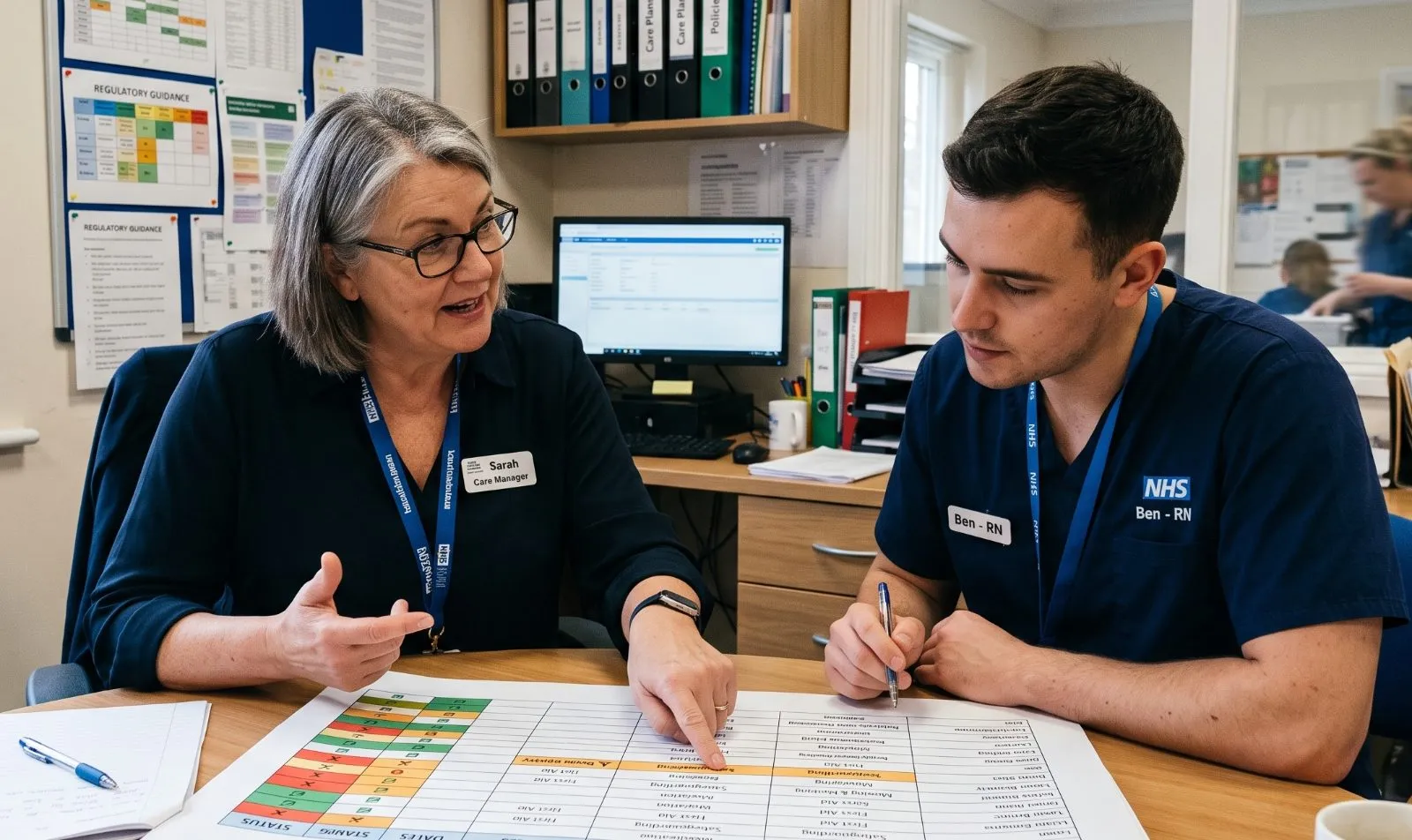
Map every mandatory topic against two questions. Does this require demonstrated competence? Does this staff member actually perform the task? The answers will sort your training into three piles: face-to-face practical, online theory, and not required for this role.
Assign delivery methods accordingly. Practical tasks get face-to-face assessment. Knowledge topics get online modules. Everything gets a recorded completion. The moving and handling of people module covers the theory, but the practical assessment still happens in person. That is the blend working as it should.
Plan refresher cycles around the annual standard for moving and handling, and build in the incident and equipment triggers for retraining. These are not optional extras. They are the moments where face-to-face training earns its place.
Budget with the split in mind. Face-to-face hours go where they are legally and practically necessary. Online modules cover the theory at a fraction of the cost. The saving is not the point. The point is that your training budget finally reflects what actually needs to happen in a room.
The Bottom Line
The law does not require a room. It requires competence, evidenced.
Face-to-face training is non-negotiable where physical handling of people is involved. Online is not a shortcut for that, and it should not be. The practical assessment is the moment where training becomes safety, and no video replaces it.
Everything else is open to a smarter split, and the sector's own guidance supports it. The Skills for Care guide, the HSE's position, the CQC's inspection focus, all point the same way. Theory online, practical in person, everything recorded.
The providers who get this right are not the ones doing everything in person or everything online. They are the ones who can show why each topic was delivered the way it was. That is the standard. That is the defence. And that is what turns training from a habit into a system.
Conclusion: The Record is Where the Blends Break
The training argument in this piece is settled. Practical people handling needs a competent person watching and signing off; theory does not, and a blended model is the sector standard rather than a compromise. What is not settled in most services is the paperwork underneath it, because a blended model runs on two systems that do not talk to each other. The online modules log themselves.
The practical session lives in a folder with a biro signature, and the gap between the two only becomes visible when an inspector asks about one staff member in particular. CareStream records face-to-face sessions against the same staff record as the online modules, so the theory completion, the practical sign-off, and the competency assessor all sit on one line rather than in two places. Your trainer still runs the session. Your staff still demonstrate competence in person, because nothing else evidences competence. What changes is that you stop stitching two records together the week before an inspection, and start being able to answer the only question that actually matters: who has been trained, in what, by whom, and can you show it? The blend was never the risk. The unrecorded half of it was.
Sources
- HSE — Moving and handling in health and social care · hse.gov.uk
- Legislation.gov.uk — Manual Handling Operations Regulations 1992 · legislation.gov.uk
- Legislation.gov.uk — Health and Safety at Work etc. Act 1974, Section 2 · legislation.gov.uk
- Royal College of Nursing — Moving and handling · rcn.org.uk
- HSE — Thorough examinations and inspections of lifting equipment · hse.gov.uk
- CQC — Regulation 18: Staffing · cqc.org.uk
- CQC — Regulation 17: Good governance · cqc.org.uk
Frequently asked
Does the law require moving and handling training to happen in a room?
No. The Manual Handling Operations Regulations 1992 and the Health and Safety at Work Act 1974 require training that is adequate and appropriate for the risk, the task and the worker. Neither specifies a delivery method, a venue, or a number of hours. What the law asks for is evidence that staff can perform the task safely, and how you achieve that is largely your judgement to make and defend.
So which parts genuinely have to be face to face?
Anything involving physical handling of people, because competence there cannot be assessed from a multiple-choice question. That means initial practical assessment, the practical element of refreshers for staff who regularly handle people, retraining after a handling incident or near miss, and hands-on training whenever a new hoist model or sling type is introduced. The setting matters less than the observation: a training room, a corridor or the bedside all work, provided a competent person watched and signed off.
Is an annual refresher legally required?
No, and this is one of the most common misconceptions in the sector. The law requires adequate and up-to-date training based on risk assessment, not a fixed calendar interval. Annual is a widely adopted convention and a defensible one for staff who handle people daily, but the justification comes from your risk assessment rather than from legislation. Be cautious of providers who present annual refreshers as a statutory requirement.
Does online delivery look like cutting corners to an inspector?
No. Inspectors look for evidence of competence rather than for a particular delivery method. A documented online module followed by a recorded practical assessment stands up better than an unrecorded classroom session. What gets flagged is a missing record: a staff member whose training cannot be evidenced, or a competency sign-off with no assessment behind it.
Why does online theory suit multilingual teams better?
Because a self paced module can be revisited and read in the staff member's own language without the pressure of a room full of colleagues. Someone who reads at their own pace retains more than someone nodding along to an English language session, and that is a property of the delivery method rather than a deficiency in the staff member. The practical assessment still happens in person.
Written by
 Len BurgessSenior Care Advisor
Len Burgess has worked in the care sector for over 8 years, with hands-on experience across residential, nursing and community settings. Having supported teams through CQC inspections and the day-to-day reality of keeping a service compliant, he writes about regulation, quality and best practice in a way that's grounded in what actually happens on the floor, not just what the guidance says.