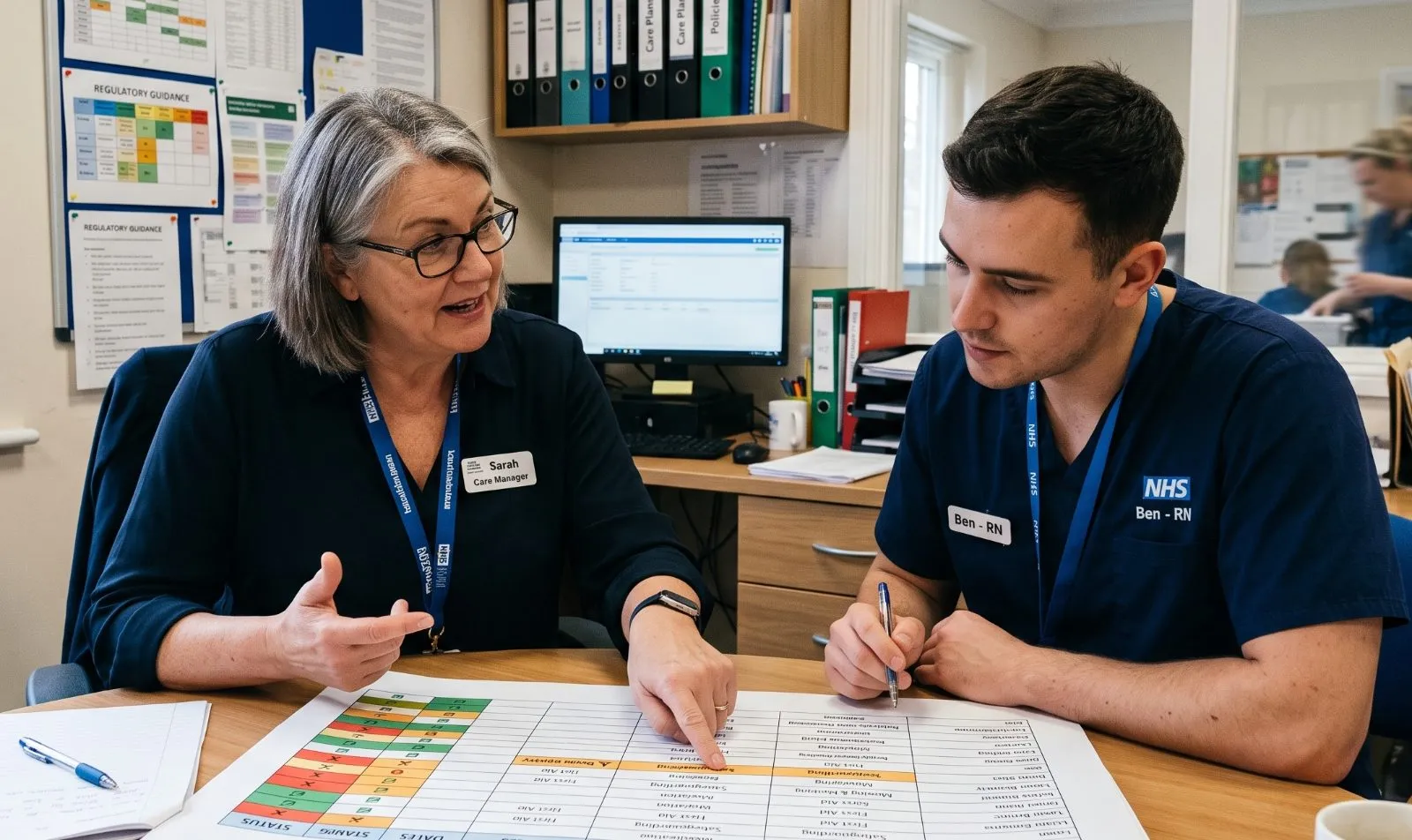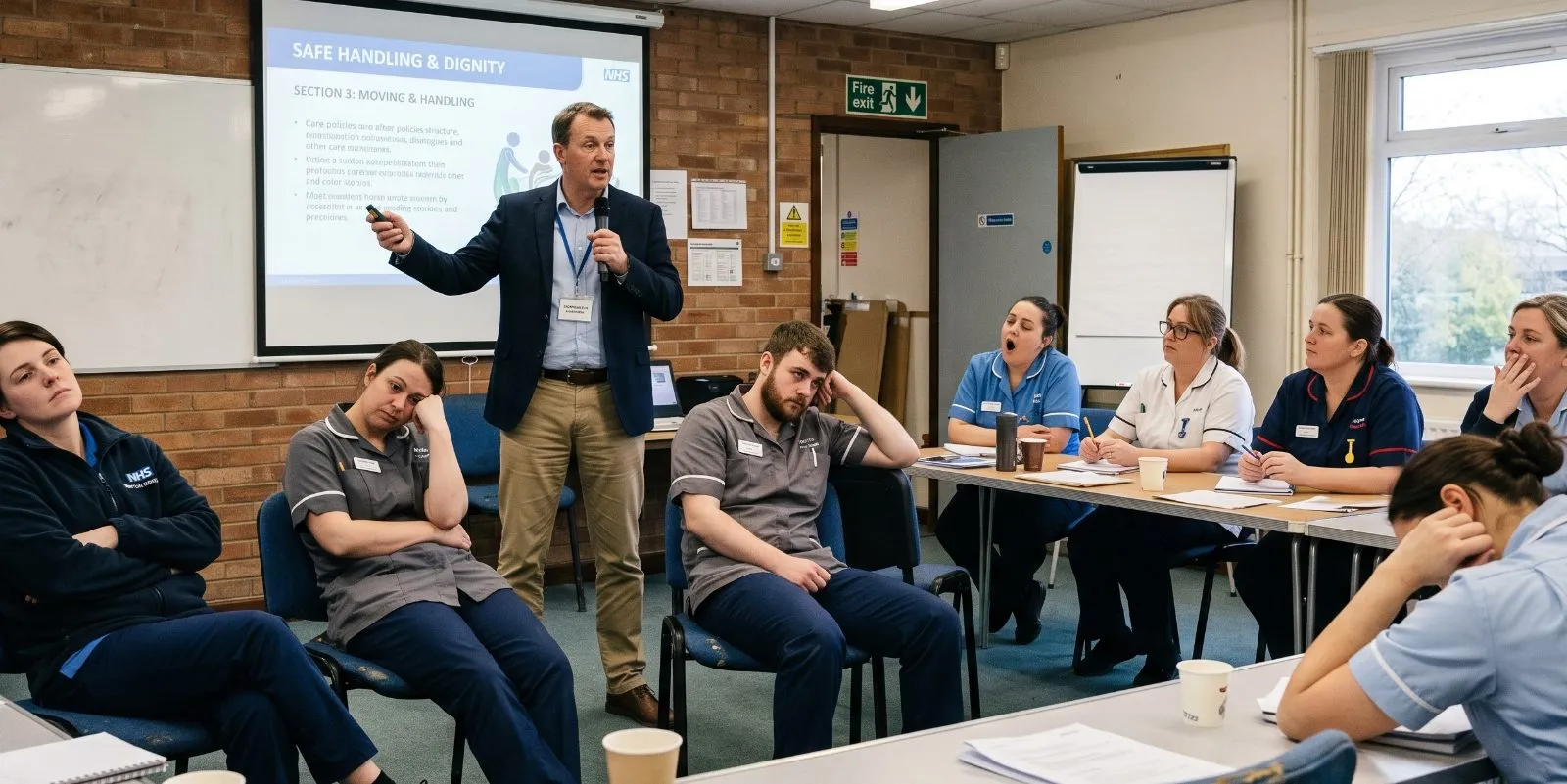
The scarce resource in a care home is not the training material; it is the person delivering it. Most in-house training fails because it is designed as if the trainer has a free day, when in reality a senior or manager has been handed the job on top of a full rota. Short, repeatable sessions built around the rota, with the reading done before staff arrive, are how you keep statutory and mandatory training current without burning out the person who delivers it.
What does in-house training actually mean in a care home?
In-house training means training delivered by your own staff, in your own setting, using your own policies, equipment and residents as the reference points. It is the opposite of sending people off-site to an external provider.
The model suits care homes for practical reasons. Travel costs disappear, sessions can be grouped around shift patterns, and scenarios can be built around the actual residents, hoists, medication systems and building layout your team works with every day, according to The Health & Safety Group. The cost per person falls when a group is trained together rather than individually.
The trade-off is real. The delivery burden lands on a manager or senior who already has a full rota to cover, and that person becomes the single point of failure for training. In-house delivery does not change what must be covered, only who delivers it and where. The statutory and mandatory subjects remain the same whether the trainer is internal or external, as Constantia Care and carehome.co.uk both make clear.
What training is mandatory in a UK care home?
The core statutory and mandatory subjects in a UK care home are health and safety, infection prevention and control, fire safety awareness, manual handling, equality, diversity and human rights, and safeguarding adults, according to carehome.co.uk.
Beyond that core set, inspectors expect to see training in the lawful care subjects, including the Mental Capacity Act and residents' rights. These are not optional extras. They sit alongside the mandatory set because they protect both the people you support and your staff.
Role-specific additions depend on the people you support. Dementia care, medication management and food hygiene are common examples, and the list changes with your service's registration and resident profile. The legal backdrop includes the Health and Safety at Work Act 1974, the Equality Act 2010, the Health and Social Care Act 2008 and the Manual Handling Operations Regulations 1992, with devolved requirements in Scotland, Wales and Northern Ireland. Many services use the Core Skills Training Framework as recommended guidance when planning what to cover, as noted by carehome.co.uk.
How long should an in-house training session be?
A 20 to 30 minute session tied to a single learning point is the right length for most in-house training in a care home. A two-hour block is the wrong shape because nobody can attend it without leaving the floor short, and the trainer cannot afford to deliver it twice.
Book a short demo and see how CareStream keeps your policies, training and CQC evidence in one place.
Book a demoSplit a mandatory subject across several short sessions over a month. The same total content gets covered, but no single absence is costly, and staff can catch the next short slot without falling a full module behind. This approach is supported by the group delivery logic in The Health & Safety Group.
Anchor each short session to one real scenario from your own service. A manual handling session built around the hoist in room 14, or an infection control session built around the laundry routine, sticks better than slides. Short sessions are also easier to repeat for staff who missed one, which protects the trainer's time. That repeatability is the point, because the mandatory subjects still have to be covered for everyone, as carehome.co.uk sets out.
How do you plan a training calendar around the rota?
The calendar has to be built around the trainer's availability and the rota, not the other way round. The person delivering training is the scarce resource, so their protected time comes first, and sessions are slotted into the gaps around it.
Spread sessions across shift patterns so night staff and part-time staff are not permanently excluded. A session that only ever runs at 2pm on a Tuesday trains the same people repeatedly and leaves the night team out. The calendar needs to rotate through handover times, late starts and early finishes.
Keep a live view of who still needs which subject. Without it, you re-deliver sessions to the same people while others slip through. A training matrix that updates itself removes the manual chasing that eats the trainer's admin time, which is the same logic behind the group delivery benefits described by The Health & Safety Group and the mandatory coverage requirements set out by carehome.co.uk.
How do you repeat a session without burning out the person delivering it?
The trainer is the scarce resource, so every repeat delivery has a real cost and should be designed down. The goal is to make the session repeatable without the trainer having to start from scratch each time.
Push pre-reading to staff before the session, so the room time is spent on practice and questions rather than reading policy aloud. This is the single biggest time-saving available, and it follows the in-house logic of using your own materials that The Health & Safety Group describes.
Record the core content once and use it as the repeatable spine, with the trainer only present for the practical element. A short video or voice note covering the policy point can be reused for every cohort. Hand delivery of a short session to a senior carer with a prepared script, so the manager is not the only person who can deliver it. A deputy can pick up a 20-minute session and run it at short notice when cover falls through, which is how in-house training stays viable in a service where the rota changes daily, as the practical training structure at Constantia Care illustrates.
How does CareStreamAI help with in-house training without replacing the trainer?
CareStreamAI helps at the edges of in-house training, not at its centre. The person delivering the session and the professional judgement in the room stay exactly where they are. The platform removes the admin around training, not the trainer.
A quick demo shows exactly how CareStream would work for your service. Book a time that suits you.
Book a demoOn the scheduling side, the training calendar books sessions around the rota, and the training matrix shows who still needs which module. The trainer can see the gaps without chasing people by hand. On the pre-reading side, monthly training module allocations per plan include standard modules plus tailored ones built around the provider's own setting, and scenario-based statutory training is pushed to the staff hub so room time is spent on practice rather than reading, which matches the mandatory coverage set out by carehome.co.uk.
Every completion is logged into an audit trail and CQC evidence pack, so the evidence for Regulation 18 support and training builds itself rather than being assembled the week before inspection, a requirement described by Constantia Care. The staff hub works on any phone with no app download and no password friction, and the AI answers staff questions in 60+ languages in under 30 seconds, drawn only from the provider's own uploaded policies. The trainer stays central. The paperwork stops being the trainer's second job.
How do you evidence in-house training to an inspector?
Good evidence is a record of what was delivered, to whom, when, and how competence was confirmed. A signed attendance sheet is not enough on its own, because it shows presence, not understanding.
New Fundamental Standard Regulation 18 requires everyone employed or self-employed by the provider to receive appropriate support, training and professional development, as Constantia Care notes. The four UK regulators, the CQC in England, the Care Inspectorate in Scotland, Care Inspectorate Wales and the RQIA in Northern Ireland, each ask for evidence of staff competence in their own way, according to carehome.co.uk.
The practical habit is to log every session and every question asked at the point it happens, so the record is live rather than reconstructed. A trainer who logs a 25-minute session on the day it ran, with the names of attendees and the scenario used, has evidence that survives inspection. A trainer who reconstructs six months of records the week before inspection does not.
Conclusion: Protect the Trainer and the Training Service
The insight this article opens with is the right one: the bottleneck in most in-house training is not content or willingness; it is one person with a full rota being handed a second job. Everything that follows should be judged by whether it reduces the load on that person. CareStream does it at the edges rather than the centre. The calendar books sessions around the rota and the matrix shows who still needs which subject, so the trainer stops chasing people by hand and stops re-delivering to the same faces. Pre-reading and scenario-based modules go to the staff hub before the session, so room time is spent on practice and questions rather than on reading policy aloud, which is the single biggest saving available to anyone delivering in-house. Completions log themselves against the staff record, so the trainer who runs a 25-minute session on a Tuesday does not also have to write it up on Wednesday. And the modules are built from your own uploaded policies, which is what keeps the scenarios anchored to the hoist in room 14 rather than to a generic example. The trainer stays central, because the practical demonstration and the professional judgement in the room are the parts that cannot be delegated to anything. What changes is that the paperwork stops being the price of doing the training, which is usually the reason in-house delivery quietly stops happening.
Sources
- Skills for Health — Core Skills Training Framework · skillsforhealth.org.uk
- CQC — Regulation 18: Staffing · cqc.org.uk
- CQC — Regulation 17: Good governance · cqc.org.uk
- GOV.UK — The Oliver McGowan Code of Practice on statutory learning disability and autism training · assets.publishing.service.gov.uk
- HSE — Moving and handling in health and social care · hse.gov.uk
- Skills for Care — Care Certificate standards · skillsforcare.org.uk
Frequently asked
What does in-house training actually give you that external does not?
Specificity and cost control. Travel disappears, sessions group around shift patterns, and the scenarios can be built around your actual hoists, your medication system and your building. A manual handling session anchored to the hoist in room 14 sticks in a way a generic course cannot. What does not change is what must be covered: the statutory and mandatory subjects are identical, whoever delivers them.
How long should an in-house session be?
Twenty to thirty minutes, tied to a single learning point. A two-hour block is the wrong shape because nobody can attend without leaving the floor short, and the trainer cannot afford to run it twice. Split a subject across several short sessions over a month and no single absence is costly, because staff can catch the next slot rather than falling a whole module behind.
How do we stop night and part-time staff being permanently excluded?
By rotating the slot. A session that always runs at 2pm on a Tuesday trains the same people repeatedly, and the night team never appears on the record. Build the calendar around handovers, late starts and early finishes, and keep a live view of who still needs which subject so you can see the exclusion happening rather than discovering it at audit.
What is the single biggest time saving for the trainer?
Pushing the reading out before the session. If staff arrive having already read the policy point, room time goes to practice and questions instead of reading aloud, which roughly halves the session and improves it at the same time. The second biggest saving is recording the core content once so it becomes a reusable spine, with the trainer present only for the practical element.
How do we stop the trainer being a single point of failure?
By writing the session down. A twenty minute session with a prepared script can be handed to a senior carer or deputy and run at short notice when cover falls through. In-house training that only one person can deliver will stop the first time that person is on leave or off sick, which is usually when it quietly dies.
Written by
 Len BurgessSenior Care Advisor
Len Burgess has worked in the care sector for over 8 years, with hands-on experience across residential, nursing and community settings. Having supported teams through CQC inspections and the day-to-day reality of keeping a service compliant, he writes about regulation, quality and best practice in a way that's grounded in what actually happens on the floor, not just what the guidance says.