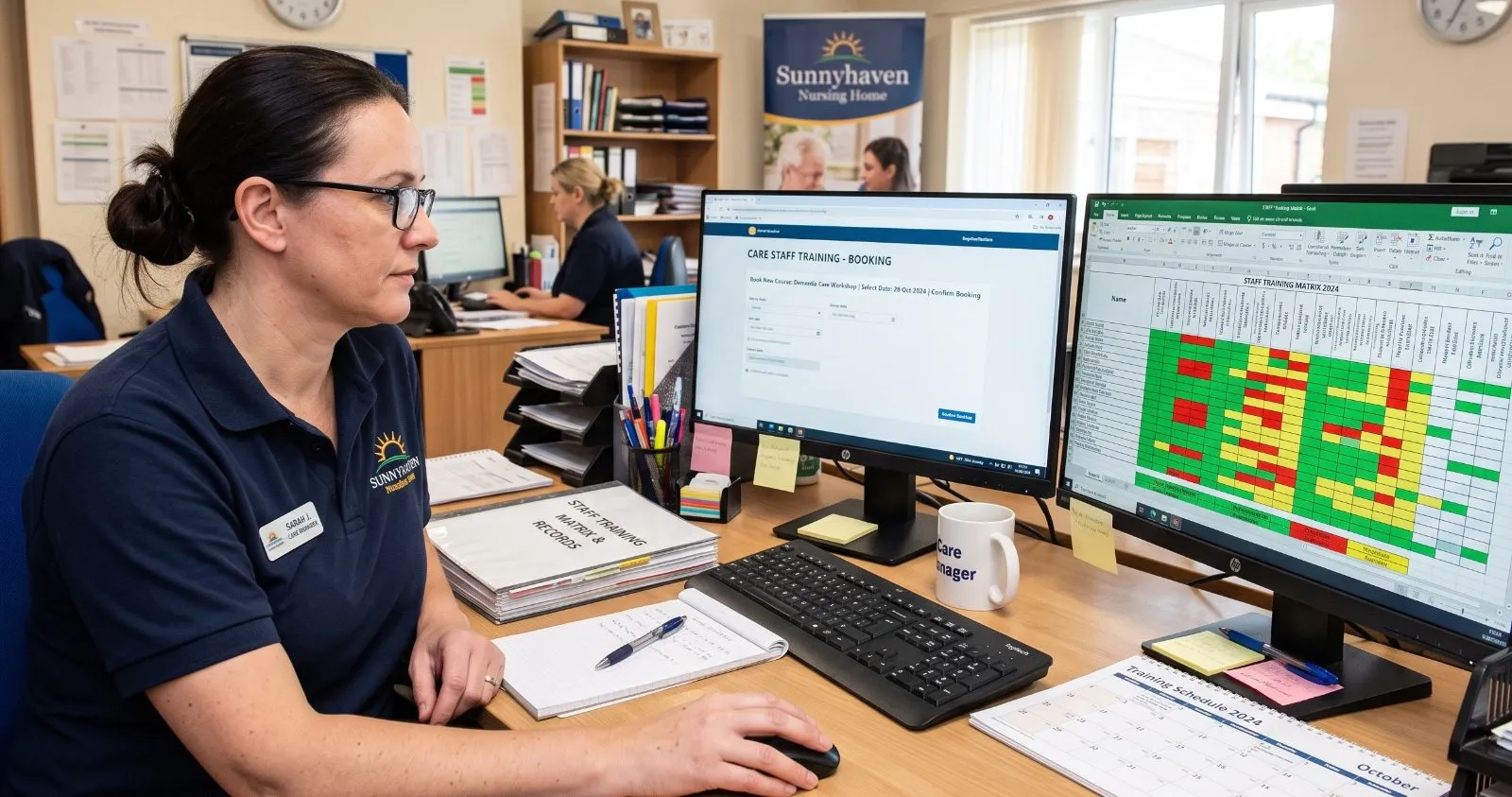
Most care providers keep a training matrix to prove compliance after the fact, then plan the rota as if training had nothing to do with it. The matrix becomes a staffing tool the moment you read it against the rota, shift by shift. That is the difference between evidence of training and evidence of safe staffing.
A spreadsheet updated monthly cannot answer the question a live matrix answers: who on tonight's shift is actually current in the task that shift will require.
What is a training matrix, and what is it actually for?
A training matrix is a live record of every staff member, their role, the mandatory training that role requires, completion dates, renewal dates and current status. A working matrix needs specific columns: staff name, job role, start date, employment type, courses required, completion date, renewal date, training status, competency sign-off, supervisor or assessor, evidence location, and notes or actions.
Useful statuses are completed, due soon, overdue, not started, in progress, not applicable, and evidence requested. Colour coding makes them scannable: green for training completed and valid, amber for renewal approaching, red for training expired or overdue, and grey for training the role does not require.
A matrix that only answers "are we compliant?" is doing half its job. The same rows answer "is this shift safe?" The data does not change. The question you ask of it does.
Which training does each role actually need before they work a shift?
Requirements differ by role, and that is what makes the matrix usable for rota planning. Typical mandatory training for a care assistant covers safeguarding adults, moving and handling, infection prevention and control, basic life support, and medication awareness. A registered nurse needs clinical training, medicines management, safeguarding, infection prevention, and basic life support.
Domestic staff need fire safety, infection prevention and control, and health and safety. Managers need leadership, safeguarding, health and safety, data protection, and risk assessment. Every role, domestic staff included, also needs learning disability and autism training at the tier appropriate to it, because that requirement is statutory for everyone working for a CQC-registered provider. A single organisation-wide list does not work, because a domestic worker does not need medication awareness and a registered nurse needs more than fire safety.
Competency sign-off matters most for medication support or administration, moving and handling, use of hoists or specialist equipment, infection prevention practice, food handling, clinical or delegated healthcare tasks, record-keeping standards, and basic life support. Completion of a course is not the same as sign-off. The matrix has to record both.
How do you read a training matrix against the rota?
For each shift, list the tasks that shift will actually involve, then check that at least one person on duty holds current training and sign off for each task. That is the method. It exposes gaps a compliance-only review misses: a night shift with nobody current in basic life support, a weekend with no one signed off for medication support, a bank-heavy shift where manual handling training sits with permanent staff who are not on.
Book a short demo and see how CareStream keeps your policies, training and CQC evidence in one place.
Book a demoColour coding turns the matrix into something you can scan against a rota in minutes. Skills for Care frames capability and confidence across fire safety, health and safety, assisting and moving, and basic life support as part of safe and effective staffing, which is exactly the lens this check applies.
The planning rule is simple: training expiry is a rota constraint, not a paperwork task. Renewals get scheduled around the shifts that depend on them.
What does a worked example look like for one week?
A residential service has one senior carer on annual leave, two bank staff covering nights, and one hoist-dependent resident. The rota looks covered on hours. The matrix shows the bank staff are current in moving and handling but not in medication awareness. The only person signed off for medication on two of those nights is the carer on leave.
The check reveals the gap before the shift starts. The fix is to move one permanent carer onto those nights, book the bank staff onto the medication module before their next shift, and log the change. The rota looked covered on hours and was not covered on competence.
The matrix caught it before the shift, not after the incident. That is the difference between a record and a tool, and it only works if compliance is reviewed regularly and refreshers are scheduled in advance rather than after they lapse.
Why does a spreadsheet matrix fail when you need an answer right now?
A spreadsheet depends on manual updates, invites human error, sends no automatic reminders, makes reporting difficult, stores no certificates centrally, and keeps only a limited audit trail. A matrix updated monthly tells you what true last month was. Rota decisions are made today.
CareStreamAI answers the question a spreadsheet cannot: who on this shift is current in this task right now. Every query and training completion is logged into an audit trail and CQC evidence pack. Staff ask questions in their own language from their own phone with no app download, and the answer comes from the provider's own uploaded policies. The training record and the policy point the same way.
The practical fit matters because adoption is as persuasive as features. A matrix nobody updates is not a matrix. A hub that works on any phone, with no password friction, is more likely to be used.
How does safe staffing connect to CQC regulations and inspections?
CQC expects providers to deploy suitably qualified, competent, skilled and experienced staff. Regulation 18 of the Health and Social Care Act 2008 (Regulated Activities) Regulations 2014 covers staffing, requiring sufficient numbers of suitably qualified, competent, skilled and experienced staff who receive appropriate support, training, professional development, supervision and appraisal. Regulation 17 covers good governance, requiring systems and processes to assess, monitor and improve the quality and safety of services.
At inspection, documented training evidence is what demonstrates the claim. A matrix read against the rota maps directly onto what CQC asks about staffing and governance, under the current framework and under the key lines of enquiry being introduced in its new sector-specific frameworks.
A quick demo shows exactly how CareStream would work for your service. Book a time that suits you.
Book a demoThe point is not to scramble before inspection. The point is that evidence builds as a byproduct of planning. When the matrix is read against the rota every week, the audit trail exists before anyone asks for it.
How should a matrix handle renewals, new starters and staff whose evidence sits elsewhere?
Many healthcare courses renew every one to three years, depending on employer policy, professional guidance, risk assessment and regulatory expectations. The routine that keeps the matrix trustworthy is monthly review, immediate updates for new starters, recording role changes, scheduling refreshers in advance, archiving leavers, and monitoring organisation-wide trends.
Agency, bank, self-employed, volunteer and contractor staff belong in the same matrix, with their own evidence location recorded. Their evidence originates elsewhere, but the shift still depends on it, which is exactly why evidence location earns its place as a required column.
A multi-site group needs the same structure across sites, so cover can be compared and moved. A separate spreadsheet per home makes cross-site cover invisible.
What makes a training matrix work in 2026?
Digital systems bring automatic renewal reminders, live compliance reporting, certificate storage, manager dashboards, role-based assignment and organisation-wide visibility. That is what turns a record into a planning tool.
The matrix is not the evidence you produce after a shift. It is the check you run before you publish the rota. The same rows that satisfy an inspector also tell a manager whether tonight is covered.
That is the whole argument. The right columns and statuses make the matrix readable. Reading it against the rota makes it a safe staffing tool. The matrix is where the two meet.
The Bottom Line: Check the Shift, Not Just the Spreadsheet
The worked example in this article is the whole case in miniature. A rota that looked covered on hours was not covered on competence, and the only thing that caught it was reading the matrix against the shift before it started. CareStreamAI makes that check something you can run in the moment rather than reconstruct from last month's spreadsheet. Completions, sign-offs, and renewal dates update as they happen, so the question of who on tonight's shift is current in medication support has an answer now rather than an answer as of the last time someone typed. Renewals surface as amber before they turn red, which lets you book the refresher around the shifts that depend on it.
Bank and agency staff sit in the same record as permanent staff, with their evidence location attached, and a group can see cover across every site rather than one spreadsheet at a time. Underneath it all, every query and completion feeds the audit trail and CQC evidence pack, so the record an inspector asks for is the same record you used to plan the week. The judgement stays with you. Deciding what a shift requires, who can safely cover it, and when to move someone is management work no system does for you. What changes is that the information you need to make that call is current when you need it.
Sources
- CQC — Regulation 18: Staffing · cqc.org.uk
- CQC — Regulation 17: Good governance · cqc.org.uk
- Legislation.gov.uk — Health and Social Care Act 2008 (Regulated Activities) Regulations 2014, Part 3 · legislation.gov.uk
- GOV.UK — The Oliver McGowan Code of Practice on statutory learning disability and autism training · assets.publishing.service.gov.uk
- HSE — Thorough examinations and inspections of lifting equipment · hse.gov.uk
- HSE — Moving and handling in health and social care · hse.gov.uk
- Skills for Care — Getting started with ASC-WDS · skillsforcare.org.uk
Frequently asked
What turns a training matrix into a staffing tool?
Reading it against the rota rather than on its own. The data is identical either way. A compliance review asks whether everyone is up to date; a staffing check asks whether tonight's shift has at least one person current and signed off for every task that shift involves. The second question catches gaps the first one never sees.
How do you actually run the check?
List the tasks each shift will involve, such as medication support, hoist transfers or basic life support, then confirm that at least one person on duty holds current training and sign off for each. With colour coding, it takes minutes per week. The gaps it exposes are specific: a night with nobody current in basic life support, or a weekend with no one signed off for medication.
Why can't one training list cover every role?
Because roles carry different risks. A domestic worker does not need medication awareness, and a registered nurse needs far more than fire safety. A flat organisation-wide list either overtrains some staff or leaves gaps for others, and it makes the rota check impossible because you cannot tell who is required to hold what. The one exception is learning disability and autism training, which every role needs at an appropriate tier.
Does completing a course mean someone can cover that task on shift?
Not for high-risk tasks. Medication support, moving and handling, hoist use, basic life support and delegated healthcare tasks need observed competency sign-off as well as course completion. The matrix has to record both, because a rota check that counts completions alone will show a shift as covered when nobody on it has been observed doing the task.
Should bank and agency staff be in the same matrix?
Yes, along with self employed workers, volunteers and contractors. Their evidence may originate elsewhere, but the shift depends on it just the same, and bank heavy shifts are exactly where gaps tend to hide. Record their evidence location as a column so the trail is followable.
Written by
 Len BurgessSenior Care Advisor
Len Burgess has worked in the care sector for over 8 years, with hands-on experience across residential, nursing and community settings. Having supported teams through CQC inspections and the day-to-day reality of keeping a service compliant, he writes about regulation, quality and best practice in a way that's grounded in what actually happens on the floor, not just what the guidance says.