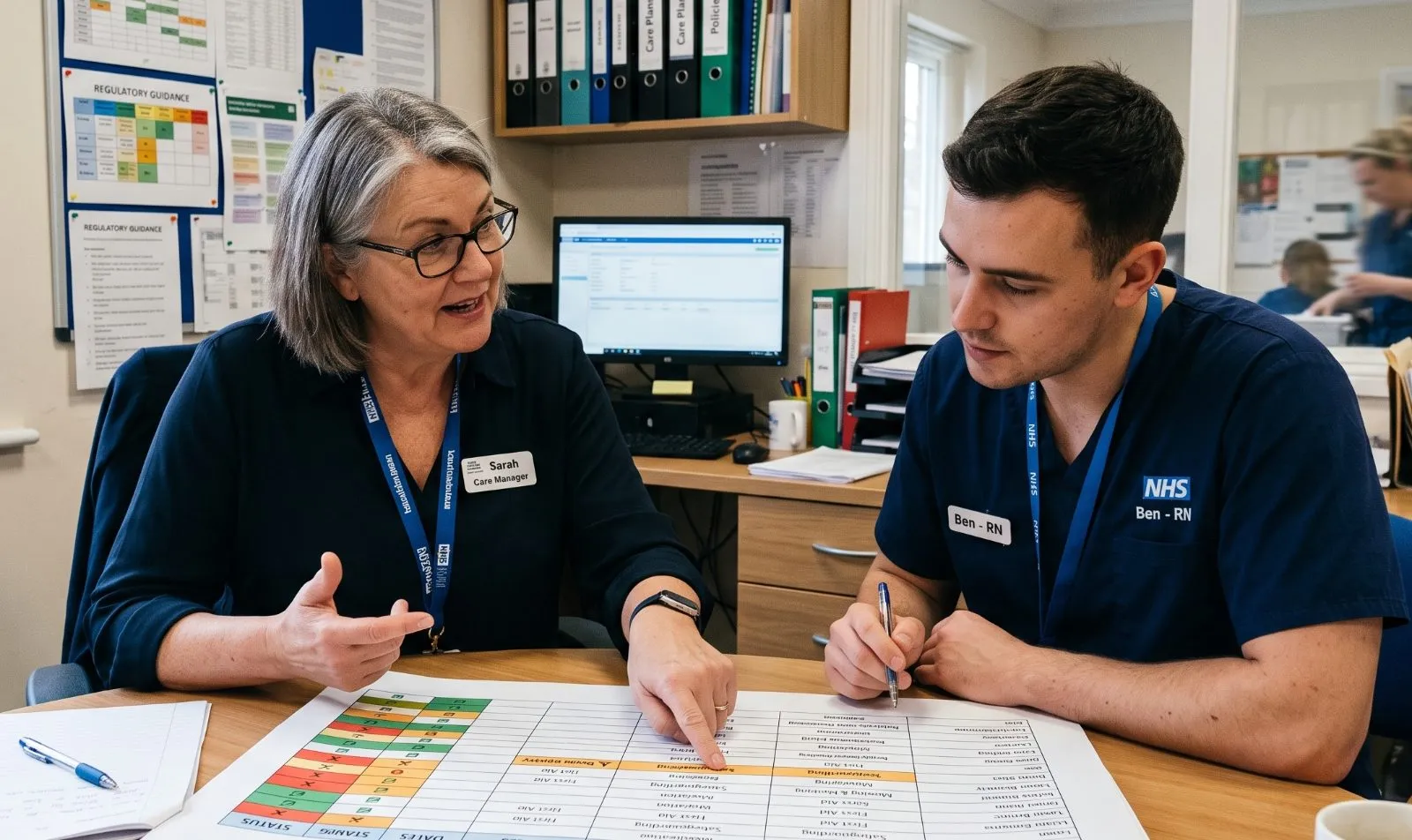
Most training plans are written in January, laminated, and dead by March. You know the feeling. You booked a full day of manual handling refreshers, then three carers called in sick, and the agency cover could not use the hoist. The session collapsed, the trainer still invoiced you, and the renewal dates slipped another month. Your annual training plan for the care home needs to survive week three, not just inspection day. This is not a template lecture. It is a planning method that treats the rota as the boss, because the rota is the boss. We are going to look at sequencing, spread, cover, and the months you should quietly avoid. A plan that fails the rota fails your staff, your evidence, and your inspection prep. Not dramatically. Just expensively, and at the worst possible time.
Why Training Plans Die in Week Three
The classic failure is the induction cohort. Everyone was hired in the same month, so every annual refresher lands in the same month. One sickness wave and the whole cycle cascades. You spend the rest of the year chasing dates that have already gone.
The rota is the real curriculum. Training that ignores shift patterns, night cover, and school-run constraints is fiction. A plan that looks beautiful in a folder but cannot survive a Thursday night handover is not a plan. It is a wish.
The "all staff must attend" trap is another quiet killer. Booking a full-day session assumes cover exists. It usually does not. Plan for half-day blocks and staggered starts. Your night staff cannot attend a 9am session after a 12-hour shift, and pretending they can is how you end up with a register full of names and a team full of gaps.
Then there is the silent killer: no one owns the matrix. When responsibility is diffuse, renewals slip by unnoticed until the inspector asks. The cost of collapse is not just an awkward conversation. Gaps in statutory and mandatory training become a Regulation 18 issue, and your evidence trail has holes you cannot explain.
What CQC Actually Wants From Your Training Plan
CQC does not publish a single mandatory training list. Inspectors assess competence and knowledge against the frameworks, so your plan must show your reasoning, not just a tick list. That is a crucial distinction. You are not proving that training happened. You are proving that your staff know how to keep people safe.
Regulation 18 on staffing and Regulation 12(c) on safe care and treatment are the frameworks that matter. Your plan must show how training keeps people safe, not just that a session was delivered. The plan needs induction details, role-specific training for all staff including managers, named providers per topic, refresher frequency, and how you support overseas workers.
Specialist training matters. Dementia, learning disability, autism including the Oliver McGowan tiers, sensory impairments, and mental health. Generic "care" training is not enough for a service that supports people with complex needs. And the evidence question is the one that catches people out: how do you prove competence, not just attendance? Your plan needs to show assessment, not just bums on seats.
The Training Calendar: Spreading Renewals So They Don't All Land at Once
The induction cohort problem is real. If you hired six staff in March, their annual refreshers all fall in March. Break the cycle by staggering renewals to individual anniversary dates instead of team-wide dates. Yes, it is more admin. It is also the difference between a manageable month and a crisis.
The quarterly distribution model works. Spread core refreshers across the year. Fire safety and safeguarding in one quarter, manual handling and infection control in the next, COSHH and first aid in the next, catch-ups in the final quarter. This is not about hitting a target. It is about keeping the training load steady enough that your rota can absorb it.
Book a short demo and see how CareStream keeps your policies, training and CQC evidence in one place.
Book a demoThe months to avoid are not a mystery. December is a write-off for training. August is thin on cover. Plan your heaviest training months for September and January, when staffing is more stable, and people are actually in the building. Align equipment training with LOLER inspection schedules and COSHH risk assessment reviews. If the hoist is serviced in June, train on it in June. That way the training and the maintenance evidence tell the same story. Build buffer time into every quarter. Never fill the calendar to 100%. Leave one training slot per quarter as a catch-up window for staff who missed their slot, because someone always misses their slot.
Building the Training Matrix Before You Book Anything
The matrix is your single source of truth. Staff member, role, required training, last completion date, next due date, delivery method, and evidence location. If it is not in the matrix, it does not exist.
Start with the gaps, not the calendar. Run a skills gap analysis before you book anything. What do your staff actually need, not what did you do last year? Map training to service user needs. If you support people with learning disabilities, the Oliver McGowan training is non-negotiable. If you run a dementia unit, that shapes your specialist list. The training plan follows the service, not the other way round.
Include bank and agency staff. They are part of your rota, so they are part of your training risk. Your matrix should show how you verify their competence before they work unsupervised. And the matrix is a living document. Update it weekly, not quarterly. If you are not looking at it every Monday, it is already out of date.
Sequencing: What Has to Come First, and What Can Wait
Induction is the foundation. Care Certificate standards, fire safety, safeguarding adults, and manual handling basics must land in the first week, not the first month. The order matters. Do not book manual handling before staff understand their own body mechanics. Do not book infection control before they understand why it matters. Training that lands in the wrong order is training that does not stick.
Role-specific training follows induction. Medication administration, PEG feeding, catheter care, and other clinical skills need a competence assessment, not just a session. A certificate is not the same as a supervised demonstration.
Manager training is the most skipped and the most important. The Skills for Care Management Induction Standards are your starting point for new managers without prior experience. A manager who has never been trained to manage is a risk you cannot afford to carry. Supervision is where training becomes competence. Use one-to-one sessions to check understanding and log evidence, not just to review performance. That is where the plan becomes real.
The Delivery Mix: E-Learning, Classroom, and the Blended Reality
E-learning has a place. It is flexible, trackable, and works for night staff. But it does not teach manual handling techniques or a hoist transfer. Know which topics need hands-on assessment. Classroom training is expensive and hard to schedule. Use it for the topics that genuinely need it: practical skills, scenario-based safeguarding, and fire evacuation drills.
The blended approach is the honest one. E-learning for knowledge, classroom for practice, and supervision for reinforcement. Your plan should show all three, not just one. The overseas worker question is part of this. Your plan must show how you support staff whose first language is not English. That means translated materials, longer induction where needed, and checking understanding, not just attendance. The delivery method should be written into the matrix. If you cannot see at a glance who needs classroom time and who needs e-learning, your plan is not operational.
Cover and Cost: The Operational Reality Check
Training is working time. It must be paid, and it must be planned around the rota, not bolted onto it. Your budget needs to account for backfill, not just course fees. The cost question is one no regulator publishes benchmarks for, so build your own. Course fees, staff hours, backfill cover, and lost productivity all count. Your annual training budget should be a line item, not an afterthought.
The cover calculation is simple but brutal. For every training day, count how many staff are out of the building and what that does to your staffing ratios. If the answer is "unsafe", split the session. The agency trap is real. If you rely on agency cover for training days, you are paying twice. Build a bank of internal cover options first. And the honest question: can you afford to train everyone in one go? If not, stagger by team or by shift pattern. A plan that spreads cost across the year is easier to fund than a January spike.
A quick demo shows exactly how CareStream would work for your service. Book a time that suits you.
Book a demoThe Evidence That Builds Itself
Every training session, every completion, and every assessment should leave a trace. If it is not logged, it did not happen. When your inspector asks how you know staff are competent, what do you show them? Attendance registers are weak. Completion records with assessment scores are stronger.
The policy gap problem is one most managers only notice during an inspection. If staff ask questions about a procedure and the answer is not in your policies, that is a gap. Flag it, fix it, and log it. Unanswered questions are evidence of risk. Your evidence pack should build itself as you go, not be assembled in a panic the week before an inspection. The payroll link helps here. Training completion should feed into payroll reporting, so you can see at a glance who is compliant and who is not, without chasing spreadsheets.
A Plan You Could Actually Adopt Next Monday
Step one: pull your current training matrix and mark every date that has passed. That is your real starting point, not the plan you wrote in January. Step two: run the gap analysis. What is overdue, what is due in the next 90 days, and what has no date at all? Step three: build the calendar backwards from the rota. Block out the months you know are thin, then slot training into the gaps. Step four: assign ownership. One person owns the matrix. They update it weekly and flag risks before they become gaps. Step five: set the review cadence. A monthly 30-minute training review in your supervision or team meeting keeps the plan alive. If you are not reviewing it, it is already dying.
The Tools That Keep the Plan Honest
A spreadsheet can work, but it depends on someone updating it. The moment that person is off sick, the plan goes blind. The practical alternative is a system that logs every query and completion automatically, so the evidence builds itself without a weekly data-entry session. Staff adoption is the real test. If your staff cannot ask a question or access a policy from their phone, the plan is not serving them. No app download, no password friction, works on any phone. The language question matters too. If your team includes staff whose first language is not English, the training plan must be accessible in their language. English-only paperwork is the failure, not the workforce. For groups running multiple sites, you need benchmarking across sites, not just one building. A multi-site console shows where coverage is thin before you book anything. That is the difference between guessing and knowing.
Conclusion: A Plan That Survives Contact With The Rota
The method in this guide works, and a manager who staggers renewals to individual anniversary dates, builds the calendar backwards from the rota, and leaves a catch-up slot in every quarter will have a plan that is still alive in June. What it depends on is one person maintaining the matrix every week, and that dependency is the plan's weakest joint. CareStream removes it. Completions log themselves against the staff member, the date and the module, so the matrix stays current without a weekly data entry session and does not go blind when its owner is off sick.
Staff reach their training on the phone already in their pocket, in the language they read, which is what makes the night shift and the overseas worker questions answerable rather than aspirational. And the query log does the job an attendance register never could: when three carers ask the same question about a hoist transfer, that is your skills gap analysis arriving in real time rather than in next January's review. For groups, the multi-site console shows where cover is thin before you book anything, which is the difference between scheduling and guessing. The plan still belongs to you. The sequencing, the months you avoid, the judgement about who needs classroom time and who does not- all of that is management work no system replaces. What changes is that the evidence accumulates while your staff work, so the week before an inspection is no longer the week you find out what your matrix has been hiding.
Sources
- HSE: Thorough examinations and inspections of lifting equipment · hse.gov.uk
- CQC: Regulation 18: Staffing · cqc.org.uk
- CQC: Regulation 12: Safe care and treatment · cqc.org.uk
- GOV.UK: The Oliver McGowan Code of Practice on statutory learning disability and autism training · assets.publishing.service.gov.uk
- CQC: Brief guide: Mandatory training requirement on learning disability and autism · cqc.org.uk
- Skills for Care: Care Certificate standards · skillsforcare.org.uk
- HSE: Moving and handling in health and social care · hse.gov.uk
Frequently asked
Can we deliver everything through e-learning?
No. E-learning is genuinely good for knowledge, flexible for night staff and easy to track, but it cannot teach a hoist transfer or assess whether someone positions themselves safely during a move. The honest model is blended: e-learning for knowledge, classroom for practical skills, supervision for reinforcement, with the delivery method written into the matrix so you can see at a glance who needs which.
How do we plan around equipment servicing?
Align the two deliberately. Hoists, slings and other equipment used to lift people must be thoroughly examined every six months under LOLER, and slings need the same interval regardless of the hoist. Scheduling equipment training in the same window means the training record and the maintenance record tell one coherent story, which is far stronger evidence than two unrelated dates.
Does the plan need to cover bank and agency staff?
Yes. They are on your rota, so they are part of your training risk, and the plan should show how you verify their competence before they work unsupervised. This is one of the more common gaps found at inspection, precisely because agency staff sit outside the systems built for permanent employees.
What is the difference between attendance and competence evidence?
An attendance register shows someone was in the room. Competence evidence shows someone was observed doing the task correctly, and it carries its own renewal cycle separate from the training module. For clinical skills such as medication administration, PEG feeding or catheter care, a certificate without a supervised demonstration is half the evidence.
Written by
 Len BurgessSenior Care Advisor
Len Burgess has worked in the care sector for over 8 years, with hands-on experience across residential, nursing and community settings. Having supported teams through CQC inspections and the day-to-day reality of keeping a service compliant, he writes about regulation, quality and best practice in a way that's grounded in what actually happens on the floor, not just what the guidance says.