
Which sentence in your care plan would you not read aloud to the person it describes? Start there. That question finds more in ten minutes than a full wording audit, and it works on policies too.
Person centred language care plans and policies need the same test applied twice. The policy sets the words staff learn. The plan carries them to the bedside, and the daily notes repeat them for years.
Say the man is called Ernest. He has lived at the home for two years. He likes to wash at night, he listens to the radio in the morning, and he does not like being hurried.
The sentence as it is usually written
Here is the entry as it often appears in a plan.
- Before: Resident is non-compliant with personal care and refuses to be washed in the morning. Staff to encourage.
Read it as a new starter would. It names a problem, it names no preference, and it gives one instruction that could mean anything. The word encourage is doing a lot of work there.
Have your policies read against the regulations to see what is missing or out of date. No card needed.
Create a free account- After: Ernest prefers to wash at night. He says mornings are for the radio and his tea. Offer a wash after supper, and accept a no without asking twice.
Three things changed. The preference is now the fact, the person's own words are in the record, and the instruction tells a stranger what to do.
What the regulation asks you to write
The duty is more specific than most people remember. Regulation 9 on person-centred care requires care and treatment that is appropriate, meets the person's needs and reflects their preferences.
Two of its requirements bear directly on wording. The assessment of needs and preferences has to be carried out collaboratively with the relevant person. Care then has to be designed with a view to achieving those preferences.
Dignity sits alongside it. The provider guidance on dignity and respect is blunt. All communication with people using services must be respectful. People should also be addressed in the way they prefer.
A record is communication. It is read by staff, by the person and by anybody who asks to see it.
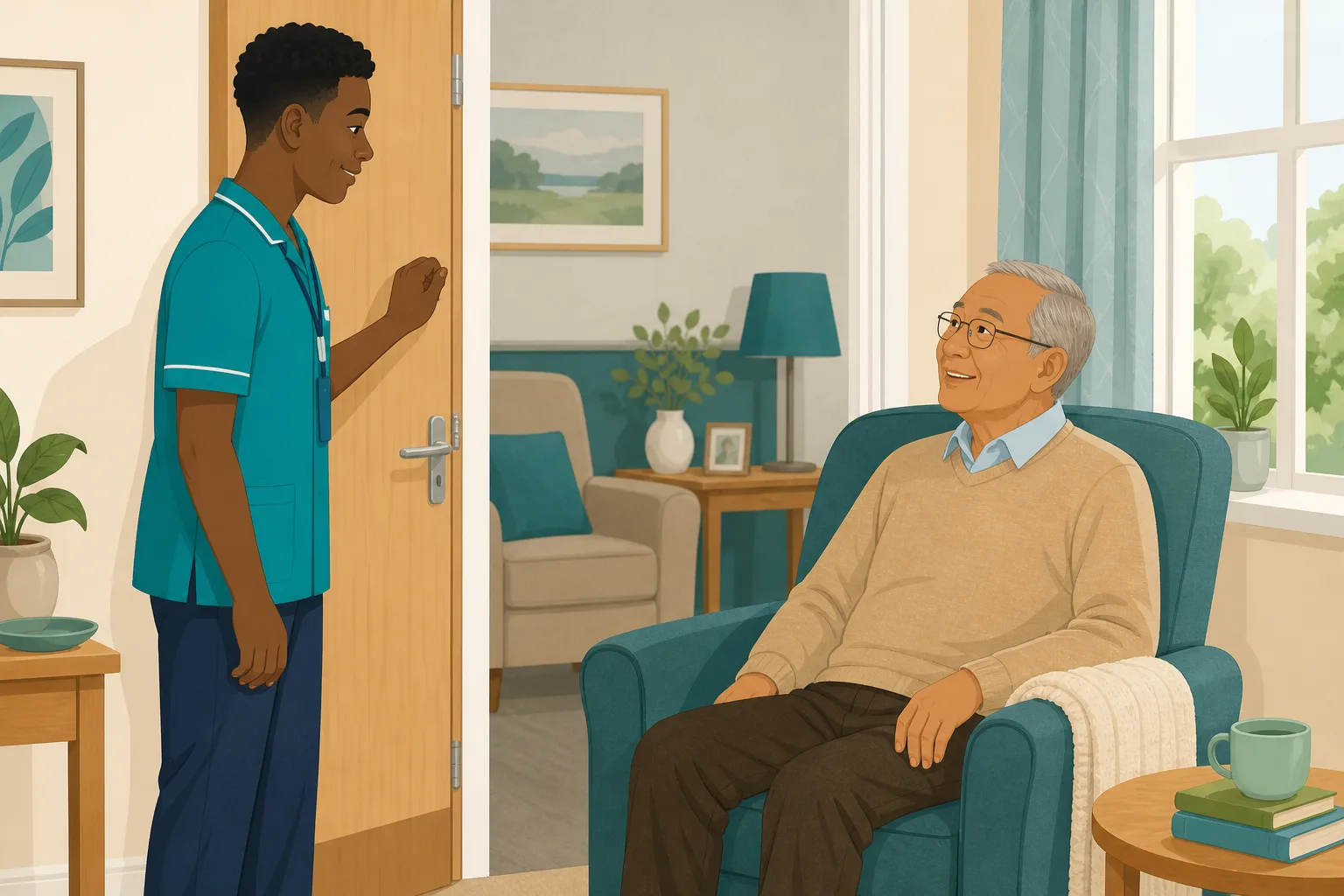
Figure: the knock at the door and the wording of the plan are the same habit, written down.
Rewrite one: from a label to a need
- Before: Wanderer. Needs redirecting.
- After: Ernest walks the first floor corridor most afternoons, looking for his wife's room. Walk with him, talk about her, and he usually settles in the lounge.
A label tells the next reader what to brace for. A description tells them what to do, and it is easier to prove it was followed.
Rewrite two: from a refusal to a choice
- Before: Refused medication again. Non-compliant.
- After: Ernest declined his tablets at lunch and asked what they were for. The nurse explained, and he took them later the same afternoon.
Record what was offered, what the person said, what you did and what happened. That reads as care. The first version reads as a complaint about the person taking it.
Rewrite three: from the rota to the person
- Before: To be hoisted by two staff. Personal care to be completed before breakfast service.
- After: Ernest needs two people for a hoist transfer and asks for the same pair where the rota allows. He would rather be up after breakfast than before it.
The first version is written for the shift. The second is written for the person, and it still tells you how many staff to send.
Rewrite four: the policy sentence
Care plans copy the voice of the policy behind them, so the policy is where this work pays off twice.
- Before: Residents must not be allowed to leave the premises unaccompanied.
- After: People living here can go out. We agree with each person how they want to do that, and we record the agreement and the risks we talked through.
Allow is the word to watch. It puts the service in charge of an ordinary decision, and staff who read it start asking permission on the person's behalf. Where somebody cannot make a decision for themselves, the policy still has to say what happens next, and that needs its own capacity record.
The free policy check shows where a policy falls short of the regulations. Create a free account to begin.
Create a free account
Figure: person centred policy writing is a pen and one paragraph at a time, not a new folder.
The words we would take out first
This is our list, not a rule from anywhere. Each one hides a person behind a process.
- Allow, let and permit, when the subject is an ordinary choice.
- Non-compliant, which describes the plan's failure as the person's.
- Refuses, where declined and a reason would be more accurate.
- Wanderer, feeder and any other noun made out of a behaviour.
- Placed, when a person moved in.
- Challenging, unless the sentence says challenging for whom and why.
Swap each one for what you actually saw. That single habit does more for a person centred care plan than any template.
One warning goes with all of this. A rewrite that changes the words and not the care is worse than the entry it replaced, because it reads well and tells the next person nothing true. Change the sentence when you change the practice.
Keeping the plan and the policy in one voice
A person centred care policy that says we offer, and a plan that says staff will ensure compliance, cannot both be true. One of them is describing a different service.
So read them together. Take one policy and the three plans it touches, and mark every place the verbs disagree. Fix the policy first, because that is what new staff are trained on.
Records have to be accurate, complete and kept up to date under regulation 17 on good governance. Wording that nobody follows fails that test as surely as a blank page.
Benefits of CareStream for person centred language care plans and policies
CareStream reads the policy side of this for you, and the free account covers a real sample.
- The free check reads the first 5 policies you already hold, with no card needed.
- It reports regulation coverage, out of date content, contradictions between documents and wording set against the quality statements.
- Example wording for each gap, and checks beyond the first few policies, sit on the paid plans.
- The Person-Centred Outcomes and Community Participation Review runs 44 quarterly checks for supported living, extra care and shared lives services.
Run the free policy gap check against the document you quote most often. Our person centred care policy page shows what a written one covers.
Where to start with your own documents
Pick one care plan and read it aloud. Mark every sentence you would not say to the person. Rewrite three of them, and ask the person or their family whether you got it right.
Then book the check. The care plan review audit looks at currency, person centredness, capacity and consent, and whether people were involved.
For the people who write the plans, the person centred care planning course covers the same ground in a session. Our guide to the this is me document shows where the person's own words come from in the first place.
A rewrite only lasts if the next reader meets the same voice everywhere. Keeping the policy, the audit and the course in one CareStream account is one way to stop the wording and the training drifting apart.
Sources
- Regulation 9, person-centred care (legislation.gov.uk) · legislation.gov.uk
- Regulation 9 provider guidance on needs and preferences (Care Quality Commission) · cqc.org.uk
- Regulation 10, dignity and respect (legislation.gov.uk) · legislation.gov.uk
- Regulation 10 provider guidance on respectful communication (Care Quality Commission) · cqc.org.uk
- Regulation 17, good governance and accurate records (legislation.gov.uk) · legislation.gov.uk
Frequently asked