Start at the printer. A care plan sits in the output tray from the night before, and the name on it can be read from the corridor. That is where a GDPR audit starts, with what is in the room rather than with the policy file.
The names vary. A GDPR audit checklist, a GDPR audit template, a data protection audit checklist: the work behind them is the same. Seven steps, in this order.
Step one: walk the building before you open a file
Take twenty minutes and look at the places paper gathers.
- The printer tray, the fax shelf and the post pile.
- Handover sheets left on a trolley or in a pocket.
- Whiteboards with names and room numbers on them.
- The medication room door, and who holds the key.
- Screens left logged in at the nurses' station.
- Photographs of residents on personal phones.
Write what you see, not what should be there. Photographs taken on personal phones belong on this list too, along with the staff messaging group that half the team uses for handover.
This part of the audit cannot be done from an office. Everything after it can.
Every audit in the library is free to run, with scoring, actions and a report. No card needed.
Create a free accountStep two: list what you hold, and why
Next comes the record of processing. Article 30 on records of processing activities sets out what it must contain.
- The name and contact details of the controller, and of the data protection officer.
- The purposes of the processing.
- The categories of people and the categories of personal data.
- The categories of recipients the data goes to.
Most services have the first two and guess the rest. Recipients are the ones worth care. Think of the pharmacy, the local authority, the hospital, the payroll bureau and the agency that supplies your night staff.
Three principles sit underneath all of it. Article 5 on the principles of processing puts them plainly:
- Data is processed lawfully, fairly and in a transparent way.
- It is collected for specified, explicit and legitimate purposes.
- It is adequate, relevant and limited to what is necessary.
Read the third against your admission pack. Most packs ask at least one question nobody ever uses, and it has been copied forward for years.
Step three: name the lawful basis for care records
Health data is a special category, and processing it is prohibited unless a condition applies. The condition that fits a care service is the health and social care one.
Article 9 on special category data allows it where processing is necessary for the provision of health or social care. The basis for that sits in domestic law, or in a contract with a health professional.
Consent is the wrong basis for most care records. A person cannot withdraw consent to being recorded and still be given safe care, so consent was never doing the work.
Check the first page of your privacy notice against that. Many still say consent, and many were written for a different kind of organisation.
Step four: run one subject access request from end to end
Pick a request you have already answered and time it. The clock runs for one month. It starts at whichever of these falls last:
- The day the request arrives.
- The day any information you reasonably asked for arrives.
- The day any fee is paid.
Two more rules matter, and both are newer than most policies.
- You may extend by up to two further months, where complexity or the number of requests makes that necessary.
- Notice of the extension must go out before the first month ends, with reasons for the delay.
There is also a stop the clock rule. Where you reasonably need more information to identify what the request covers, the days between asking and receiving do not count.
That is a real gain for a care service, where a request for everything can touch years of daily notes. Chapter 3 of the regulation holds the detail.
Step five: check who can see what
Now the security side. Article 32 on security of processing asks for measures that fit the risk.
It names four things to be able to do: keep systems confidential, available and resilient, restore access after an incident, and test the measures regularly.
In a care home that means a leavers process. When a carer leaves on a Friday, who removes the logins, and who checks the week after that it happened?
Access levels are the quickest win. Four questions cover most of it:
Pick an audit, assign it, score it on a phone and close the actions. Create a free account to start.
Create a free account- Who can open a full care record, and who sees only the handover summary.
- Who can export or print.
- Who holds an administrator account, and why.
- Which accounts belong to people who have left.
Then add the awkward one. Did an agency worker use somebody else's login on a night shift, and would you know?
Step six: rehearse the personal data breach clock
A lost handover sheet is a personal data breach. Article 33 on breach notification gives the timing.
- Report without undue delay and, where feasible, within 72 hours of becoming aware.
- No report is needed where the breach is unlikely to risk people's rights and freedoms.
- A report after 72 hours must carry the reasons for the delay.
- A processor who finds a breach tells the controller without undue delay.
Check the name in your own policy while you are there. The Data (Use and Access) Act 2025 provides for the Information Commission, and the breach article now names the Commission.
Rehearse it like a fire drill. Who decides it is a breach at nine on a Sunday evening, and what is the number they ring?
Write the answer on one card and keep it where the on call manager will find it, because the first hour is where most of the 72 goes.
Step seven: tie it back to the care regulations
Records are also a care duty. Regulation 17 on good governance asks for an accurate, complete and contemporaneous record for each person, kept securely.
The same regulation covers staff records and management records. It also gives you 28 days to send a written report when the Care Quality Commission asks for one.
So a GDPR audit is not a separate exercise from your governance. The evidence lands in the same folder. Treat it as one job.
Benefits of CareStream for a GDPR audit
The free GDPR audit checklist is one of the templates in the library, free to run on a free account.
- It covers data responsibilities, consent, security, accuracy, staff training and subject access rights.
- Answers can carry a photograph, which suits the walk round in step one.
- The finished run becomes a report with section scores, the action plan and signatures.
- Actions have an owner and a due date, and the next run shows what was outstanding.
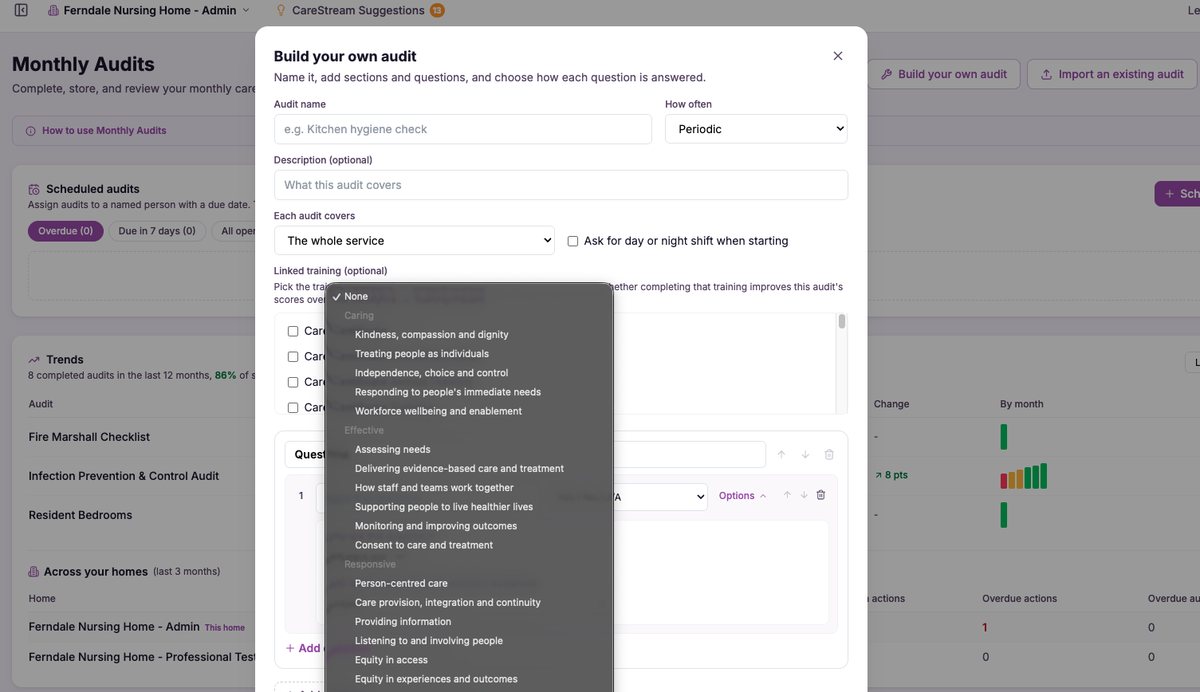
Figure: building your own audit, or importing one you already use, sits on the Enterprise plan.
How often? The template is set to run periodically. We would run it once a year, and again after any change of system, any move of records and any breach.
CareStream will not write your record of processing. It gives the audit a date, an owner and a trail.
What to do with the findings in the first week
Fix the walk round items first. They cost nothing and they are the ones a visitor sees. Clear the printer, move the whiteboard, lock the door.
Then take the three findings with the longest tail. They are usually the privacy notice, the leavers process and the record of processing.
Our data protection and GDPR policy carries wording a service can adopt. The free GDPR course for care staff covers the daily habits behind these steps.
Sources
- Article 5, UK General Data Protection Regulation: principles relating to processing of personal data · legislation.gov.uk
- Article 9, UK General Data Protection Regulation: processing of special categories of personal data · legislation.gov.uk
- Article 30, UK General Data Protection Regulation: records of processing activities · legislation.gov.uk
- Article 32, UK General Data Protection Regulation: security of processing · legislation.gov.uk
- Article 33, UK General Data Protection Regulation: notification of a personal data breach · legislation.gov.uk
- Chapter III, Section 1, UK General Data Protection Regulation, including Article 12A on the applicable time period · legislation.gov.uk
- Regulation 17, Health and Social Care Act 2008 (Regulated Activities) Regulations 2014: good governance · legislation.gov.uk
- Data (Use and Access) Act 2025, Part 6: the Information Commission · legislation.gov.uk
Frequently asked