A carer finishes the medication course in the office, prints the certificate and goes back onto the floor. Nothing about the next drug round is different yet. Training effectiveness evaluation is the work that happens after that moment, and it is four short checks rather than a project.
Before anyone starts, name the thing that should change
Write one sentence before you allocate the course. Not a topic. An action you could watch someone do.
- After the moving and handling course, slings are checked for the right size and damage before every transfer.
- After the fluids course, a low intake is escalated the same shift rather than at handover.
- After the medication course, a refused tablet is recorded with the reason, not just a code.
Keep it to one sentence. If it takes two, you are describing a course rather than a change.
The CPD certified Care Certificate and the annual courses are free on every plan. No card needed, and every staff login is included.
Create a free accountThat sentence is what you will measure against. Without it, you are left comparing a feeling to a certificate, which is how most evaluation quietly stops.
On the day, read the score rather than the tick
A pass is a floor, not a verdict. Our courses end with a 32 question assessment and a pass mark of 80 per cent, so somebody can pass and still have several answers wrong.
The useful detail is which ones. A wrong answer on a definition is a different problem from a wrong answer on what to do when a resident refuses.
In CareStream, a wrong answer sends a short follow up lesson and a fresh question on the same point. The attempt stays on the record. Start there when you evaluate training effectiveness. It shows where the gap sat before the floor.
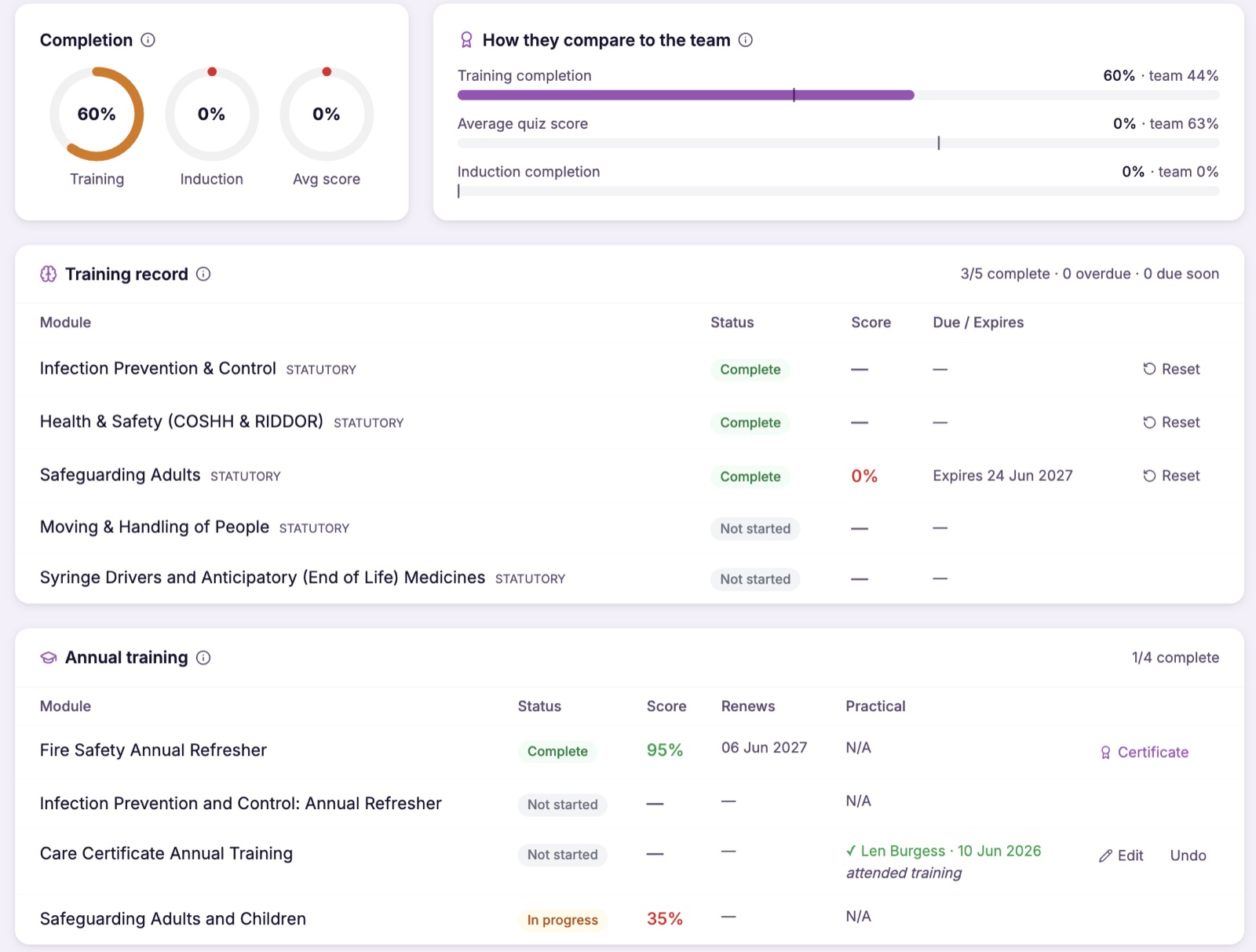
Figure: the record shows the score beside the completion, and how one person compares with the team.
That week, watch one task once
Pick the action from your sentence and watch it happen. Once is enough to start.
The regulator is direct about this. Where it fits the role, staff must be supervised until they can show they are competent to work unsupervised. So watch, then decide.
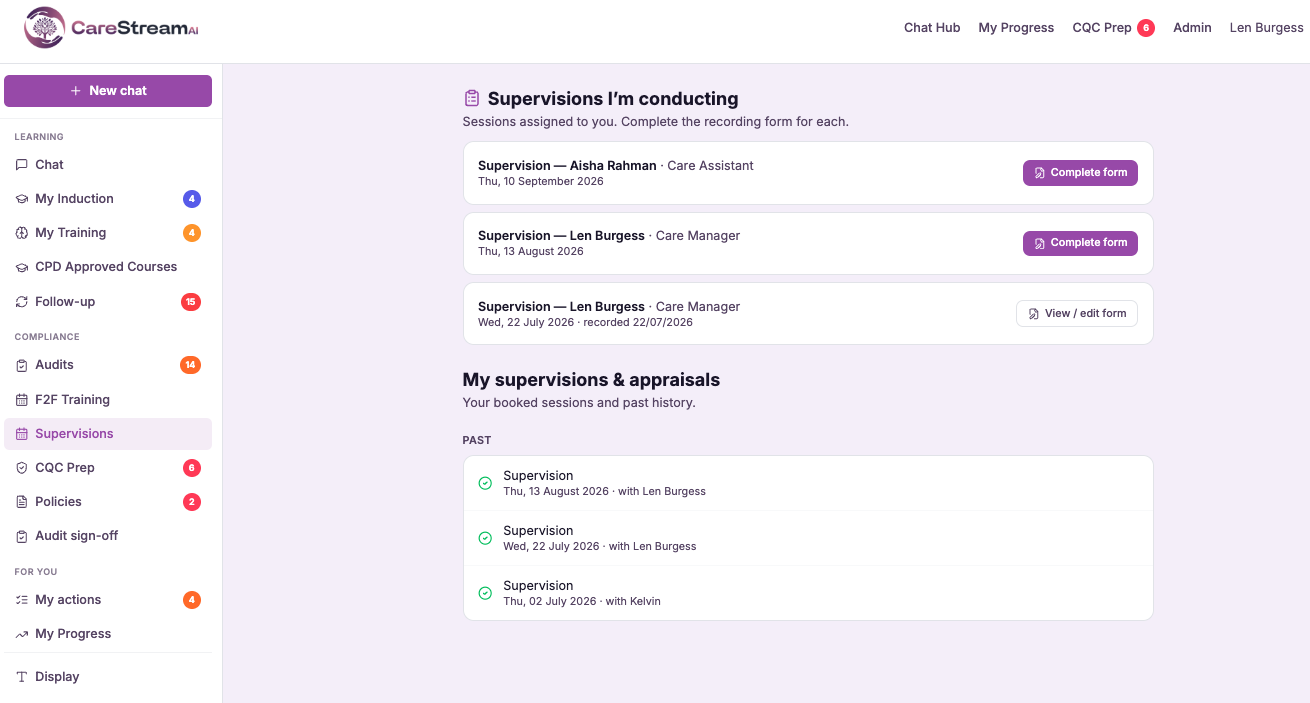
So write three things straight afterwards: what you saw, what you decided, and what happens next. Our post on supervision and training records covers how that note feeds the supervision itself.
That distinction matters more than any score. Sometimes the training landed and the system around it did not.
A month on, ask one question again
Knowledge fades, and the test is whether it held. Take a single question from the assessment, the one closest to your sentence, and ask it again in a handover or a supervision.
Two answers are useful here. A right answer, explained in their own words, is better evidence than a certificate. A wrong one tells you the course needs a short follow up rather than a repeat.
This is the quickest way to measure training effectiveness, and it costs about a minute per person.
At the next audit, look for the same ground
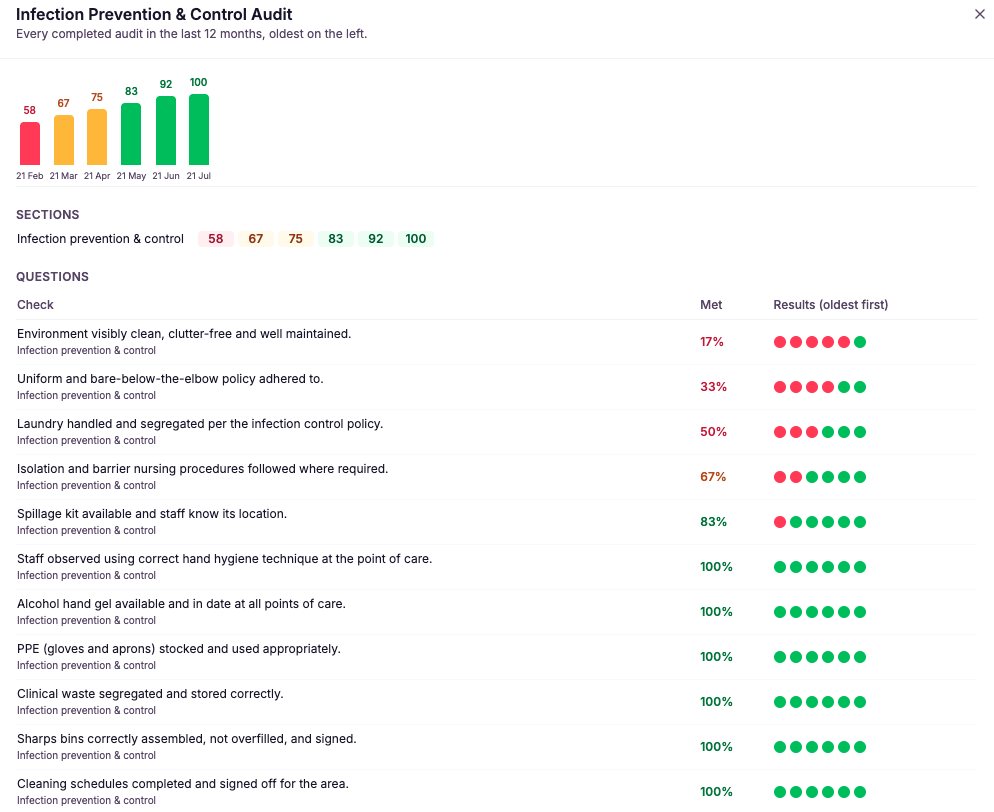
Now move from the person to the service. Every audit you run keeps its results, and the per question view shows how often each check was met across consecutive runs.
If the hand hygiene audit kept failing on one question before the training and passes it afterwards, that is your evidence of impact. If it keeps failing, the course did not reach the floor, whatever the scores said.
The trend view also lists repeat failures. A question that fails three runs in a row is telling you something that one more course will not fix, and the fix sits in the process.
The staff training and compliance audit covers the training system itself, which is a different question from whether one course worked.
Free courses, an 80% pass mark assessment, certificates and a training matrix. Create a free account and start with the Care Certificate.
Create a free accountFigure: six runs of the same audit, with the questions that keep failing listed underneath.
Where a training evaluation form helps, and where it does not
A training evaluation form asks what people thought of the session. That is worth knowing. It tells the trainer what to change, and it tells you whether the room was too cold to learn in.
It does not show competence. Nobody has yet been judged safe on the strength of a tick in a satisfaction box.
So keep the form to one side of paper, and keep it separate from the competence record. Mixing them is how services end up with a thick file that answers the wrong question.
Who does the watching when the office is empty
Most managers cannot watch four people in a week, so the watching has to be shared. Give it to the seniors who are already on those shifts.
Three rules keep it honest.
- One task each. A senior who is asked to observe everything observes nothing.
- A named decision at the end: safe to work unsupervised on this task, or not yet.
- Five minutes of protected time to write it, on the shift, not at home.
The quality of the note matters less than the fact that somebody made a judgement and signed it. An inspector reading a file can tell the difference between a record of a decision and a tick that was applied to twelve people at once.
What the regulations ask you to show
One regulation sits behind all of this. It is Regulation 18 of the Health and Social Care Act 2008 (Regulated Activities) Regulations 2014.
Staff must get the support, training, professional development, supervision and appraisal their duties need. The last three words do most of the work.
The same guidance adds a monitoring duty. Learning and required training should be monitored, and gaps acted on quickly.
Regulation 17 then asks for systems that assess, monitor and improve quality, with accurate records kept. An evaluation habit is one of those systems, and it is easier to show than to describe.
Benefits of CareStream for training effectiveness evaluation
A free account already holds most of what the four checks need.
- The assessment score for every person, beside the completion.
- A follow up lesson and a fresh question after a wrong answer.
- A named, dated certificate and a matrix showing who is missing.
- Every audit template, with per question results across runs.
Two views go further and sit on the Enterprise plan: effectiveness of training and training impact, which line training up against audit scores over time.
Neither replaces the watched task. CareStream can show you the score, the gap and the trend. Only a person can watch the transfer and decide it was safe.
What to do after the next course
Take the next course your team is booked onto and do four things.
- Write the sentence before anyone starts, and tell them what it is.
- Read the scores the day they finish, and note the questions missed.
- Watch one task in the first few shifts and record the decision.
- Put the matching audit in the diary, and compare it with the last run.
Four checks, one course. Do it twice and you will know which of your training actually changes a shift. That is a better basis for a training budget than any attendance list. The training matrix with renewals and gaps will keep the dates for you while you do the part that matters.
Sources
- Regulation 18: Staffing, guidance for providers (Care Quality Commission) · cqc.org.uk
- Regulation 17: Good governance, guidance for providers (Care Quality Commission) · cqc.org.uk
- Monitoring and improving outcomes, a quality statement in the assessment framework (Care Quality Commission) · cqc.org.uk
Frequently asked