Which standard does that sit under? An inspector can ask it about a wet floor, a missing signature or a rota gap. The CQC standards below run in the order the law numbers them, each with the record that answers it.
Where the fundamental standards of care come from
The Care Quality Commission registers and inspects services in England. The CQC fundamental standards are the ones below which care must never fall.
The regulator writes them twice over. One version is a plain English list of the fundamental standards for the public. The other is the law.
The legal wording is set out in Part 3 of the Health and Social Care Act 2008 (Regulated Activities) Regulations 2014. That is the part a notice of decision quotes.
Regulation 8 is the hinge. It says a registered person must comply with Regulations 9 to 20A when carrying on a regulated activity. Fourteen duties follow it.
Registration turns on them as well. The regulator states that it must refuse registration where a provider cannot satisfy it that the service can and will keep meeting a regulation.
There is no separate set of CQC standards for care homes. One set covers every regulated activity, in a nursing home, a supported living service or a home care round. Only Regulation 9A is narrower.
So searches for CQC regulations for care homes land on the same fourteen duties under another name. The setting changes how you evidence them. It does not change the list.
None of them is a one off task. Each is a duty you hold while the service runs. So the evidence has to be live, not tidy.
The four standards about the person
These are the duties that shape what the day feels like for the person you support.
- Regulation 9, person centred care. Care must be appropriate, meet the person's needs and reflect their preferences, with an assessment done with them.
- Regulation 9A, visiting and accompanying. In a care home, a hospital or a hospice, people must be helped to receive visits. Care home residents must not be put off going out.
- Regulation 10, dignity and respect. This covers privacy, autonomy, independence and due regard to protected characteristics under the Equality Act 2010.
- Regulation 11, need for consent. Care must be given with the consent of the relevant person, and the Mental Capacity Act 2005 route applies where capacity is lacking.
An inspector rarely asks for the policy here. They ask the person. Then they read the care plan to see whether the plan and the person describe the same week.
Consent is the one that gets written down least. A care plan that records a best interests decision, with who was asked and what was weighed, settles more questions than any policy on the shelf.
The four standards about safe care
- Regulation 12, safe care and treatment. It names risk assessment, competent staff, safe premises, safe equipment, safe medicines and the control of infection.
- Regulation 13, safeguarding from abuse and improper treatment. Systems must prevent abuse, and any allegation must be investigated as soon as the service knows of it.
- Regulation 14, meeting nutritional and hydration needs. Food and drink must meet assessed needs, including preferences and religious or cultural needs, with support to eat and drink where it is needed.
- Regulation 15, premises and equipment. Everything must be clean, secure, suitable, properly used, properly maintained and in the right place.
Regulation 12 is the one that carries the widest reach. Read it as nine separate duties rather than one, because that is how a report will break it down.
Every audit in the library is free to run, with scoring, actions and a report. No card needed.
Create a free accountRegulation 14 has sharper teeth. The regulator can prosecute a breach of it where a failure causes harm that could have been avoided. No warning notice has to come first.
The six standards about running the service
- Regulation 16, receiving and acting on complaints. Complaints must be investigated, acted on, and summarised for the regulator within twenty eight days of a request.
- Regulation 17, good governance. Systems must assess, monitor and improve quality, mitigate risk, keep accurate records and act on feedback.
- Regulation 18, staffing. Enough suitably qualified, competent, skilled and experienced people, with the support, training, supervision and appraisal their duties need.
- Regulation 19, fit and proper persons employed. Good character, the right skills, sound recruitment and the information listed in Schedule 3 on file.
- Regulation 20, duty of candour. Be open about a notifiable safety incident, tell the person, support them and apologise.
- Regulation 20A, display of performance assessments. The rating goes where people can see it, and on the website.
Complaints and candour look like paperwork and behave like culture. A service that logs three complaints a year and reports no concerns is telling an assessor that people do not feel able to speak.
Regulation 17 is the one that catches services out. The duty is to show the system worked, not that an audit took place. A finding with no closed action reads worse than no audit at all, because it shows that the service saw the problem and then let it sit.
What the CQC standards are not
Two sets of standards share a name and do different jobs. The ones here are legal duties on the provider, enforced by the regulator. The 16 Care Certificate standards for a new worker are an induction framework, signed off by the employer after watching the work.
A policy is not a standard either. Plenty of services hold a thick folder and still pick up findings. The duty is about what happened on the last late shift, not what the folder says should happen.
How a standard becomes a question on the day
The regulator assesses services against the Single Assessment Framework. It holds five key questions and a set of quality statements. Each statement is tied to the regulations it relates to.
So the standard is the duty and the quality statement is the wording. Our page on what the single assessment framework changed for providers covers that shift in full.
What an assessor needs is narrower than either. For any standard, they want the record that shows the duty met on an ordinary day. They want the name of the person who checked.
Which free audit answers which CQC standard
A regulation is easier to evidence when one routine check sits under it. The free audit library pairs up with the standards like this.
Pick an audit, assign it, score it on a phone and close the actions. Create a free account to start.
Create a free account- Regulation 12: the infection control, medicines management and health and safety audits.
- Regulation 14: the fluid intake and hydration, weight monitoring and mealtime experience audits.
- Regulation 15: the premises and maintenance and resident bedroom audits.
- Regulation 17: the monthly governance review audit and the quality assurance audit.
- Regulation 18: the staff training and compliance audit and the staff competency observation.
- Regulation 19: the HR staff files audit.
Each of these is free to run. The whole set, grouped by the kind of service it was written for, sits on the care audits library page.
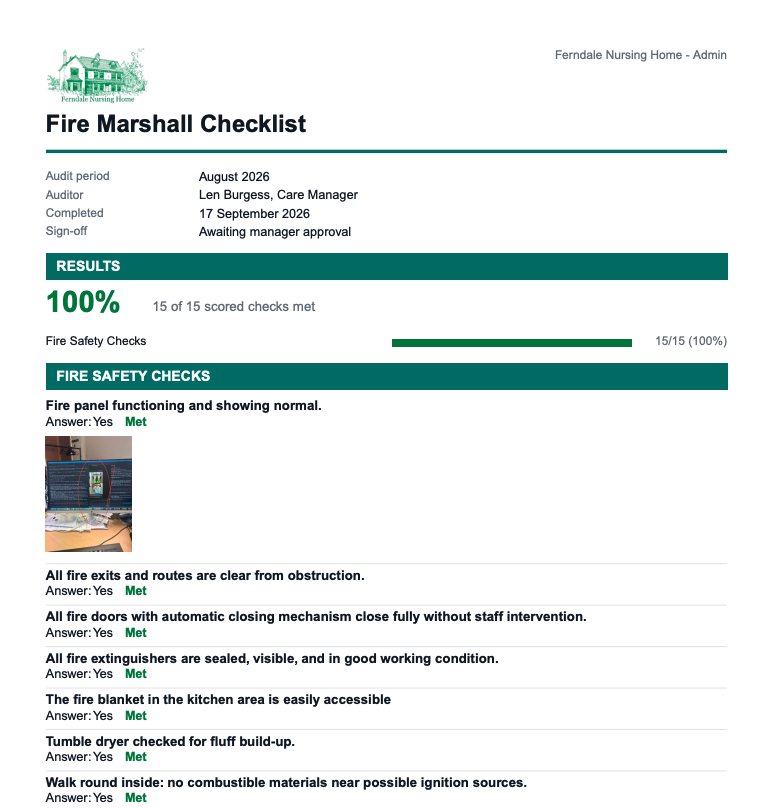
Figure: a completed audit report carries the auditor, the sign off state, the section score and each answer.
The three records an assessor keeps coming back to
- The care plan, read against what the person says.
- The audit, read against what happened to its findings.
- The staff file, read against the rota it sits behind.
Pick one standard and try it. Slow to find means a gap. An assessor who waits while three people look through a shared drive has learned something about the service before reading a word. It is a records gap rather than a care gap, and the two want different fixes: one needs a routine, the other needs a conversation.
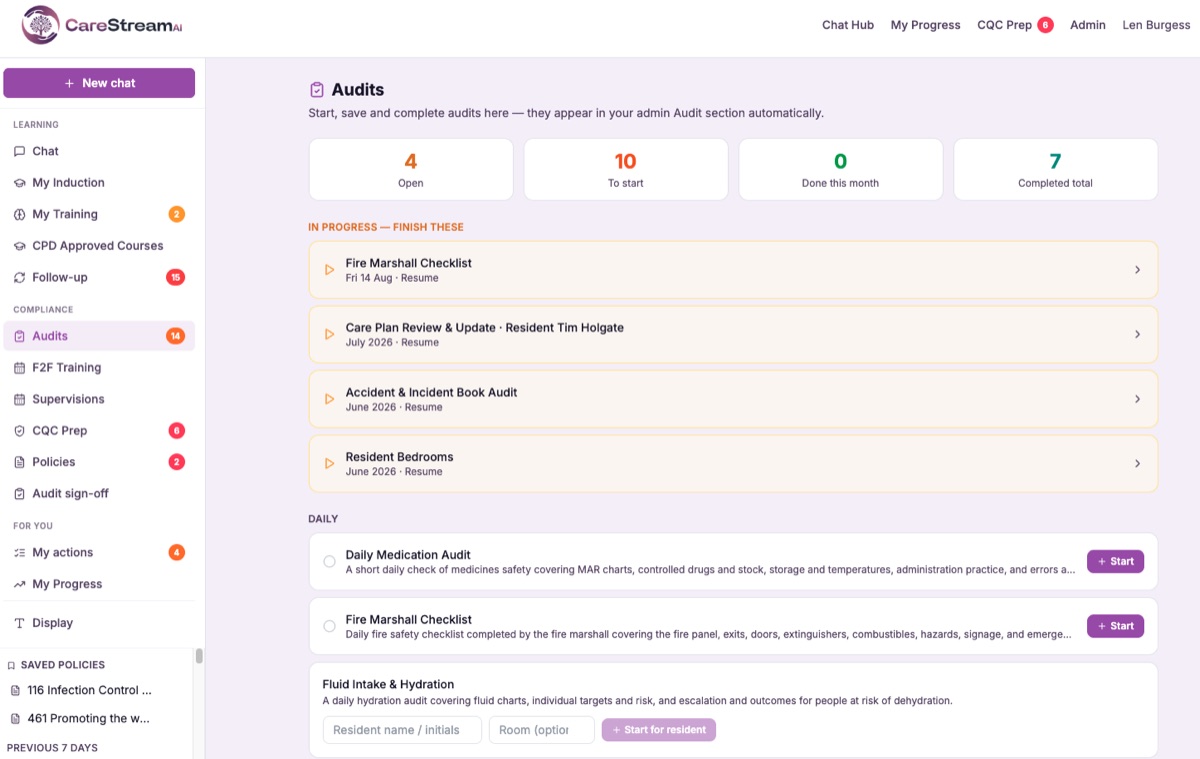
Figure: the audits screen shows what is open, what is due daily and what has been finished.
Benefits of CareStream for evidencing the CQC standards
A free account runs every audit template in the library. Reports, signatures and action tracking come with it. The finished report shows the section score, each answer, any photo taken on the phone and the action plan behind it.
A free account also gives a gap check on your first 5 policies. CPD certified training is free for every member of staff, with a certificate each time.
Two limits are worth stating plainly. The recommendations written at the end of an audit sit on the paid plans. No product can meet a standard for you: the audit records the check, and your team does the work.
Where to start with your own evidence
Take the four standards about the person first. Those are the ones an assessor tests by talking to people, not by reading files.
Then work down the six about running the service. There, it is a weak record rather than weak care that shows up in a report.
Keep the pairing simple: one standard, one routine check, one named person who closes the findings. If you do nothing else, write that pairing out for the six standards about running the service and put a name beside each line. An empty line there is a duty that sits with everybody, which usually means it sits with nobody at all.
Sources
- Part 3 of the Health and Social Care Act 2008 (Regulated Activities) Regulations 2014 (legislation.gov.uk) · legislation.gov.uk
- The fundamental standards of care (Care Quality Commission) · cqc.org.uk
- Regulation 17: Good governance, guidance for providers (Care Quality Commission) · cqc.org.uk
- Key questions and quality statements in the assessment framework (Care Quality Commission) · cqc.org.uk
Frequently asked