A senior carer sits down for her supervision. Her manager opens the training matrix and sees green across the board. Twenty minutes later, nobody has mentioned that she passed the medication course on the last possible attempt.
A green tick says a course is done. It says little about how the person is doing.
That gap is what good staff supervision and training records should close. This walkthrough follows one supervision from preparation to record. It shows how to link training to supervision, and how supervision and appraisal in care can share the same training records.
Before the supervision: find out where the person stands
Start with the facts. A good supervisor wants to know what is overdue, what is due soon, what has expired and what the person finished since you last met.
Add the softer signals. Low scores, courses never opened and questions the person asked that nobody could answer all point to a conversation worth having.
On the Enterprise plan, CareStream gathers these into a training brief for the person. It lists courses overdue, due soon or expired, and low scores.
The CPD certified Care Certificate and the annual courses are free on every plan. No card needed, and every staff login is included.
Create a free accountIt adds courses finished since the last supervision and gaps in CQC preparation. Questions they asked that the policies could not answer appear too, with open actions from earlier supervisions. A short worth raising list sits at the top.
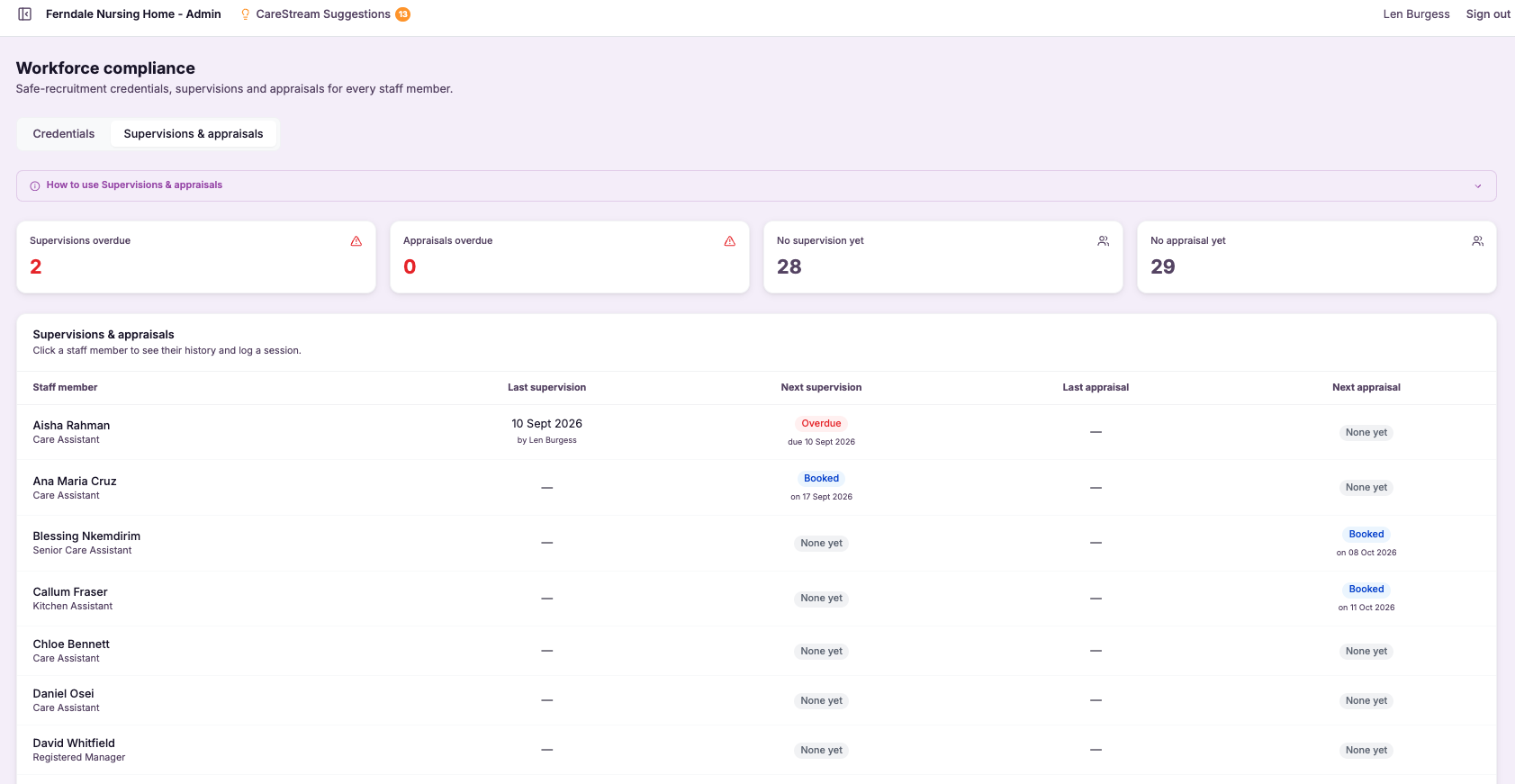
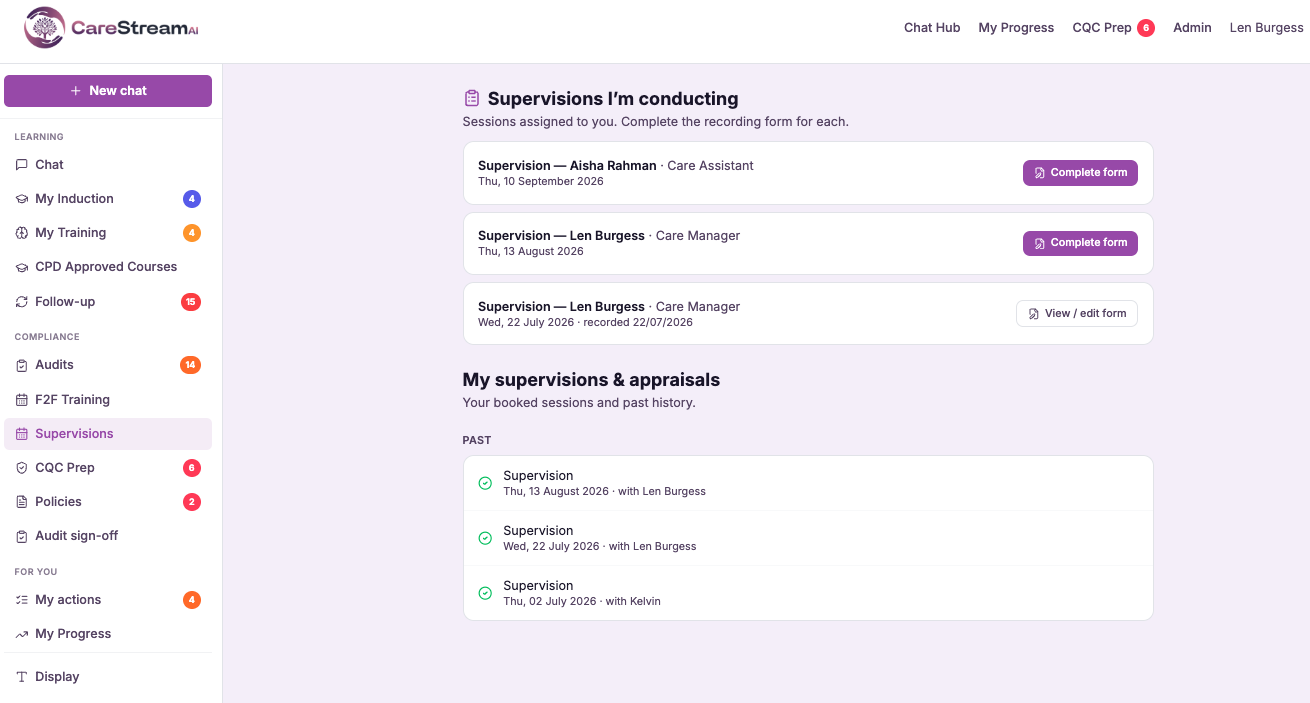
Figure: the supervisions and appraisals table in the Compliance area. Open a person from here to see their training brief.
The brief is for the supervisor and the account's administrators. The person being supervised does not see it. Staff see the actions that come out of the supervision in their hub.
What the law and the guidance actually ask for
The duty is short. Regulation 18 covers staffing. It is part of the Health and Social Care Act 2008 (Regulated Activities) Regulations 2014. The full text of the regulation says staff must get the support, training, development, supervision and appraisal they need to do their jobs.
Supervision and training share a sentence. The Care Quality Commission says staff should get appropriate supervision and regular appraisal. Its guidance for providers on Regulation 18 sets this out.
Neither says how often. Skills for Care calls supervision a regular meeting with a manager. It covers spotting chances to learn and develop, in its guidance on supervision.
The frequency is your decision. Write it in your policy and keep to it. Then check that supervisions happen, and that the training record is read when they do.
Read the training in full, not as a single colour
Training in supervision works best when the detail is in front of you.
A summary shows the shape of things. The detail shows the person. Before you go in, open each course allocated against the supervision and read what is behind the status.
Each course gets its own card. Each carries the status (not started, started, completed, expired or overdue), the dates, the score and the time spent on the lesson. It also shows the pre course check, and the questions answered wrongly alongside the person's answer and the correct one.
If the course came from an earlier supervision action, the card says so. If the person did any follow up, that appears too. With several courses, each opens as an accordion, closed at first with a one line summary.
Why the wrong answers matter to a supervisor: a score of 80 might hide a single miss on a point that is central to the person's role. A score of 100 after a long time on the lesson tells a different story from the same score in four minutes.
Use suggestions as prompts, not as verdicts
Sometimes you want a starting point for the conversation. CareStream offers suggestions worked out by fixed rules from the scores and answers. There is no AI in them and no cost to use them.
Each suggestion shows the evidence behind it. Examples include a low score with the questions missed. Others are a clear learning gain from the pre course check, a course overdue or not opened, and all attempts used. For short courses the wording is softer, along the lines of worth checking.
Treat each one as a question to ask. A person who scored low might have been interrupted on shift. A clear gain from the pre course check is a reason to say well done.
If a suggestion is worth acting on, Add as agreed action puts it on the supervision as one of your supervision actions. Leave out the ones you do not agree with.
Free courses, an 80% pass mark assessment, certificates and a training matrix. Create a free account and start with the Care Certificate.
Create a free accountIn the room: four questions that use the evidence
You do not need to read the record aloud. Use it to ask better questions. These four work in most services:
- Which part of this course will you use most on your next shift?
- Is there a question you got wrong that you still feel unsure about?
- What got in the way of finishing the course on time?
- What would help you most in the next three months: a refresher, shadowing, or a different course?
Write down what the person says, in their words where you can. Then agree one or two actions, each with an owner and a date. Resist a long list. Long lists rarely close.
After the supervision: turn the agreement into supervision training that gets done
An action written on a form often fades. The fix is to attach it to something that can be completed and checked.
When you assign training in CareStream, a tick box adds it to each person's next booked supervision as an action. When the person completes the course, the action closes by itself. Nothing is added unless you tick the box, so routine allocations do not clutter supervisions.
The person sees the action in their staff hub, so they know what was agreed. At the next supervision, the open actions from the last one are in the brief, and you start with what happened, not with a blank page.
Keep the evidence without keeping a pile of paper
Two kinds of evidence help later. One is what was agreed. The other is what you knew when you agreed it.
When a supervision is completed in CareStream, a short summary of the person's training at that time is saved in the record. It cannot be edited afterwards. A reader can see what the supervisor saw on the day, not only what the position is now.
You can also print the training in full as a clean page, or email it to an administrator on the account. It cannot be sent to any other address, because it holds a staff member's training records. If a colleague outside the account needs a copy, an administrator can print it for them.
Benefits of CareStream for staff supervision and training records
All of the above is in training linked to supervisions. It is on the Enterprise plan at £385 a month, and sits with supervisions and appraisals tracking in the Compliance area. That is where bookings and the recording form live.
Start with the paperwork if you prefer. Our staff supervision and appraisal audit checks your records. The supervision and appraisal policy sets out who does what.
The courses themselves are also here: our CPD certified training is free to every member of staff. The feature does not make a service compliant. It gives a supervisor the information to have a better conversation, and a record that shows what happened next.
A one page checklist for your next supervision
- Open the brief or the training record for the person the day before.
- Note anything overdue, expired or not opened.
- Read the missed questions on any low score.
- Pick no more than three things to raise.
- Ask the four questions above and write down the answers.
- Agree one or two actions, each with an owner and a date.
- Tick the box when assigning training so it follows the person.
- At the next supervision, start with the open actions.
Sources
- Regulation 18, Staffing, of the 2014 Regulated Activities Regulations · legislation.gov.uk
- CQC guidance for providers on Regulation 18, Staffing · cqc.org.uk
- Skills for Care guidance on supervision · skillsforcare.org.uk
Frequently asked