
A training certificate is not a training record. It proves somebody finished something on a day. The record is the thing a manager has to hold, and it carries far more than the certificate ever will.
There is no legal training certificate template. The Health and Social Care Act 2008 (Regulated Activities) Regulations 2014 ask for staff who are trained, supported and competent. The format is left to you, which is why the rest of this page is our template rather than the law's.
What the law asks for, and what it leaves to you
Three duties do the work here. Together they explain why the certificate is the smallest part of the paperwork.
Staff must receive the support, training, professional development, supervision and appraisal they need to do their jobs. That duty sits in regulation 18 on staffing.
The CPD certified Care Certificate and the annual courses are free on every plan. No card needed, and every staff login is included.
Create a free accountThe provider must also keep secure records about the people it employs. That one comes from regulation 17 on good governance.
The staff file itself must hold the items in Schedule 3 on information about persons employed. Documentary evidence of a relevant qualification is one of them.
None of the three names a certificate. None sets a format, a layout or a logo. So the test is not whether your certificate looks official. It is whether a stranger could open your file and see who was trained, in what, to what standard and when.
The lines we would put on a care staff training certificate
This is the template we would use. It is our view, not a rule, and it is built so that one page answers the questions an auditor asks in order.
- Full name of the person, spelled as it appears on the staff file.
- Course title, and the version or edition of the course.
- A short line on what the course covered, or a link to the outline.
- How long the course took.
- How it was assessed, and the pass mark needed.
- The result achieved.
- The date of completion.
- Any refresher date your service has set for that topic.
- Who provided the training, named as an organisation or a person.
- Any certifying mark, such as CPD certification, where it genuinely applies.
- A reference number that lets anyone find the underlying record.
Two of those lines are missed most often. The version of the course matters when guidance changes, because a certificate with no version cannot be matched to the content a person actually saw. The reference number matters because a certificate without one is a dead end.
What a certificate cannot tell you
A pass tells you somebody answered questions correctly. It does not tell you they can move a person safely, or notice a change in someone's breathing.
The provider guidance on staffing, supervision and competence puts it plainly. Where it is appropriate, supervise a person until they can show the competence to work unsupervised. Only then does a pass mean much.
So pair the certificate with an observation. One line is enough: who watched, what task, what they saw, what happens next.

Figure: the observation that turns a certificate into evidence happens on the floor, not in the folder.
The training sign in sheet, line by line
Face to face sessions rarely produce a certificate each. A training sign in sheet is the record, so it has to stand on its own.
- The course title and a short outline of what was delivered.
- Who ran it, their role and their organisation.
- Start and finish times, so the length is not a guess.
- Printed name, role and signature for every person in the room.
- A column for the assessment result, if one was taken that day.
- A signature from the person who ran the session.
We would add one more column: who was booked and did not come. That turns a sign in sheet into a catch up list, and it is the column most templates leave out.
What the staff file has to hold
Schedule 3 is a recruitment list rather than a training list. It still sets the tone for the file.
Free courses, an 80% pass mark assessment, certificates and a training matrix. Create a free account and start with the Care Certificate.
Create a free accountIt asks for proof of identity with a recent photograph. It asks for criminal record information where that is required. It asks for evidence of conduct in previous care work, and the reason that work ended.
It also asks for a full employment history. Any gap needs a written explanation. And it asks for documentary evidence of a relevant qualification, so far as that is reasonably practicable to obtain.
A course certificate is not a qualification. Keep the two apart in the file, or you will spend an inspection explaining the difference.
How long we would keep each record
No rule in the care regulations sets a retention period for training records. That is a gap each provider fills in its own retention policy, and the only wrong answer is a different answer for each member of staff.
We would hold the training record for the whole of employment, and for a defined period after a person leaves. We would keep the sign in sheets for the same period as the sessions they evidence.
Say what the period is, write it down once and apply it to everyone. An inspector can follow a stated rule. Nobody can follow a habit.
What we would stop keeping
A drawer of printed certificates with no index costs more time than it saves. So does a spreadsheet that holds only dates, because a date cannot tell you what the course covered or how it was assessed.
If you want a training records template that survives a staff change, start from the questions you get asked. Who is due, who is overdue, what did this person actually do, and where is the evidence.
Answer those four in one place and the format matters far less than the filing. A tidy certificate that nobody can find has done nothing for the person who has to answer at the door.
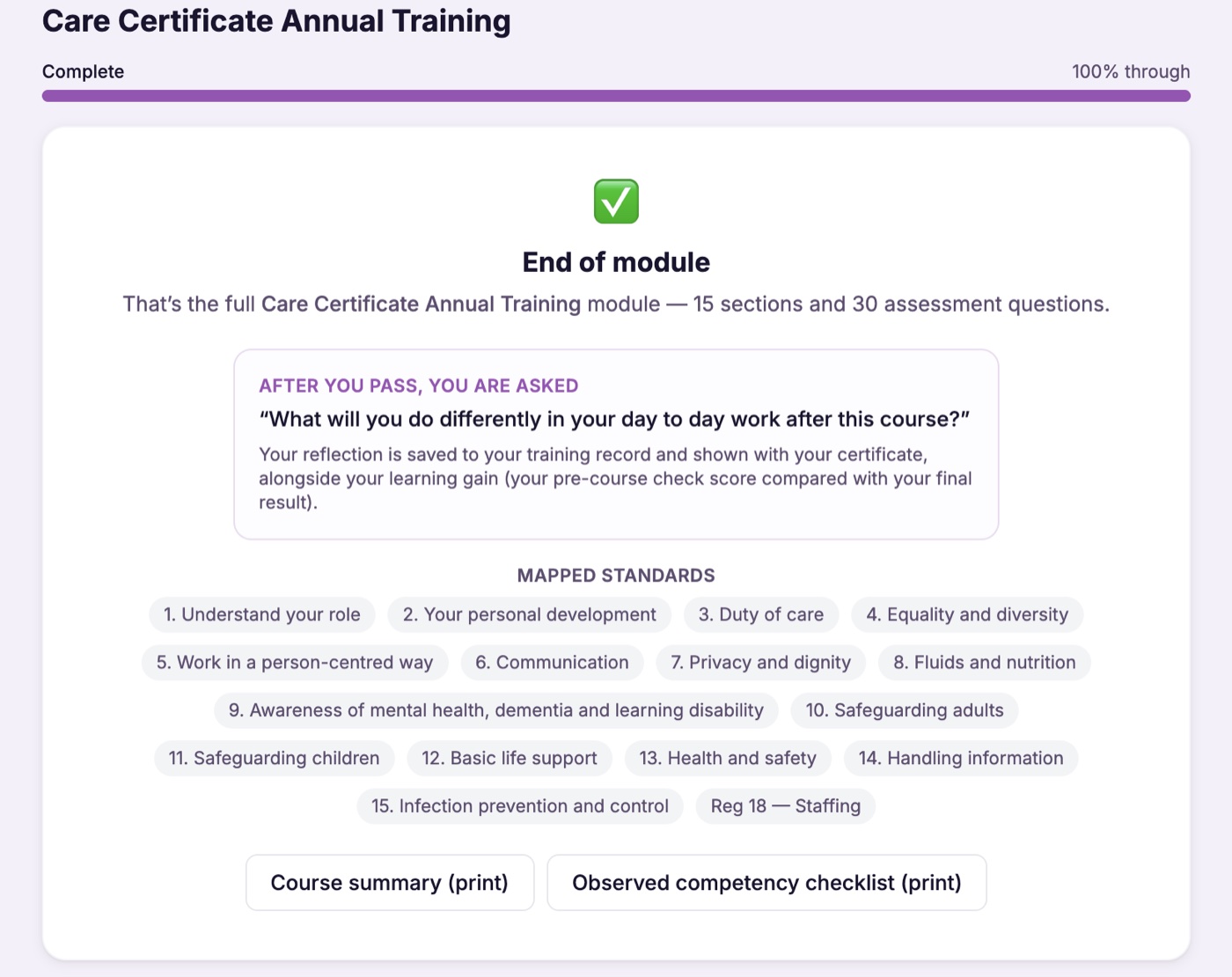
Figure: the end of module screen, with the reflection, the mapped standards and the two documents you can print.
Benefits of CareStream for your training certificate template
Care staff training records on a free CareStream account are built around those four questions.
- Every CPD certified course is free for every member of staff, with the certificate included and no card needed.
- Each course runs about 60 minutes, with 32 questions and a pass mark of 80 per cent.
- The end of a course saves a reflection answer with the record, next to the learning gain.
- It also offers a printable course summary and an observed competency checklist.
- The training matrix shows who is due and who is overdue.
The free CPD certified courses are the quickest way to see what a complete record looks like.
What to do with the next certificate that lands
Before it goes in the file, check three things: the name matches the file, the course version is on it, and there is a reference you can trace. If any of the three is missing, ask for a new one while the trainer still remembers the session.
Then put the observation in the diary. Our guide to supervision and training records shows how that conversation uses the evidence you have just filed.
The sign in sheets and certificates in the evidence pack cover the paper side. CareStream keeps each sheet with the session it belongs to.
If you would rather test the whole set at once, the training matrix compliance audit runs 42 monthly checks against the records you hold.
Sources
- Regulation 17, good governance, including records about persons employed (legislation.gov.uk) · legislation.gov.uk
- Regulation 18, staffing, support, training, supervision and appraisal (legislation.gov.uk) · legislation.gov.uk
- Schedule 3, information required in respect of persons employed (legislation.gov.uk) · legislation.gov.uk
- Regulation 18 provider guidance on competence and supervision (Care Quality Commission) · cqc.org.uk
- Regulation 19, fit and proper persons employed (legislation.gov.uk) · legislation.gov.uk
Frequently asked