Care certificate workbook answers are the most searched part of a scheme that is mostly watched, not written. The belief behind the search is simple. Fill the workbook in, pass the Care Certificate. It runs the other way round.
We would not blame the new starter for looking up care certificate workbook answers, or care certificate answers more broadly. The paperwork looks like the task. Five beliefs get in the way, and each one costs a manager time later.
Belief one: the workbook is the Care Certificate
The workbook is a record of learning. The award is a decision made by a person in your building.
The assessor and employer guide is direct about who decides. The employer is responsible for assuring the quality of the teaching and the assessment. Sign off falls to the registered manager in adult social care, once every standard is met.
Their confidence in how the worker was taught and judged is the thing being tested. A completed care certificate workbook does not provide that assurance on its own.
The CPD certified Care Certificate and the annual courses are free on every plan. No card needed, and every staff login is included.
Create a free accountThis matters most in a service that recruits in small numbers. One deputy often carries every induction, and the workbook becomes the only thing anybody files.
There are sixteen standards now, not fifteen. Skills for Care added one to capture awareness of learning disability and autism, and plenty of workbooks in circulation predate the 2025 update.
Belief two: a right answer counts as evidence
Not on its own. The guide sets out what evidence has to be, and one word does the damage to a copied answer: authentic, meaning produced by the learner.
A downloaded answer is not produced by the learner. It fails the test before anyone reads it.
How much is enough? The guide says evidence is sufficient when the assessor is confident the learner has met the standard, and calls that a judgement of the individual assessor. No page count exists to hit.
We think that is the right design. It also means a thick folder of tidy answers can still be refused, which surprises people.
Standardisation is the optional part. The guide says some employers bring assessors together to compare the evidence they accepted and agree what sufficient looks like, and that this is not a requirement.
We would do it once a year with two assessors and a kettle. An hour of comparing notes settles more arguments than any new form.
Belief three: knowledge and practice are the same thing
They are assessed differently, and the verbs tell you which is which. Verbs such as demonstrate, take steps to, use and show point at performance, which the assessor has to watch happening in the workplace.
Our guide to the care certificate assessor role covers who may do that watching. We will not repeat it here.
Classroom practice is allowed as practice. The guide says learners can develop new skills in a skills lab, but that assessment evidence must be collected during real work wherever possible.
Online learning has the same limit. Where eLearning is used, it must carry an assessment such as questions, and on its own it cannot give full achievement of the standards.
Belief four: copied answers harm nobody
This is the belief we would push back on hardest. The harm does not land on the workbook. It lands on a Tuesday morning, at a hoist, with a resident waiting.
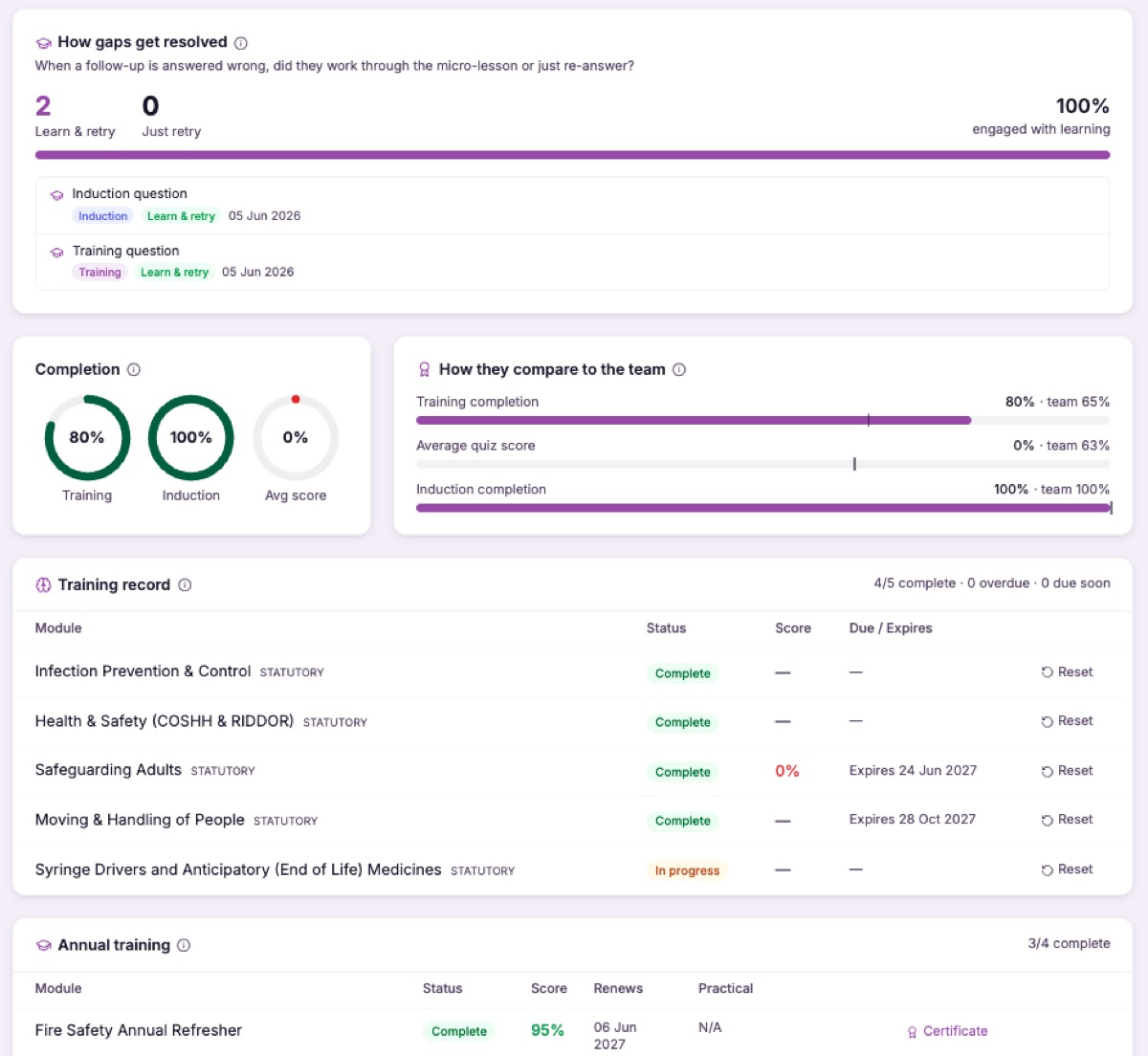
Figure: the record shows what each person has completed and what is still open.
A care certificate observation is where the gap shows. The worker who read somebody else's answer never had the conversation that makes it stick. The assessor sees hesitation, not habit.
Three questions find a copied answer in about a minute, and none of them is a trap:
- Talk me through that answer in your own words.
- What would you do if the person said no?
- Where would you find our policy on it?
A worker who learned the material answers all three. A worker who borrowed the pages stalls on the first.
There is a regulatory edge as well. Regulation 18 on staffing requires that staff get the support, training, supervision and appraisal they need for the duties they are employed to perform.
An inspector asking about a new starter is not asking to see tidy pages. They are asking how you knew that person was safe to work alone.
Free courses, an 80% pass mark assessment, certificates and a training matrix. Create a free account and start with the Care Certificate.
Create a free accountThat question has a short answer in a good service. A named person watched them do the task, on a named date, and wrote down what they saw.
Belief five: a workbook from the last employer carries over
Partly true, and worth handling well. The guide makes documentation the responsibility of the support worker and their employer. A portfolio can travel with the worker between employers.
Two limits sit alongside that. The employer must still assess all the evidence the standards require. The employer also decides whether evidence of prior experience counts at all.
We would accept the portfolio as a starting point and re-observe the practical standards. It takes one shift. It is cheaper than finding out later that the sign off was borrowed.
Phasing helps here too. The standards must be completed and assessed before a new worker practises without direct supervision, and supervision can be eased standard by standard as each one is met.
Belief six: it is the same thing as the Level 2 certificate
It is not, and the names make that hard. Skills for Care says the standards were updated to align with sector developments and with the introduction of the Level 2 Adult Social Care Certificate qualification.
One is an induction standard signed off by your registered manager. The other is a qualification awarded by an awarding organisation.
The guide does leave a door open between them. Evidence from the standards may count towards a qualification where it holds up as authentic and sufficient. That usually runs through a recognition of prior learning process, handled by the learning provider.
So copied pages close a door that a worker might want later. That is worth saying out loud to a new starter who is pressed for time, and it tends to land better than a warning about rules.
Benefits of CareStream where care certificate workbook answers run out
The knowledge half can be done properly without a workbook at all, and the judgement stays with your assessor.
- The free Care Certificate course runs 90 minutes.
- It asks 32 questions and maps to the 16 standards.
- Each learner answers under their own login, so the result belongs to a named person.
- A printable observed competency checklist gives the assessor somewhere to sign.
- The certificate and the training matrix sit in one record, with no card needed to start.
CareStream does not award the Care Certificate, and no course can. Your registered manager does that, after somebody has watched the work.
What to do instead of hunting for answers
Say it plainly at induction. Tell the new starter that the care certificate sign off rests on what an assessor sees. Copied pages cost a second visit rather than save one.
Then make the honest route the easy one:
- Book the first care certificate assessment into the rota in the first week.
- Name the assessor for each standard, and tell the worker who they are.
- Give the worker the standards in advance, so nothing at the observation is a surprise.
- Agree what happens when a standard is not yet met, before it happens.
Our explainer on the sixteen standards is a reasonable thing to hand over on day one.
Keep the induction honest in one more way. Write down which standards the worker has met, which are still open, and what supervision they are on until the rest close.
The workbook can follow. The watching is the part that counts.
Sources
- Care Certificate standards assessor and employer guide (Department of Health and Social Care, NHS England, Skills for Care and Skills for Health) · skillsforcare.org.uk
- Skills for Care: the Care Certificate standards page · skillsforcare.org.uk
- Regulation 18, Health and Social Care Act 2008 (Regulated Activities) Regulations 2014: staffing · legislation.gov.uk
Frequently asked