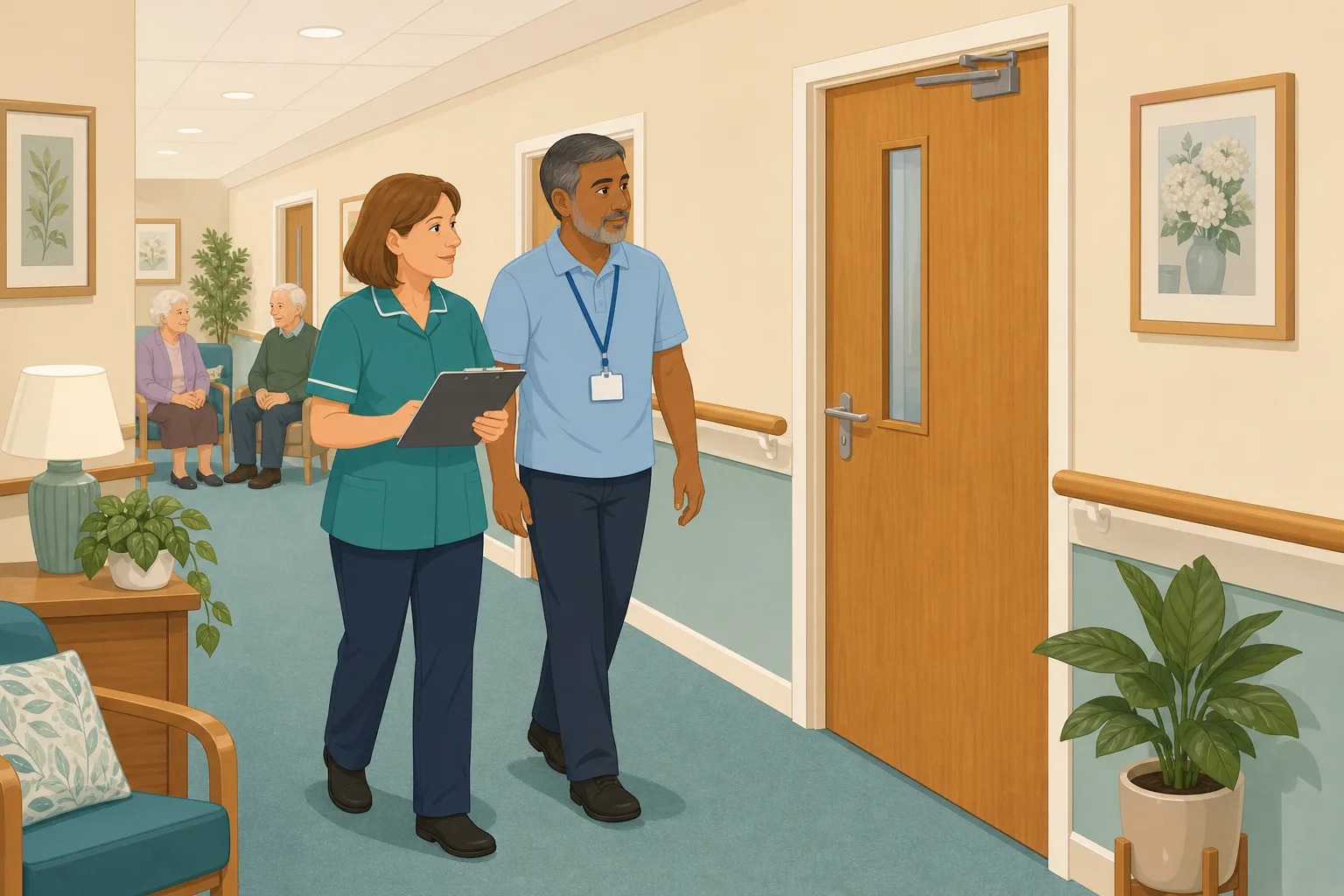
The Health and Safety at Work Act is not a care sector rulebook. It names no care home, no resident and no registered manager. It sets duties on employers, on workers, and on anyone who runs an undertaking. A care inspector will still ask how you meet them.
Below is each duty that lands on a care service, with the wording the law uses and the record that answers it. Everything here comes from the Act or from the regulations made under it.
The duty you owe your own staff
Section 2 carries the main duty. An employer must ensure, so far as is reasonably practicable, the health, safety and welfare at work of all employees. Those five words set the test. They ask what a careful employer could do, not what would be perfect.
The section then lists what the duty reaches:
- safe plant and safe systems of work
- safe use, handling, storage and transport of articles and substances
- information, instruction, training and supervision, as far as is needed
- a safe place of work, with safe ways in and out
- a working environment that is safe, with adequate welfare facilities
Training and supervision are named in the Act itself, in the full text of section 2 on employers' duties to employees. They are not an extra that sits outside the duty.
The CPD certified Care Certificate and the annual courses are free on every plan. No card needed, and every staff login is included.
Create a free accountThe duty you owe residents, visitors and contractors
Section 3 is the one most managers skip. It covers people who are not your employees at all. Residents, families, visiting professionals, agency staff and contractors all sit inside it.
You must run the undertaking so that those people are not exposed to risks to their health or safety, so far as is reasonably practicable. The duty is about how the service runs, not only about what staff do.
So a cleaning trolley left across a corridor is a legal matter, not only an untidy one. The same goes for a contractor's ladder by a lounge door. The full text of section 3 on duties to people other than employees is short enough to read in a minute.
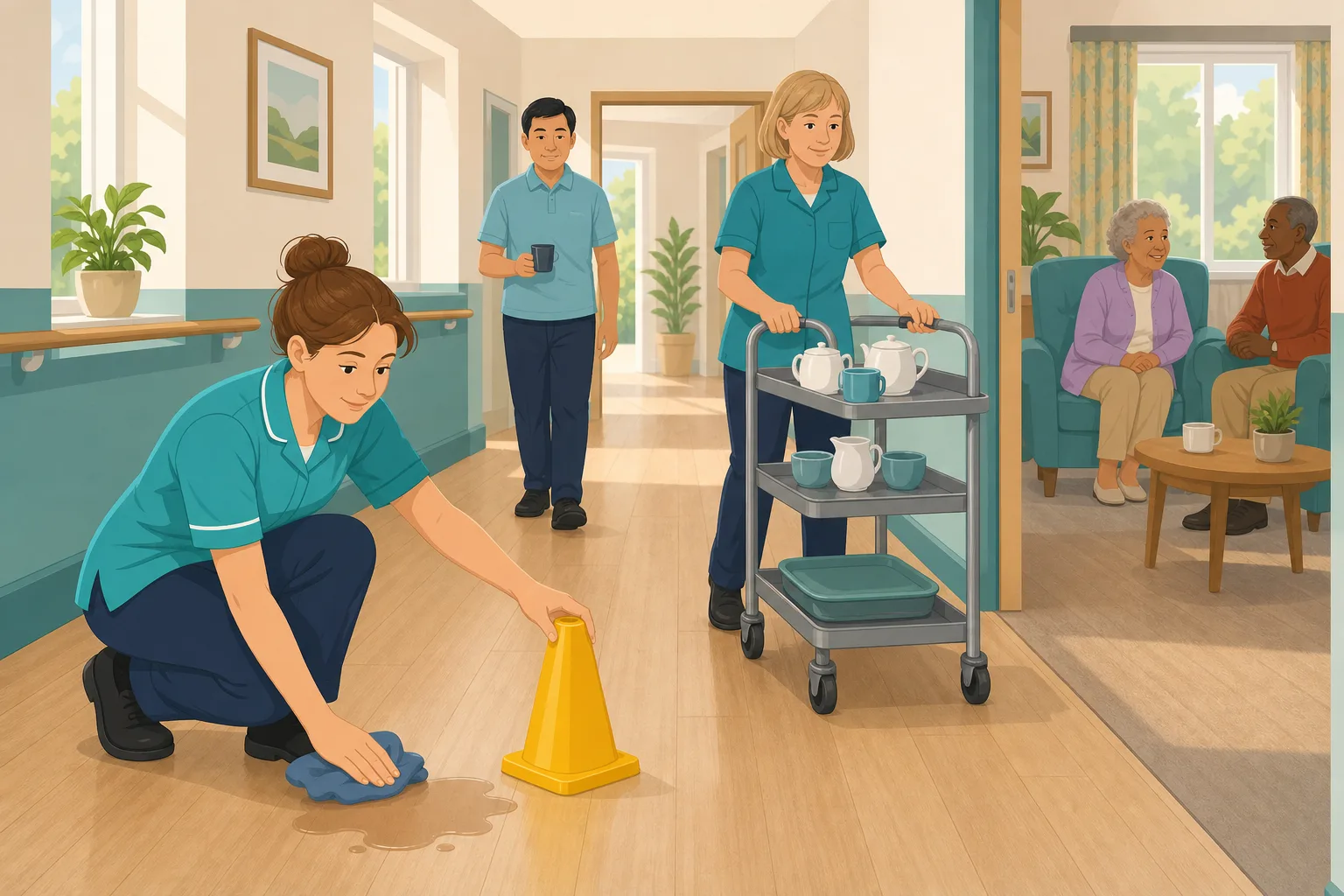
Figure: the duty to residents and visitors is met by what happens in the corridor, not by what the folder says.
What the Act asks of every care worker
Section 7 gives each employee two duties. The first is to take reasonable care for their own health and safety, and for anyone affected by what they do or fail to do. The second is to co-operate with the employer so far as is needed.
This matters when you write a supervision note. A worker who ignores a safe system they were trained in is not simply off process. They sit outside a duty the Act places on them in person.
When a written health and safety policy stops being optional
Section 2(3) asks for three things in writing. A general policy statement on health and safety. The organisation behind it. The arrangements in force for carrying it out.
The statement must be brought to the notice of all employees, and revised as often as is appropriate. A policy nobody has seen does not meet that test.
One exception exists. An employer with fewer than five staff need not write the statement. That comes from the Employers' Health and Safety Policy Statements (Exception) Regulations 1975. Most care services pass five, so it rarely helps.
Our health and safety policies for care services are written to be read by staff, not filed in a cupboard.
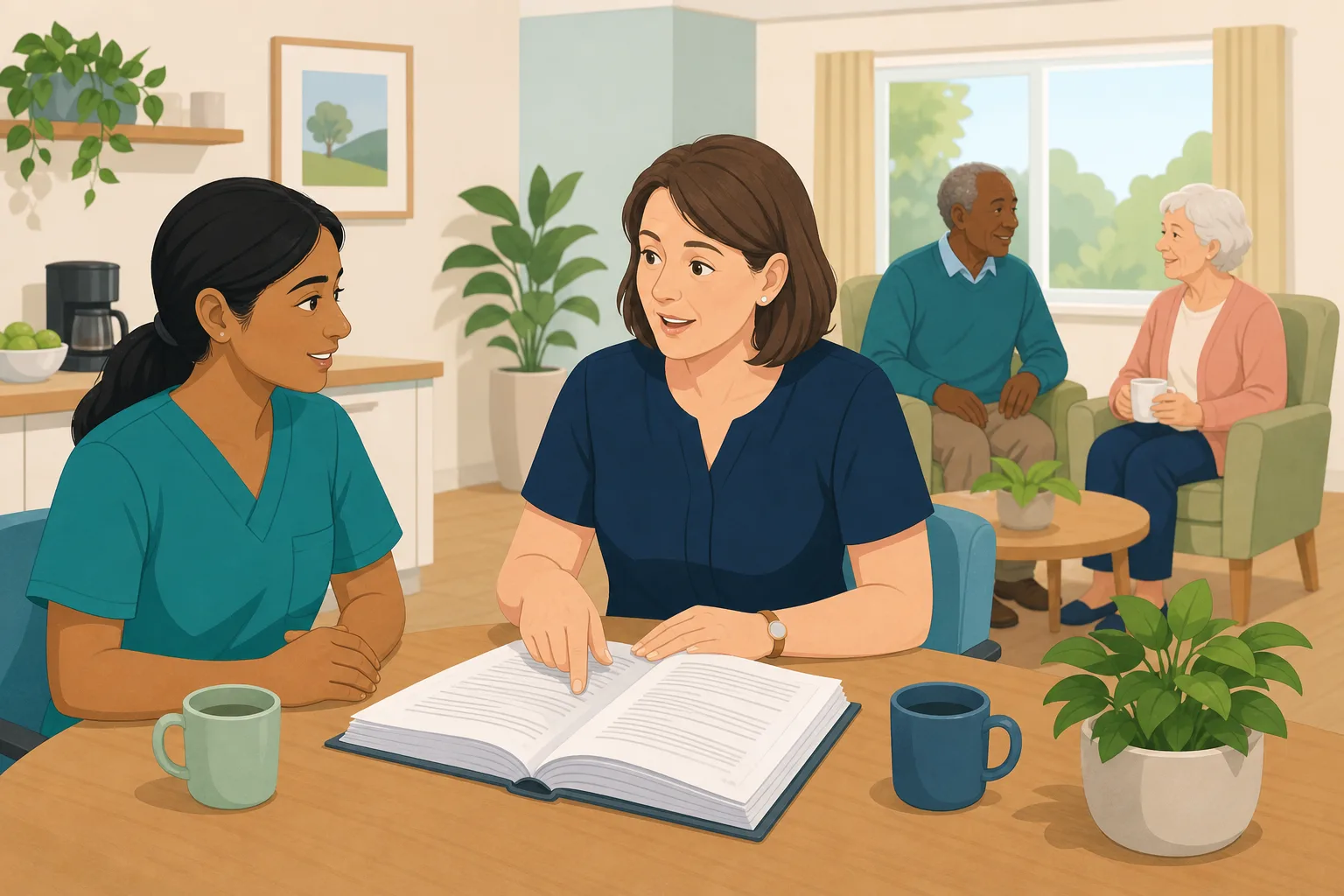
Figure: the arrangements are the part staff have to recognise, so the policy is read in the staff room, not only signed.
The regulations that turn a duty into a method
The Act sets the duty. The Management of Health and Safety at Work Regulations 1999 set the method.
Regulation 3 asks for a suitable and sufficient assessment of two sets of risks. Those to your employees, and those to people who are not employed but are affected by the service. Review it when there is reason to think it no longer holds, or when something significant changes.
Where you employ five or more people, the significant findings go on record. So does any group of employees the assessment marks as especially at risk. Night staff and lone workers often sit in that group.
Regulation 5 asks for arrangements to plan, organise, control, monitor and review the work. At five or more staff you write those down too. Monitoring is the word services skip. It is also the one an audit answers.
Who your competent person can be
Regulation 7 asks every employer to appoint one or more competent persons to help them meet these duties. Competent has a plain meaning here. The person needs sufficient training and experience, or knowledge and other qualities, to do that job.
Free courses, an 80% pass mark assessment, certificates and a training matrix. Create a free account and start with the Care Certificate.
Create a free accountTwo details catch services out. The number you appoint, the time they have and the means at their disposal must match the size of the service and its risks. Where a competent person already works for you, they are appointed ahead of a consultant from outside.
Health and safety induction, and what triggers more training
Regulation 13 does two jobs. It asks you to weigh a worker's capabilities when you hand out a task. It then fixes the points at which training falls due.
A health and safety induction is the first of those points, because training is due on recruitment. After that it falls due on exposure to new or increased risk. A transfer, a change of responsibilities, new work equipment, new technology or a new system of work all count.
Two further lines matter. Training is repeated periodically where appropriate, which leaves the interval to your risk assessment rather than to a fixed rule. And it takes place during working hours, which settles a question managers are asked often.
So a new hoist, a new sluice room or a new way of moving people is a trigger on its own. Health and safety awareness training is not only an annual tick in a matrix.
How a care inspector reaches the same ground
The same ground turns up in the rules the Care Quality Commission inspects against. Start with Regulation 12 of the Health and Social Care Act 2008 (Regulated Activities) Regulations 2014. It covers safe care and treatment.
It asks you to assess the risks to the people you support, and to do all that is reasonably practicable to reduce them. It also asks that the people providing care have the competence, skills and experience to do it safely.
Regulation 15 covers premises and equipment. They must be clean, secure and suitable for the purpose. They must also be properly used, kept in good repair and well placed.
Where the Single Assessment Framework asks how you know people are safe, your health and safety records are often the clearest answer you hold.
Benefits of CareStream for Health and Safety at Work Act duties
Two free parts of CareStream line up with the duties above.
A free account opens the whole audit library, 30 templates, including a health and safety audit built for care settings. Answers are scored by section, and a failed item becomes an action with an owner and a due date. Photos and signatures attach to the run, and the report saves against it.
The General Health & Safety Awareness course is CPD certified and free in English for every member of staff. It runs to 8 lessons and about 60 minutes, with a 32 question assessment and a pass mark of 80 percent. A wrong answer sends a short follow up lesson on the same point.
Neither makes a service safe by itself. They give you the record that section 2 and regulation 13 both expect. Start with the free health and safety awareness course or the free health and safety audit template.
What to do with these duties first
Four short jobs, in this order.
- Open your written policy statement and check it names your service, your arrangements and the people who hold them.
- Put the review date of each risk assessment somewhere visible, and write down who reviews it.
- Name your competent person in writing, and give them the hours the work needs.
- List the training triggers since the last review, then check each person caught up.
Then run the health and safety audit in CareStream once, start to finish, and let the failed answers write your action list. Our walkthrough of how to carry out a health and safety audit in a care home covers the route round the building.
Sources
- Section 2, general duties of employers to their employees, Health and Safety at Work etc. Act 1974 · legislation.gov.uk
- Section 3, general duties to persons other than employees, Health and Safety at Work etc. Act 1974 · legislation.gov.uk
- Section 7, general duties of employees at work, Health and Safety at Work etc. Act 1974 · legislation.gov.uk
- Employers' Health and Safety Policy Statements (Exception) Regulations 1975 · legislation.gov.uk
- Regulation 3, risk assessment, Management of Health and Safety at Work Regulations 1999 · legislation.gov.uk
- Regulation 5, health and safety arrangements, Management of Health and Safety at Work Regulations 1999 · legislation.gov.uk
- Regulation 7, health and safety assistance, Management of Health and Safety at Work Regulations 1999 · legislation.gov.uk
- Regulation 13, capabilities and training, Management of Health and Safety at Work Regulations 1999 · legislation.gov.uk
- Regulation 12, safe care and treatment, Health and Social Care Act 2008 (Regulated Activities) Regulations 2014 · legislation.gov.uk
- Regulation 15, premises and equipment, Health and Social Care Act 2008 (Regulated Activities) Regulations 2014 · legislation.gov.uk
Frequently asked