Show me the last time you said no to a visit, and tell me why. A manager who says it has never happened has either a very settled home or a short memory.
Care home visiting carries a fundamental standard of its own. The duty is easy to meet in spirit and easy to fail on paper, because what is checked is the record of the decision.
Where is this duty written down?
In Regulation 9A of the Health and Social Care Act 2008 (Regulated Activities) Regulations 2014. It is short. You can read the full text of Regulation 9A on visiting and accompanying in a few minutes.
It says three things for a care home. Unless there are exceptional circumstances, people must be facilitated to receive visits at the home. They must not be discouraged from taking visits out of it.
And the visits must be arranged in a way that is appropriate, meets the person's needs and, so far as reasonably practicable, reflects their preferences.
Where does it say what this person prefers?
This is the question that catches services out. Preferences are named in the regulation, so a file that records only times and rules has answered half the question.
Write down who the person wants to see, where they like to sit, and what time of day suits them. That belongs in the resident profile, beside everything else the team needs on shift.
The Care Quality Commission expects you to enable visits in a way that meets the person's preferences, so far as is reasonable. Where you cannot, talk to them. Offer as many options as you can.
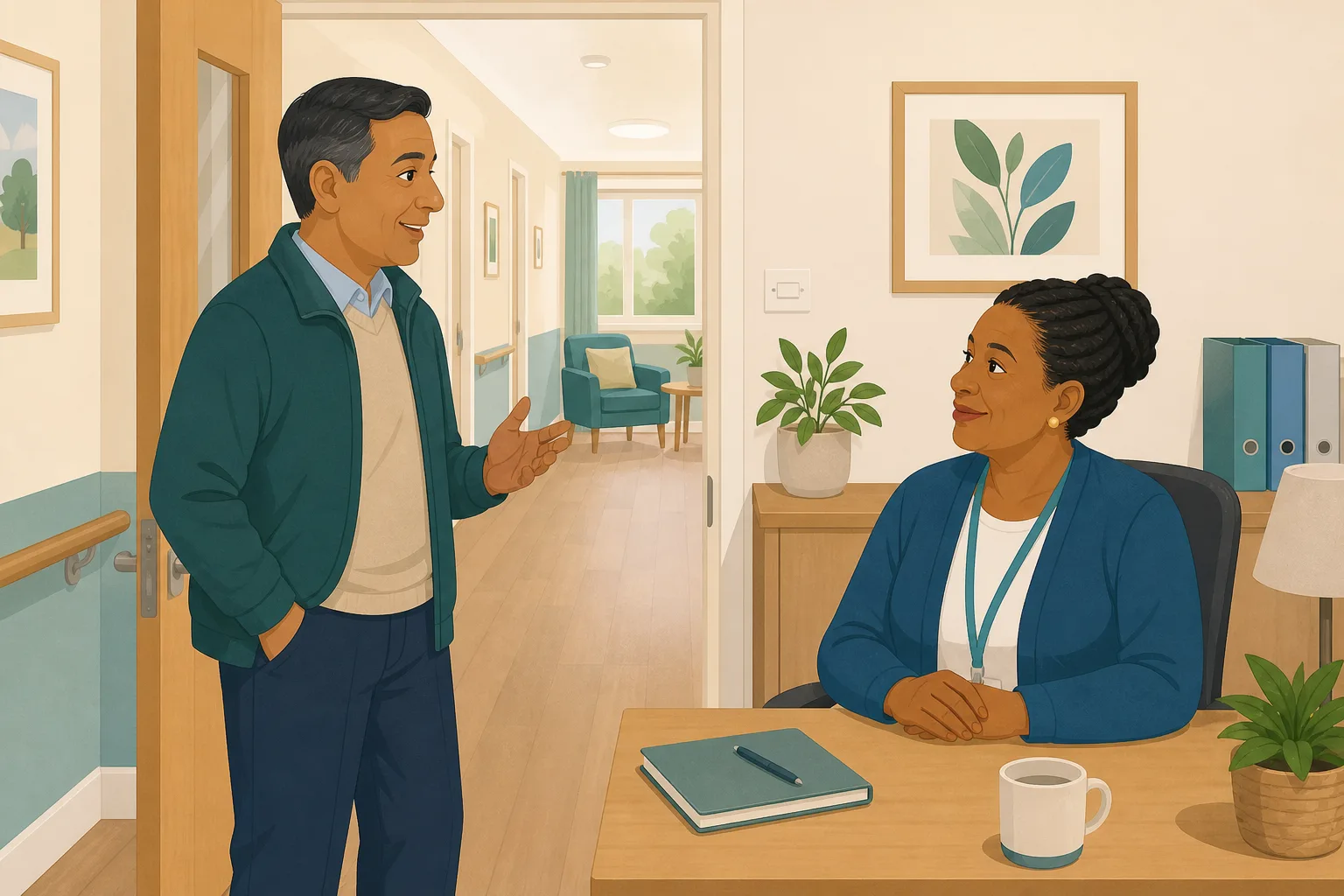
Figure: most visiting decisions are made standing in a doorway. The record is what survives them.
What did you put in place instead of saying no?
Everyone should work on the assumption that visiting in person is possible. That is the starting position in the Care Quality Commission guidance on Regulation 9A.
Have your policies read against the regulations to see what is missing or out of date. No card needed.
Create a free accountWhere a risk is found, the expectation is precautions, not prevention. A restriction is for the rare case where a visit would still pose a significant risk despite everything you could put in place.
So the evidence an inspector wants is the list of things you tried first. A different room. A different hour. A shorter visit.
Visits out of the home sit in the same place. The regulation names them, and the guidance warns against rules that act as a restriction when someone comes back.
An isolation period after every trip out is the usual example. If you ask for one, be ready to explain why it was necessary for that person on that day.
How do you know it was the least restrictive option?
Because you wrote down the alternatives and why each was rejected. There is no other way to show it.
The Care Quality Commission asks you to consider whether a restriction is lawful, legitimate and proportionate. It points to a human rights based approach. That means weighing private and family life against risk and safety.
It also asks you to review the restriction regularly and remove it as soon as circumstances change. A restriction with no review date is a restriction that will outlive its reason.
Who decided, and who was involved?
Regulation 9A says relevant persons must be involved in the arrangements and decisions. It also says you must have regard to any care or treatment plan for the person.
So the care plan is part of this. Where advance care planning has recorded what someone wants as their health changes, visiting arrangements should match it rather than cut across it.
Mental capacity sits underneath all of it. Decisions must be made by those with the legal authority to make them, and providers must work within the Mental Capacity Act 2005.
What happens when the family and the resident want different things?
This comes up more often than restrictions do, and the answer is firm.
Sometimes a resident with capacity wants one thing and a visitor wants another. The Care Quality Commission says to give priority to the wishes of the person using the service.
Record that conversation carefully. A relative who is told no should be told who to speak to if they are unhappy, and that name belongs in the note as well.
Two things make these conversations easier. Say what the person themselves asked for, without editorialising. And give a date when the arrangement will be looked at again.
What about someone receiving end of life care?
Always support visits in person. The Care Quality Commission states that plainly for care homes, hospitals and hospices.
It uses the NHS definition of end of life care, which includes people thought likely to die within twelve months, not only in the last days.
That is a wider group than most rotas assume. It is worth checking which of your residents it already covers.
The free policy check shows where a policy falls short of the regulations. Create a free account to begin.
Create a free accountThe practical step is small. Flag it on the care plan, so the night staff do not have to make a judgement at the door.

Figure: visits out of the home, and visits from children, both count as visiting.
Where do video calls fit, and where do they not?
They fit in the gap between visits, and nowhere else. The Care Quality Commission names video or phone calls as a way of keeping contact until visits in person can resume.
Then it draws the line. Options such as these should not be used as alternatives to visiting in person where the person wants to be visited.
We would print that sentence and put it on the office wall. It settles a question that otherwise gets decided by whatever is convenient.
What would a commissioner visit ask for?
Much the same, in a different order. A commissioner visit tends to start from one family's complaint and work outwards.
Have four things ready:
- Your visiting and accompaniment policy, with a review date on it.
- The record of every assessment and decision on visiting.
- Evidence that restrictions were reviewed and lifted.
- The names of who was involved in each decision.
The Care Quality Commission also points providers to good governance when they do this, which is where the Single Assessment Framework picks it up.
Benefits of CareStream for care home visiting
CareStream does not replace care home visiting, and nothing here should be offered to a family instead of a visit.
What it does cover is the stretch between visits.
- A relative sends a short video message through a private link, with no account and no password.
- A video can run up to 60 seconds, and the link lasts 14 days.
- Nothing reaches staff until a manager previews and approves it.
- Reminders are off by default, carry a stop link in every email, and stop after 3 with no reply.
- Family photos and video messages are on Professional plans and above.
What to do before your next visiting decision
Find your visiting policy and check it names a decision maker, a review period and a complaints route. If it does not, it will not survive the first awkward case.
Then look at your last three visiting decisions. Can you see the alternatives considered, the people involved and the review date on each?
If one of them is missing a review date, add it before you do anything else. It is the single detail that turns a defensible decision into an open ended rule.
Our visiting and accompaniment policy is written for this regulation, and CareStream checks your first 5 policies against the regulations free of charge.
Sources
- Regulation 9A (Visiting and accompanying in care homes, hospitals and hospices), Health and Social Care Act 2008 (Regulated Activities) Regulations 2014, legislation.gov.uk · legislation.gov.uk
- Care Quality Commission guidance for providers on Regulation 9A: Visiting and accompanying in care homes, hospitals and hospices · cqc.org.uk
- Regulation 10 (Dignity and respect), Health and Social Care Act 2008 (Regulated Activities) Regulations 2014, legislation.gov.uk · legislation.gov.uk
Frequently asked