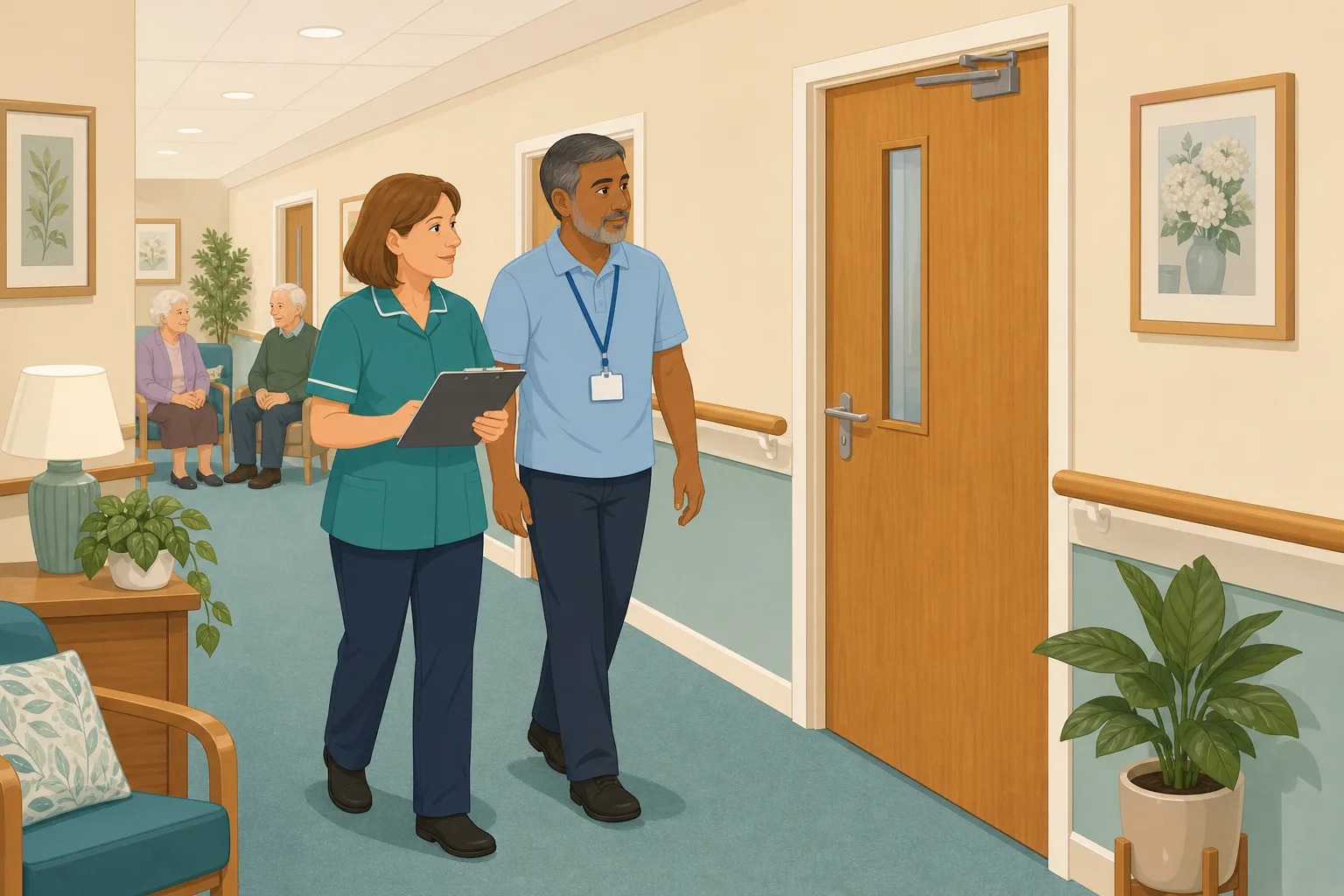
A fire marshal is someone your service names. It is not a badge a person earns. The Regulatory Reform (Fire Safety) Order 2005 never uses the words fire marshal or fire warden. It asks for competent people, named to run the evacuation.
That one fact settles most questions about fire marshal training. The Order fixes who nominates, what competence means and when training falls due. Your fire risk assessment fills in the rest.
Who nominates, and who carries the duty
The duty sits with the responsible person. In a workplace that is the employer, where the workplace is under their control. In a registered care service that is normally the provider, with the registered manager doing the work day to day.
Two articles create the nomination. Article 15 covers getting people out. It asks for a sufficient number of competent people to carry out the procedures. Article 13 covers firefighting, and asks for enough trained people with the right kit.
Sufficient is judged against your building and the people in it. A service where most residents need help to move is not covered by one marshal on a day shift. Nights are where this is usually thin.
Every audit in the library is free to run, with scoring, actions and a report. No card needed.
Create a free accountWhat competent means here
Competence is defined inside the Order, which saves an argument. A person counts as competent where they have enough training and experience, or knowledge and other qualities, to run the evacuation properly. That is the whole test.
Notice what is missing from it:
- no certificate is named
- no awarding body is named
- no renewal period is named
You decide who meets the test. You write down why. Then you stand behind it, which is why the walk round below matters more than a wall certificate.
That freedom cuts both ways. If a marshal cannot say where the panel is or how to sweep a corridor, the nomination fails on its own terms.
When fire marshal training falls due
Article 21 sets the timing. Staff get adequate safety training when they are first employed, and again when a change at work exposes them to a new or increased risk. A new wing, a new alarm panel or a change of role all qualify.
Two further lines in the same article matter. Training is repeated periodically where appropriate, so the interval comes from your risk assessment rather than from a number someone quoted you. And it takes place during working hours.
Read the full text of article 21 on fire safety training before you buy anything. It is shorter than most course brochures.
What the training has to contain
The Order is specific on content. Training must cover the precautions and the actions a person should take. It has to protect them and everyone else on the premises.
It must also suit the risks your own assessment identified. That rules out a generic session that never mentions your layout, your evacuation strategy or the people who cannot use stairs.
For residential services, the Home Office guide on fire safety risk assessment in residential care premises is the document to build the content from.
Figure: most marshal findings are this ordinary, and clearing them is the job.
The daily walk round, and what it covers
A fire marshal checklist is a short walk round that confirms the basics are right today. The free CareStream version runs to 15 checks in one section, scored, with a space for findings.
It covers the panel showing normal, exits and routes clear of obstruction, and self closing doors that close fully without a shove. Extinguishers sealed and visible. Call points intact, exit signs undamaged, emergency lighting working.
Then come the details that catch real services out:
- the kitchen fire blanket
- fluff in the tumble dryer
- anything combustible near a heat source, inside and out
- trip hazards along the escape route
- the visitors logbook, because the list at the assembly point has to be right
None of those needs a qualification to spot. They need someone named, on shift, who walks the same route every day and writes down what they found.
Where a fire warden checklist differs
It does not. A fire warden checklist covers the same ground, because the law behind both is the same and neither word appears in it.
Pick an audit, assign it, score it on a phone and close the actions. Create a free account to start.
Create a free accountWhat matters is picking one term and using it everywhere: in the fire safety arrangements, on the rota, and in the training record. Inspectors follow the thread you give them. Two words for one role makes the thread harder to follow.
Article 11 asks for written arrangements. They cover planning, organisation, control, monitoring and review. The name you use for the role belongs in that record, beside who holds it.
Drills, and the record that proves one happened
Article 15 asks for procedures to be established and given effect, including safety drills. A drill nobody wrote up is hard to evidence later.
A fire drill record form answers that. The free one runs to 7 checks, set to quarterly. It records the panel, the simulated call, the meeting point and how the drill went. You then write up staff response, communication and the actions needed.
Decide who holds the pen before the alarm sounds. The marshal is usually too busy counting people to write anything useful, so a second person takes the notes and the two compare them afterwards.

Figure: the debrief at the assembly point is where the useful findings come from, so capture it before people go back inside.
What a care inspector adds to the fire officer's view
The fire and rescue service enforces the Order. The Care Quality Commission comes at the same building from a different angle.
Regulation 15 of the Health and Social Care Act 2008 (Regulated Activities) Regulations 2014 covers premises and equipment. They must be suitable. They must be properly used and kept in repair. A signed daily check and a written drill answer that.
Where the Single Assessment Framework asks how you know people are safe, a run of daily records beats a policy on its own. Our fire safety policies for care services cover the written side.
Benefits of CareStream for fire marshal training records
The training and the record sit in one place on a free account.
In CareStream the fire marshal checklist is free to run on every plan, as is the drill record form. Each check is scored, and every gap becomes an action with an owner and a due date. Photos and signatures attach to the run.
One CPD certified course supports the role without pretending to replace it. General Health and Safety Awareness, free in English on every plan, covers everyday fire safety and reporting hazards. Your marshal still needs a practical briefing on your own building.
The audit library holds 30 templates in all. So the fire checks sit beside the rest of your round, not in a folder of their own.
Start with the free fire marshal checklist audit and read the checks before you sign up.
What to do if you have never named a marshal
Four steps, in order.
- Name the marshals shift by shift, nights included, and write the names into your fire safety arrangements.
- Walk the building with each of them once, using the daily checklist as the route.
- Book the first drill, and decide who writes it up before anyone goes back inside.
- Put the periodic refresher interval in your fire risk assessment, with the reason beside it.
Then run the daily check for a fortnight and look at what keeps coming back. Repeat findings tell you where the training has to go next, and the free fire drill record form gives the quarterly record a home.
Sources
- Article 3, meaning of responsible person, Regulatory Reform (Fire Safety) Order 2005 · legislation.gov.uk
- Article 9, risk assessment, Regulatory Reform (Fire Safety) Order 2005 · legislation.gov.uk
- Article 11, fire safety arrangements, Regulatory Reform (Fire Safety) Order 2005 · legislation.gov.uk
- Article 13, firefighting and fire detection, Regulatory Reform (Fire Safety) Order 2005 · legislation.gov.uk
- Article 15, procedures for serious and imminent danger, Regulatory Reform (Fire Safety) Order 2005 · legislation.gov.uk
- Article 21, training, Regulatory Reform (Fire Safety) Order 2005 · legislation.gov.uk
- Fire safety risk assessment: residential care premises (Home Office) · gov.uk
- Regulation 15, premises and equipment, Health and Social Care Act 2008 (Regulated Activities) Regulations 2014 · legislation.gov.uk
Frequently asked