Show me how you know the care here is good. That question names no form, and that is the point. A care home quality audit is not one document. It is a short set of checks, and each one answers a different question.
Below is the set, the question each check answers, and what the record has to show at the end.
The duty that sits under all of it
The law asks for systems, not forms. Systems must be run to assess, monitor and improve the quality and safety of the service, under Regulation 17 on good governance.
Two other parts of the same regulation matter here. You must seek and act on feedback from people who use the service. You must keep accurate records of care and of the way the service is run.
Nothing in it names an audit or sets a frequency. That is why two good services can audit quite differently and both be right.
Every audit in the library is free to run, with scoring, actions and a report. No card needed.
Create a free accountOne duty does carry a clock. When the Commission asks for a written report on how you assess and monitor quality and safety, it has to arrive within 28 days.
Six checks, and the question each one answers
A quality audit template is only as good as the question behind it. These are the six questions worth having a check for.
What do people and their families actually say?
This is the one most services do last and need first. Gather what people tell you, then sort it so patterns show.
CareStream has a free quality assurance audit for this. It turns questionnaire answers from residents and families into a red, amber and green summary. That summary is mapped to the five key questions.
Feedback that sits in a drawer is not evidence of anything. Feedback that is grouped, dated and acted on is.
A resident feedback round each month keeps the picture fresh between the longer surveys.
What did the month add up to?
A governance review pulls the month into one place. It is the check that spots the link between three small things.
- Incidents, safeguarding and the notifications that followed.
- Complaints and feedback, and what came of them.
- Open actions, staffing and training.
- The records a regulator can ask to see.
Run it monthly. A quarterly version misses the pattern while it is still small.
Is the care record still true?
Care plans and risk assessments drift quietly. A monthly review asks whether the plan still matches the person, whether capacity and consent are recorded, and whether the family had a say.
This is the check inspectors test by talking to a resident and then reading the file.
Did we answer the complaint, and did we learn?
Complaints are a quality signal before they are a problem. A quarterly check through the log asks whether each one was recorded, answered in time and used to change something.
Look at the small ones as well. A service that only reviews formal complaints will miss the worry a relative mentioned at the door and never repeated.
Is practice safe today?
Medicines, infection control and the kitchen are task checks, and they are short for a reason. They tell you about today, not about the year.
Keep them brief and frequent. A daily medicines check that takes five minutes gets done, and the one that takes an hour quietly stops happening.

Figure: a daily or weekly check looks at practice in the room, which is why the findings are small and the fixes are quick.
Are the findings closing?
The last question is about the others. Across consecutive audits, which items fail again? A repeat failure is a governance finding, not a cleaning finding.
What the record has to show
Most audits in care homes are run well and recorded thinly. The record is the part an inspector can read without you.
A complete one holds six things:
- The finding for each section, with the date it was made.
- The evidence behind the finding, which can include a photo.
- An action for every gap, written as a task rather than a hope.
- A name and a due date beside each action.
- What was done, and by whom.
- The re-check at the next audit that proves the fix held.
Signatures matter too. Who ran it, who approved it, and when.
Pick an audit, assign it, score it on a phone and close the actions. Create a free account to start.
Create a free account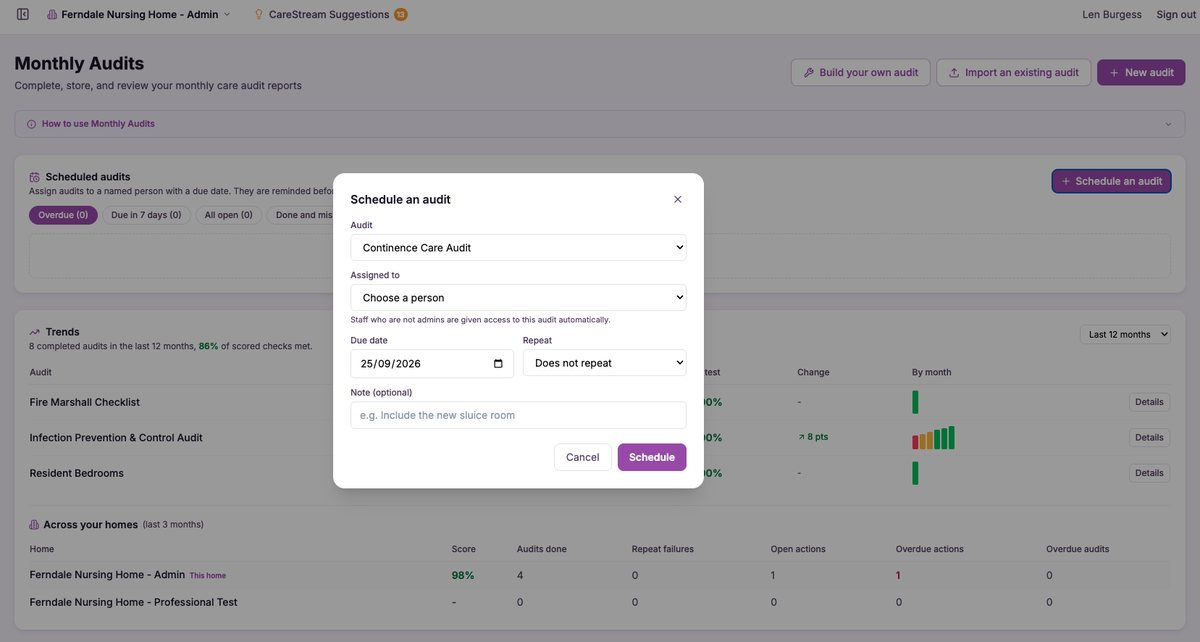
Figure: scheduling an audit to a named person with a due date, with trends for completed audits listed below.
Call them care home compliance audits if the word helps, but keep the test simple. Could someone else pick up this record and see what changed?
Where the quality statements fit
The Single Assessment Framework asks the same thing in its own words. Under well-led, a service needs effective governance and management systems. It should use what it learns about risk and performance to make care better.
The governance quality statement goes further. It wants clear roles, and it wants to know who answers for what. It also wants you to use what you learn to improve care.
Read the governance, management and sustainability quality statement in full.
New providers meet this at the registration stage. An application has to say how you will assess, monitor and improve quality.
It must also give details of your audits in the governance and quality assurance policies.
Start the habit on day one and you never have to build it later. A set of checks you can name is worth more than a folder you have to explain.
Three ways the cycle goes wrong
The first is volume. A service adds a check after every incident. Within a year nobody finishes any of them properly, and the pile itself becomes the risk.
The second is ownership. Findings are recorded, actions are written, and no name sits beside them. An action owned by everyone is owned by nobody, and it will still be open at the next run. Our post on building a care home audit schedule covers how to spread the load across the month.
The third is silence. The audit never reaches the people whose practice it describes. The same gap then returns next quarter wearing a different name.
There is a fourth, quieter fault. A service runs the checks, finds almost nothing, and files a run of green scores. A check that never fails is usually asking the wrong question.
Benefits of CareStream for a care home quality audit
Every CareStream audit is free to run, with 30 templates that cover the checks above. A finished audit becomes a report. It holds section scores, the answers, photos, signatures and an action plan.
Actions carry an owner, a priority and a due date, and the next run of the same audit shows last time's actions for re-checking. Trends show the score by month and the items that failed again.
Audits are scheduled to a named person with a due date, with reminders before and after it passes. Drafted recommendations at the end of an audit are a paid plan feature. The free care audit library is the place to start, including the free quality assurance audit and the monthly governance review.
Where to start if the set feels thin
Pick the question you cannot answer today. For most services that is the first one, what people and families say.
Run that check within the month. Write the actions with names against them, and put the re-check in the diary before you close the file. Good care home auditing is a habit, built one question at a time.
Sources
- Health and Social Care Act 2008 (Regulated Activities) Regulations 2014, regulation 17: good governance · legislation.gov.uk
- Care Quality Commission: governance, management and sustainability quality statement · cqc.org.uk
- Care Quality Commission: governance and quality assurance policies for registration · cqc.org.uk
- Care Quality Commission: well-led assessment framework · cqc.org.uk
Frequently asked