When the CQC inspects your service, equality and diversity is not a box-ticking exercise. Inspectors look for evidence that your workforce, and the people you care for, have genuinely equitable access to information, support and guidance. A signed equality policy sitting in a folder is necessary, but on its own, it is not enough.
This guide explains where equality and diversity sit within the CQC framework, the gap most care organisations quietly carry, and how to close it and prove you have closed it. It also shows how CareStream helps care homes, nursing homes, home care agencies (and everything in between that is regulated by the CQC) and every other kind of care service turn equitable access from a stated intention into evidence you can show on the day.
What does the CQC stand for, and where does diversity fit?
CQC is the independent regulator of health and adult social care in England, and it monitors, inspects and rates services so the public can make informed choices.
Every assessment is organised around five key questions: Safe, Effective, Caring, Responsive, and Well-led. Equality and diversity are not a separate sixth question. Instead, it runs through the whole framework, and it shows up most clearly under two of those questions:
- Responsive. Is care shaped around each person's individual needs, preferences, culture and background, and is information accessible to everyone who needs it?
- Well led. Does the leadership, culture and governance of the service actively promote equality, inclusion and fair treatment for both the people you support and the people who work for you?
So when an inspector explores equality and diversity, they are really asking whether your stated values change what actually happens day to day, for staff and residents alike.
What the CQC actually wants to see
Under the Responsive and Well-led key questions, the CQC expects an organisation to demonstrate practical things, not just paperwork. In particular:
- That staff with different first languages can access the information they need to do their job safely.
- That your communication approach genuinely reflects the diversity of your workforce and the people you support.
- That equality is embedded in everyday practice, and is not simply documented in a policy that nobody reads.
The Equality Act 2010 and the CQC's own approach to equality and human rights make the same point. Having a policy in place is not, by itself, evidence of compliance. What matters is whether that policy changes behaviour. The question an inspector is trying to answer is simple. Does this service treat people fairly in practice, and can it prove it?
The gap most care organisations carry
The UK care sector employs a wonderfully diverse workforce, and in recent years, it has become more international than ever. According to Skills for Care, around 105,000 international recruits started direct care roles in England's independent sector in 2023/24, and roughly 185,000 joined over the two years to March 2024. In many homes, a significant proportion of staff have English as a second language.
Yet policies, procedures and compliance documents are almost always written in formal, legal English. This creates a structural inequality. Staff who are confident in written English can navigate the policy library far more easily than colleagues who are not. In a setting where getting the procedure right matters for someone's safety, that gap has real consequences. A medicines policy or a safeguarding procedure is only useful if the person reading it under pressure actually understands it.
This is exactly the inequality the CQC is probing when it asks how you ensure fair access for everyone. It is also the gap CareStream was built to close.
Where equality and diversity show up in the evidence
A defining feature of the CQC framework is that it draws on six evidence categories rather than relying only on what an inspector sees on the day. They are people's experience, feedback from staff and leaders, feedback from partners, observation, your processes, and outcomes.
Equality and diversity thread through several of these. Feedback from staff tells inspectors whether your team feels supported and fairly treated. Your processes show whether information is genuinely accessible. Outcomes reveal whether your inclusion efforts actually make a difference. The organisations that score well are the ones that can produce real evidence across these categories, not just assert good intentions.
How to close the gap, and how to evidence it
There are practical steps any care organisation can take, and the most credible ones produce evidence automatically.
Make policy access multilingual. If your staff speak Polish, Romanian, Tagalog, Portuguese, Yoruba or a French or English-based Creole, your policy guidance should be accessible in those languages. CareStream lets a staff member ask a question in their own language. The platform detects the language automatically, finds the relevant policy, and answers in that same language, while still pointing back to the underlying source document. The right procedure stops being locked behind formal English, which removes a genuine barrier to compliance under Safe, Effective, Caring and Responsive.
Log who is accessing what. Inspectors want evidence that policies are actually being used, not just stored. An audit trail showing which staff accessed which documents, including a breakdown by language, is direct and credible evidence. CareStream captures this as a matter of course.
Report the data. Language analytics, showing the range of languages your team uses to access your policies, is powerful evidence of equality. It demonstrates, in numbers, that your organisation provides equitable access rather than simply claiming to.
What this looks like in a CQC conversation
Picture the moment an inspector asks, "How do you ensure staff from different backgrounds have equal access to your policies?"
The weakest answer is, "We have a diversity policy." The strongest answer is, "In the last three months, our staff accessed our policies in eleven languages. Here is the breakdown, and here is the trail showing who read what."
That second answer is the difference between asserting equality and proving it. The good news is that this kind of evidence does not require anyone to assemble it by hand the week before an inspection.
With the right system in place, it is generated continuously and is ready whenever it is needed, and that system is called CareStreamAI.
How CareStream helps every care service get ready
CareStream is a platform built for UK care providers that turns your library of policies and procedures into an always available, intelligent assistant. Each provider's content, staff and data are kept fully separate, and group operators can run several homes under a single account. Instead of staff hunting through binders, shared drives or out-of-date handbooks, the right answer is one question away, by web chat (our hub) or by email, and every answer is traceable back to your own source document.
Here is how that maps to getting ready on equality and diversity, and on the wider framework.
Talking to your policies in any language is the heart of the platform, and it is the single most powerful equality feature a care service can offer its team. It directly answers the CQC's question about equitable access, and it produces the language analytics that prove it.
CQC staff questions let managers build and deliver a bank of inspection-style questions to the team, sent through each person's preferred channel, with tracking of who has responded and how well. You learn where your people are confident and where they need a refresher, across your whole diverse workforce, before an inspector ever arrives.
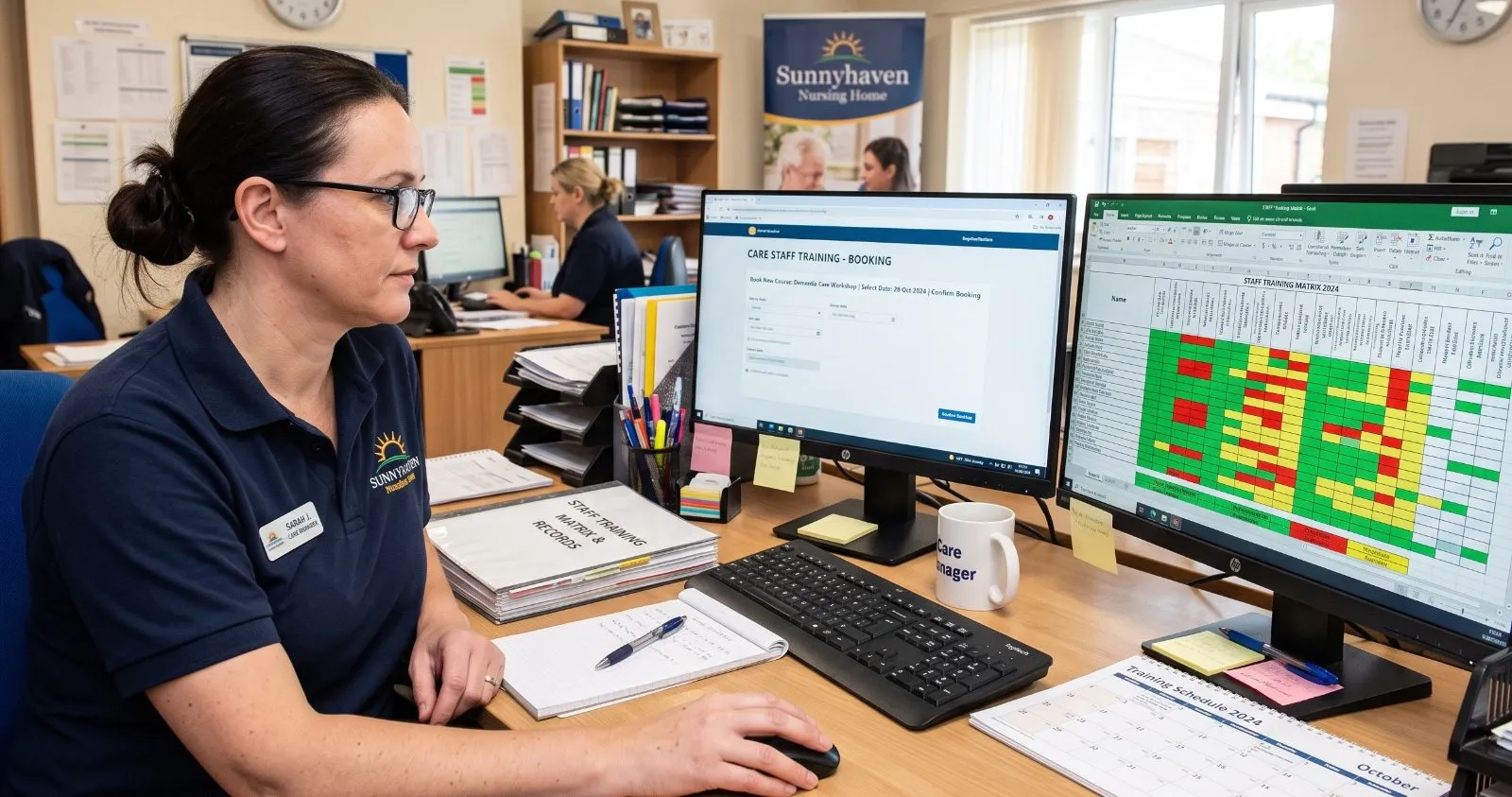
Training lets managers create and assign learning modules drawn from their own policies, auto-generate questions and answers, lock approved versions, and watch a live compliance grid showing exactly who has completed what, with automated delivery rules built in. That is clear evidence for Effective and well-led, and it ensures learning reaches everyone equally.
New staff onboarding brings this together into structured flows for each role, so a new starter works through the policies they need to read and the questions they need to answer from day one. The result is a clear, auditable record that every person was properly inducted, whatever their background or first language.
Audits provide templated, repeatable checks that teams can run against their policies and practices, capturing evidence and surfacing issues early rather than at inspection.
The CQC Report and gap analysis pull all of this together. By looking at the questions staff actually ask, including the ones the policy library could not answer, the regulations your policies do and do not cover, training compliance and audit results, CareStream produces a coverage score and a readiness picture mapped to the CQC framework. Your service is not just about storing policies. It is continuously demonstrating that those policies are understood, trained, followed and evidenced, for every member of a diverse team.
This applies just as much to nursing homes, home care and domiciliary agencies, supported living, learning disability and autism services, hospices and other care settings as it does to residential care homes. Wherever you have a diverse workforce and a duty to give everyone fair access to the information they need, the same approach works.
Common questions about the CQC and equality
What does CQC stand for?
CQC stands for the Care Quality Commission, the independent regulator of health and adult social care in England. It registers providers, inspects services against five key questions, awards ratings from Outstanding to Inadequate, and can take enforcement action where standards are not met.
What are the five questions the CQC asks?
They are Safe, Effective, Caring, responsive, and well-led. Equality and diversity are not separate questions. It runs through all five and is assessed most directly under Responsive and Well-led.
What are the six evidence categories for the CQC?
They are people's experience, feedback from staff and leaders, feedback from partners, observation, processes, and outcomes. Equality and diversity evidence can be drawn from several of these, particularly staff feedback, processes and outcomes.
Is having an equality policy enough for the CQC?
No. A policy is necessary but not sufficient. The CQC and the Equality Act 2010 both focus on whether a policy changes real behaviour. Inspectors look for practical evidence of equitable access and fair treatment, such as data showing staff can use your policies in their own language.
How do you evidence equitable access for a multilingual workforce?
Make your policy guidance accessible in the languages your staff actually speak, log who accesses which documents, and report the range of languages used. Numbers showing that your team accessed policies in multiple languages over a given period are far more persuasive to an inspector than a statement of intent.
The bottom line
For the CQC, equality and diversity are about practice, not paperwork. The services in the strongest position are the ones that can show, with real data, that every member of a diverse team can find, understand and follow the right policy when it matters. CareStream exists to make that the everyday reality, and to turn it into evidence that is ready whenever an inspector asks.
Book a demo or start your free trial today.
Sources
- Equality Act 2010 · legislation.gov.uk
- CQC: Quality statements · cqc.org.uk
- CQC: Fundamental standards · cqc.org.uk
Frequently asked
What does the CQC look for on equality and diversity?
Where does equality and diversity sit in the CQC framework?
Is having an equality policy enough to satisfy the CQC?
How do you evidence equitable access for a multilingual care team?
Why is a diverse care workforce a compliance issue?
Written by
 Len BurgessSenior Care Advisor
Len Burgess has worked in the care sector for over 8 years, with hands-on experience across residential, nursing and community settings. Having supported teams through CQC inspections and the day-to-day reality of keeping a service compliant, he writes about regulation, quality and best practice in a way that's grounded in what actually happens on the floor, not just what the guidance says.