
Training collection
Restraint Training for Care Staff: What the Law Allows
Restraint training has to settle one question first: what counts as restraint. The legal answer is wider than most teams expect. It reaches a hand on an arm and a chair across a doorway.
Restraint training here starts from that definition and works backwards. It heads for the moments where a situation could still have gone another way.
Six courses sit behind this page, and between them they cover how distress builds and how staff talk a situation down before it turns. They cover where restrictive practice has to be recorded. They also cover how the law judges a decision made for a person who cannot make it alone.
None of them teaches holds. That belongs in a room with an instructor, and we say so plainly below. What you get instead is the knowledge half, done on a phone between shifts. Every person who passes gets a named certificate, and the record sits where a manager can find it at short notice.

This training helps you understand dementia and how to provide person centred care to residents living with dementia at our home. You will learn to recognise signs of dementia, support residents with dignity and respect, and follow our policies to meet their individual needs.

This annual refresher covers essential dementia care principles for staff working in our nursing home. You will learn how to support people living with dementia through person centred approaches, meaningful activities, and safe, dignified care that respects individual preferences and maintains wellbeing.
This training helps you understand and respond safely to challenging behaviour in our home. You will learn how to recognise triggers, use de-escalation techniques, and follow our policies to protect residents and staff. Managing behaviour well keeps everyone safe and maintains dignity.

This module teaches you how to support residents who display behaviours that challenge, using positive approaches to prevent distress and de-escalate situations safely. You will learn how to recognise triggers, respond calmly, and follow your organisation's policies on managing antisocial behaviour while protecting everyone's dignity and safety.

This module helps you provide person centred dementia care that respects and celebrates each person's cultural background, beliefs and traditions. You will learn how cultural identity remains important throughout dementia, and how to use our policies on activities and outings to support cultural and spiritual needs in meaningful ways.

This training covers how we assess mental capacity, make decisions in someone's best interests when they cannot decide for themselves, and protect the rights of people who may be deprived of their liberty. Understanding these legal duties protects residents and ensures we provide lawful, person centred care.
What your team does instead, and what the law permits
Restraint is rarely a decision. It is usually the end of a chain that began hours earlier, with pain nobody noticed or a routine that changed. Much of the training below is about reading that chain early enough to step in.
What counts as restraint under the Mental Capacity Act 2005
The law sets a narrow gate. Section 6 of the Mental Capacity Act places two limits on restraint.
A member of staff restrains a person in one of two ways. One is to use or threaten force to make them do something they resist. The other is to restrict their freedom to move, whether they resist or not. Both count.
Both conditions then have to be met. The staff member must reasonably believe the act is needed to stop harm to that person. It must also be in proportion to how likely the harm is, and how bad it would be. Both tests, every time.
A principle sits under all of it. Before you act, you must ask whether a less restrictive route would work as well. That is written into the principles that open the Mental Capacity Act.
De-escalation, and the lesson that names restrictive practice
Most of the work happens long before any of that. The positive behaviour support and de-escalation course for care staff is the longest here, at about 48 minutes.
It runs to 8 lessons.
- Behaviour as communication, and the early warning signs and triggers behind it.
- Positive behaviour support principles, and de-escalation techniques that work.
- What to do when behaviour becomes antisocial, and how to report it safely.
- Restrictive practice and the least restrictive approach.
- The debrief afterwards, and what goes into a behaviour support plan.
Then comes a 30 question assessment. This course asks for more than knowledge. A manager or assessor watches the learner at work and signs off competence, using a printable observation checklist.
That puts it closer to restrictive practice training than to an awareness module. Somebody has to put their name to what they saw. That matters.
Where restraint becomes a deprivation of liberty
A short restraint and a deprivation of liberty are not the same thing. One is an act. The other is a whole situation: constant supervision and control, and not being free to leave.
The regulator treats both seriously. Its guidance on safeguarding people from improper treatment names unlawful restraint as improper treatment.
That covers a deprivation of liberty which should never have happened. Providers are told to take a zero tolerance approach to it.
The capacity course here covers the five principles and the two stage test. It then covers best interests decisions and how the safeguards process runs. Our guide to the deprivation of liberty safeguards in a care home goes further.
This area of law has been under review for years, so we have kept to what is in force and left the rest out.
The six courses, and what is included in the price
Five courses check knowledge. One checks knowledge and then asks you to watch the person work. All six are bought the same way, one licence at a time, with no plan to join and no minimum order.
What one licence covers, and what it costs
A CareStream licence is £25.99 plus VAT for one member of staff, paid once. It lasts twelve months. Nothing renews.
Each licence gives that person the full course and a follow up lesson on anything they get wrong. A named, dated certificate arrives the moment they pass. It shows their score and when it is due again, and downloads as a PDF.
Lessons and questions are available in over sixty languages, switched one tap at a time. Records and certificates stay in English for your evidence file. No extra charge.
The price a licence falls as you add more. Any licence nobody has started can be refunded in full within fourteen days.
What this collection does not teach
Physical intervention training is a different purchase. Holds, breakaway and any hands on technique have to be taught in a room. They have to be practised, and assessed by an instructor watching the learner do it.
Nothing online can sign that off, and we will not pretend otherwise, so if your service genuinely needs it, book it and keep the paperwork. Then record the session beside these certificates so the two halves sit in one place.
The face to face training matrix that records attendance and renewal dates is built for exactly that.
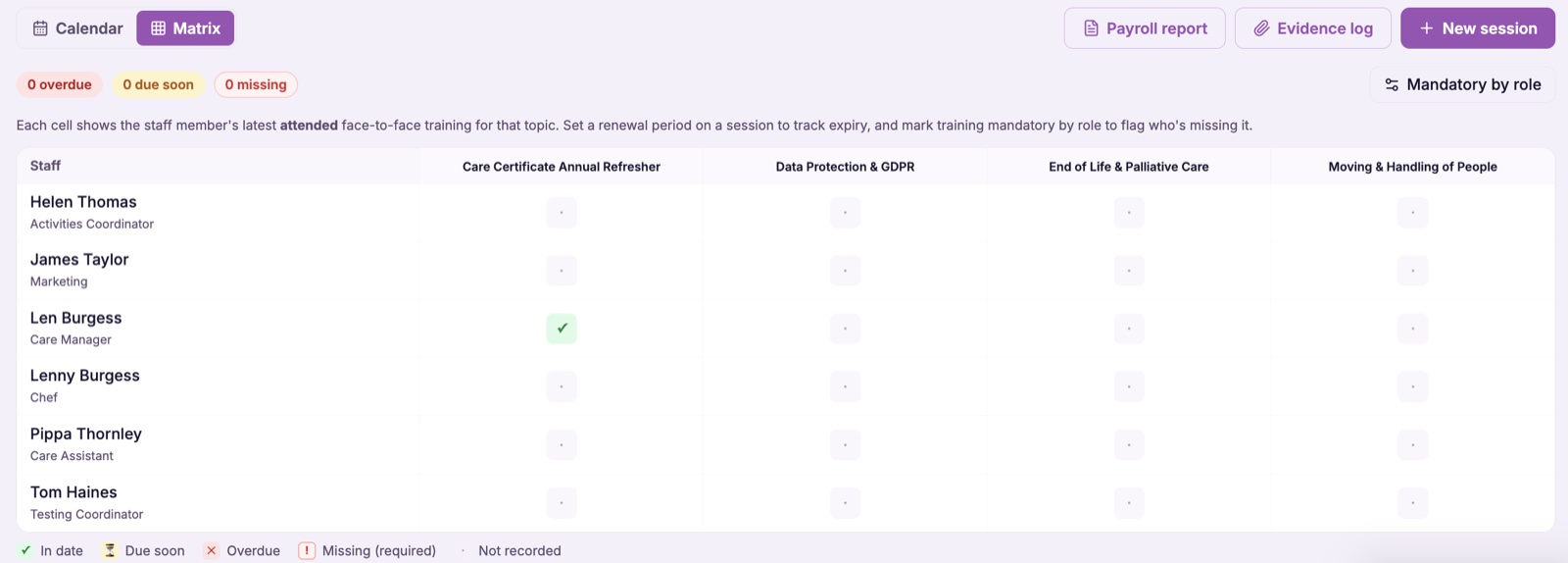
Figure: the face to face matrix, where an attended session is marked against each person and a renewal period is set on the session.
Who this collection is perfect for
It suits a registered manager or training lead in a care home or a dementia unit. It suits a supported living service or a home care agency just as well. Anywhere, in short, where distress is part of the work and the team has to answer for the way it responded.
Three moments send managers looking.
- A restraint has happened, and the debrief exposed a gap in what staff knew.
- An inspection is coming, and the training record is thin on behaviour.
- A person has moved in whose needs the team has not supported before.
It suits teams who read in more than one language, because the lessons switch without a second purchase. It does not suit a service that needs certificated holds, because that has to be booked with an instructor who can watch and sign.
Why CareStream fits a small service better than the usual options
The usual routes are a classroom day bought per head, a yearly library subscription, or a free slide pack with no assessment. Each has a real strength.
Classroom teaching gives practice, a subscription gives breadth, and a slide pack costs nothing at all.
What a small service often wants is narrower. One subject, a price it can see before buying, and a record that outlasts the person who bought it.
So the price a licence is published, you pay once, and the certificate belongs to the member of staff. We do not promise an inspection outcome, and no course can give one.
Benefits of CareStream for restraint training that stands up on paper
- Six courses on distress, de-escalation, restrictive practice and the law, bought one licence at a time.
- A named, dated certificate for each person, with the score and the renewal date on it.
- A follow up lesson on every wrong answer, so a weak point is closed rather than logged.
- Lessons in over sixty languages, with the records kept in English for your file.
- A plain line about what still has to be taught in a room, and somewhere to record it.
You can compare the six courses in our mental capacity and dementia training collection before you decide which your team needs first.
Restraint Training for Care Staff: What the Law Allows FAQs
What is restraint training?
It is training that teaches staff what counts as restraint in law, what has to be true before anyone restrains a person, and what to do instead. Our six courses cover distress and its triggers, de-escalation, restrictive practice, the least restrictive approach, and the rules on capacity and deprivation of liberty. They do not teach physical holds.
What counts as restraint?
Under section 6 of the Mental Capacity Act 2005, a person restrains someone if they use or threaten force to make them do something they are resisting, or if they restrict their liberty of movement, whether or not the person resists. That is wider than most staff expect. A chair across a doorway and a lap belt both count.
Is restraint ever lawful in a care home?
It can be, within limits. Where the person lacks capacity for the decision, the Act allows restraint only if the member of staff reasonably believes it is necessary to prevent harm to that person, and the act is a proportionate response to how likely that harm is and how serious it would be.
Do my staff legally have to do restraint training?
No single rule names a restraint course. The staffing regulation requires that people employed in a regulated activity receive the support, training, professional development, supervision and appraisal they need to do their job. Where your service supports people whose distress leads to restrictive practice, that duty points plainly at this subject.
Does this collection teach physical holds?
No. Holds, breakaway and any hands on technique must be taught and assessed in a room by a qualified instructor who watches the learner do it. No online course can sign that off, and we do not claim to. Buy that separately and record the session alongside these certificates.
Which six courses are in this collection?
Dementia Awareness, Dementia Care, Challenging Behaviour Management, Positive Behaviour Support and De-escalation, Cultural Diversity in Dementia Care, and Mental Capacity Act and DoLS. Five are knowledge courses. The behaviour support course also asks a manager to sign off competence at work.
How long does each course take?
Most are about 35 minutes: 6 short lessons, each with a care scenario and a quick check, then a 20 question assessment. The behaviour support course is longer at about 48 minutes, with 8 lessons and 30 questions.
What does a licence cost?
£25.99 plus VAT for one member of staff, paid once. The price a licence falls as you add more, and the reduction is applied in your basket. There is no subscription and nothing renews on its own.
What happens if someone fails the assessment?
The pass mark is 80 per cent. A wrong answer triggers a follow up lesson on that point, so the gap is closed rather than just scored. The learner can stop and pick up where they left off on a phone, tablet or computer.
What evidence do I get for an inspection?
A named, dated certificate for each person showing the course, their score and when it renews, downloadable as a PDF, plus a training record showing who has started and who has finished. An inspector reads records, not promises, and no training makes a service compliant.
Can staff take these courses in another language?
Yes. Lessons and questions can be switched into over sixty languages, one tap at a time, so a member of staff understands the material rather than guessing at it. The records and certificates stay in English, ready for your evidence file.
How often should staff redo this training?
Each licence lasts twelve months, and most services refresh this subject every year. Services also repeat it after a serious incident, when a behaviour support plan changes, or when a person moves in whose distress the team has not supported before.
Is this the same as mental capacity training?
They overlap. The capacity and deprivation of liberty course in this collection is the same one that sits in our mental capacity collection. This page groups it with the behaviour and dementia courses, because restraint is usually the end of a chain that starts with distress nobody read in time.
Do I need a card to try it?
No. You can open a real lesson and question from a course on its own page and switch it into another language, with nothing to sign up for. A free account also gives every member of staff the CPD certified courses, the training matrix and the audit templates.
Can I get a refund if I buy too many licences?
Yes. Any licence that has not been started can be refunded in full within fourteen days. Email us from the address you ordered with and the money goes back to the card you paid with. You do not need to give a reason.
More on training
Guides and collections that go with this page, and the full libraries.
Policies are one part of it.
CareStream is the compliance system underneath: your policies, your staff training, your audits and your evidence, kept current and ready for the day somebody asks to see them.
- Policies written and kept updated for you
- Staff training that records itself against the standard
- Gap analysis showing what you are missing before an inspector does
- Everything in one place, for one price




