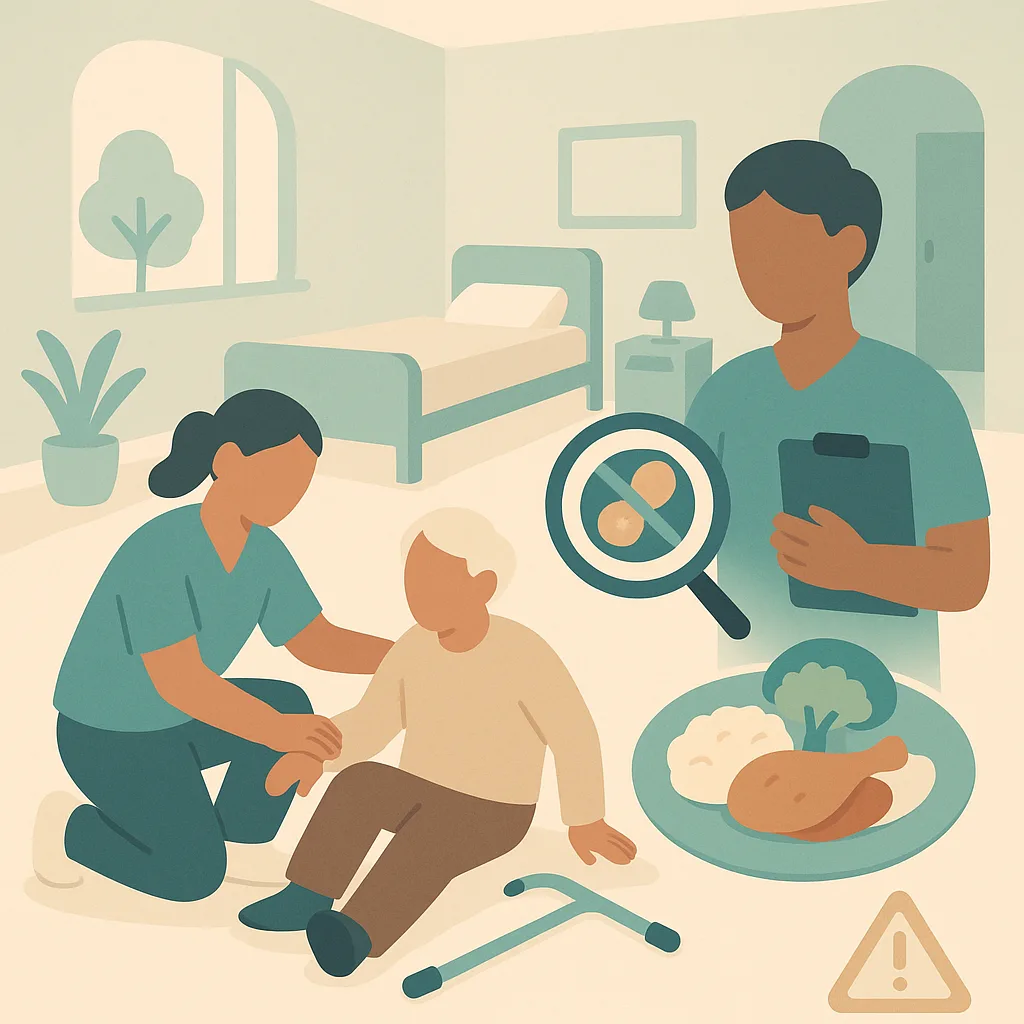
A health and safety awareness course for care staff teaches everyone in your service how to spot hazards, follow risk assessments, work safely alone, respond to accidents and report what happens, so that the people you support, your team and visitors all stay safe. Generic workplace courses are built around offices, factories or building sites. Care is different: your staff work in people's homes and bedrooms, with hot water, medicines, equipment and people whose needs change day to day. The best training reflects that reality and is refreshed every year.
This guide sets out what health and safety awareness training should cover in adult social care, the law behind it, what the CQC expects and how often your staff need it.
Why do care staff need a care-specific health and safety awareness course?
Health and safety in a care home or in home care is not mostly about hard hats and scaffolding. The risks your staff face, and the risks they manage for others, look like this:
Slips and trips on wet floors, trailing wires and cluttered rooms in someone's home.
Scalding from hot water outlets and baths, and burns from hot surfaces such as radiators.
Falls from windows without suitable restrictors, and entrapment risks from bed rails.
Cleaning chemicals and other hazardous substances.
Lone working, travelling between calls and visiting homes at night.
Violence and aggression, including from people in distress.
Work-related stress, fatigue and the strain of long shifts.
The Health and Safety Executive (HSE) publishes guidance specifically for health and social care because these hazards are so particular to the sector. A course built on that guidance gives your staff examples they recognise from their own shifts, which is what makes the learning stick.
What does the law say about health and safety in care?
The Health and Safety at Work etc. Act 1974 is the foundation. It places a duty on every employer to ensure, so far as is reasonably practicable, the health, safety and welfare of employees, and to protect others affected by their work, which in care includes the people you support and their visitors. Employers must provide the information, instruction, training and supervision needed to achieve that.
The Act also places duties on employees. Your staff must take reasonable care of their own health and safety and that of others, and co-operate with you on safety matters. That shared responsibility is one of the first things a health and safety awareness course should make clear: safety is not something the manager does on everyone else's behalf.
Other regulations build on the Act, including:
The Management of Health and Safety at Work Regulations 1999, which require suitable and sufficient risk assessments.
The Control of Substances Hazardous to Health Regulations 2002 (COSHH).
The Manual Handling Operations Regulations 1992.
The Health and Safety (First-Aid) Regulations 1981.
The Reporting of Injuries, Diseases and Dangerous Occurrences Regulations 2013 (RIDDOR).
For registered providers, the Health and Social Care Act 2008 (Regulated Activities) Regulations 2014 add Regulation 12, safe care and treatment, and Regulation 15, premises and equipment. Broadly, the CQC leads on the safety of people using your service, while the HSE or local authority deals with the safety of your workers.
What should health and safety awareness training cover?
Health and safety awareness training for care should build practical judgement. These are the areas that matter most.
CareStream turns your policies into role-based training with tracking and certificates. See the plans and get started.
See training plansUnderstanding and using risk assessments
Your staff do not usually write the formal risk assessments, but they live by them. They need to know where to find them, what the control measures mean and, crucially, when to say that something has changed. A new rug in a client's hallway, a person who has become unsteady, a hoist sling that looks worn: every one of these should prompt a worker to report and ask for a review. Training should also cover the quick, dynamic assessment staff make on arrival at each visit, deciding whether it is safe to carry on.
Hazardous substances
Even in a small service, staff use bleach, disinfectants, laundry products and sometimes clinical substances. They should know to read labels, follow the COSHH assessment, wear the right protective equipment, never mix products and store chemicals away from people who might drink or misuse them.
Security and lone working
Home care workers often spend most of their working day alone. HSE guidance on lone working expects employers to assess the risks and put arrangements in place, such as check-in procedures, safe parking and travel advice, and a clear way to raise the alarm. In care homes, security includes managing visitors, keeping doors and keypads secure and knowing what to do if someone unknown is on the premises.
Stress, violence and wellbeing
Work-related stress is a health and safety issue, not a personal failing, and HSE treats it that way. Training should help staff recognise the signs in themselves and colleagues, understand how to de-escalate a tense situation, and know that they must report incidents of verbal or physical aggression so they can be supported and the risk reviewed.
Accidents and sudden illness
Staff should know how to respond safely to a fall, a burn or someone becoming suddenly unwell: making the area safe, calling for help, contacting the emergency services when needed and not moving a person who may be injured unless they are in immediate danger. This awareness complements, rather than replaces, formal first aid training.
Why are recording and reporting so important?
An accident that is not recorded cannot be learned from. Every accident, incident and near miss should be written up promptly and accurately, so you can spot patterns, such as repeated falls at the same time of day or recurring problems with a particular piece of equipment.
Some events must also be reported outside your organisation. Certain work-related injuries, diseases and dangerous occurrences must be reported to the HSE under RIDDOR, and registered providers must send statutory notifications to the CQC about events such as serious injuries to the people they support. Your staff do not need to know every reporting threshold, but they do need to report to you quickly and completely so that you can decide what has to go where.
What does the CQC look for in health and safety?
Inspectors want to see that people are protected from avoidable harm and that your environment and equipment are safe. When they look at health and safety, they may check:
Whether risk assessments are current, personalised and followed by staff in practice.
How the service learns from accidents and incidents, and what changed as a result.
Whether premises checks, such as water temperatures and window restrictors, are carried out.
Whether staff can explain what they would do in an emergency or if they felt unsafe.
Whether training records under Regulation 18, staffing, show everyone is up to date.
Assign, track and evidence staff training in minutes. Explore the plans and roll it out this week.
See training plansClear, dated training records for every member of staff, including night, bank and agency workers where you are responsible for their training, are part of showing that your service is well led.
How often do care workers need health and safety awareness training?
The Skills for Care statutory and mandatory training guide lists health and safety awareness as a core topic for everyone in adult social care. It is part of the Care Certificate for new workers, and most providers then refresh it every year. Annual refreshers make sense in care because staff turnover, new equipment, new clients and changing guidance all shift the risks your team faces.
You should also arrange extra training when something changes significantly, such as moving into a new building, introducing new equipment or after a serious incident that shows a gap in knowledge.
Is a health and safety awareness course online suitable for care staff?
Yes, for the knowledge part. An online course lets staff on different shifts and in different locations train without waiting for a classroom date, and lets your night team learn at a time that suits them. The key is that it should be written for care, use realistic scenarios and include a proper assessment, so you know the learning has landed. Practical skills such as first aid or using specific equipment still need hands on training in addition.
The CareStream General Health & Safety Awareness CPD Certified course
Our General Health & Safety Awareness course is a CPD Certified Course, certified by The CPD Certification Service and worth 1 CPD hour. It is built on the Skills for Care statutory and mandatory training guide and HSE guidance for health and social care, for staff in care homes, home care, supported living and day services. Its eight lessons are:
CareStream is a registered CPD Provider (No. 50224). You can check our membership and see every CPD-certified course we offer on our page on The CPD Certification Service website.
Health and safety law and your responsibilities
Risk assessment
Common hazards in care settings
Hazardous substances
Security and lone working
Stress, violence and your wellbeing
Accidents and sudden illness
Recording and reporting
Lessons include care scenarios and interactive activities, and the course ends with a 32-question knowledge assessment with an 80% pass mark. It takes about an hour on any phone or computer, at the learner's own pace, and can be taken in over 60 languages. When a learner answers a question wrongly, a short follow-up lesson covers that point again.
Everyone who passes gets a named, dated certificate with the CPD mark, which evidences completion of CPD Certified training and a pass in our knowledge assessment. It is not a qualification and does not by itself prove competence in practice. Managers allocate licences and see who has finished, with their scores, on a single dashboard. The course is designed as an annual refresher, team prices start from 10 licences, and there is a 14-day refund on any licence not yet started.
Making health and safety part of every shift
Health and safety in care works best when every member of staff sees it as part of good care, not paperwork. A care-focused health and safety awareness course, refreshed every year and backed by clear risk assessments and an open reporting culture, helps your team notice hazards early, act sensibly when things go wrong and keep everyone in your service safe.
Sources
- HSE: health and social care services · hse.gov.uk
- HSE: managing risks and risk assessment at work · hse.gov.uk
- HSE: protecting lone workers · hse.gov.uk
- HSE: work related stress · hse.gov.uk
- HSE: RIDDOR reporting · hse.gov.uk
- legislation.gov.uk: Health and Safety at Work etc. Act 1974 · legislation.gov.uk
- CQC: Regulation 12, safe care and treatment · cqc.org.uk
- CQC: Regulation 15, premises and equipment · cqc.org.uk
- CQC: Regulation 18, staffing · cqc.org.uk
- Skills for Care: statutory and mandatory training guide · skillsforcare.org.uk
Frequently asked
Is health and safety awareness training mandatory in care?
The Health and Safety at Work etc. Act 1974 requires employers to provide the information, instruction and training staff need to work safely, and Regulation 18 requires care staff to be trained for their role. Skills for Care lists health and safety awareness as core training for everyone in adult social care.
How often should care staff do health and safety awareness training?
Most care providers refresh health and safety awareness training every year. You should also provide extra training when something changes significantly, such as new premises, new equipment or after a serious incident.
Can I do a health and safety awareness course online?
Yes, for the knowledge part. An online course lets staff on all shifts train at a time that suits them. Practical skills such as first aid or using specific equipment still need hands on training.
What are an employee's health and safety responsibilities in care?
Staff must take reasonable care of their own health and safety and that of others affected by their work, co-operate with their employer, follow risk assessments and safe systems of work, and report hazards, accidents and near misses.
Who enforces health and safety in care homes?
Broadly, the CQC leads on the safety of people using registered care services, while the Health and Safety Executive or the local authority deals with the health and safety of workers.
Written by
 Len BurgessSenior Care Advisor
Len Burgess has worked in the care sector for over 8 years, with hands-on experience across residential, nursing and community settings. Having supported teams through CQC inspections and the day-to-day reality of keeping a service compliant, he writes about regulation, quality and best practice in a way that's grounded in what actually happens on the floor, not just what the guidance says.