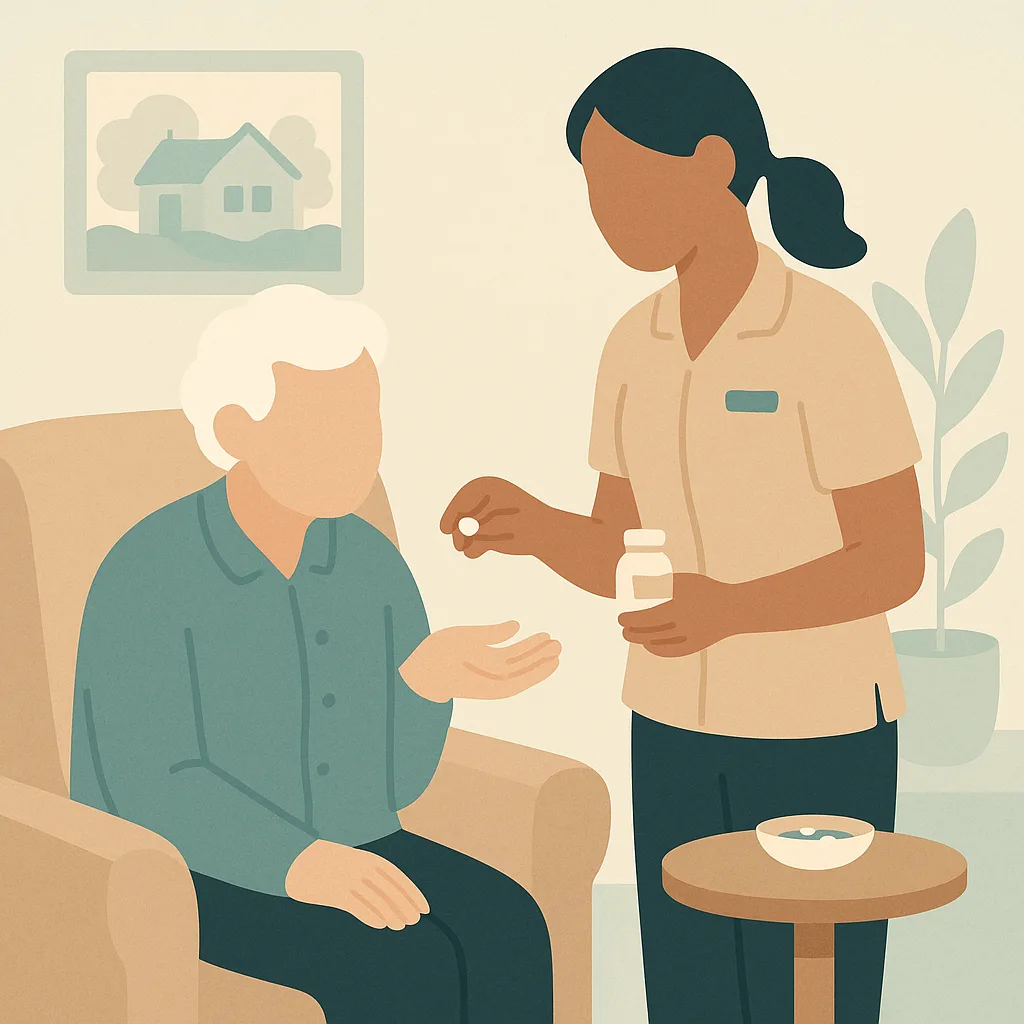
Medication training for care workers should give every staff member who handles medicines the knowledge to do it safely, and then confirm in practice that they can do it. That means understanding the law and their role, the medicines people commonly take, consent and capacity, how to prepare and give medicines, how to record them, how controlled drugs are stored, and what to do when something goes wrong. Knowledge alone is not enough. NICE guidance expects care providers to check each worker's competence by observing them and reviewing it at least once a year.
This guide is written for registered managers and care providers. It explains what good medication administration training looks like in a care home, home care or supported living service, what the CQC looks for, and how an online course fits alongside the practical sign-off that only you can give.
Why does medication training for care workers matter so much?
Medicines are one of the few areas of care where a small slip can cause serious harm very quickly. A dose given twice, a tablet crushed that should never be crushed, a patch left on when a new one is applied, or a time-critical medicine given hours late can all put someone in hospital. Most of these mistakes happen when staff are rushed, interrupted or working from memory rather than the medication administration record (MAR).
Regulation 12 of the Health and Social Care Act 2008 (Regulated Activities) Regulations 2014 requires providers to ensure the proper and safe management of medicines, and to make sure the people providing care have the qualifications, competence, skills and experience to do so safely. In other words, the law places the responsibility on you as the provider, not just on the individual worker. Good training, followed by an observed competency check, is how you show that you have met it.
What should medication administration training cover?
Good medication administration training follows the journey of a medicine from the moment it arrives in the service to the moment it is taken, recorded or disposed of. It should help staff understand not just what to do, but why each step matters. As a minimum, your staff should be confident in the following areas.
The law and their role. The Human Medicines Regulations 2012, the Misuse of Drugs Act 1971 and the Misuse of Drugs Regulations 2001, Regulation 12, and your own medicines policy. Staff should know exactly which tasks they are trained and authorised to do.
Common medicines. What the main groups of medicines are for, such as painkillers, anticoagulants, inhalers, insulin and laxatives, and the side effects worth reporting.
Consent and capacity. How the Mental Capacity Act 2005 applies when someone declines a medicine, and why covert administration can only happen after a best interests decision involving the prescriber and pharmacist.
Preparing to administer. Checking identity, the MAR, the label, allergies and when the last dose was given, before anything is opened.
Administration techniques. Tablets, liquids, eye drops, creams, inhalers and patches, and when crushing or opening capsules is not allowed without advice.
Recording and monitoring. Completing the MAR at the time, using the right codes for refused or omitted doses, and noticing changes after a new medicine starts.
Controlled drugs, storage and disposal. Secure storage, the controlled drugs register, witness signatures, temperatures and returns.
Errors and limits. What to do after a mistake or near miss, who to tell, and when to stop and seek advice.
CareStream turns your policies into role-based training with tracking and certificates. See the plans and get started.
See training plansThe level of support matters
Not every worker in your team does the same medicines tasks. Some prompt a person to take medicines they manage themselves. Others give medicines directly, and a smaller number may carry out specialist tasks such as giving medicines through a feeding tube, which need extra training and delegation from a healthcare professional. NICE guidance NG67 for home care is clear that the care plan should record exactly what support each person needs, and staff should only do what they have been trained and assessed to do. Training should make that boundary obvious.
What do NICE and Skills for Care say about medication competency training?
Two pieces of NICE guidance underpin medication competency training in adult social care. NICE SC1, Managing medicines in care homes, recommends that staff who administer medicines have the required training and are assessed as competent before they do so, and that their knowledge, skills and competence are reviewed every year. NICE NG67, Managing medicines for adults receiving social care in the community, makes the same point for home care: providers should make sure care workers receive training and are assessed as competent, with competence reviewed at least annually.
Skills for Care's statutory and mandatory training guide lists medication as training that providers should put in place for staff whose role involves medicines. Read together, these sources describe two separate things that you need for each person:
Knowledge. Training that explains the principles, the law and safe practice, checked through an assessment.
Competence in practice. A manager or experienced senior observing the worker giving medicines to real people, using your systems, and signing them off.
An online course can deliver and evidence the first. Only you, in your service, can evidence the second.
Can medication training for carers be done online?
The knowledge part can, and for many services it works better online than in a classroom. Staff can complete it on a phone between shifts, revisit lessons they found difficult, and work through realistic scenarios at their own pace. That flexibility helps night staff, part-time workers and home care teams who rarely gather in one place.
What cannot be done online is the observed practical. Medication training for carers is only complete when someone competent has watched them prepare, give and record medicines safely in the setting where they work. That observation should check that they:
wash their hands and prepare a clean, uninterrupted space
confirm the person's identity and check the MAR against the label
ask for consent and explain what the medicine is for
give each medicine in the right way and stay until it is taken
record straight away, accurately and legibly
store everything securely afterwards and report anything unusual
Many services use their own competency checklist for this, observed on more than one occasion before a new worker gives medicines alone. Keep the signed record with the worker's training file.
What does CQC look for in medication training for care homes?
Medicines feature heavily in CQC inspections under the Safe key question. Inspectors look at MAR charts, storage, controlled drugs records and how errors are handled, and they talk to staff about what they would do in everyday situations. When it comes to medication training for care homes and home care services, they will usually want to see:
a training record for every member of staff who handles medicines, with dates
evidence of observed competency assessments, not just certificates
annual reviews of competence, in line with NICE guidance
staff who can explain your medicines policy, including covert medicines and when required (PRN) protocols
Assign, track and evidence staff training in minutes. Explore the plans and roll it out this week.
See training plansa culture where errors and near misses are reported, investigated and learned from
extra training or reassessment after an error, rather than blame
How often do care staff need medication training?
Plan for an annual refresher of knowledge and an annual review of competence for everyone who handles medicines. This follows the NICE recommendation that competence is reviewed at least every year, and it fits the way most providers already schedule mandatory training.
You should also reassess sooner when something changes. Good triggers include a medication error or near miss involving the worker, a new medicines system such as an electronic MAR, a change of pharmacy supplier, a new type of task such as giving insulin under delegation, or a long period away from work. A refresher course followed by a fresh observation gives you a clean, dated record that the worker is safe to continue.
The CareStream Medication Administration and Competency course
CareStream's Medication Administration and Competency course is a CPD Certified Course, certified by The CPD Certification Service and worth 1 CPD hour. It is an annual refresher built on the Skills for Care statutory and mandatory training guide, NICE guidance SC1 and NG67, and CQC medicines guidance, for care workers in care homes, home care and supported living.
CareStream is a registered CPD Provider (No. 50224). You can check our membership and see every CPD-certified course we offer on our page on The CPD Certification Service website.
The course has eight lessons with interactive activities:
The law, guidance and your role
Common medicines and their use
Consent, capacity and covert medication
Preparing to administer
Administration techniques
Recording and monitoring
Controlled drugs, storage and disposal
Errors, your limits and seeking advice
It takes about an hour, online on any phone or computer, and learners can take it in over 60 languages. A 32-question knowledge assessment follows, with a pass mark of 80%. If a learner gets an answer wrong, a short follow up lesson explains the point again so the gap is closed, not just scored.
The observed practical comes before the certificate
Because medicines are a hands-on task, this course requires an observed practical. The course covers the knowledge. You, as the employer, then observe the learner giving medicines in practice and sign them off before the certificate is issued. Each learner who passes and is signed off receives a named, dated certificate carrying the CPD mark. The certificate evidences completion of CPD Certified training and a passed knowledge assessment. It is not a qualification, and it does not replace your own judgement about a worker's competence; your observation is what confirms that.
Managers allocate licences and track who has finished, their scores and who is waiting for sign-off from a single dashboard. Team prices start from 10 licences, and there is a 14-day refund on any licence not yet started.
Getting medication training right
Safe medicines practice rests on two things: staff who understand what they are doing and why, and a manager who has seen them do it properly. Give your team clear, current knowledge every year, observe them in your own setting, keep the records together and act quickly when something goes wrong. That combination protects the people you support, supports your staff and gives inspectors exactly the evidence they expect to see.
Sources
- NICE SC1: Managing medicines in care homes · nice.org.uk
- NICE NG67: Managing medicines for adults receiving social care in the community · nice.org.uk
- CQC: Regulation 12, safe care and treatment · cqc.org.uk
- CQC: Medicines in adult social care · cqc.org.uk
- Skills for Care: statutory and mandatory training guide · skillsforcare.org.uk
Frequently asked
Is medication training mandatory for care workers?
There is no single law that names a course, but Regulation 12 requires providers to manage medicines safely using competent staff, and NICE guidance SC1 and NG67 expects anyone who gives medicines to be trained and assessed as competent first. In practice, CQC expects to see it for every worker who handles medicines.
How often should medication competency be assessed?
NICE guidance recommends reviewing the knowledge, skills and competence of staff who manage medicines at least once a year. You should also reassess after an error or near miss, a new medicines system, or a long absence from work.
Can medication administration training be done online?
The knowledge part can be completed online. Competence cannot. A manager or experienced senior must observe the worker giving medicines in your service and sign them off before they give medicines alone.
Does a medication training certificate prove a carer is competent?
No. A certificate shows the learner completed the training and passed the knowledge assessment. Competence is confirmed by your own observed assessment in practice, which should be recorded and kept with the training certificate.
Can care workers give covert medication?
Only when a person lacks capacity to make the decision and a best interests decision under the Mental Capacity Act 2005 has been made and recorded, involving the prescriber and usually a pharmacist on how to give it safely. Staff must follow the written plan.
Written by
 Len BurgessSenior Care Advisor
Len Burgess has worked in the care sector for over 8 years, with hands-on experience across residential, nursing and community settings. Having supported teams through CQC inspections and the day-to-day reality of keeping a service compliant, he writes about regulation, quality and best practice in a way that's grounded in what actually happens on the floor, not just what the guidance says.