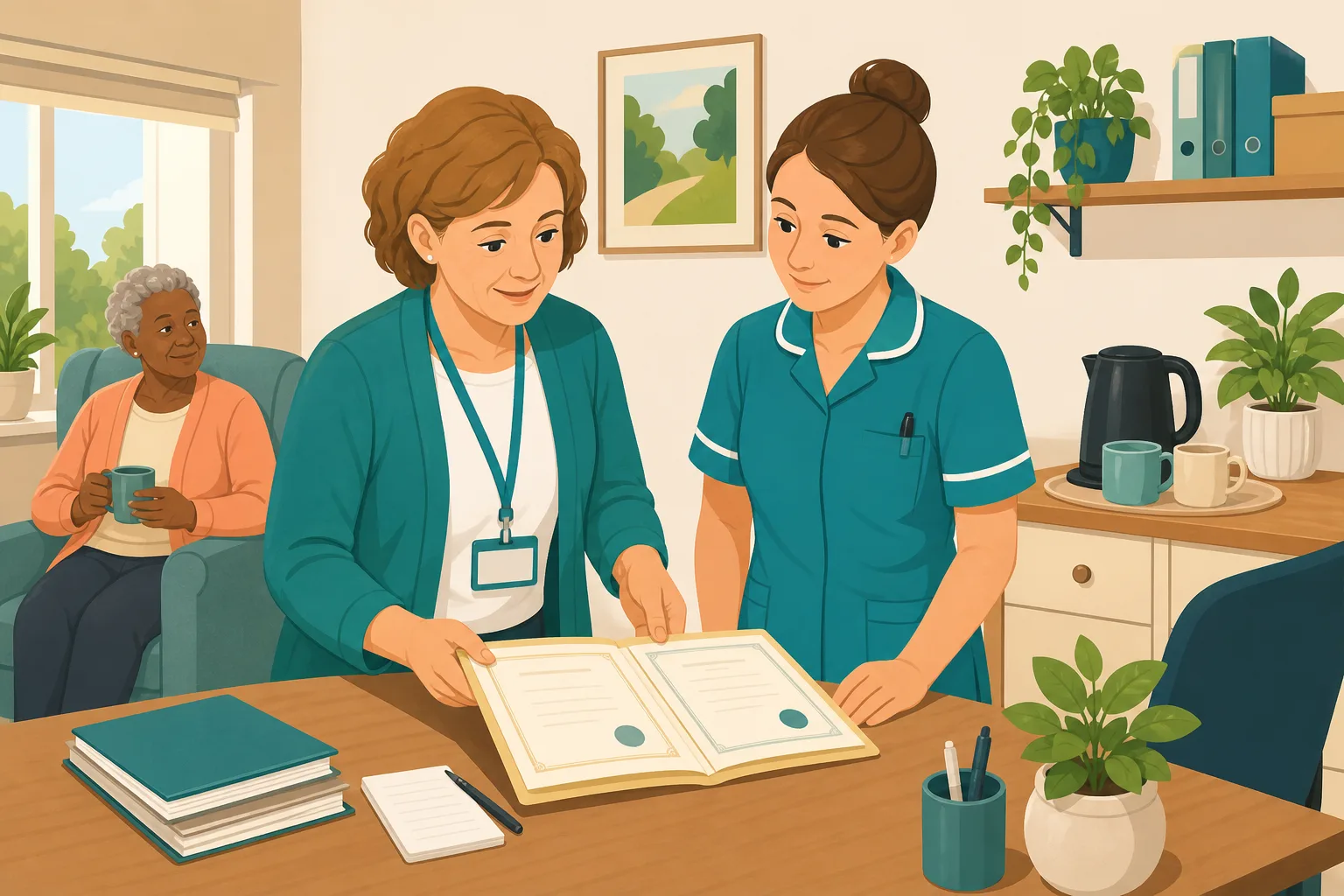
It only counts as a complaint when the family puts it in writing. That belief is common, and it is wrong. People must be able to complain to any member of staff, out loud or on paper. Six beliefs about complaints in care homes are worth correcting, and that is the first.
It is not a complaint until it is in writing
A worry said at the door is a complaint. The regulator is plain about it: people must be able to complain to any member of staff, either verbally or in writing.
That puts a duty on the team, not just the office. All staff must know how to respond when they receive a complaint, says the Care Quality Commission guidance on Regulation 16.

Every audit in the library is free to run, with scoring, actions and a report. No card needed.
Create a free accountFigure: most complaints start here, in a short conversation that nobody writes down unless the carer knows to pass it on.
So the test for your team is simple. Could the newest carer on shift say what to do when a relative stops them in the corridor?
Write it down the same day. A note of what was said, who said it and who was told is enough to start. The detail can follow once somebody has looked into it properly.
An anonymous complaint can be set aside
It cannot. When complainants do not wish to identify themselves, the provider must still follow its complaints process as far as possible.
That feels odd at first. You cannot reply to nobody, and you cannot gather their side of it.
What you can do is look into it, record it and act. The learning does not depend on knowing who raised it.
There is a second reason to take it seriously. A person who complains without giving a name is often the one most worried about what happens next.
Complaints are the manager's job
Partly true, and the part that is false does the damage. Someone has to lead the investigation, and that person needs the knowledge and skill to do it.
Everyone else still has a role. Staff have to recognise a concern, respond well and pass it on. A complaints policy care home staff have never read is a policy that fails at the front door.
The regulator also expects the service to tell people how to complain, and to offer the support people need to do it. That can mean an advocate, an interpreter or a different format.
One more rule deserves a line of its own. Complainants must not be discriminated against or victimised, and care must not change because someone complained.
If we put it right, there is nothing to record
This is the quiet one. The kettle gets replaced, the call bell gets fixed, and nothing is written down.
Providers must maintain a record of all complaints, the outcomes and the actions taken in response. Where no action is taken, record the reason for that too.
Six lines cover most entries:
- The date it was raised, and how it reached you.
- Who raised it, or a note that it was anonymous.
- What they said, in their words where you can.
- What you did to look into it.
- The outcome, and the date of the reply.
- What changed, or why nothing needed to.
Keep the record in one place, not in three inboxes. Our view is that a complaints log is worth more than a complaints file, because a log can be read across a year in one sitting.
Records about the running of the service have to be kept accurately and securely in any case, under Regulation 17 on good governance.
The complaint ends with the reply
The reply closes the correspondence. It does not close the loop.
The complainant, and the person complained about, must be kept informed of the status of the investigation. They must also be told about any changes made as a result.
Then there is the wider job. Providers should monitor complaints over time, looking for trends and areas of risk, and should consider whether the process itself needs revising.
That is where learning from complaints stops being a phrase and starts being work. Three similar grumbles about mealtimes are a service design question, not three separate apologies.
Pick an audit, assign it, score it on a phone and close the actions. Create a free account to start.
Create a free accountA word at handover means the team has learnt
Here is the belief that costs services an inspection answer. The manager reminds the team at handover, everyone nods, and the matter is treated as closed.
Weeks later nobody can say who understood what. Part time staff, night staff and new starters were somewhere else when it was said.

Figure: a team meeting spreads the message, but the record of who was there is what an inspector can read afterwards.
The fix is a check for understanding rather than a longer briefing. Ask two or three questions about the point that went wrong, and look at the answers.
Keep the questions about practice, not about wording. What would you do if a relative said this to you at the door? Who would you tell, and how quickly?
Our scenario page on checking that staff understood the policy after a complaint walks through one way to do that, step by step.
Learning from mistakes is only visible when someone wrote down what changed. A reminder leaves no trace.
When a complaint is also something else
Some complaints change category as you read them. Treat that as normal, and have the second route ready.
Say a complaint is about care that led to a notifiable safety incident. The duty of candour then applies as well. It brings its own duty to tell the person and to say sorry.
You can read Regulation 20 on the duty of candour in full.
Some complaints belong elsewhere as well. The local safeguarding team or a professional body may need to know. The regulator expects an early look to decide how far the matter has to go, and who else to tell.
And one deadline sits behind all of it. When the Commission asks for a summary of complaints and responses, it must arrive within 28 days, beginning the day after the request.
Benefits of CareStream for complaints in care homes
CareStream does not run your complaints process, and it should not. What it does is make the record and the learning easier to show.
The free complaints and concerns audit works through the log with 42 questions. Was each one written down, acknowledged, looked into and answered in time? Did anything change because of it?
Every gap becomes an action with an owner and a date. The next run of the audit shows you whether it closed.
On paid plans, CareStream can build a short training module from your own policy on the topic involved. You assign it, then see who answered the questions correctly. Wrong answers come back as a follow up for that person rather than a message to the whole team.
Start with the free complaints and concerns audit, or look at the written complaints policy if yours has not been touched in years.
What to do with the next concern that reaches you
Write it down on the day, in the complainant's own words where you can. Acknowledge it, unless it came anonymously.
Decide early whether it is also a safeguarding or candour matter. Agree one owner and one date for the reply.
Then do the part most services skip. Write down what changed, and check that the people doing the work can say it back to you.
Sources
- Health and Social Care Act 2008 (Regulated Activities) Regulations 2014, regulation 16: receiving and acting on complaints · legislation.gov.uk
- Care Quality Commission guidance on Regulation 16: receiving and acting on complaints · cqc.org.uk
- Health and Social Care Act 2008 (Regulated Activities) Regulations 2014, regulation 20: duty of candour · legislation.gov.uk
- Health and Social Care Act 2008 (Regulated Activities) Regulations 2014, regulation 17: good governance · legislation.gov.uk
Frequently asked