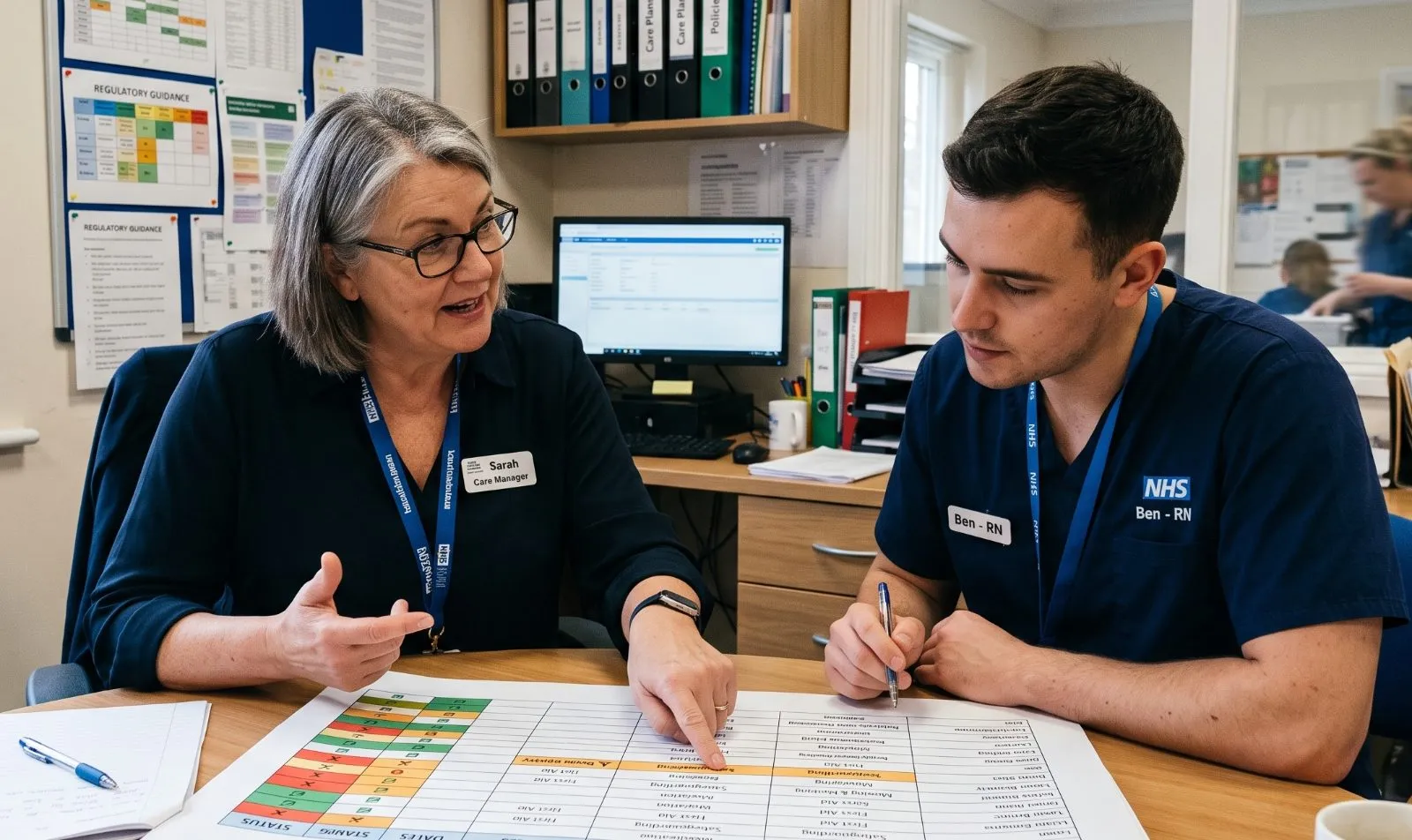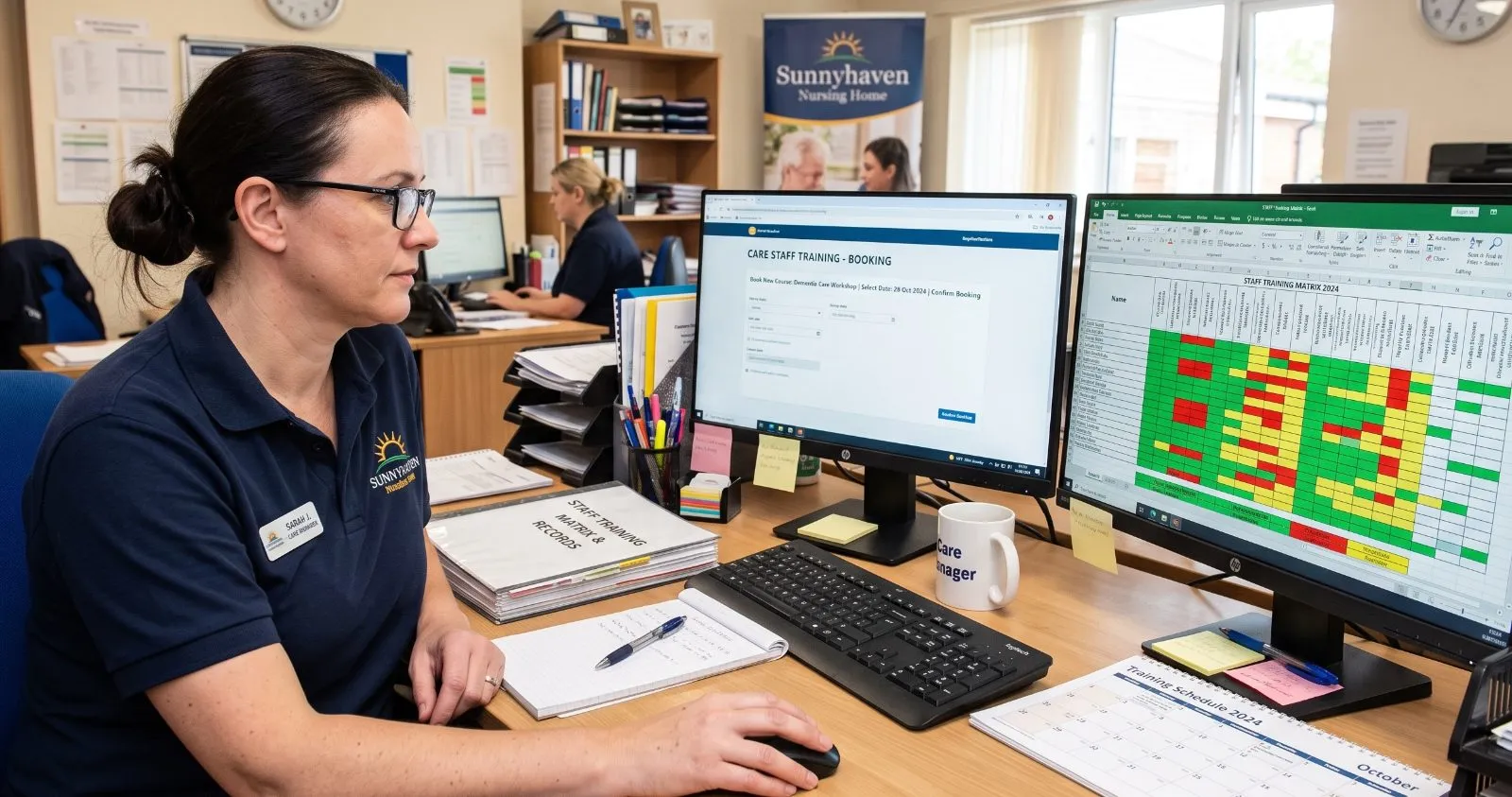
Your training matrix is full of certificates. Most of them carry the letters CPD. Somewhere between the fire safety refresher and the moving and handling update, you have probably nodded at the logo and filed the certificate without ever being told what the accreditation actually means, who awarded it, or whether it would survive a sceptical inspector's question. That is not a criticism. It is what the training industry has allowed to happen.
This piece fixes it. By the end, you will know what CPD accreditation is, who the main accrediting bodies are, what it costs your training provider, and when it genuinely matters for your evidence. The short version: it is a useful quality signal; it is not a legal requirement; and saying that plainly matters more than any badge.
What Is CPD Accreditation, Anyway?
CPD stands for Continuing Professional Development. It is the ongoing learning that keeps professionals current, whether that means a half-day refresher on safeguarding, an eLearning module on infection control, or a workshop on supervision skills. The key word is continuing. CPD is not a one-off qualification. It is the accumulated learning that happens across a career.
Accreditation is something different. It is the independent, third-party recognition that a particular course or learning activity meets a defined quality standard. So a course is not "CPD". It is "CPD-accredited". The activity is the CPD. The accreditation is the quality mark attached to that activity.
In the UK, the main bodies that award CPD accreditation include The CPD Certification Service, established in 1996, the CPD Standards Office, and The CPD Group. They are private organisations. They assess training materials against their own criteria and, if satisfied, allow the provider to use their trustmark and issue certificates carrying CPD points or hours.
What accreditation is not is just as important. It is not a regulated qualification. It carries no Ofqual or RQF status. It is not a legal requirement for care training, and it is not a government scheme. If you are a sceptical registered manager, that is the right instinct to hold. Accreditation is a quality signal, not a guarantee of regulatory compliance. Your inspector cares whether staff can do the job safely and consistently. The logo on the certificate is only ever supporting evidence, never the main event.
Who Accredits Care Training in the UK, and How Does It Work?
Three bodies dominate the UK landscape. The CPD Certification Service has been operating since 1996 and lists over 40,000 CPD providers, courses, and events on its website. The CPD Standards Office reports that its accreditation is recognised in 72 countries. The CPD Group claims 13,000 approved providers and was named the most trusted CPD accreditation service at the UK Business Excellence Awards 2024.
The assessment process is broadly similar across all three. A training provider submits course materials, learning outcomes, and assessment methods. The accrediting body reviews them against quality criteria. The CPD Standards Office, for example, operates a 30-day assessment period after materials are submitted. If the course passes, the provider can issue certificates and use the body's trustmark.
There are practical differences worth knowing. Some bodies charge for accreditation. Others offer free provider registration with paid accreditation for specific courses. Some accredit unusual formats, including podcasts and written publications, which matters if your team learns through audio rather than screen reading.
The honest gap in public information is cost. Accreditation fees vary by body, by course, and by volume, and none of them publishes a simple price list. Renewal terms vary too. There is no government-mandated CPD accreditation body for care, and no single organisation is "the official one". For your purposes as a care manager, the name on the badge matters less than three things: is the content current, is it relevant to your setting, and does it actually change staff practice? A certificate from a prestigious-sounding body means nothing if the course itself is generic, outdated, or written for a different sector entirely.
Book a short demo and see how CareStream keeps your policies, training and CQC evidence in one place.
Book a demoIs CPD Accreditation a Legal Requirement in Care?
No. CPD accreditation is not a legal requirement for training in care settings. What the law and the regulator require is that staff are trained and competent to perform their roles. The Care Quality Commission does not ask to see a CPD logo. It asks to see evidence that training happened, that staff understood it, and that competency was assessed.
Where CPD does carry regulatory weight is for registered professionals. The Health and Care Professions Council requires registrants, including occupational therapists and paramedics, to maintain CPD records. The HCPC randomly selects 2.5 per cent of each profession during every renewal cycle for a CPD audit. If you employ HCPC-registered staff, their personal CPD obligations are real, and accredited courses make their record-keeping easier. But that is a professional registration requirement, not a care service requirement.
The Care Certificate is often confused with accreditation. It was introduced in April 2015 after the Cavendish Review found training in health and social care was inconsistent and inadequate. It is a defined set of 16 standards covering fundamentals like safeguarding, infection control, and communication. It is not an accreditation scheme. Some providers offer the Care Certificate as a CPD-accredited course, which is a quality signal, not a requirement. The Care Certificate was designed to be delivered in-house, and plenty of services do exactly that without any external accreditation.
The honest bottom line: accreditation is a shortcut to trust, not a substitute for your own judgement about whether a course meets your staff's needs.
When CPD Accreditation Actually Matters in Care
The first place it matters is mandatory and statutory training. When an inspector asks how you know your staff are current on fire safety, moving and handling, or safeguarding, an accredited course with a completion date and a named learner is strong evidence. It shows you took training seriously enough to choose a provider that submitted to external scrutiny.
The second place is professional registrants. If you employ HCPC-registered staff, accredited courses make their CPD audits easier. They can log the course, the points, and the certificate without a debate about whether the learning counted.
The third place is tenders and commissioning. Some local authorities and NHS commissioners specify accredited training in their procurement criteria. If you bid for contracts, it is worth checking whether your training provision meets the stated requirements. Losing a tender on a technicality is an expensive way to learn that accreditation mattered.
The fourth place is staff confidence and retention. A certificate with an independent quality mark means something to a carer building their professional identity, especially those who trained overseas and are navigating a new regulatory environment. It says their learning is recognised beyond the walls of your service.
The honest caveat: non-accredited in-house training can be excellent. The Care Certificate itself was designed for in-house delivery. Accreditation is one quality signal among several, not the only one, and certainly not the most important one.
What CPD Accreditation Does Not Do
It does not guarantee CQC compliance. Your evidence is how training translates into practice, supervision records, and observed competency. A certificate proves attendance, not application.
It does not replace your professional judgement. You still need to decide whether a course fits your setting, your service users, and your staff's learning needs. Accreditation tells you the course met a standard. It does not tell you the standard was right for your team.
A quick demo shows exactly how CareStream would work for your service. Book a time that suits you.
Book a demoIt does not mean the content is current forever. Accreditation is a point-in-time assessment. Legislation changes, guidance updates, and a course accredited in 2023 may not reflect the realities of 2026.
It does not make a bad course good. Accreditation bodies assess quality against their criteria, but no external mark can make up for training that does not land with your team. Think of accreditation like a food hygiene rating. It tells you the kitchen has been checked. It does not tell you the meal will be delicious.
How to Choose Accredited Training for Your Care Team
Start with your training matrix, not the accreditation logo. Identify the gaps in statutory and mandatory training first, then look for courses that fill them. A beautifully accredited course on a topic your staff do not need is still a waste of time and money.
Check the accrediting body, not just the badge. A quick look at the body's website tells you whether it is a recognised organisation with transparent processes. If the badge is vague, the accreditation probably is too.
Look at the course content, not just the certificate. Does it reference current UK legislation, CQC guidance, and realistic care scenarios? Is it written for a UK care audience, or is it generic content with a care-themed wrapper?
Consider your staff's practical needs. Can they access the training on a phone, in their own language, without IT friction? An accredited course nobody can complete is worthless. The best accredited training in the world means nothing if your night staff cannot log in.
Ask the training provider directly: who accredited this, when, and what did the assessment involve? A straight answer is a good sign. Evasiveness is not.
CareStream's annual training modules are CPD accredited, and every completion is logged to your audit trail automatically. That matters when you are building evidence, not just collecting certificates. The accreditation is one part of the picture. The automatic record is the part your inspector will actually want to see.
The Bottom Line on CPD Accreditation for Care Managers
CPD accreditation is a useful quality signal. It is not a legal requirement, and it is not a substitute for your own judgement. Use it as one filter in your purchasing decisions, but weigh it alongside content quality, staff accessibility, and evidence capture.
What CQC wants is proof that training happened, that staff understood it, and that it changed practice. Accreditation supports that story, but it does not write it. Your compliance evidence should build itself, and that includes training records your staff actually completed, not certificates you filed and forgot.
Conclusion: The Badge Is Not Evidence, The Record Is.
If you take one thing from this piece, make it the distinction the training industry has spent two decades blurring. Accreditation tells you a course was assessed against someone's criteria at some point. It does not tell you your staff completed it, understood it, or changed anything about how they work. Those are three separate claims, and only the last one interests an inspector. CareStream's annual training modules are CPD accredited (and the ones that are carry the CPD logo), which is worth having as a quality filter, but the part that earns its place in your evidence pack is what happens after the module: every completion logged automatically against the staff member, the date and the version, feeding the training matrix without anyone typing it in. Alongside it sits the thing a certificate can never capture, which is whether the learning landed. When a carer asks a question about your medication policy at 3am, in their own language, and gets an answer drawn from your own document, that exchange is logged too. Over months it becomes the closest thing most services have to continuous evidence of understanding rather than attendance. Buy accredited training if the content is right for your setting and your staff can actually reach it. Then make sure the record builds itself, because the certificate you filed and forgot is not the story your inspector is asking you to tell.
Sources
- HCPC: The CPD audit process · hcpc-uk.org
- HCPC: CPD audit data · hcpc-uk.org
- Skills for Care: Care Certificate standards · skillsforcare.org.uk
- CQC: Regulation 18: Staffing · cqc.org.uk
- CQC: Regulation 17: Good governance · cqc.org.uk
- Ofqual: Regulated Qualifications Framework · gov.uk
Frequently asked
Is CPD accreditation a legal requirement for care training?
No. There is no legal requirement for care training to be CPD accredited, and there is no government-mandated accrediting body for the sector. What the law requires, through Regulation 18, is that staff are suitably qualified, competent, skilled and experienced, and appropriately trained and supervised. An inspector will not ask to see a logo. They will ask how you know your staff can do the job.
What is the difference between CPD and CPD accreditation?
CPD is the learning itself, accumulated across a career. Accreditation is independent third-party recognition that a specific course meets a defined quality standard. A course is never "CPD"; it is CPD-accredited. The distinction matters because providers frequently market the first as though it were the second.
Who awards CPD accreditation in the UK?
Private organisations, principally The CPD Certification Service, The CPD Standards Office and The CPD Group. None is official in any regulatory sense; none is government-backed, and accreditation carries no Ofqual or RQF status. They assess submitted materials against their own criteria and license a trustmark if satisfied.
Does an accredited course prove compliance?
No. It evidences that the course met a standard, not that your staff completed it, understood it or applied it. Those are the three things that constitute your evidence, and only the first is captured by a certificate. Competency assessment, supervision records and observed practice do the rest of the work.
Does accreditation expire or go stale?
Accreditation is a point-in-time assessment, which is the risk most managers miss. A course accredited in 2023 may reference legislation and guidance that have since changed, and the badge does not update itself. Ask the provider when the course content was last reviewed, not just when it was accredited.
Written by
 Len BurgessSenior Care Advisor
Len Burgess has worked in the care sector for over 8 years, with hands-on experience across residential, nursing and community settings. Having supported teams through CQC inspections and the day-to-day reality of keeping a service compliant, he writes about regulation, quality and best practice in a way that's grounded in what actually happens on the floor, not just what the guidance says.